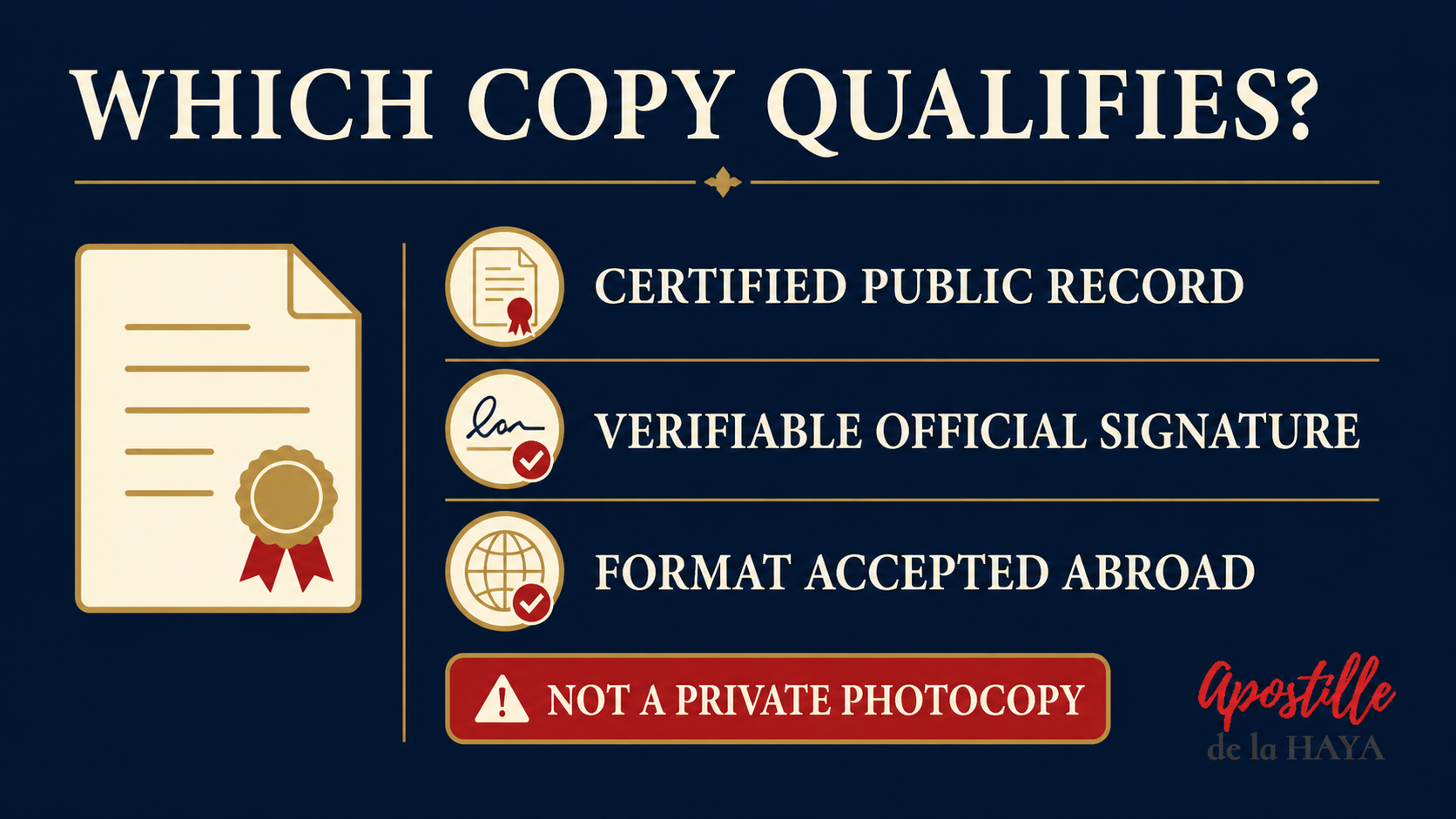
A certified copy marriage certificate apostille request starts with the record itself. You generally need a certified document from the government office responsible for the marriage record. A photograph, home photocopy, or keepsake certificate serves a different purpose.
The word “original” can cause confusion. An office may ask for the original certified copy, meaning the actual document it issued. It does not mean that you must obtain the government’s underlying register or remove a record from its files.
Apostille de la Haya helps identify the required record and coordinate retrieval, apostille or legalization, and delivery. The starting point is what the receiving authority needs, together with the issuing state’s requirements.
What the apostille verifies
An apostille authenticates the signature on a public document, the signer’s official capacity, and, where appropriate, its seal or stamp. It does not certify the truth of every statement in the record.
Nor does it establish that a marriage remains in force today. A marriage certificate records the event described in it. A foreign authority may need other evidence for a separate question about current marital status.
Finally, an apostille does not guarantee that the document meets every requirement of a foreign procedure. The recipient may need a particular record format, a recent issue date, or a translation.
These are separate checks. First identify a document that the competent authority can authenticate. Then confirm that its contents and format satisfy the office that will use it.
Who issues the certified marriage record?
The responsible office depends on the jurisdiction and the record. It may be a county clerk, clerk of court, probate office, or state vital records office. The year of the marriage can also affect where to request it.
That office issues its certification in an official capacity. The apostille process examines the relevant official signature and seal, including any preliminary certification the state requires.
For example, Florida requires the issued certified copy of a public document rather than a photocopy. Its instructions use the phrase “original certified copy.” Keep that wording in mind when comparing the document you received with a scan saved on your phone.
Our guide to which copies of documents can be apostilled explains the broader distinction. For a marriage record, begin with the government office responsible for issuing certified records.
Certified copy marriage certificate apostille: compare the versions
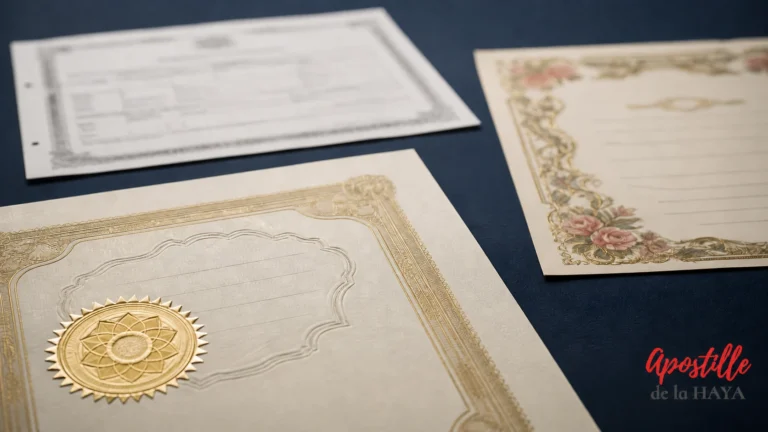
Different documents can refer to the same marriage. Their appearance alone does not tell you which one meets the requirements. Read the issuer’s name, certification, and any limitation printed on the document.
The government-issued certified copy
This is the usual starting point for a marriage certificate apostille. It carries the issuing office’s certification. However, the state may require another official to authenticate that signature before the apostille stage.
A county version and a state version may follow different routes. Therefore, identify the actual certifying office before preparing the submission. A state name printed at the top does not always identify the issuer.
A notarized photocopy
A notary’s certification of a photocopy does not turn it into a certified marriage record from the custodian. The notarial act and the government record certification concern different things.
Florida law excludes vital records from the documents a notary may copy-certify under section 117.05(12)(a). The restriction also covers public records when the custodian can supply a copy. A notary should not use this procedure to replace an official marriage certificate.
Elsewhere, check the relevant notarial law before assuming a copy-certification act is available. Even a lawful notarization does not establish that the recipient will accept that document instead of the government-issued record.
An abstract or informational copy
These terms do not describe one uniform category. An official abstract may be a valid certification. Florida’s Bureau of Vital Statistics issues marriage certificates as abstracts and provides a route for obtaining them for apostille.
California makes a different distinction between certified authorized and certified informational copies. Both are certified copies, but an informational copy cannot establish identity. Certain information may also be redacted.
Consequently, do not reject or select a document merely because someone calls it a “short form” or “informational copy.” Check the issuing authority’s requirements and the recipient’s intended use. A genuine certification can still omit information that the foreign office needs.
A ceremonial or keepsake certificate
A decorative certificate from an officiant, church, or venue does not replace the official civil record. Signatures and an attractive seal do not establish that it carries the government certification needed for the requested procedure.
The document’s role matters more than its title. Our comparison of a marriage certificate and marriage license explains why a license, recorded marriage document, and keepsake can serve different purposes.
Why the state and issuer change the route
Florida accepts qualifying marriage records for authentication through its Department of State. Documents certified by a Florida Clerk of the Court involve a Certificate of Incumbency in the apostille process. That affects the required charges.
New York uses a different sequence. Marriage certificates from local or county officials require certification by the County Clerk of the issuing county before submission to the Department of State.
By contrast, qualifying certificates from the New York State Department of Health can go directly to the state apostille step. They must bear the signature of the Director of Vital Statistics or the NYS Registrar.
New York warns that local offices may also use terms such as “registrar” or “vital statistics.” Those words alone do not establish that the State Department of Health issued the record.
Moving to another state does not transfer responsibility for authenticating the original state’s public record. Our guide to a marriage certificate issued in another state addresses that situation.
Signature formats and additional certifications
A handwritten signature or raised seal is not the only format an official document can use. Some authorities use printed signatures, flat seals, or electronic features. Check the relevant office’s rules rather than judging authenticity by appearance.
The question is whether the competent authority can authenticate the official certification presented. An older signature, an unfamiliar format, or a missing preliminary certification may require clarification.
Also distinguish an official certified reproduction from a private copy of a certified document. Do not assume that every second reproduction is invalid. What matters is who issued or certified it, under what authority, and what the receiving process permits.
If the office cannot authenticate the document in its present form, ask whether a new certified record will resolve the issue. Avoid adding stamps or notarizations without establishing what they would accomplish.
Issue dates and destination requirements
The Apostille Convention does not impose an expiration period on an apostille. Nevertheless, a receiving authority may require an underlying document issued within a specified period.
Those are different dates. A new apostille does not change the marriage certificate’s issue date. Conversely, an old marriage date does not mean that the certified copy itself was issued long ago.
Ask the recipient which date it uses and when it measures compliance. A rule measured at submission may affect an order differently from one measured at an appointment.
Requirements also differ by procedure within a country. Do not treat a three-month rule mentioned for one Colombian visa or civil-record process as a universal rule for every Colombian consular registration. Confirm the instruction for the actual filing.
Condition, lamination, and the document you send
Damage or alteration may interfere with inspection of a signature, seal, or security feature. Lamination can also create a problem, depending on the authority and the document.
Do not try to remove laminate, rewrite a damaged entry, or repair an official seal yourself. First ask whether the office will accept the document as it stands. If it will not, a newly issued certified copy may be necessary.
For a paper submission, the issued certified document normally needs to travel through the process. A scan can help with preliminary review, but it does not automatically replace that document. Electronic options depend on the competent authority and the particular record.
If you only have one certified copy, establish whether to order another before mailing it. Use suitable packaging and the return method the processing office accepts. Delivery estimates should include the record-ordering stage as well as authentication.
How many copies does the destination need?
Ask whether each receiving office will keep the document. If two separate procedures each require their own apostilled certified record, plan for two complete sets.
A photocopy of the finished apostille package is not automatically an equivalent substitute. However, some recipients permit copies or electronic submission for certain stages. Their instructions determine what you need.
Keep the apostille and its underlying document together. Before dispatch, confirm the destination, recipient details, number of sets, and any translation requirement. This check helps identify missing pieces while there is still time to address them.
Mistakes that can delay a certified copy request
One problem is choosing a record from an ordering screen without checking its intended use. An informational copy, abstract, or full copy may each have a different role. Price alone does not establish suitability.
Another is adding a notarization to compensate for a missing government certification. That may create a different document without addressing the actual requirement. Identify the missing official step first.
Likewise, do not assume that every delay occurs at the apostille office. Locating the record, correcting an application, obtaining an intermediate certification, and delivery can each affect the schedule.
Finally, avoid making arrangements around an unconfirmed completion date. Ask for an estimate based on the particular state, record, destination, and shipping route. An estimate is not a guarantee of government processing or foreign acceptance.
How Apostille de la Haya can help
Apostille de la Haya can coordinate record retrieval and the authentication process. We review the issuing jurisdiction, the document available, and the destination’s stated requirements before defining the work.
Retrieval may form part of the service; you do not necessarily need to solve that stage alone. Where the custodian limits access, the request must still meet its eligibility, identification, and authorization requirements.
We can identify the relevant office, request the appropriate record where permitted, and coordinate preliminary certifications and submission. The scope can also include delivery and arrangements for multiple document sets.
Share the receiving office’s written instructions when available. They help distinguish a request for a full record from one that accepts an abstract. We can then explain the proposed route, expected stages, and any unresolved requirement before quoting.
Certified marriage copies: common questions
Can a notarized photocopy replace the certified marriage record?
Do not assume so. Florida notaries cannot copy-certify vital records under the ordinary copy-attestation rule. In other jurisdictions, both the notarial rules and the recipient’s requirements matter. The usual route starts with a certified document from the responsible government office.
Do I have to send my only certified copy?
A paper process generally requires the actual issued certified document. You may prefer to order another copy for the submission. Before mailing anything, confirm the accepted format and whether the foreign recipient will retain it.
Does an apostille make an older certificate recent?
No. The apostille has its own issue date and does not change the date on the underlying certificate. If the recipient requires a recently issued marriage record, obtain a copy that meets that requirement before completing authentication.
Is a long-form certificate always necessary?
No single format applies to every procedure. An official abstract may qualify for apostille, while the recipient may require information found in a fuller record. Confirm the necessary fields and format rather than relying only on the label “long form.”
Can I use a laminated certificate?
That depends on the competent authority and the document’s condition. Lamination may prevent inspection of its security features. Do not remove it yourself. Ask whether the office will accept the document or requires a newly issued certified copy.
Confirm your copy before starting the apostille
Contact Apostille de la Haya about your certified marriage record. Tell us the issuing state, destination country, and intended procedure. We can review the available document and explain the proposed scope.
Call +1 (305) 500-0185 or write through WhatsApp before sending your only copy. The service can include retrieval, authentication coordination, and delivery, subject to the relevant office’s requirements.
This publication provides general information and does not constitute legal advice or a guarantee of acceptance. Requirements depend on the issuing jurisdiction, document, destination, and procedure. Confirm the receiving authority’s instructions for your case.