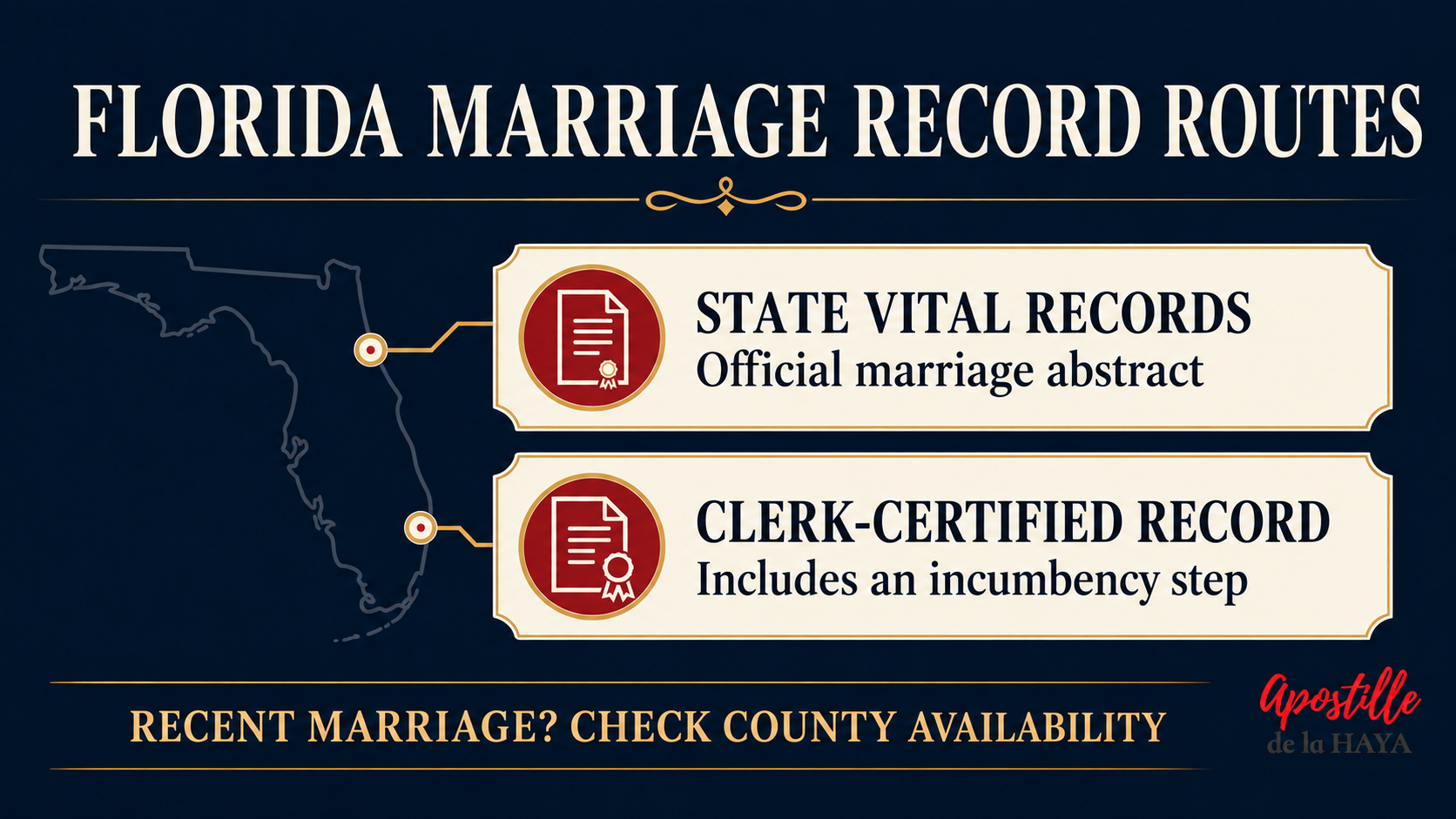
A Florida marriage certificate apostille can involve a certified record from the Clerk of the Circuit Court or a certificate from the Bureau of Vital Statistics. The right source depends on the record’s availability and the foreign recipient’s requirements.
The state certificate is an abstract of information from the marriage license. A clerk can issue a certified copy of the recorded county document. Both routes can support authentication, but the documents and processing steps differ.
Apostille de la Haya can coordinate record retrieval, authentication, and delivery. Before ordering, we review where the record originated, when the marriage occurred, and what the receiving office needs.
Where Florida keeps marriage records
After the ceremony, the completed marriage license returns to the issuing clerk for recording. The clerk then forwards the record to the Florida Bureau of Vital Statistics for permanent filing.
The Department of Health describes this process as taking approximately 60 days. Therefore, a recent marriage record may be available from the county before the Bureau can supply it.
If the ceremony took place less than 60 days ago and you need immediate evidence, contact the clerk that issued the license. The clerk must first receive and record the completed document. Do not assume that the certificate will be ready immediately after the wedding.
The Bureau holds recorded Florida marriages from June 6, 1927 onward. For a marriage before that date, request the record from the clerk of court in the county that issued the license.
County copy or state certificate?
Start with the receiving authority’s instructions. A civil registry may need fields that do not appear in the usual state abstract. Another procedure may accept that abstract without requiring a copy of the full recorded county document.
Florida describes its state marriage certificate as evidence that a marriage was finalized and recorded. It also allows applicants to request additional statistical information, such as the number of previous marriages, by noting that request on the application.
That option does not mean every recipient will accept the same format. Compare the requested information with the available record before choosing a route.
| Source | Document | Availability to check | Authentication difference |
|---|---|---|---|
| Clerk of the Circuit Court | Certified copy of the recorded county marriage document | After the clerk receives and records the completed license | Florida's apostille charge for clerk-certified documents includes a Certificate of Incumbency |
| Bureau of Vital Statistics | Official certificate issued as an abstract | After the record reaches the Bureau; older records follow different processing arrangements | The standard state-document apostille route applies |
Our general guide to the marriage certificate apostille explains how authentication relates to the destination’s requirements. A lower government charge alone does not make one version suitable for every filing.
Who issues a Florida marriage certificate apostille?
The Florida Department of State issues apostilles through its Division of Corporations in Tallahassee. The current office address is 2415 N. Monroe Street, Suite 810, Tallahassee, FL 32303.
A county clerk or the Bureau of Vital Statistics supplies the underlying marriage record. Neither step alone completes the Department of State authentication process.
For documents certified by a Florida Clerk of the Court, the state’s apostille fee includes a Certificate of Incumbency. This additional certification concerns the clerk’s official capacity.
By comparison, a qualifying Bureau certificate follows the standard state-document route. Record-ordering charges remain separate from authentication charges. The full cost may also include delivery and any service arrangements.
What Florida requires for submission
Florida requires the actual issued certified copy of a public document. A private photocopy does not meet that requirement. A scan may help us review the document, but it does not replace the required paper record in a paper submission.
The request also needs the Department of State’s completed form, the appropriate payment, and an accepted return-delivery arrangement. Identify the destination country correctly because it affects the type of authentication.
The apostille route applies when the Convention operates between the relevant countries. A destination outside that framework may require a notarial certification and further legalization steps. Confirm the route before submitting the document.
An apostille authenticates the relevant official signature, capacity, and seal. It does not certify every statement in the marriage record or guarantee that a foreign office will accept the document for its procedure.
How long does the process take?
Separate record availability, record issuance, authentication, and delivery. An estimate covering only the apostille office can leave out much of the time your file needs.
For mail orders of computer certificates from 1970 onward, the Bureau lists normal processing of three to five business days. Shipping is additional. Records before 1970 require extra processing time, and application-specific instructions should also be checked.
The approximately 60-day transfer period for a recent marriage is a different issue. It concerns the record reaching the Bureau, not the time needed to process every later certificate order.
Meanwhile, the Department of State’s apostille FAQ says it processes requests in receipt order. Florida also publishes a document-processing page showing the receipt dates of apostille requests currently under review.
That published date helps assess the queue; it is not a promised delivery date for your file. Check the latest entry when planning. Our guide to marriage certificate apostille processing time explains the stages that affect the calendar.
Mail, walk-in, and rush options
You do not have to travel to Tallahassee for a standard mail request. Florida’s instructions provide for submission and return by mail or an accepted delivery service.
The Department of State also offers walk-in service at its Tallahassee office. Its FAQ says most walk-in requests may be completed while the customer waits. That wording is not a guarantee for every document or visit.
Florida distinguishes walk-in service from expedited processing. The Department of State says it does not offer an expedited service. A private provider’s courier arrangements do not create a separate government priority entitlement.
The Bureau of Vital Statistics has its own rush arrangements for record orders. Those concern a different agency and stage. Confirm whether a quoted service includes priority record handling, faster shipping, personal submission, or some combination.
Find the county that issued the license
A Florida marriage license permits a ceremony anywhere in the state. As a result, the ceremony location may differ from the county that issued the license and holds the recorded document.
For example, a couple can obtain a license in one county and marry at a venue in another. Searching only the ceremony county may miss the relevant record.
Use the license information when available. Otherwise, review the names, marriage date, and possible issuing county before placing an order. An incomplete search result does not by itself establish that no record exists.
Miami-Dade offers certified-copy requests for licenses it issued. Its ordering options vary by year and delivery destination. Our guide to looking up Miami-Dade marriage records describes the search context.
Older marriages need a separate timing check
A 1958 Florida marriage falls within the Bureau’s date range. However, it belongs to the pre-1970 group that requires additional processing time.
A marriage from 1919 follows a different route. The Department of Health directs requests for marriages before June 6, 1927 to the clerk that issued the license.
County ordering systems may have their own cutoffs. For instance, Miami-Dade’s online certified-copy ordering covers licenses issued from 1971 onward. Earlier records require the office’s other request methods.
Consequently, a recent online order from one county is not a useful timing guarantee for an older record elsewhere. Identify the custodian and its current retrieval procedure before estimating completion.
Names, corrections, and document condition
Compare the issued record with the recipient’s requirements before seeking authentication. Check the spouses’ names, relevant dates, and any information the foreign office needs to transcribe.
A maiden name, middle initial, or spelling variation may require clarification. Do not alter the certified record yourself. Ask the custodian about any necessary correction and the recipient about acceptable supporting evidence.
If a correction results in a new document, the old apostille does not automatically authenticate that replacement. The authentication must correspond to the document you will submit.
Likewise, damage or lamination may affect inspection of the seal, signature, or security features. Confirm acceptance before mailing a questionable record. A new certified copy may be necessary if the office cannot process the existing one.
Payment and return delivery
The Department of State requires a check or money order payable to the Florida Department of State. Its instructions require U.S. currency drawn on a U.S. bank and state that cash and credit cards are not accepted.
Do not apply that payment rule to every office in the process. The Bureau, county clerk, and any ordering service have their own methods and charges.
This distinction can matter when you live abroad. Before sending a payment, confirm the payee, acceptable instrument, and amount for that particular stage. A payment accepted by the county may not satisfy the Department of State.
Also check return shipping. Florida requires a suitable self-addressed stamped envelope or prepaid, pre-addressed airbill with the requestor identified as sender and recipient. Confirm the delivery details before the file leaves your hands.
Mistakes that can delay the file
Ordering a state certificate immediately after the ceremony can lead to a search before the Bureau has the record. First check county availability and recording status.
Choosing an abstract without confirming the recipient’s needs can create a second order. Conversely, assuming every recipient needs the fullest available record can add work that the instructions do not require.
Another error is treating a certificate order and an apostille request as one automatic step. Some coordinated ordering options cover both, but a basic record order does not necessarily include authentication.
Finally, Florida residence does not make Florida the apostille authority for another state’s marriage record. Our guide to a marriage certificate issued in another state explains how the issuing jurisdiction determines the route.
How Apostille de la Haya coordinates the work
We begin with the destination’s written requirements and the available record. The marriage date and issuing county help determine whether to request a clerk-certified copy or a Bureau certificate.
The service can include locating and ordering the record, reviewing the required authentication steps, coordinating submission, and arranging return delivery. The request must still meet the custodian’s requirements.
For a recent or older marriage, we assess the relevant availability and retrieval issues before estimating the schedule. Where a name discrepancy or missing record needs attention, we explain that issue rather than promise an automatic resolution.
Share any appointment or filing deadline at the start. We can compare it with the expected stages and identify uncertainties. Government processing, delivery, and the receiving authority’s decision remain outside a guarantee.
Florida marriage certificate apostille: common questions
What affects the total cost?
The record source, authentication route, number of copies, delivery, and service scope affect the total. A clerk-certified document also involves the Certificate of Incumbency charge. Request a quote that identifies the stages included and any separate arrangements.
Can we start immediately after the wedding?
You can check whether the issuing clerk has received and recorded the completed license. A certified county copy may become available before the Bureau receives the record. Florida describes the transfer to the Bureau as taking approximately 60 days.
Do I have to visit Tallahassee?
No. Mail submission is available, and a provider can coordinate submission within the agreed scope. Florida also offers walk-in service. Confirm current arrangements before planning a visit or treating same-day completion as certain.
Does Florida publish information about the apostille queue?
Yes. Its document-processing page lists the receipt date of apostille requests currently being processed. The FAQ also explains receipt-order processing. Check the current entry, then allow for obtaining the record and delivery on both sides.
Can the Bureau supply a certificate for a 1958 marriage?
Its record range includes recorded Florida marriages from June 6, 1927 onward. A 1958 record therefore falls within that range, but pre-1970 requests need additional processing time. For earlier marriages outside the range, contact the issuing county clerk.
Plan your Florida marriage certificate request
Contact Apostille de la Haya for help with a Florida marriage certificate apostille. Tell us the marriage date, issuing county if known, destination country, and intended procedure.
Call +1 (305) 500-0185 or write through WhatsApp. We can review the document, define the work, and discuss the expected stages before submission.
This publication provides general information and does not constitute legal advice or a guarantee of acceptance. Requirements and processing conditions can change. Confirm the issuing office’s instructions and the receiving authority’s requirements for your procedure.