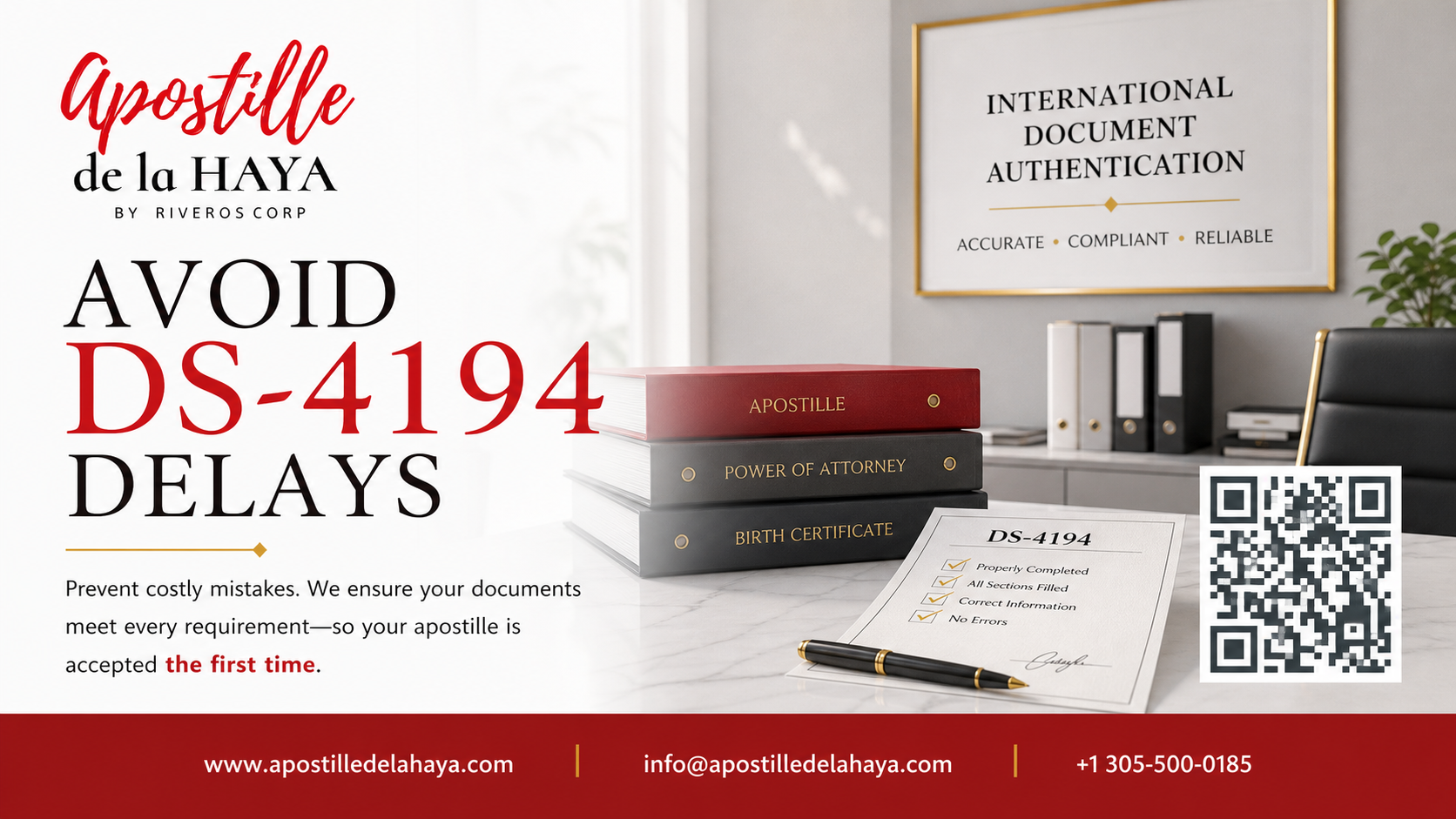
Form DS-4194, officially the Request for Authentications Service, is what the U.S. Department of State uses to identify the applicant, the documents enclosed and the country where they will be used. It is a page of boxes, and it does not look like a place where anything can go wrong. Incomplete contact details, missing document details, an incorrect country of use or a missing return method can each delay processing or send the request back unprocessed.
Apostille de la Haya · Federal & State Dept Apostille
None of those is an error of judgement. They are boxes — which is exactly why they are missed by people who spent all their attention on the harder question of which office the envelope should go to in the first place.
The form travels with the file: who is asking, which documents are enclosed, which country they are going to and how they come back.
The country written on the form is what determines whether the appropriate certificate is an apostille or an authentication. Get it wrong and the request may produce the wrong instrument for the place it is going — which is discovered abroad, not at the counter.
The Department uses the form to confirm that the documents submitted match the documents received and processed. A mismatch in the document type, the number of documents or the details given is a returned request rather than a corrected one.
The form also identifies the customer, the return method and a representative where one applies. A request that has been processed but has nowhere to go is the most frustrating way to lose a week.
The two certificates
Same office, same form — and the destination decides which one comes out
For a qualifying federal document intended for a country participating in the 1961 Hague Convention. One certificate, one authority, and the file is finished when it comes back.
For a destination that does not participate. The same office issues it, but it is not the end of the road: additional legalization steps generally apply after it, at the destination’s own mission.
Outside the Convention
Which is why confirming the issuing authority and the destination before anything is posted is not caution, it is the whole method: it prevents the request from starting in the wrong office and from producing the wrong certificate. What the longer road involves once the authentication certificate exists is the subject of Legalization & Embassy.
Under the 1961 Convention the United States has more than one competent authority, and which one applies depends entirely on who signed or issued the document. The federal office serves federal signatures: documents signed by U.S. federal officials, U.S. consular officers, foreign consuls registered with the Department of State, military notaries and judge advocates. It verifies that the signature and seal belong to a genuine, currently commissioned official — and then it attaches its certificate.
A birth certificate, a marriage certificate, a diploma, a notarised power of attorney or a corporate record is issued or notarised at state level, so it is apostilled by the Secretary of State of the state that issued it. A Florida record is apostilled in Tallahassee; a California one in Sacramento. Washington will not touch them, and posting them there only guarantees a return trip.
An apostille for a destination inside the 1961 Convention, an authentication certificate for one outside it. The country of use decides.
5
kinds of signature
The federal route serves documents signed by U.S. federal officials, U.S. consular officers, foreign consuls registered with the Department, military notaries and judge advocates.
0
branches or portals
No regional centre, no state office of the federal authority, and no online service that produces the certificate instantly.
4194
the form
Form DS-4194, the Request for Authentications Service: customer, return method, representative where applicable, country of use, document type and quantity.
Apostille de la Haya
The right desk, the right certificate, the first time
We settle two things before anything is posted: who signed the document, which decides the office, and where it is going, which decides the certificate. Then we prepare the request so the form and the enclosure agree, and follow it back.