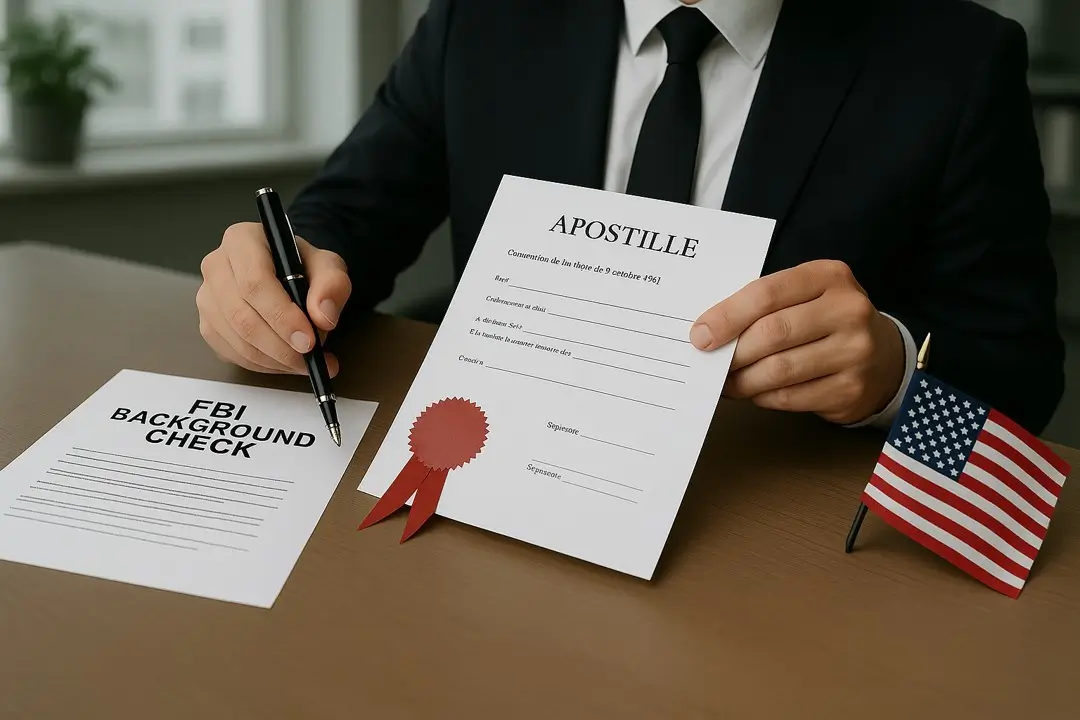
A foreign employer, a university, an immigration office or a court asks for an apostilled FBI background check, and the hard part is not the one everyone expects. The FBI Identity History Summary is a federal document, so there is exactly one office in the country that can apostille it and no room for choosing wrongly. The reports that come back unusable fail somewhere else: a summary that was a little too old, or issued in a format the destination does not treat as a properly issued version.
Apostille de la Haya · FBI Background Check Apostille
Nothing on the FBI’s own page warns you about a freshness rule, because the rule does not belong to the FBI: it belongs to the authority abroad that will read the report. Which is why an aged summary is the quietest way to lose a package at the finish line.
Many destination countries and institutions only accept a summary issued within a recent window, often a few months. The rule belongs to the destination and it is not published on the FBI’s page — so an aged report is usually discovered after the apostille has already been attached.
The FBI issues Identity History Summaries in more than one format, and not every format is treated the same way downstream. Knowing which version your case needs before anything travels to Washington is one of the most common places a self-managed file goes wrong.
FBI-approved channelers are legitimate and usually quicker than the direct route. But the version they deliver, and how it is then presented, has to line up with what the Department of State and the destination accept. Speed upstream does not survive a mismatch downstream.
The three checks
What has to be true before the envelope leaves — none of it is on a government page
«Police clearance», «criminal record certificate» and «background check with apostille» are different words for the same request. In nearly every case they mean the FBI Identity History Summary — not a state or county record.
The freshness window is set abroad and measured in months more often than years. Ordering the summary too early is as expensive as ordering it too late, because the clock starts on the day the FBI issues it.
More than one output exists and they are not interchangeable. A report obtained quickly but issued in the wrong version still travels to Washington and still comes back.
Format · the version
The clocks
Two windows people add up wrong, and one they forget entirely
Two windows, and they are distinct: obtaining the FBI summary typically needs a window of its own, and the apostille turnaround is a second one after it. «Expedite» is not a switch anyone can flip — it is the removal of rework: the right authority chosen first, fingerprints that clear on the first attempt, an apostillable output, and a request package without defects.
The summary carries a federal signature, so the competent authority is the U.S. Department of State through its Office of Authentications, in Washington. Your state Secretary of State cannot apostille it, wherever you live. That is the whole of the jurisdiction question in this section — the general rule, and the state offices it does apply to, belong to Federal & State Dept Apostille.
Obtaining and reading a U.S. criminal record — rather than authenticating one — is handled in Background & Criminal Records.
The file
Four figures this section actually states
1
office in the country
The federal Office of Authentications is the only one authorised to issue a federal apostille. There is no branch, no regional centre and no instant portal.
0
state offices that can
A state counter rejects a federal document on sight. Sending it there costs the mailing time in both directions and produces nothing.
2
separate windows
Obtaining the FBI summary is one timeline; apostilling it is another. They are distinct, and adding them up wrong is the commonest planning error.
4194
the form
Form DS-4194, the Request for Authentications Service, accompanies the federal request and has to agree with the report enclosed with it.
Apostille de la Haya
The federal route, managed end to end
We confirm the destination first, because that is what sets the freshness rule and the format. Then we secure an apostillable version of the summary, prepare the federal request without defects, and track it to the counter and back.