Parte de la red Riveros Corp: Apostille de la Haya·Notary Public Center·Compliance Officers·USJurisdiction
Part of the Riveros Corp network: Apostille de la Haya·Notary Public Center·Compliance Officers·USJurisdiction
Jurisdicción de Estados Unidos,
explicada con claridad.
U.S. jurisdiction,
explained clearly.
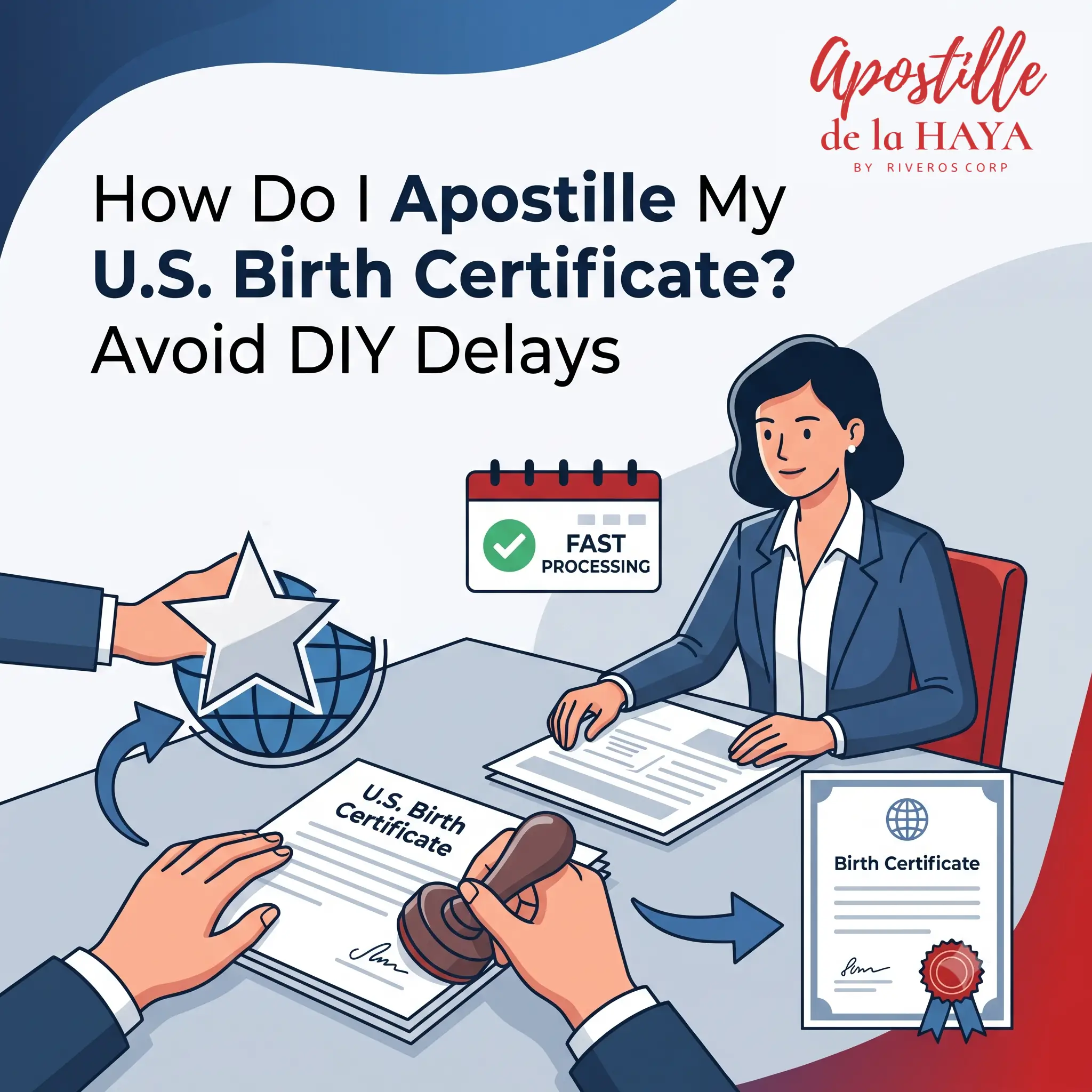
A birth in Florida produces a Florida record; a birth in California produces a California record. For a destination inside the Hague Convention, that record is apostilled by the Secretary of State of the state that issued it, and the federal office in Washington never sees it. Almost every delayed file in this section starts with the opposite assumption — that «federal» is a stronger or faster version of the same thing.
It is not stronger and it is not faster. It is a different level, for different documents — and the two situations that do send a birth record to Washington are narrow, nameable and easy to check before anything is posted.
Three questions settle the whole file, and the order matters:
The state that issued it is the competent authority, whatever state you live in now and however long ago it was.
Inside, the state apostille is the end of the road. Outside, the state step is only the first of three.
A Consular Report of Birth Abroad is a federal document from the moment it exists. No state ever issued it, so no state can certify it.
The federal office cannot authenticate a signature it has no basis to verify. Without the required state-level certification underneath it, the request has nothing to stand on and the document is returned — having spent the mailing time in both directions.
A Consular Report of Birth Abroad is issued by the Department of State, so no state office ever issued it and none can certify it. People holding an FS-240 who try the state route are turned away, and usually only find out why after the trip.
Each authority in the chain verifies only the step immediately before it. Ask the mission to legalise a document that has not yet been authenticated federally and it refuses — the sequence is not a formality, it is what each signature is checking.
If you were born abroad to U.S.-citizen parents, your birth was likely documented by a Consular Report of Birth Abroad — form FS-240. That is a federal document issued by the Department of State, not by any state office, so the state route does not apply to it at all.
Then a state birth certificate is certified at state level, authenticated federally, and only afterwards legalised at the destination’s embassy. The federal stage here is a required middle link — not an alternative to the state step, but the step that comes after it.
Everything else — which is to say almost everything — is the ordinary state route, and it ends at the Secretary of State of the issuing state. Which desk applies to which document, across the whole branch, is the subject of Federal & State Dept Apostille; the longer consular chain is handled in Legalization & Embassy.
It begins with a certified copy from the Vital Records office of the state where the birth was registered — not a photocopy, not a hospital souvenir certificate. That copy is then submitted to the Secretary of State of that same state, the state’s fee is paid, and the apostilled document is returned. The stage that dominates the calendar is usually the first one, and it is the one no apostille timetable mentions.
Florida, California, Texas and every other state run their own counter, on their own schedule. There is no national queue to join.
If you do not already hold one, that request has to be finished before the apostille request can even start.
A birth certificate proves who you are, who your parents are, and when and where you were born — facts a foreign government relies on for weddings, residency, citizenship by descent, inheritance, school enrolment and adoption. But a foreign ministry has no way to know whether the paper in front of it is a genuine U.S. record or something printed at home.
It confirms that the signatures and seals belong to genuine officials. It says nothing about the contents of the record.
A document prepared for the wrong framework is not valid at its destination, however many stamps it carries — which is why the destination is settled first.
Requesting and receiving U.S. vital records is a service of its own, and it is where most of the waiting actually happens.
The Consular Report of Birth Abroad. Issued by the Department of State for certain births abroad to U.S.-citizen parents — and no state office can certify it.
A record that was federal from the start, and a destination outside the Hague Convention. Everything else is the ordinary state route.
Each authority in the chain verifies only the step immediately before it, and trusts that everything earlier was done correctly. That is why the order is not negotiable.
Certified copy from the state’s Vital Records office, submission to that state’s Secretary of State, the state’s fee, and the return of the apostilled document.
We confirm the destination first, because that decides whether an apostille is the right instrument at all. Then we order the certified copy from the state that holds the record, route it to that state’s Secretary of State, and follow it back.