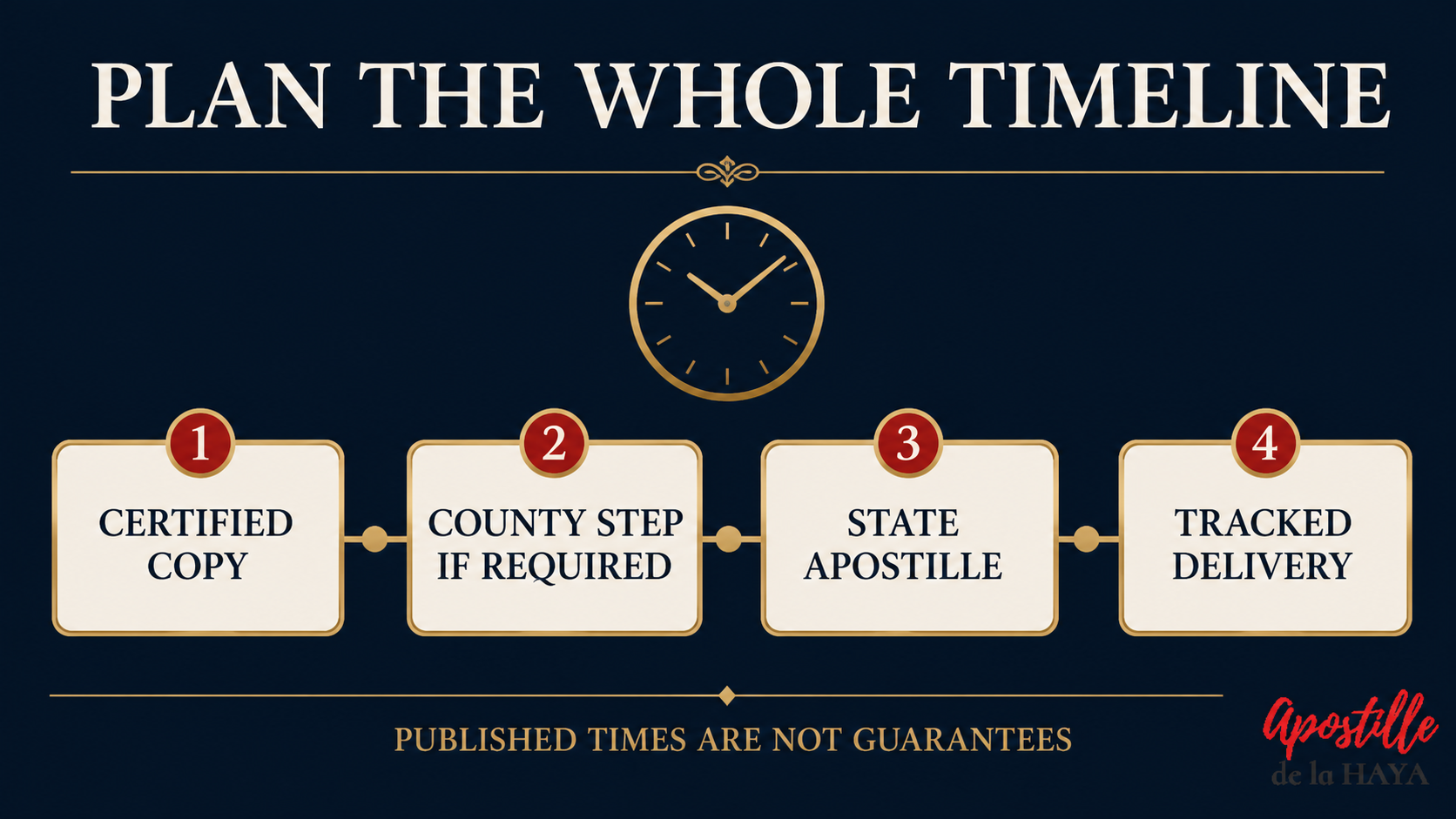
Marriage certificate apostille processing time depends on more than the apostille office’s queue. You may first need a certified record, an intermediate certification, or a correction. Delivery and the receiving country’s requirements can add further time.
A useful estimate identifies those stages separately. It also distinguishes an office’s published processing information from a provider’s estimate and from the date the completed document will reach you.
Apostille de la Haya reviews the record, issuing jurisdiction, and destination before proposing a schedule. The aim is to identify what your file needs and which steps may affect completion.
Start with the certified marriage record
If you already hold a suitable certified copy, the ordering stage may be unnecessary. However, confirm the format, official signature, issue date, and condition before relying on it.
For a replacement, the custodian’s workload and request requirements matter. An older record, uncertain marriage date, or incomplete application may take additional work. The apostille office cannot supply a missing certified record for you.
Florida’s Bureau of Vital Statistics lists normal mail-order processing of three to five business days for computer certificates from 1970 onward. Shipping is additional, and records before 1970 require more processing time.
That figure describes a particular record service. It is not a national standard or a complete Florida apostille timeframe. Check any instructions specific to the application and service you choose.
Recent marriages and preliminary certifications
A recent wedding can create an availability issue before processing begins. Florida describes the transfer of recorded marriages from the clerk to the Bureau as taking approximately 60 days.
If you need evidence sooner, check with the clerk that issued the license. The clerk must receive and record the completed document first. A county copy may be available before the state Bureau can supply its certificate.
Some records also need an intermediate certification. In New York, marriage certificates from local or county officials require certification by the County Clerk of the issuing county. New York City records follow the New York County Clerk step.
Qualifying certificates from the New York State Department of Health avoid that County Clerk requirement. They must bear the signature of the Director of Vital Statistics or the NYS Registrar. The recipient’s required format still matters when choosing the source.
Marriage certificate apostille processing time by office
The comparison below covers selected offices and their published service information, checked on September 30, 2026. It does not promise a completion date for every file or represent all U.S. jurisdictions.
| Office | Published processing information | What to include in your schedule |
|---|---|---|
| Florida Department of State | Receipt-order processing; a separate page lists the receipt dates of apostille requests currently in process. Walk-in service is available. | Record retrieval, current queue, submission method, and return delivery |
| New York Department of State | Same-day walk-in service at several locations, subject to the office's requirements | Any County Clerk certification, travel or submission arrangements, and the separate mail route if used |
| California Secretary of State | Publishes the mail-request receipt date currently in process; in-person submissions typically take about 30 minutes after submission | Current office arrangements, waiting before submission, record preparation, and delivery |
| Texas Secretary of State | Mailed requests can take up to two weeks from receipt; actual processing varies with volume | Certified-record eligibility, current submission arrangements, and shipping |
These descriptions measure different things. A moving receipt date describes a queue, while a counter estimate describes a particular submission method. Neither includes every stage from ordering a marriage record to using it abroad.
How to read a published queue date
Florida and California publish dates for apostille requests currently being processed. Compare the posted receipt date with the page’s update date to understand the reported backlog.
Do not simply add that interval to your mailing date and treat the result as guaranteed. The office must receive a complete request, workloads can change, and delivery takes additional time.
For example, a page showing earlier September receipt dates during a later September update indicates that earlier mail remains in the queue. It does not establish when a new request will finish.
Recheck the office’s information near submission. Also keep proof of delivery where the chosen carrier provides it. Delivery to an office and completion of its review are different events.
When federal authentication affects the timeline
A state marriage certificate for use under the Apostille Convention normally follows the issuing state’s apostille route. The federal Office of Authentications is not an additional routine apostille stage for that record.
A non-Convention destination may require state authentication, federal authentication, and consular legalization. Confirm the specific chain with the receiving country before adding those steps.
For requests within its authority, the U.S. Department of State currently publishes processing within five weeks of receipt for mail submissions. Its walk-in drop-off service lists seven business days.
Those figures cover the federal processing stage. They exclude earlier record retrieval and state certification, and they do not include later consular work or all delivery time.
Our explanation of marriage certificate apostille requirements helps identify the applicable route. Do not apply a federal timeframe to every marriage certificate simply because the document is American.
Walk-in service and rush service are different
Some offices can handle a qualifying in-person request sooner than a mailed request. However, someone must present a complete file at the correct office during the available service hours.
Florida says it does not offer expedited apostille processing, while also offering walk-in service. Its FAQ states that most walk-in requests may finish while the customer waits. This is not a guarantee for every visit.
A vital records office may separately offer rush handling for the certified-copy order. Faster record issuance does not necessarily shorten the apostille queue or include expedited shipping.
Before choosing a service described as “express,” ask which stage it changes. Our article on express apostille service discusses how to evaluate the proposed arrangements.
The federal emergency appointment has narrow conditions
The federal Office of Authentications does not treat an ordinary filing deadline as a life-or-death emergency. Its published appointment criteria concern qualifying travel within two weeks because of an immediate family member abroad.
The family member must have died, be dying, or have a life-threatening illness or injury. The office determines eligibility and publishes same-day processing for an approved appointment.
Ordinary walk-in drop-off follows a different process. The office currently accepts it from 7:30 to 9:00 a.m., Monday through Thursday, excluding applicable closures.
Its limit is one request per day with up to 15 documents for one customer or company. It processes requests on Fridays but does not accept walk-ins or appointments that day. Confirm current arrangements before traveling.
Payment and incomplete submissions can add time
An otherwise suitable document can still need correction if the package lacks the required form, payment, or return method. Check the receiving office’s instructions for that submission.
Florida’s Department of State requires an accepted check or money order in U.S. currency drawn on a U.S. bank. It does not accept cash or credit cards for this process. Other offices may use different methods.
Do not assume that a provider’s quote includes every government stage. Ask what the quoted timeline covers and whether the provider already has the required certified record.
If the office returns a request, the impact depends on the reason. Some issues need a corrected package; others require a new record. It is too broad to say that every problem restarts every stage from zero.
Translation belongs in the plan
Translation requirements depend on the receiving authority. Some offices require a translation of both the marriage certificate and its apostille. Others specify who may translate or certify it.
You can identify the accepted translator and discuss scheduling while authentication is underway. Whether the translator can begin work from an earlier copy depends on the document and the recipient’s rules.
If the final submission must include a translated apostille, that portion cannot be completed before its text is available. Likewise, a corrected marriage record may require changes to an earlier translation.
Therefore, plan translation early but confirm what the final translated package must contain. Do not assume that all translation must wait until the end or that an early translation will always be acceptable.
Delivery can change the completion date
Include delivery to the custodian, between offices where necessary, and to the final recipient. Some stages may allow direct forwarding, while others require the document to return to you or your provider.
Check which prepaid labels or envelopes each office accepts. Standard return mail may not provide tracking. A tracked service can improve visibility, but it does not control the government’s processing queue.
Also consider the actual delivery address abroad. A consulate, registry, private address, or local representative may each have different receiving arrangements. Confirm who will receive and retain the original package.
Keep a scan and shipment details for reference. They can help explain the file’s status if a question arises, although a scan does not automatically replace the required certified document.
The destination may impose a separate deadline
Apostille processing is only part of the schedule for a foreign filing. Appointment availability, certificate issue-date limits, and local registration rules may affect when you can use the document.
For example, article 161 of Mexico’s Federal Civil Code addresses transcription of marriages of Mexicans celebrated abroad. It describes a three-month period after arrival and distinguishes the stated civil effects of timely and later transcription.
That provision should not become a universal deadline for every marriage or procedure in Mexico. The Code governs federal matters, and the applicable local law and procedure require separate review. Seek qualified Mexican advice about legal consequences.
Similarly, do not assume every Colombian consular marriage registration requires a U.S. certificate issued within three months. Requirements for a visa or another civil-record procedure may concern a different document. Ask the actual receiving office.
Several documents may proceed at the same time
Independent records from different jurisdictions can often move through their respective processes concurrently. That can avoid adding one complete state process after another.
However, some requests depend on an earlier document to establish identity, eligibility, or a name change. Confirm those dependencies before deciding which applications can begin together.
If the foreign filing needs all documents at once, the last required item determines readiness. Allow time afterward for final translations, assembly, and delivery where needed.
Our guide to a marriage certificate issued in another state explains why each record must follow its own jurisdiction’s route.
How Apostille de la Haya plans the work
We start with the destination’s requirements and any appointment or filing date. Then we review whether the available record meets those requirements and which offices must handle it.
The proposed schedule separates known steps from unresolved issues. For instance, an existing certified copy presents a different starting point from a recent marriage that the clerk has not yet recorded.
Where available and suitable, the service can include rush record ordering, in-person submission arrangements, concurrent independent requests, and tracked delivery. We explain what those choices change and what they cannot control.
A service estimate does not bind a government office or guarantee foreign acceptance. If the available information does not support the requested deadline, we identify that limitation before presenting the schedule as workable.
Marriage certificate apostille processing time: questions
How many days should I allow in total?
There is no single national timeframe. Identify the certified-record stage, any preliminary certification, the competent authority’s current processing information, and delivery. Add translation or further legalization where the destination requires it.
Can I pay for an expedited apostille?
Options depend on the office and submission method. A rush record order, walk-in apostille service, and faster courier service affect different stages. Ask exactly what the proposed service includes and whether any government priority service actually exists.
We just married. Can the record be ready next month?
Possibly, but first confirm recording and availability. In Florida, the issuing clerk may supply a certified copy before the Bureau receives the record. The destination must also accept that version, and the remaining authentication and delivery stages need time.
Why do providers quote different timelines?
They may start from different assumptions or include different stages. One estimate may assume you already hold an acceptable certificate; another may include retrieval. Compare the document, submission method, delivery, and stated conditions before comparing the number of days.
Does the federal five-week figure apply to every marriage certificate?
No. A state record for use under the Apostille Convention normally follows its state route. Federal authentication may form part of a non-Convention legalization chain. Confirm whether that stage applies before adding its published processing time.
Review your deadline before choosing a service
Contact Apostille de la Haya to review your marriage certificate apostille processing time. Share the issuing jurisdiction, available document, destination, and filing deadline.
Call +1 (305) 500-0185 or write through WhatsApp. We can explain the required stages and the limits of the available timing information.
This publication provides general information and does not constitute legal advice or a guarantee of completion or acceptance. Processing information can change. Confirm current requirements and obtain qualified advice about legal deadlines in the destination jurisdiction.