A marriage certificate apostille for Mexico starts with a certified U.S. marriage record and the authority responsible for that record. The Mexican office receiving it then sets the requirements for its particular procedure. Those may include a Spanish translation and registration with a Mexican civil registry.
Before ordering documents, identify the Mexican state, receiving office, and purpose. Registering a foreign marriage, supporting an immigration application, and proving a family relationship can involve different requirements. A checklist for one procedure may leave another incomplete.
Apostille de la Haya can review the U.S. document and the apostille route. Questions about the marriage’s legal effects in Mexico require the receiving authority or a qualified Mexican lawyer.
What Mexico recognizes through an apostille
The Apostille Convention entered into force for Mexico on August 14, 1995. For a covered U.S. public document, an apostille generally replaces the diplomatic or consular legalization chain between Convention countries. A state-issued marriage record normally goes through the competent authority in its issuing state.
The apostille verifies the public signature, the signer’s capacity, and the seal or stamp identified on the document. It does not translate the certificate or decide whether the marriage meets a Mexican procedure’s requirements. Moreover, it does not resolve questions about divorce, inheritance, marital property, or immigration eligibility.
Keep those functions separate when planning the request. Successful authentication completes the U.S. authentication stage. The Mexican office still decides whether the record, translation, and supporting evidence satisfy its rules.
Identify the Mexican office before ordering the U.S. copy
Ask the receiving office for its current checklist in writing. Specify that the marriage occurred in the United States and name the state that holds the record. Also explain whether either spouse is Mexican and whether you are seeking registration or using the certificate for another procedure.
Confirm the accepted certificate format, any requirement for a recently issued copy, and the translator’s required qualifications. Then check whether the office needs both the certificate and apostille translated. Ask about appointments, identification, supporting civil records, and representation if someone will submit the file for you.
For example, an office registering a foreign marriage may request documents connecting each spouse’s identity to the foreign record. An immigration process may require a Mexican marriage act in a particular situation. Consequently, neither “Mexico accepts apostilles” nor a general consular checklist answers every document question.
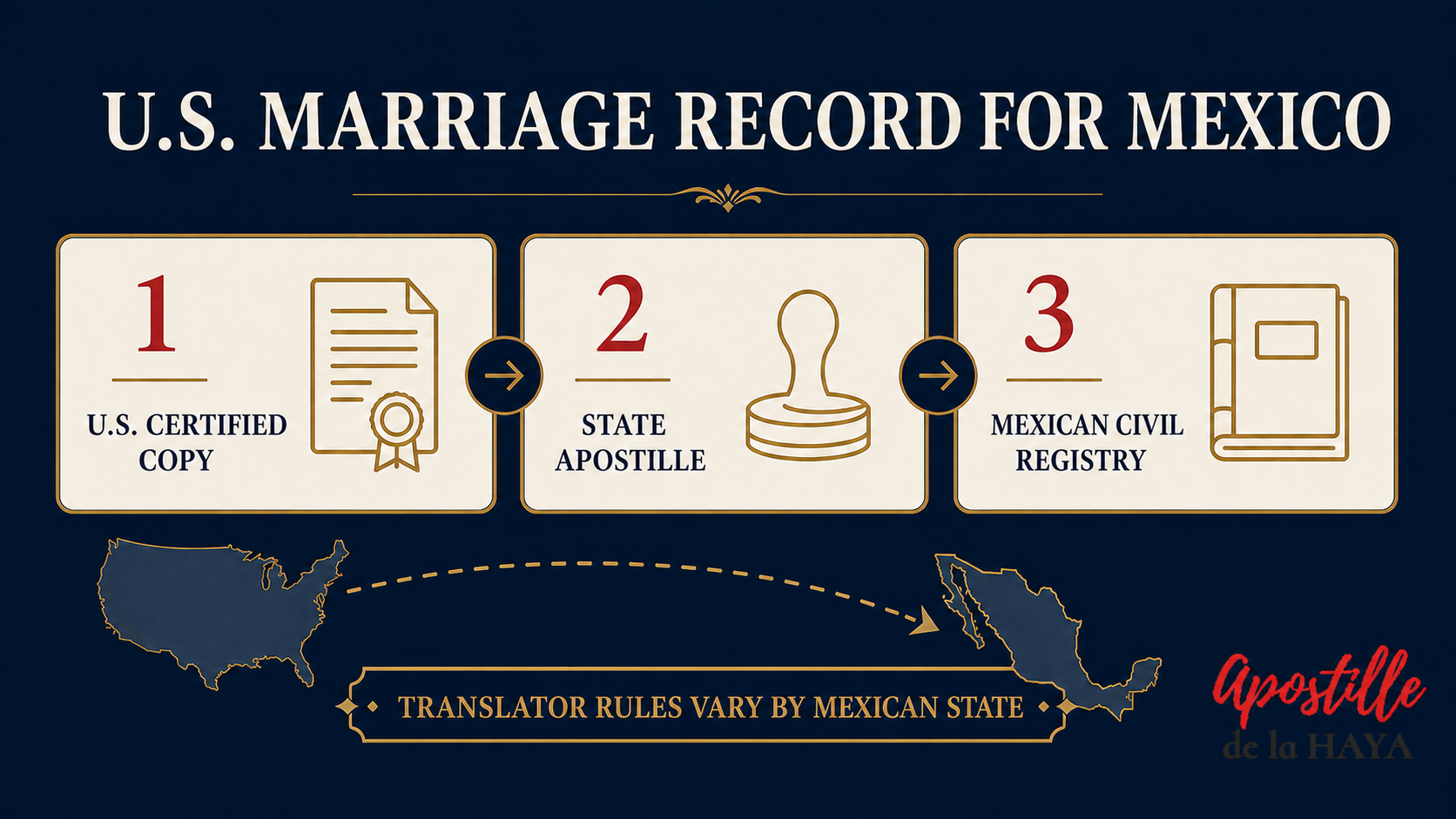
Marriage certificate apostille for Mexico: the U.S. steps
Order a certified record from the proper custodian
Use the government office that holds the recorded marriage. Depending on the state, this may be a county clerk or a state vital records office. A ceremonial certificate, an ordinary photocopy, and a certified government copy are different documents.
Check the names, marriage date, issuing office, signature, and certification before forwarding the record. If the marriage was recent, confirm that the officiant’s return has been recorded. Otherwise, a request for a completed marriage record may reach the custodian before the record exists in its system.
The word “original” can cause confusion. Usually, the custodian retains the underlying record and issues certified copies. Our guide to certified marriage copies and apostille eligibility explains why the official certification matters.
Follow the issuing state’s authentication route
Send the record through the route required by its issuing state, even if you now live elsewhere. A Florida address does not give Florida authority to apostille a New York marriage certificate. Also, the office handling apostilles is not called the Secretary of State in every jurisdiction.
Some records need an intermediate certification. For example, New York distinguishes local marriage records from certain state-issued vital records. Florida also distinguishes the state vital records route from a Clerk of Court route. Therefore, confirm the signature and issuing office before choosing the submission method.
Identify Mexico as the destination on the application. Include the required payment and return arrangement using the authority’s current instructions. For more detail, see how to apostille a marriage certificate issued in another state.
Check the completed package before delivery
When the package returns, confirm that the apostille belongs to the submitted certificate and that the destination information is correct. Keep the official attachment intact. Make a working scan for review while retaining the physical package for the receiving office.
If the document contains an error, contact the responsible office before altering anything. A handwritten correction to a certified record can create a new acceptance problem. In addition, ask whether correcting the underlying record requires a new certified copy and apostille.
Spanish translation depends on the receiving authority
A marriage certificate apostille for Mexico often requires a Spanish translation, but the translator’s qualifications depend on the procedure. Do not assume that a U.S. notarized translation will satisfy a Mexican civil registry. Conversely, do not reject a translation solely because it was prepared outside Mexico without checking the applicable rule.
General guidance from Mexico’s foreign affairs ministry refers to a translator authorized by a state’s Superior Court of Justice. Local instructions can use different authorization requirements. For example, Michoacán’s civil registry checklist identifies its required translator authorization for foreign civil records.
Give the translator the receiving office’s actual checklist. Ask whether the translation must include the apostille, seals, handwritten notes, and reverse-side entries. A translation that omits an official annotation may fail to reproduce the record completely.
You can request a quote or begin translation planning while the apostille is pending. However, if the final translation must cover the apostille, the translator needs that completed document before finishing. This distinction helps coordinate the work without promising that every stage can run at the same time.
Registering a foreign marriage in Mexico
The process may appear as inscripción, inserción, or transcripción of a foreign civil record. Ask the Registro Civil serving the relevant location which procedure applies. Registration requirements can depend on the Mexican state, the spouses’ circumstances, and the purpose of the filing.
Article 51 of the Federal Civil Code addresses civil status acquired by Mexicans outside the Republic. Its current text refers to the Código Nacional de Procedimientos Civiles y Familiares and registration in the corresponding office in Mexico City or a state. Older explanations that still cite the former federal procedural code need updating.
However, Article 1 limits that federal code to federal matters. Local civil law and the receiving office’s rules therefore remain important when assessing a particular registration. A general article cannot determine every marriage’s property, inheritance, or procedural effects across Mexico.
Michoacán’s published checklist illustrates why local review matters. It requests the foreign civil record, apostille or legalization as appropriate, identification, and a qualifying translation when the document is not in Spanish. It also addresses representation. Another state may request a different set of supporting documents.
What the three-month rule does and does not establish
Article 161 of the Federal Civil Code refers to Mexicans who marry abroad. It directs transcription within three months of their arrival in the Republic, in the civil registry where the spouses establish their domicile. It also distinguishes the civil-effect date for timely and later transcription.
Under that provision, timely transcription gives civil effects from the marriage date; later transcription gives them from the transcription date. That is the provision’s wording and scope. It should not become a blanket statement that every foreign marriage becomes invalid after three months.
Nor should readers assume that every local deadline runs from the wedding date or the apostille date. The applicable jurisdiction and facts matter. If you have already returned to Mexico, identify your arrival and residence dates and obtain advice about the rule relevant to your case.
Questions involving an estate, disputed marital property, a prior marriage, or rights against third parties deserve individual legal review. An apostille service cannot decide those issues. Nevertheless, a late registration question is a reason to investigate the proper procedure, rather than assume the marriage has ceased to exist.
Consular marriage services and an existing U.S. marriage
A Mexican consulate’s requirements for celebrating a new marriage should not automatically be applied to registering an existing foreign marriage. They are different procedures. For example, a nationality condition listed for a consular wedding does not, by itself, establish the rule for inserting a U.S. marriage record.
The Mexican consulate in Miami describes civil registry functions that include insertion of foreign records. However, that general description does not confirm that every applicant can complete every foreign-marriage procedure there. Ask specifically about an existing U.S. marriage, each spouse’s nationality, and the office that will ultimately use the record.
Also distinguish a Mexican marriage act issued through a consular civil registry from a U.S. government marriage certificate. The documents come from different authorities. A Mexican consulate does not supply the U.S. state apostille for a U.S. marriage record.
Immigration use requires its own checklist
For Mexico’s INM family-unity visa procedure, published instructions address foreign public documents, apostilles or legalization, and Spanish translation. They also specify a Mexican marriage act when the sponsoring person is Mexican. That requirement belongs to the identified procedure.
Other visa or consular routes can have different documentary requirements. Therefore, confirm the exact application before deciding that the apostilled U.S. certificate alone is enough. Ask whether registration must occur first and which version of the resulting Mexican record the application requires.
Names should also match across the marriage certificate, passports, and supporting records. If a spouse uses a married surname, ask how the office wants that connection documented. Do not silently change a name in the translation to make the file look consistent.
Plan the certificate, apostille, and Mexican filing together
The U.S. work can include record issuance, intermediate certification, apostille processing, and delivery. The Mexican work may add translation, an appointment, and registry processing. Each office controls its own queue and may ask for corrections or additional evidence.
Check current government processing information before choosing a delivery date. Some authorities publish the receipt dates they are processing; others describe service options or estimated turnaround. Our guide to marriage certificate apostille processing time explains how those stages affect the schedule.
The Apostille Convention itself does not set an expiration date for an apostille. Nevertheless, a receiving office may require a recently issued marriage record. Confirm that requirement before ordering, especially when a translation or appointment will follow much later.
For an initial review, provide the issuing state, document type, destination office, and deadline. Use a secure channel for the certificate and identification if those materials are needed. Avoid sending unrelated personal documents simply to request a general quote.
Marriage certificates for Mexico: common questions
Does Mexico require an apostille or consular legalization?
For a covered U.S. public document used in Mexico, the Apostille Convention generally replaces the consular legalization chain. A state marriage record usually requires the competent issuing-state authority. Confirm the receiving office’s remaining requirements, including translation and any registration procedure.
Can I arrange the Spanish translation in the United States?
Possibly, if the receiving authority accepts the translator’s qualifications and format. Obtain that authority’s instructions first. A notarized translation prepared in the United States does not automatically meet a Mexican registry’s requirements for an authorized translator.
What if more than three months have passed?
Ask the relevant civil registry or a Mexican lawyer which rule applies to your circumstances. Article 161 addresses Mexicans marrying abroad and links timing to arrival in Mexico. Its federal scope and local requirements matter; do not assume the marriage is automatically invalid.
Can a Mexican consulate handle the entire process?
Ask the consulate whether it offers the foreign-record insertion procedure you need. Its rules for celebrating a new marriage may address a different service. The U.S. apostille still comes from the competent U.S. authority for the record.
How long does a marriage certificate apostille for Mexico take?
The U.S. timeline depends on the issuing office, any preliminary certification, apostille processing, and delivery. Translation and Mexican registration can add separate waiting periods. Review the current requirements for each stage before committing to an appointment or travel date.
Check your U.S. marriage record before submission
Apostille de la Haya can review the issuing state and document format for your marriage certificate apostille for Mexico. Share the receiving office’s checklist and your intended deadline so the U.S. steps can be assessed. Call +1 (305) 500-0185 or contact Apostille de la Haya on WhatsApp.
This publication provides general information, not individual legal advice. Confirm current requirements with the receiving authority and consult a qualified Mexican lawyer about registration deadlines or the legal effects of your marriage.