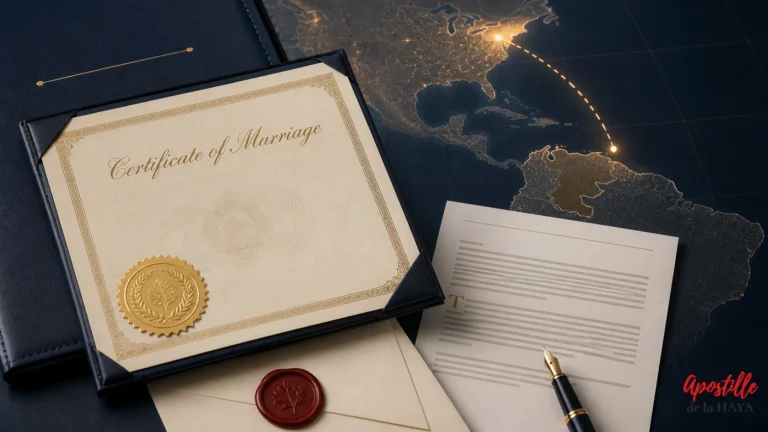
Colombia has been a Contracting Party to the Hague Apostille Convention since 30 January 2001, so a marriage certificate apostille for Colombia is the correct instrument and the long consular legalisation chain does not apply. What makes these files awkward is not the route. It is a recency requirement that runs on a three-month clock, and a consular exception that means some couples pay for an apostille they may not have needed while others skip one they certainly did.
A common purpose for the document is: registering a marriage celebrated in the United States in the Colombian civil registry, so that it produces effects in Colombia. That registration is a Colombian procedure with Colombian requirements, and the apostille is one input into it. Below is how the Colombian side is structured, where the timing traps sit, and the distinction that decides whether the apostille is needed at all.
What Colombia is actually asking for
A marriage celebrated abroad is entered into the Colombian civil registry through the registro civil de matrimonio celebrado en el exterior, which is requested at Colombian consulates. Until that entry exists, an American marriage certificate, apostilled or not, is a foreign document rather than a Colombian civil status, and the practical effects people are usually pursuing depend on the registry entry rather than on the certificate.
The supporting file is more than the marriage certificate. It generally includes the marriage certificate or registry itself, the birth registry of the Colombian spouse, and identity documents for each spouse, the Colombian identity document for Colombians and a valid passport for a foreign spouse. Documents issued by another State in a language other than Spanish have to be translated by an authorised translator and apostilled or legalised as applicable. The registration itself carries no cost, although consular fees for obtaining copies of the civil registry still apply.
Note what that list implies for planning. Several of the documents in the file come from different American jurisdictions, each with its own ordering process and its own apostille authority, and they all have to be ready at the same time. The file moves at the speed of its slowest document, which is rarely the one people are watching.
The three-month recency window
The requirement that reshapes these files is the age of the certificate. The consular registration works with a marriage certificate or registry issued no more than three months earlier. That condition changes the sensible order of preparation.
The instinct with any bureaucratic file is to gather documents early and hold them until everything else is ready. For a procedure applying that recency rule, a certificate obtained in March and presented in July would be outside the stated window regardless of the rest of the file, and a fresh certified copy has to be ordered and apostilled again from the beginning. The certificate is the last thing that should be ordered, not the first, and everything upstream of it has to be timed around that.
It also means the entire American chain has to fit comfortably inside three months: ordering the certified copy from the state that recorded the marriage, any county-level certification that state requires, the apostille itself, the translation, and the mail in both directions. In most states that is achievable. It stops being achievable when the record is old, when the state is slow, or when the file is started without anyone realising the clock was already running.

When the apostille may not be required, and when it certainly is
There is a limited consular exception worth checking before spending money. Colombian national guidance indicates that, when registration is made before the Colombian consulate with jurisdiction over the place where the event occurred, the consul may authenticate or recognize the document directly without apostille or legalization. This is not an automatic waiver: the current checklist of the specific consulate controls, and the Miami consulate presently publishes an apostille requirement for a foreign marriage certificate.
Two cautions apply, and both matter. First, this depends on the consulate whose jurisdiction covers the place of the marriage, not simply the consulate that is most convenient to you: a couple married in Florida but living in Texas is not automatically in the same position as a couple who married and remained in Florida. Second, consular practice is set by the consulate, and the only reliable confirmation comes from that office. We treat it as a question to be asked at the start of the file rather than an assumption to build on.
Where the apostille is unambiguously required is when the certificate is going to be used in Colombia rather than presented at a consulate in the United States: a notaría, the Registraduría, a court, a bank or a counterpart in a property or inheritance matter is receiving a foreign public document, and the apostille is what allows it to be relied on. If the document will be presented in Colombia, the apostille is ordinarily required unless the receiving authority identifies a valid exception. A later, different use should be evaluated separately rather than assumed.
Practical points the checklist may not resolve
Translation and apostille may have a required order. When the receiving authority needs a Spanish translation of both the certificate and its apostille, the translation should be prepared after the apostille is attached. The specific office should confirm the accepted translator and whether both instruments must be translated.
«Authorised translator» is not a self-description. The requirement refers to a translator recognised for this purpose, and a translation prepared by a competent bilingual professional who lacks that standing is refused on a basis that has nothing to do with the quality of the translation. This is an administrative qualification, not a linguistic one.
The version of the American record matters. Where a U.S. state issues both an abstract and a certified copy of the full recorded entry, a registry that is transcribing data into its own books may need the complete entry. Florida is the clearest example: its state-level certification is issued as an abstract of the information taken from the marriage licence, while the Clerk of the Circuit Court issues a certified copy of the recorded record. The choice is explained in our article on which marriage certificate copy qualifies.
Each supporting document has its own American jurisdiction. A marriage recorded in New Jersey and a birth certificate from New York are two separate files with two separate authorities, two fee structures and two mail routes. Running them sequentially is what turns a three-month window into a missed one.
Recency applies to the certificate, not to the apostille. The apostille has no expiry date of its own. What ages is the underlying certified copy, so a file that stalls for four months does not need a new apostille on the same paper: it needs a new certified copy and a new apostille on that.
Mistakes that can add time and cost
- Ordering the certificate first and everything else afterwards. The certificate ages out while the rest of the file is assembled, and the American chain restarts.
- Assuming the consular exception applies. It depends on the consulate whose jurisdiction covers where you married, and it is a question to be confirmed, not assumed.
- Assuming it does not apply and apostilling reflexively. In some cases that is money and weeks spent on a step the receiving office was not going to require.
- Using a translator without the required standing. The file is refused and the translation is commissioned again.
- Treating the apostille as the end of the matter. The marriage still has to be entered in the Colombian civil registry, and that is a separate procedure with its own requirements.
The costly pattern here is specific to Colombia: because of the recency rule, these errors may do more than delay the file, they force the American stage to be repeated from the beginning.
How Apostille de la Haya resolves it for you
We start by establishing where the document will actually be presented, because that determines whether the apostille is required and what version of the record is needed. If the file is going to a consulate in the United States, that is one set of requirements. If it is going to a notaría, the Registraduría or a court in Colombia, it is another. Asking that question first is what prevents both of the expensive outcomes: paying for a step that was not needed, and missing one that was.
From there we sequence the work against the three-month window rather than against convenience. Supporting documents from other states are ordered first and run in parallel; the marriage certificate is ordered at the point in the sequence where it will still be inside the window when it is presented; the apostille follows immediately; the translation is arranged last so that it covers the apostille. You do not deal with a county clerk, a Secretary of State or a translator directory. We coordinate the required offices and document handoffs, reducing avoidable paperwork and preventable submission errors. The full scope is on our apostille services page.
What we do not do is promise you an outcome that belongs to a Colombian authority. The registration is theirs to make under their rules. Our work is to ensure that nothing on the American side gives them a reason to send you back, and that the documents are still current on the day they are examined. The general framework is set out in our overview of the marriage certificate apostille, and if the timing is tight, our analysis of how long the process takes explains which step controls the calendar.
Frequently Asked Questions
Does Colombia accept apostilles from the United States?
Yes. Colombia has been a Contracting Party to the Hague Apostille Convention since 30 January 2001, so the correct instrument is an apostille issued by the U.S. state that recorded the marriage rather than consular legalisation. The frequent error is obtaining it from the wrong jurisdiction, since only the state that holds the record can issue it.
Is it true that I may not need an apostille at all?
In one specific situation. Where the registration is made before the Colombian consulate corresponding to the jurisdiction in which the marriage took place, the consul may be able to recognise the document without an apostille. It depends on that consulate and on where you married, so it has to be confirmed rather than assumed. We raise the question at the start, before any fee is spent.
How recent does the marriage certificate have to be?
The consular registration works with a certificate issued no more than three months earlier, which is why the certificate should be ordered late in the sequence rather than early. If your certified copy is older than that, the apostille on it does not rescue it: a new copy is required, and the apostille goes on the new one.
Who can do the translation?
It has to be an authorised translator for this purpose, which is an administrative qualification rather than a statement about language ability. A translation from an otherwise excellent professional without that standing is refused. We arrange a translation that matches the requirement of the office receiving the file.
Does the apostille register my marriage in Colombia?
No. The apostille authenticates the signature and seal on the American certificate so that Colombian authorities can rely on it. Registering the marriage in the Colombian civil registry is a separate procedure with its own documents and its own requirements. We prepare the American side so that the registration is not delayed by a defect in it.
Registering a U.S. marriage in Colombia and unsure what the consulate will accept?
Apostille de la Haya coordinates the document from record retrieval through apostille or legalization and delivery, reducing avoidable paperwork and preventable submission errors.
Phone and WhatsApp: +1 305 500 0185