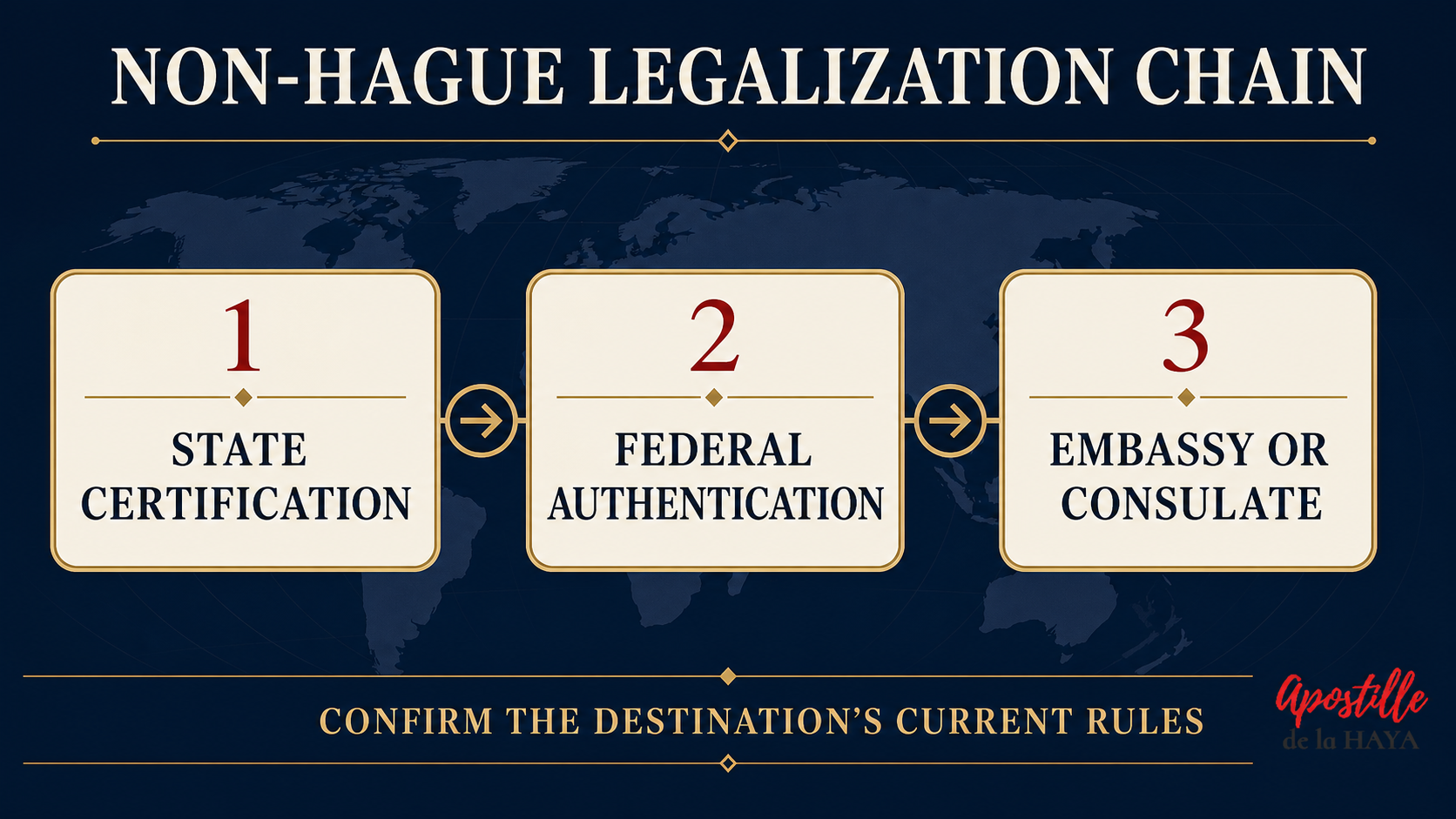
An apostille is not a universal document. It exists only between countries that are party to the Hague Convention of 1961, and when your destination is not one of them, marriage certificate legalization follows a completely different and considerably longer road: a state certification, then a federal authentication certificate, then legalisation at the embassy or consulate of the destination country. Three authorities instead of one, and the last of them writes its own rules.
The list of countries using each route changes as accessions enter into force, and the bilateral effect of an accession can also depend on objections. Preparing a file from an old checklist can therefore send a document through the wrong sequence. Below is how the consular chain actually works, which countries are currently on which side of the line, and the dated changes that are about to move several of them.
Two roads, and the line between them moves
The U.S. Department of State states the distinction plainly: apostille certificates are for documents you use in countries in the 1961 Hague Convention Treaty, and authentication certificates are for documents you use in countries not in it. The instrument follows the destination, not the document and not your preference.
According to the status table maintained by the Hague Conference on Private International Law, updated 30 June 2026, there are 130 Contracting Parties, a count that includes accessions not yet in force. The number has been climbing, and each accession quietly retires a set of instructions that were previously correct. Saudi Arabia came in with effect from 7 December 2022, Pakistan from 9 March 2023, Senegal from 23 March 2023, China from 7 November 2023, Canada from 11 January 2024, Rwanda from 5 June 2024 and Bangladesh from 30 March 2025. For each of those destinations, a couple following older guidance is preparing an embassy legalisation that is no longer the route.
Three accessions are especially relevant as of August 2026. Algeria’s Convention entry took effect on 9 July 2026; Viet Nam’s is scheduled for 11 September 2026; and Thailand’s for 28 February 2027. Those dates do not by themselves settle every U.S. file. Before changing the route, confirm that the Convention is in force between the United States and the destination, that the competent authority is operating, and that no timely objection affects the bilateral relationship. Until those conditions are satisfied, follow the authentication and consular instructions currently published for that destination.
The HCCH table reviewed in August 2026 does not list Cuba, Haiti, Egypt, Lebanon, Qatar, Kuwait, the United Arab Emirates or Nigeria as Contracting Parties. A U.S. marriage certificate intended for one of those destinations generally follows authentication and consular legalization, subject to the current instructions of the destination’s mission and any special diplomatic limitations.
What the chain actually involves
For a state-issued marriage certificate, the ordinary non-Hague sequence has a defined order, although the destination mission’s current instructions control the final requirements.
It begins with the certified copy from the office that holds the record, exactly as it would for an apostille. That record then goes to the competent authority of the state that issued it, which for a non-Hague destination issues a certification or authentication rather than an apostille. Florida, for example, issues an apostille for Convention destinations and a certification for the others, and its Clerk-certified records still attract the additional Certificate of Incumbency.
The file then goes to the U.S. Department of State’s Office of Authentications on Form DS-4194, which issues the federal authentication certificate. Its published service levels are the ones that dominate the calendar: mail requests are processed within five weeks of receipt, and walk-in requests, dropped off between 7:30 and 9:00 in the morning Monday to Thursday with a limit of fifteen documents and one request per customer per day, are processed in seven business days. Same-day appointments exist only for life-or-death emergencies, meaning travel within two weeks because an immediate family member outside the United States has died, is dying or has a life-threatening illness or injury. That is a humanitarian provision and not an expedite service. The federal office’s role is explained further in our article on the U.S. Department of State apostille and authentication process.
Only then does the document reach the embassy or consulate of the destination country, which legalises it under its own rules. This is the stage nobody can standardise, because every mission sets its own requirements.
Practical points the checklist may not resolve
The embassy stage is the wild card, and it is the last one. Fees, appointment systems, translation requirements, whether a document may be submitted by post or must be presented in person, whether a third party may present it, and how long the mission takes are all set by the mission itself and are not published anywhere in a consolidated form. Discovering an unusual requirement at that point means the document has already passed through two authorities and several weeks.
Several missions want the translation done in their own way. Some require translation into the destination language before legalisation, some require it to be produced by a translator they recognise, and some legalise the translation as a separate document with a separate fee. Producing a translation in the wrong sequence or from a translator the mission does not recognize can require correction or a new submission.
The five-week federal step compounds everything upstream. A state certification that took three weeks and a federal step that takes five puts you two months in before the embassy has seen anything. Files for non-Hague destinations need to be started on a completely different calendar from apostille files, and treating them as equivalent creates a substantial planning risk, as our analysis of how long these files take sets out.
Accessions do not apply retroactively to your paperwork. When a country joins, the change takes effect on a specific date. A document legalised before that date is not invalidated, but instructions, checklists and well-meaning advice from before the change are. This is why we check the current status of the destination at the start of every file rather than relying on what was true the last time we saw that country.
Some destinations have no straightforward route at all. Where diplomatic relations are limited or a mission’s services are restricted, the practical path may run through a different office or may not exist in the form the requesting party imagines. That is a conversation to have at the beginning, honestly, rather than after two authorities have been paid.
Mistakes that can add time and cost
- Requesting an apostille for a non-Hague destination. The state may well issue one, since it issues what you ask for. The embassy then refuses the document, and the entire chain restarts with the correct state certification.
- Following instructions written before the destination joined. Paying for embassy legalisation for a country that now accepts an apostille, in a queue that was avoidable.
- Planning a non-Hague file on an apostille timeline. The federal stage alone is five weeks by mail, before the embassy is reached.
- Arranging the translation at the wrong point. Missions that require translation in a particular form or from a particular source will not accept one produced earlier for a different purpose.
- Sending a single certified copy through a chain that retains it. Where the mission keeps the document, a second copy means running the whole sequence again from the county.
The cost profile of these mistakes is different from apostille files. Because the chain is long, an error at stage one is not discovered until stage three, by which point two authorities have been paid and two months have gone.
How Apostille de la Haya resolves it for you
The first thing we do on any file is check the current status of the destination, because that single question determines whether you are dealing with one authority or three. It is a check worth making even when an older checklist seems clear, because several countries have changed status recently and additional accessions have future effective dates.
Where the consular chain applies, we run it as one continuous process rather than three disconnected errands. We obtain the certified copy from the state that recorded the marriage, secure the state certification in the correct form for a non-Hague destination, prepare and submit the federal request, and then handle the embassy or consular stage under whatever requirements that mission imposes, including translation arranged in the sequence that mission accepts. You are not booking appointments at three offices, tracking envelopes between Tallahassee, Virginia and Washington, or discovering a consular requirement at the end of a two-month sequence. We coordinate the required offices and document handoffs, reducing avoidable paperwork and preventable submission errors. The full scope is on our apostille services page.
We are equally direct about what we cannot control. An embassy sets its own rules and can change them, and no service can promise you that a foreign mission will act within a given period. What we can do is make sure the document arrives there complete and correct, so that the only variable left is the one nobody controls. For Convention destinations, which are the majority, the shorter route is explained in our overview of the marriage certificate apostille.
Frequently Asked Questions
How do I know whether my destination needs an apostille or legalisation?
It depends on whether that country is a Contracting Party to the Hague Apostille Convention, and the list changes. As of the status table updated 30 June 2026 there are 130 parties. Cuba, Haiti, Egypt, Lebanon, Qatar, Kuwait, the United Arab Emirates and Nigeria remain outside it. We verify the current status of your destination before any fee is spent.
My country is joining the Convention soon. Should I wait?
It depends on your deadline. Viet Nam’s accession is scheduled to take effect on 11 September 2026 and Thailand’s on 28 February 2027. Waiting may change the route only if the Convention is then in force between the United States and the destination, the competent authority is accepting requests and no objection prevents bilateral operation. A deadline after the stated date does not automatically remove the federal and consular stages. That is a decision worth taking deliberately, and we will lay out both timelines for you.
How long does the whole legalisation chain take?
It can be substantially longer than a state apostille route. The federal stage alone is processed within five weeks of receipt for mail requests, or seven business days for walk-in requests dropped off in a narrow morning window, and that is before the destination’s embassy has the document. Add the state stage and obtaining the certified copy, and a realistic plan for a non-Hague destination looks nothing like an apostille plan.
Can the embassy stage be done by mail?
Some missions accept postal submissions and some require an appointment or personal presentation, and a number have rules about who may present a document on someone else’s behalf. Because this varies by mission and changes, we confirm the current requirement with the specific embassy or consulate before the document leaves the federal office.
Is the federal certificate the same as an apostille?
No. The Office of Authentications issues apostille certificates for Convention countries and authentication certificates for the rest, and only the second is part of the consular chain. An apostille presented to a non-Hague mission does not substitute for it, which is why asking for the wrong instrument at the state stage forces the whole sequence to be repeated.
Sending a U.S. marriage certificate to a country outside the Hague Convention?
Apostille de la Haya coordinates the document from record retrieval through apostille or legalization and delivery, reducing avoidable paperwork and preventable submission errors.
Phone and WhatsApp: +1 305 500 0185