Consular legalization requires identifying the mission responsible for the document and the service requested. The consulate has to be competent to handle the document, the earlier certifications have to fit its rules, and the requested service has to match the recipient’s intended use. This article covers U.S. documents that will be used abroad and focuses on deciding when a destination’s consular involvement is relevant.
That review applies whether you hold a public certificate, a business record or a signed private instrument. Your current address, your citizenship and the state that issued the document can each play a different role in a consular process, so don’t treat them as interchangeable tests of jurisdiction. Apostille de la Haya can review the document and the destination’s requirements, explain the documentary preparation, and point out any questions that the competent mission or the receiving authority has to answer directly before the file is sent.
Consular legalization follows one government's requirements
A foreign embassy or consulate in the United States represents the destination government. Its certification service is different from the notarial or consular services an American embassy provides abroad. Mixing up the two can lead to an appointment or a shipment that does nothing for the requirement. Find out which government’s act the recipient is asking for.
Consular legalization generally sits within a document-authentication framework where the destination’s mission recognizes a relevant official signature or certification. It does not automatically confirm that the contents of the document are legally sufficient. The exact requirements depend on the mission, the document and the intended use. So when you see the word “consular,” check jurisdiction instead of assuming there is one chain that fits every case.
Whether an apostille route applies is a separate question. The HCCH Apostille Convention status table is the reference for which countries participate in the Convention and when it entered into force for them. Membership in the wider HCCH organization, or participation in another Hague convention, does not show that the Apostille Convention applies between the countries involved.
Apostille or consular legalization: find out which one applies
Before you ask a mission to certify a record, establish the country where it will be used and the authority that will receive it. If the applicable Convention relationship lets that document use an apostille, consular legalization is not an optional extra seal of quality. If a consular route is required, don’t presume that an apostille obtained for an unrelated destination will satisfy it.
The document category matters too. A public certificate, a private signed authorization and a commercial instrument may be treated differently. Don’t describe a set of unrelated documents as one file without listing what is in it. A destination’s instructions for personal records should not be stretched to cover commercial submissions or academic recognition requirements.
The general legalization and apostille discussion gives related background. For an individual case, compare the official route with the recipient’s instructions before the record is changed or shipped. If the two seem to conflict, ask for clarification. Picking whichever instruction looks easier is not a safe way to resolve it.
Jurisdiction is narrower than “the nearest consulate”
A mission may split its service responsibilities by state, by residence, by where the document came from, or by a mix of these. The criteria can change from one service to another. The office closest to the applicant may not be the one responsible for the document. In the same way, an embassy in Washington may not accept every record issued anywhere in the United States for every consular service.
List the relevant facts one by one: where the record was issued, where a private instrument was signed or notarized, where the applicant lives, and which service is being requested. If a jurisdiction page lists states, compare the right fact against that list. Don’t swap in the applicant’s residence for the issuing state without checking the rule.
For a service that requires a personal appearance, the identity document and the applicant’s eligibility may be what counts most. For the legalization of a public record that is already certified, the authority whose signature appears in the chain may matter more. Both requests can involve the same person and still follow different consular requirements. Describe the service precisely when you ask for clarification.
Example: a U.S. power of attorney for Egypt
Take a hypothetical applicant who needs a power of attorney for use in Egypt. One question is whether the applicant can sign directly before an Egyptian consular official. Another is how a power signed before a U.S. notary is treated. These are different acts with different eligibility requirements, and they are more than two ways of shipping the same service.
The Egyptian Embassy’s guidance on signature legalization separates signatures made directly at the consulate from documents prepared before U.S. authorities. It covers identity, personal attendance where it applies, jurisdiction and prior certifications. It also states that apostilles are not accepted for the authentication service it describes. Its consular notice stresses dealing directly with applicants for the services concerned.
The example shows why a documentary service should not promise to replace a required personal appearance or a review of the legal content. Our scope may include reviewing the preparation, while some actions stay with the applicant and the consulate. The Egypt legalization service and the power of attorney service are good places to start that conversation.
Before anyone signs, the person or qualified professional receiving the power should confirm its required content, form and language. A certified signature cannot add powers that the instrument leaves out, and it cannot replace the recipient’s legal assessment. Keeping that question separate spares the applicant from certifying a document that cannot carry out the transaction it was meant for.
Check prior certifications without adding acts you don't need
Identify the official signature the mission expects to recognize and the prerequisites for that document category. A state-issued record and a federal document do not start with the same issuer. Private notarized instruments have yet another starting point. Review the official acts on the record to establish which certifications are still needed.
The State Department’s authentication requirements explain how federal and state documents differ in its authentication-certificate process. That reference helps clarify the federal stage when it applies. Read it together with the destination mission’s requirements. It does not mean every consular service needs exactly the same prior steps.
Don’t detach existing certificates to make the file easier to handle. How they connect to the underlying document may be what shows what was certified. If the file was prepared for another destination, keep the complete set for review. A new destination can change the right route, and that does not make the earlier work useful everywhere or worthless everywhere.
Questions to answer before a consular legalization submission
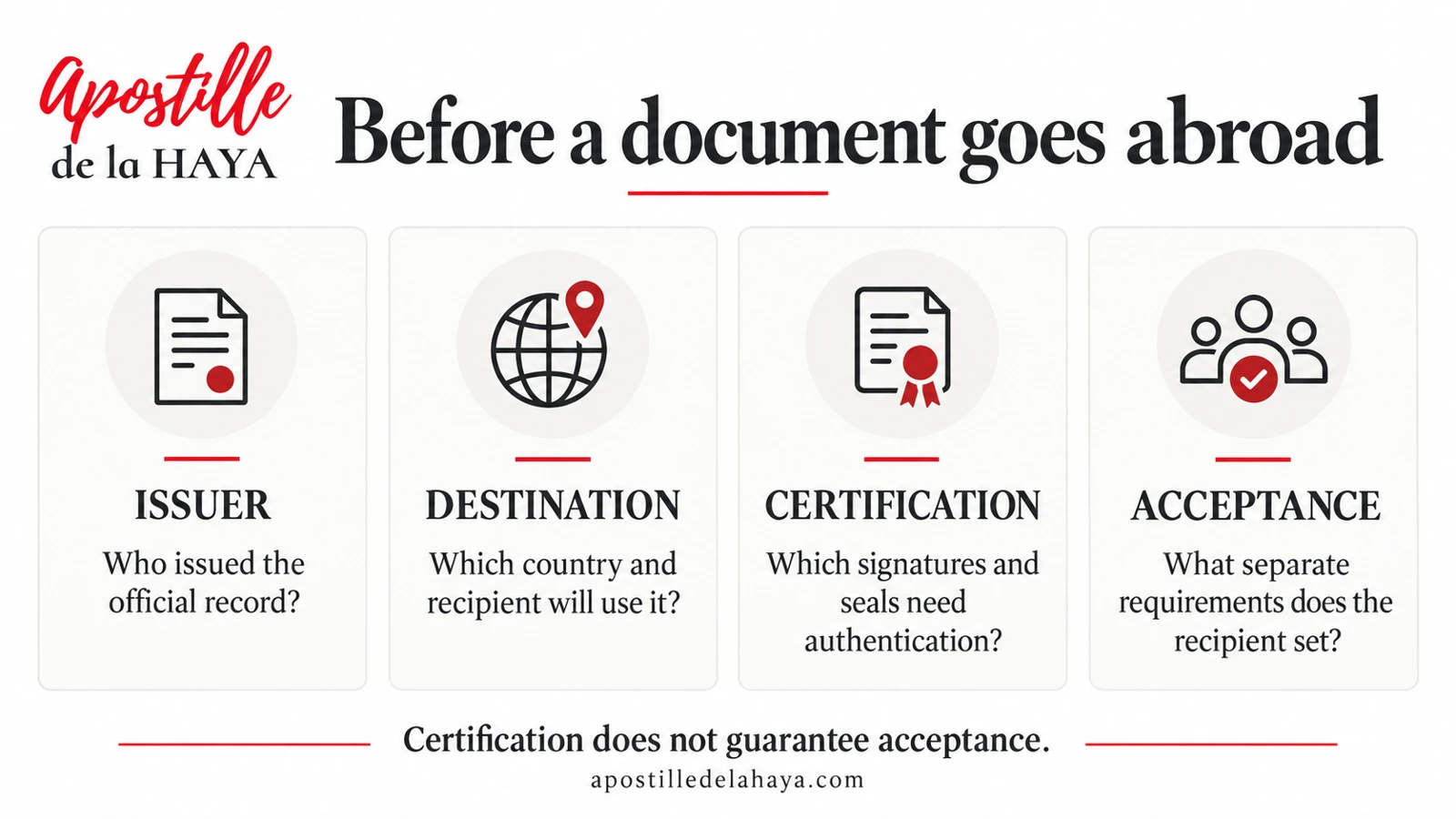
Start by asking whether the mission handles the requested service for this document and this jurisdiction. Then ask which version of the document is acceptable, and which prior certifications are required. Together, those answers tell you whether the mission can actually consider the file. Having it packed in an envelope is a different matter.
Next, confirm any form, translation, copy or identity requirements for the service you selected. Ask whether you must attend in person or use a designated submission provider. A general consular contact page may not include every instruction for a particular document. Use the page for that specific service, and ask for clarification if an important question is still open.
Finally, confirm the current submission and return arrangements and any further requirement at the destination. The service scope should distinguish the mission’s act from private preparation, translation and transport. Conditions vary according to the nature, complexity and requirements of the case; consult Apostille de la Haya directly before arranging assistance.
Preparation errors that can delay a submission
Sending a document to the wrong jurisdiction can get it returned while the underlying requirement stays unmet. The applicant then has to ship it again and rethink the time left before the deadline. Faster shipping shortens transit, but it does not change which mission is competent. Settle jurisdiction before you ship. A delivered package tells you nothing about it.
Following instructions meant for another country of origin can leave the certification chain incomplete. A mission’s requirements in London or New Delhi may describe documents issued there accurately and still not apply to U.S. records. Even when the destination is the same, the authentication authorities in each country of origin are not interchangeable. The issuer and the mission’s location have to match the case you are preparing.
Treating legalization as legal approval causes a different problem. A power can be certified and still lack necessary wording. An academic record can be attested and still need recognition. A marriage certificate can meet a documentary requirement without securing an immigration outcome. Identify the substantive decision the recipient will make, and don’t fold every possible outcome into consular certification.
How Apostille de la Haya helps define the consular assignment
Through its document legalization service, Apostille de la Haya can review the U.S. record, the existing certifications, the destination and the written requirement. The review should name the documentary stages included in the assignment and any steps that remain with the applicant or the recipient, outside that service.
This is most helpful when several authorities are involved. You should know which stage is complete, which office makes the next decision and where the finished documents will go. An organized file helps each status update identify the completed work and the requirement that remains unresolved.
If you already received a return notice, include it in the review. A notice about a missing certification calls for a different response from one about personal attendance, jurisdiction or the content of the document. The point is to deal with the stated reason before you resubmit. Contact Apostille de la Haya to assess the outstanding work and discuss the conditions applicable to your case.
Frequently Asked Questions
Is consular legalization always necessary for documents used abroad?
No. The destination’s rules, the Convention relationship and the document category determine the route. In some cases an apostille may be appropriate, and in others a consular process applies. Apostille de la Haya can review the U.S. document and the recipient’s instructions before you arrange a consular submission that may be unnecessary or unsuitable.
Can I choose the consulate closest to my home?
Only if that consulate is competent for the service you need and for your circumstances. Jurisdiction may depend on facts other than distance, such as where the document came from or where the applicant lives. Write those details down separately and check the relevant mission’s instructions. Apostille de la Haya can help you organize the information that review needs.
Can a service appear at the consulate for me?
It depends on the service. You cannot assume that required personal signatures or identity checks can be delegated. Some consular instructions expressly require the applicant’s direct involvement. Apostille de la Haya can explain the documentary assistance available within the applicable scope. Any required personal appearance or question about consular eligibility has to be taken up with the competent mission.
Does the consular stamp confirm the legal contents of my document?
Don’t treat it as a substitute for a substantive legal review. Certifying a signature or seal does not necessarily show that a power grants the right authority, or that a record meets every requirement of the recipient. Apostille de la Haya can help with the documentary preparation and point out the matters that belong with the recipient or a qualified professional.
What if my document already has an apostille?
Keep the complete document and the attached certificate for review. Whether it works for the new purpose depends on the destination and the process requested. Don’t detach the apostille, and don’t assume that adding a consular stamp is automatically the right move. Contact Apostille de la Haya with the current file and the new recipient’s written requirement.
Confirm the right consular legalization route before you send the record
Contact Apostille de la Haya with your U.S. document, the destination and the recipient’s instructions. We can review the preparation and explain the assistance that fits the consular service involved, including any steps that require you to take part directly.
Contact Apostille de la Haya by phone or WhatsApp: +1 305 500 0185.