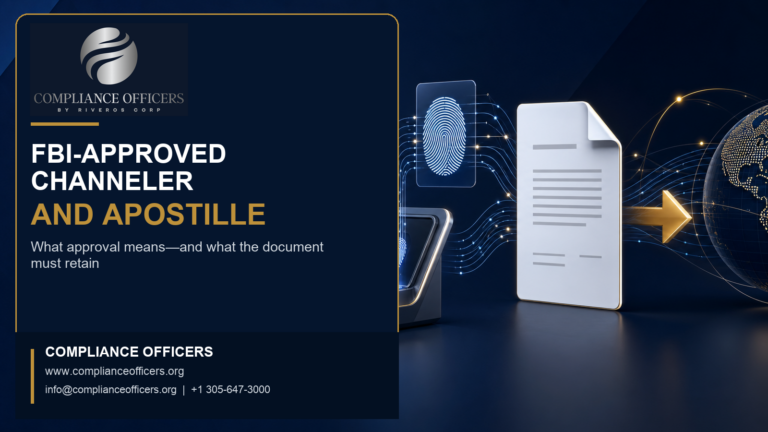
Choosing an FBI-approved channeler can make an Identity History Summary request more convenient, but the word approved is often misunderstood. It describes the channeler’s role in transmitting fingerprints and receiving the electronic FBI result for delivery to the individual. It does not mean that the company is a government office, that it issues apostilles, or that every document in its portal will satisfy every foreign institution.
That distinction matters when you plan to use the FBI result abroad. The document must first be identifiable as the FBI fingerprint-search result that the federal government can authenticate. The destination then determines whether an apostille, a different authentication chain, a translation, a particular issue date or another presentation requirement applies. Those are separate decisions, controlled by different authorities.
This article explains the relationship between an FBI approved channeler and the apostille process without treating “channeler,” “FBI report” and “apostille” as interchangeable terms. It focuses on the evidence visible in the result and the limits of each actor. It also covers the questions to resolve before you commit time and money. The goal is not to provide a replicable filing tutorial. It helps you recognize when a file deserves professional review. It also shows how Compliance Officers coordinates the administrative route, while the responsible authorities keep control of government issuance and destination acceptance.
What an FBI-Approved Channeler Actually Does
The FBI describes an approved channeler as a private contractor with a defined role. The channeler receives a fingerprint submission and the associated information and collects the applicable fees. It then forwards the submission electronically to the FBI’s Criminal Justice Information Services Division and receives the electronic result for delivery to the individual. In practical terms, the channeler is a conduit that helps expedite the delivery of the request and the electronic FBI result. The criminal history information still comes from the FBI’s systems.
This role can be useful because electronic transmission and an established delivery channel may reduce friction at the request stage. It does not change the content the FBI finds, create a different category of federal record or authorize the channeler to speak for the U.S. Department of State. The FBI’s approval is therefore relevant to the contractor’s channeling function, not a universal endorsement of every ancillary service, cover page, translation, notarization or international-use claim the contractor may offer.
The first editorial correction to the earlier draft matters. It is not accurate to call channeler results generally ineligible for an apostille. The FBI states that approved channelers receive the electronic summary result for delivery to the individual. The FBI also states that it authenticates fingerprint-search results with an FBI watermark and a division official’s signature when the result is issued. The responsible question is not “Was any channeler involved?” It is “What exact document was delivered, and does the copy being presented retain the federal features needed for the next stage?”
Do not confuse a receipt, appointment confirmation, channeler cover sheet or privately prepared summary with the underlying FBI response. Before the file advances, identify the operative document. This is a document-control issue, not a reason to characterize all channeler-delivered results as defective.
What the FBI Result Must Retain for the Federal Stage
People commonly call an FBI Identity History Summary an FBI background check, criminal history or rap sheet. The FBI explains that it authenticates fingerprint-search results at issuance with an FBI watermark and a division official’s signature. The U.S. Department of State identifies FBI background checks as federal documents. The FBI background check may be submitted to the U.S. Department of State for an apostille or authentication certificate when required for its intended foreign use.
An administrative review relies on a few checkpoints. These include the agency identity, the FBI watermark, the official’s signature and title, the issue date, the individual’s identifying information and the integrity of the pages. An electronic result can be legitimate; the FBI permits recipients of an electronic response to print copies. What matters is that the copy stays an intelligible FBI response, not a cropped screenshot, a channeler receipt or a rewritten commercial summary.
Do not notarize the original federal document as a substitute for the federal certificate. Current Department of State instructions for federal documents warn against notarizing the document. They require agency letterhead, a legible official signature, the printed name and title, and the agency seal or an equivalent identifying feature. A local notarization does not convert a private attachment into an FBI record. A state apostille also cannot authenticate the signature of a federal FBI official.
This is why the next authority also matters. A qualifying FBI background check follows the federal route described in our guide to the U.S. Department of State and FBI apostilles. The federal certificate authenticates the origin of the public document within its legal limits. It does not certify that every statement in the criminal history is correct or erase a record. It also cannot establish eligibility for a benefit or compel a foreign institution to accept the document for every purpose.

Channeler or Direct FBI Request: The Factors That Matter
Both a direct FBI request and an approved-channeler request can lead to an FBI Identity History Summary. The better route depends on the applicant’s location, fingerprint-capture options, delivery preference, available time and the written requirements of the receiving institution. Assess those factors together rather than reducing them to a slogan that one route is always faster or always safer.
The FBI’s direct electronic option may allow fingerprints to be submitted at participating U.S. Post Office locations, while a mailed request uses a current fingerprint card. An approved channeler may offer its own capture network or submission arrangements. Coverage, appointment availability and applicant eligibility vary by provider. Compliance Officers reviews those conditions before recommending a channeler route. FBI approval does not make every channeler accessible from every country or suitable for every applicant.
Speed also has boundaries. The FBI says it does not offer expedited handling of Identity History Summary requests. Still, it processes an electronic request faster than a paper route once it receives a complete fingerprint submission. A channeler may help expedite the electronic transmission of the request and delivery of the result, but it does not control the separate U.S. Department of State stage or the final decision of the receiving institution. Our discussion of FBI background check apostille processing time explains why you should evaluate the complete timeline as a chain rather than as a single advertised turnaround.
For that reason, “channeler or direct” is not the final question. A more useful analysis asks several questions. Is the chosen intake route available? Do the fingerprints meet the FBI’s quality requirements, and does the resulting document keep the required federal features? Which certificate applies to the destination, and has the receiving authority imposed additional conditions?
Destination Rules Still Control the Final Use
An apostille may be appropriate when the Convention is in force between the United States and the destination country and the receiving authority requires it and the receiving authority requests that certificate. For a non-Apostille destination, the Department of State explains that authentication by the appropriate foreign embassy is generally also required after completing the applicable U.S. authentications after the U.S. authentications. Therefore, treat a destination name as a substantive input, not as a shipping label added at the end.
The receiving authority may also define what kind of criminal-record document it wants. People sometimes use “police clearance,” “background check,” “criminal record” and “FBI report” loosely. These terms do not always identify the same issuing authority or geographic scope. An institution may request a federal FBI Identity History Summary, a state record, a local police letter or more than one document. A federal apostille cannot correct a mismatch between the document requested and the document obtained.
Issue-date rules, translation requirements and physical-versus-electronic presentation can also depend on the country, institution and intended use. Do not invent a universal validity period. A recent FBI response does not prove that a specific consulate, licensing body, employer, university or immigration authority will accept it. Likewise, the apostille does not extend the age of the underlying report or decide whether a particular country’s translation qualifies.
Written destination instructions are therefore valuable evidence. Compliance Officers reviews the language from the receiving institution and flags questions to confirm before finalizing the administrative route. When instructions are incomplete or contradictory, we do not turn assumptions into guarantees. The receiving authority remains responsible for its substantive acceptance decision.
Common Mistakes That Put the Wrong Document on the Wrong Route
The most common problems begin with category confusion rather than with a complicated form. One example is submitting a channeler receipt or cover page instead of the FBI result. Another is assuming that an approved channeler also issues the apostille. A third is notarizing the FBI document and pursuing a state certificate, even though the signature that needs authentication belongs to a federal official.
Other errors arise when someone alters the document. Cropping the footer, omitting a page, obscuring the watermark or changing the file can obscure the government record. Separating material that belongs together or presenting an unreadable scan creates the same problem. The correct response is not to “improve” the document with a private certification. The appropriate response is to preserve the FBI result and determine whether a complete, legible replacement should be obtained.
Timing assumptions create a different risk. A fast fingerprint appointment or rapid electronic result does not establish the U.S. Department of State’s processing time, international shipping time or the receiving authority’s review period. No provider controls all of those stages. Planning should distinguish estimated administrative handling from government processing and destination acceptance.
Finally, applicants sometimes order the report before confirming what the foreign institution actually requires. If the institution wanted a state police record, a local clearance, a different issue date or a translated package, an apostille on the FBI document cannot cure the mismatch. The apostille authenticates origin; it does not validate the report’s content, determine its fitness for a particular legal purpose or guarantee acceptance.
How Compliance Officers Coordinates the Administrative File
Compliance Officers coordinates the administrative file around the document’s intended use. We begin by identifying the receiving country, institution, stated purpose and any written instructions. Next, we review the available FBI result to separate the operative Identity History Summary from receipts, cover sheets or other material. We also check whether the visible federal features are intact.
When the client needs a new FBI request, we help evaluate an appropriate capture and submission route based on location and available options. When the FBI response is already available, we review its format and organize the next federal-certificate stage that corresponds to the destination. We can also coordinate tracked delivery and provide procedural updates. These services are administrative. They do not change the FBI record or replace legal advice from qualified counsel when the underlying criminal history raises a legal question.
Government agencies retain control of issuance and processing. The FBI controls the Identity History Summary, the U.S. Department of State controls its apostille or authentication certificate process, and the foreign institution controls final acceptance. Compliance Officers does not guarantee a particular criminal-record outcome, government processing time, completion date or acceptance abroad.
Our review of an FBI approved channeler and apostille file begins with the underlying FBI document, not the provider’s label. Learn more about our FBI Background Check service. For an administrative review, send us the destination country, intended use, any written instructions from the receiving institution and a legible copy of the document you currently have. That information lets us assess the route without relying on the word “approved” alone.
Frequently Asked Questions
Can a result obtained through an FBI-approved channeler receive an apostille?
Potentially, yes. The channeler only conveys the fingerprint submission and the electronic FBI result. The federal certificate stage needs the identifiable FBI Identity History Summary with the FBI watermark, official signature, agency format and issue date. A receipt or cover page does not qualify.
What does FBI approval of a channeler actually mean?
It means the FBI approved the contractor to perform the channeling function: receive the submission and data, collect fees, transmit the fingerprints to the FBI and deliver the result. It does not make the channeler a government agency or let it issue an apostille.
How can I distinguish the FBI result from channeler paperwork?
Review the document as a whole. The operative FBI response should identify the FBI, keep the watermark and a division official’s signature and title, show its issue date and preserve the agency format. Do not substitute an invoice or private summary for it.
Should I notarize my FBI background check before requesting an apostille?
No. Current U.S. Department of State instructions say not to notarize the original federal document. An FBI background check is federal, so state notarization and a state apostille cannot replace the federal route.
Does an approved channeler make the entire process faster?
A channeler may speed up fingerprint transmission and delivery of the electronic FBI result. That advantage does not set the timing for the separate State Department certificate, shipping or the receiving authority’s review. Treat those stages separately.
Does an apostille guarantee that the foreign authority will accept the FBI report?
No. The apostille authenticates the origin of the public document—the signature, official capacity and seal—within the Convention’s limits. It does not certify the report’s content or compel acceptance. The receiving authority may still impose its own requirements.
Get Help With Your FBI Channeler Apostille
Do you need an FBI result reviewed for international use?
Compliance Officers identifies the operative document and reviews the destination instructions. Then it coordinates the appropriate administrative route to reduce avoidable errors and delays.
Phone and WhatsApp: +1 305-647-3000
Email: info@complianceofficers.org
Legal disclaimer: This article provides general information and does not constitute legal advice or a promise of acceptance. Requirements can vary by country, institution, intended use, document version and date. Confirm current substantive requirements with the authority that will receive the document.