«Bring your FBI rap sheet, apostilled.» Maybe that instruction reached you from a lawyer, a consulate or a foreign employer. If so, you face one of the most misunderstood document requests in international paperwork. The phrase sounds informal because ‘rap sheet’ is a commonly used term rather than the FBI document’s formal name. Yet the requester expects something precise: a specific federal document, certified in a specific way, through the federal authority. One wrong link in that chain can get the file rejected or returned, creating avoidable delay.
We help clients prepare and coordinate the administrative documents requested for immigration matters, foreign employment, marriages abroad and court matters in other countries. Careful preparation can reduce avoidable rework, although government processing and destination acceptance remain outside any private provider’s control. In this article we explain what a rap sheet formally is and what «apostilled» adds to it. We also cover the destination-specific details applicants should confirm and how we deliver the finished document to you, wherever you are.
What a "Rap Sheet" Formally Is
«Rap sheet» (from «Record of Arrests and Prosecutions») is the informal name for the FBI’s Identity History Summary. The FBI’s Criminal Justice Information Services Division maintains this fingerprint-based record. It may list information associated with fingerprint submissions retained by the FBI, including arrests and related disposition information when available. When they do not, the FBI issues a statement that no record was found. The same document travels under several names, and knowing they are equivalent saves you from ordering the wrong product:
| Name you may hear | What it refers to |
|---|---|
| FBI rap sheet | Informal name for the Identity History Summary |
| FBI background check | Common name for the same FBI-issued document |
| Identity History Summary | The official FBI name |
| FBI criminal record / clearance | Informal wording sometimes used in international or institutional requests |
| State background check | A different document — state-level, not FBI |
| Commercial "instant" background check | Not an official record at all |
The last two rows are where expensive confusion lives. For instance, a state-level check is a legitimate document with its own apostille path. Even so, it is not an FBI rap sheet and cannot satisfy a request for one. A commercial database search does not substitute for an FBI-issued Identity History Summary when the receiving authority specifically requests an FBI document. If the request names the FBI, only the FBI-issued document qualifies. Our guide to the FBI Identity History Summary apostille explains the official document in depth.
What the FBI Rap Sheet Apostille Adds and Who Can Issue It
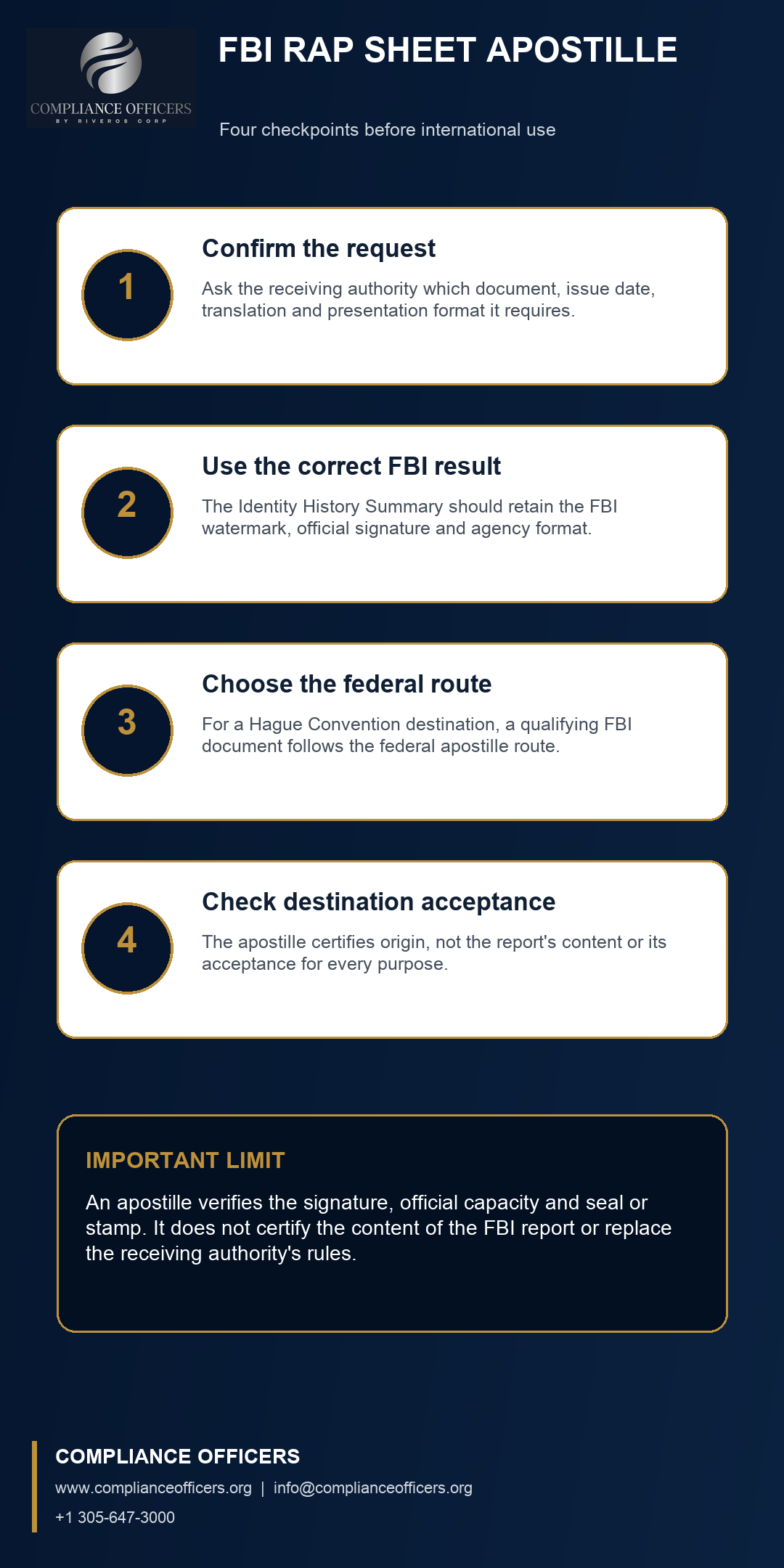
An FBI Identity History Summary is a U.S. federal document. A receiving authority may ask for an apostille in a country where the 1961 Hague Apostille Convention applies. The certificate then verifies the signature on the public document, the signer’s official capacity and, when applicable, the seal or stamp. It does not certify the report’s content, erase an entry or create a universal period of validity. It also cannot guarantee that a particular institution will accept the document for every purpose.
In addition, the FBI states that it authenticates fingerprint-search results by placing an FBI watermark and a division official’s signature on the response. If an apostille is required for that federal signature, the document follows the U.S. Department of State’s Office of Authentications route. A state office does not authenticate the federal official’s signature. Our article on the federal route for an FBI background check apostille explains that jurisdictional distinction.
In general, the country and receiving institution decide what the file needs: an apostille, a non-Apostille authentication certificate, a translation, a recent issue date or another presentation format. Government processing and delivery times can change. Confirm the receiving deadline before you submit the request, and treat any private promise of a fixed completion date with caution.
Who Asks for an Apostilled Rap Sheet and What They Do With It
In general, applicants may request an FBI Identity History Summary for procedures involving residence, visas, citizenship, employment, education, licensing, adoption or other matters abroad. The terminology varies: an institution may refer to an FBI background check, criminal-history record, police clearance or rap sheet. Those labels do not eliminate the need to confirm the exact document the institution expects.
Civil registries, courts, immigration offices, employers and licensing bodies may impose different requirements. Some accept a properly printed electronic FBI response; others may request a particular issue date, translation or presentation format. However, do not treat a requirement from one country or institution as a universal rule.
The apostille establishes the authenticated origin of the public document within the Convention framework. It cannot compel the receiving institution to approve an application, accept the report’s substantive content or ignore its own eligibility rules. The applicant should confirm those requirements directly with the institution that will receive the file.
Practical Details Compliance Officers Reviews Before Submission
Official instructions identify the required channels, but practical preparation still depends on the actual document and the receiving institution. Compliance Officers reviews the following points before the file moves:
- Review the result delivered through the selected request channel. An FBI-approved channeler forwards fingerprints and receives the electronic Identity History Summary for delivery to the individual. In addition, for the federal certificate request, inspect the exact document you will submit. Confirm that it keeps the FBI watermark, official signature, agency format and issue date. An intermediary’s cover sheet is not a substitute for the FBI result.
- Address inaccurate or incomplete record information separately. The apostille does not correct, remove, or explain an entry. The FBI provides a distinct challenge process for information the subject believes is inaccurate or incomplete.
- Check names and identifying details against the intended filing. A receiving institution may compare the report with a passport, application, or other supporting document. Therefore, raise any differences with that institution before submission.
- Confirm the receiving authority’s date rule. The apostille does not create a universal expiration date. A consulate, immigration office, employer, court, or licensing body may require a report issued within its own time window.
- Confirm translation and presentation requirements. The destination may require a translation, a particular attachment method, or an original or properly printed electronic response.
These checks do not guarantee acceptance or a completion date. Still, they reduce avoidable rework before the document reaches the federal office or the receiving institution.
The Most Common Mistakes and What They Cost
In practice, common problems follow a few patterns. Some applicants order a state or commercial background check when the institution requested the FBI Identity History Summary. Others send the federal document to a state office, submit an altered or incomplete file, notarize the original federal document, or request an apostille when the destination requires a different authentication route.
An FBI-approved channeler can transmit fingerprints and deliver the electronic FBI result to the individual. In short, the important question for the next stage is simple. Does the document you submit keep the FBI watermark, official signature, agency format and issue date? A channeler’s cover sheet or a commercial summary is not a substitute for the underlying FBI response.
These mistakes can result in a returned submission, another document request, additional handling or shipping, or a missed institutional deadline. Careful review cannot control government processing or destination acceptance, but it can reduce avoidable rework. For planning considerations, see our article on FBI background check apostille processing time.
How We Manage the Process and Reduce Avoidable Delays
Compliance Officers provides administrative coordination based on the document’s intended use. We review the instructions supplied by the receiving institution, the destination country and the FBI response available to the client. Depending on the case, we can coordinate fingerprint capture and review the identifying information required for the selected submission route and help distinguish the FBI Identity History Summary from other background checks. We can also review whether the result keeps the relevant federal features, organize the federal certificate request and coordinate tracked return delivery.
That review begins with the request as the institution actually wrote it, not with a generic assumption about what a country usually accepts. We compare the named document, the intended use, the receiving authority, any issue-date language and the requested presentation format. If the instructions look incomplete or use overlapping terms such as police clearance, criminal record and FBI background check, we flag the point to confirm before the file advances. This does not replace the receiving authority’s decision. It simply helps keep the administrative route from forming around the wrong document or certificate.
Our role is to prepare and coordinate the administrative file and provide procedural updates. The FBI controls the content and issuance of the Identity History Summary; the U.S. Department of State controls its certificate process; and the receiving institution controls substantive acceptance. We therefore do not guarantee a record outcome, government processing time, completion date or acceptance abroad.
To begin an FBI rap sheet apostille review, contact Compliance Officers with the destination country, intended use and any written instructions from the receiving institution. We will evaluate the appropriate administrative route before the document advances. We then review the appropriate route.
Frequently Asked Questions
Is a rap sheet the same as an FBI background check?
«Rap sheet» is the common informal name for the FBI Identity History Summary, a fingerprint-based FBI response. It differs from state, local, name-based or commercial background checks. Confirm the exact document requested before ordering.
Can my state apostille my FBI rap sheet?
An FBI Identity History Summary bearing the federal signature and watermark follows the federal route through the U.S. Department of State’s Office of Authentications. A state office does not authenticate the federal official’s signature.
How long does an FBI rap sheet apostille take?
Timing depends on the request channel, fingerprint submission, document review, federal processing, and delivery. Careful preparation can reduce avoidable rework. Even so, the FBI and the Department of State control their own processing times, and no private provider can guarantee a completion date.
My rap sheet shows an old arrest. Can it still be apostilled?
A qualifying summary follows the same authentication route whether it reports an entry or states that the FBI found no record. The apostille verifies the signature, official capacity and seal. It does not certify the report’s content or decide how the destination evaluates it. Address errors through the FBI’s separate challenge process.
I live outside the United States. Can you handle everything remotely?
We can coordinate fingerprint-capture instructions from abroad, review the FBI-issued summary, organize the federal certificate request and arrange return shipping on request. U.S. embassies and consulates do not provide fingerprinting services, so confirm the local options available to you.
Can I get more than one apostilled copy of my rap sheet?
You may request additional sets, but each apostille attaches to its own qualifying FBI document. Confirm how many originals or sets the receiving institutions require before you prepare the federal submission.
Does the apostilled rap sheet need a translation?
Many destinations require a certified or sworn translation of the summary, the apostille, or both. The receiving institution sets the rule, so confirm the language and format before you arrange translation.
Get Help With Your FBI Rap Sheet Apostille
Do you need your FBI rap sheet prepared for apostille and international use?
Compliance Officers reviews the file, coordinates the federal route, provides procedural updates and helps reduce avoidable errors and delays.
Phone and WhatsApp: +1 305-647-3000
Email: info@complianceofficers.org
Legal disclaimer: This article provides general information and does not constitute legal advice or a promise of acceptance. Requirements can vary by country, institution, intended use, document version and date. An apostille authenticates the origin of the public document within its legal limits; it does not certify the report’s content. Confirm current substantive requirements with the authority that will receive the document.