Understanding the FOIA Request Form
The Freedom of Information Act (FOIA) grants the public the right to request access to records from any federal agency in the United States. While many people search for a specific «FOIA request form,» the reality is that no single, universal form exists for all FOIA submissions. Instead, each federal agency has its own procedures, forms, and portals.
This article will clarify what a FOIA request form really entails, provide guidance on the content of an effective request, and explain how Compliance Officers, our expert FOIA consultancy, can help ensure accuracy and completeness.
Is There a Standard FOIA Request Form?
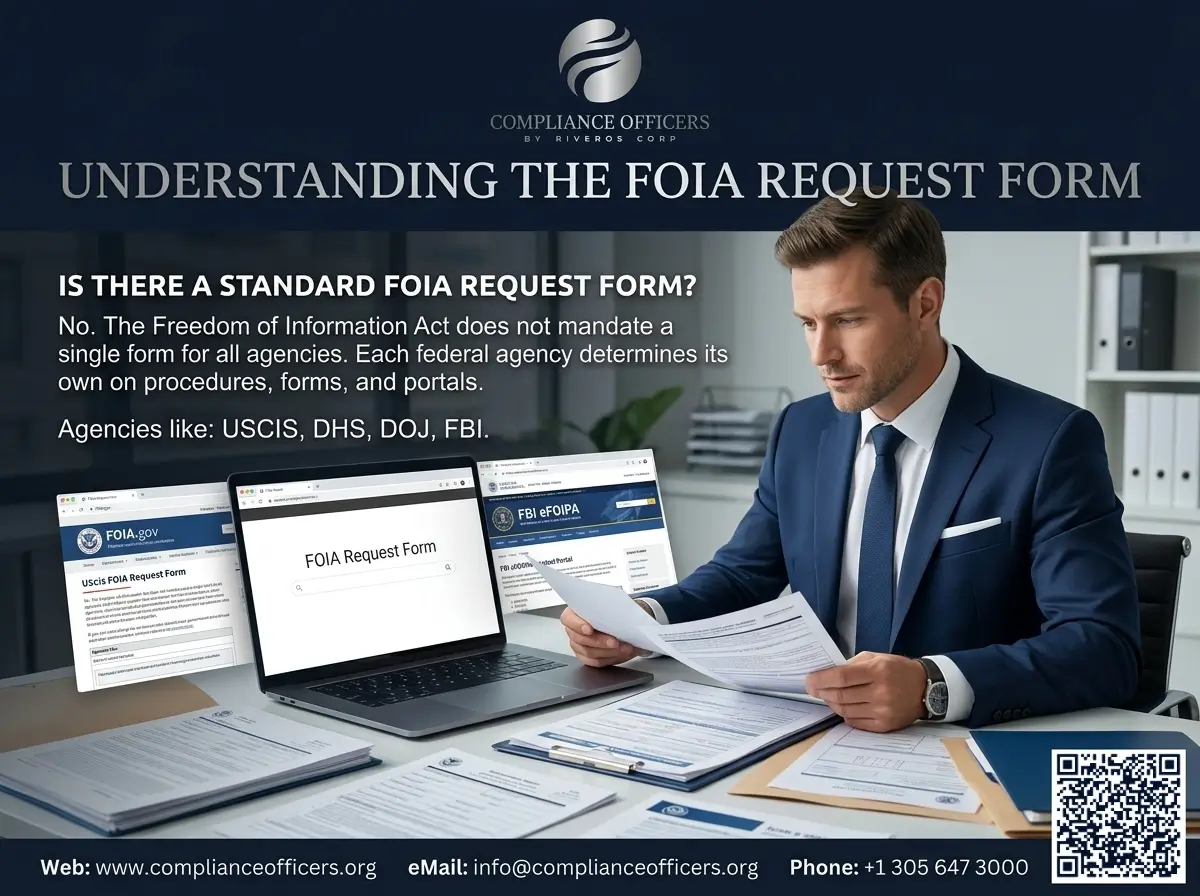
The short answer is no. The Freedom of Information Act does not mandate a single form that applies to all agencies. Instead, each agency determines how it receives and processes FOIA requests. Some agencies, like the U.S. Citizenship and Immigration Services (USCIS), offer specific forms—such as Form G-639 for immigration records—while others accept requests via email, mail, or online portals.
Agencies that commonly handle FOIA requests include:
- USCIS (Form G-639)
- Department of Homeland Security (DHS)
- Department of Justice (DOJ)
- Federal Bureau of Investigation (FBI)
Each may provide a unique submission method or template, but all must comply with FOIA guidelines.
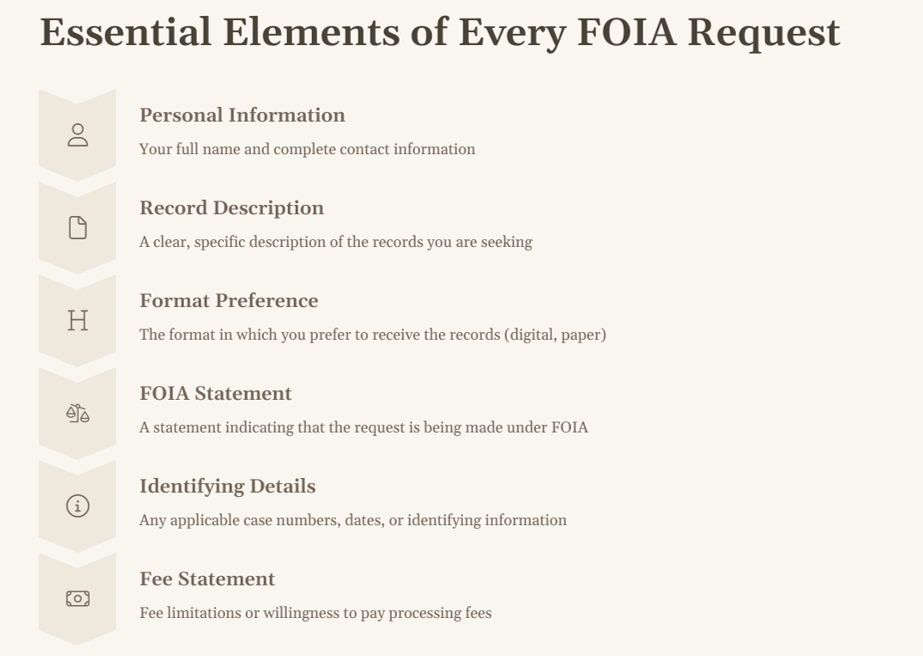
What Should a FOIA Request Include?
Even though there’s no universal form, all FOIA requests should include certain core elements to avoid delays or rejections. A well-structured FOIA request should contain:
FOIA Request Examples by Agency
USCIS: Immigration Records
- Use Form G-639
- Request «A-File» records
- Submit online through the USCIS FOIA portal
DHS: Homeland Security Records
- Submit via the DHS FOIA submission site
- Include any relevant incident or case numbers
- Be clear about the type of record: border entries, CBP interactions, etc.
DOJ: Legal and Criminal Records
- Requests often go to specific DOJ offices
- Some departments offer online portals; others accept mail/email
FBI: Background Checks or Case Files
- Submit through the FBI eFOIPA portal
- Include specific case numbers, names, or time frames for faster processing
FOIA Request Submission Methods
Depending on the agency, you can usually submit your FOIA request via:
- Online portals (e.g., FOIA.gov, USCIS, FBI)
- Email (agency-specific addresses)
- Postal mail (formal letters with required information)
- Fax (less common, but accepted in some cases)
Always verify the submission guidelines on the official agency website before sending your request.
How Long Does a FOIA Request Take?
Under FOIA law, agencies are required to respond within 20 business days of receiving a request. However, the actual response time can vary widely based on:
- Complexity of the request
- Volume of records requested
- Backlog within the agency
For example, USCIS may fulfill simple requests within a few weeks, while DHS requests involving travel histories or investigations may take several months.
FOIA Request Fees and Exemptions
Most agencies allow fee waivers for:
- Requests in the public interest
- Journalistic or academic purposes
However, standard fees may apply for:
- Searching and duplicating records
- Postage or material costs
There are also exemptions under FOIA for records involving:
- National security
- Law enforcement
- Personal privacy
- Internal agency communications
Understanding these can help set realistic expectations for what can be disclosed.
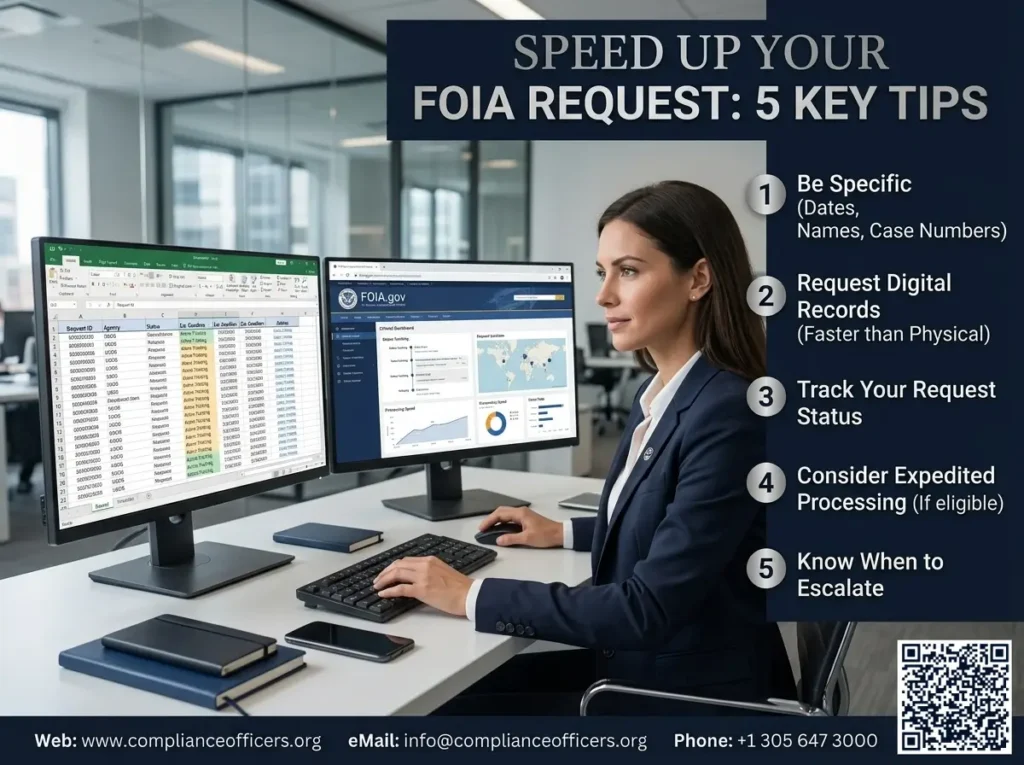
Tips to Speed Up Your FOIA Request
- Be specific: narrow requests with clear date ranges, names, or case numbers process faster than broad, open-ended ones.
- Request the right format: if you’re comfortable with digital records, say so — it can be faster than requesting physical copies.
- Track your request: most agency portals let you check status with a confirmation number; follow up if you haven’t heard back near the statutory deadline.
- Consider expedited processing: if there’s a genuine urgency (e.g., a pending deadline or a threat to life or safety), you can request expedited processing, though you’ll need to justify it.
- Know when to escalate: if an agency misses its deadline without explanation, you may be able to treat administrative remedies as exhausted and consider next steps sooner.
Following these practices from the start typically shaves weeks off the overall timeline, especially for agencies with large backlogs like DHS or the FBI.
What to Do If Your FOIA Request Is Denied
Agencies can deny a FOIA request in whole or in part, but a denial isn’t the end of the road. Every federal agency is required to provide an administrative appeal process. If your request is denied, delayed beyond the statutory deadline, or you disagree with the fees charged, you generally have the right to appeal directly with the agency, usually within 90 days of the denial letter. The appeal should clearly state why you believe the denial was incorrect, referencing the specific exemption cited if one was used. If the administrative appeal is also denied, the next step is filing a lawsuit in federal court, though most disputes are resolved before reaching that stage. Keeping a clear paper trail of your original request and all agency correspondence makes any appeal significantly stronger. It also helps to request expedited processing of the appeal itself if the underlying deadline that prompted your original request is still approaching.
Requesting Records About Someone Else
You can request records about a third party, but agencies will generally not release personal information about another individual unless you provide one of the following: written authorization or a privacy waiver signed by that person, proof that the person is deceased (often satisfies privacy concerns), or a compelling public interest that clearly outweighs the individual’s privacy interest. Without one of these, the agency will typically deny the request citing personal privacy exemptions, or will only release heavily redacted records. If you’re requesting records on behalf of a client or family member, gathering the right authorization upfront avoids a denial and a second, delayed submission. This is one of the most common friction points in FOIA practice, since requesters often assume any public record request will be honored regardless of whose information is involved.
FOIA vs. the Privacy Act: What’s the Difference?
These two laws are often confused because both deal with access to federal records, but they serve different purposes. FOIA allows any person to request access to federal agency records, with the government generally required to disclose unless an exemption applies. The Privacy Act, on the other hand, specifically governs records about individuals that are kept in a «system of records,» and generally only allows the individual themselves (or someone with their consent) to access those records, while also restricting how the government can share that personal information with others. In practice, when you request your own file, for example, an immigration record, you may be invoking rights under both FOIA and the Privacy Act simultaneously, and agencies often process the request under whichever law provides broader access. If you’re unsure which framework applies to your situation, Compliance Officers can help identify the correct legal basis before you submit, which avoids delays caused by citing the wrong authority.
Fee Waivers and Cost Categories Explained
FOIA divides requesters into fee categories that determine what you’ll be charged. Commercial requesters typically pay for search, review, and duplication of records. Educational, scientific, or news media requesters generally pay only duplication costs, with a certain number of free pages. All other requesters (most individuals) get a set amount of free search and duplication time before charges apply. On top of these categories, you can separately request a full fee waiver if disclosure is in the public interest and not primarily for your commercial benefit, for example, journalists, researchers, or nonprofits investigating government activity often qualify. Agencies must respond to a fee waiver request as part of processing your overall FOIA submission, so it helps to address the waiver explicitly in your original letter rather than waiting to be billed. Fee category disputes are also appealable, so if an agency assigns you the wrong category and bills you accordingly, you have the same right to challenge that decision as you would a denial of records.
Common Mistakes to Avoid
- Submitting vague or overly broad requests
- Sending to the wrong agency
- Forgetting to include your contact details
- Omitting fee agreement statements
Why Work With Compliance Officers?
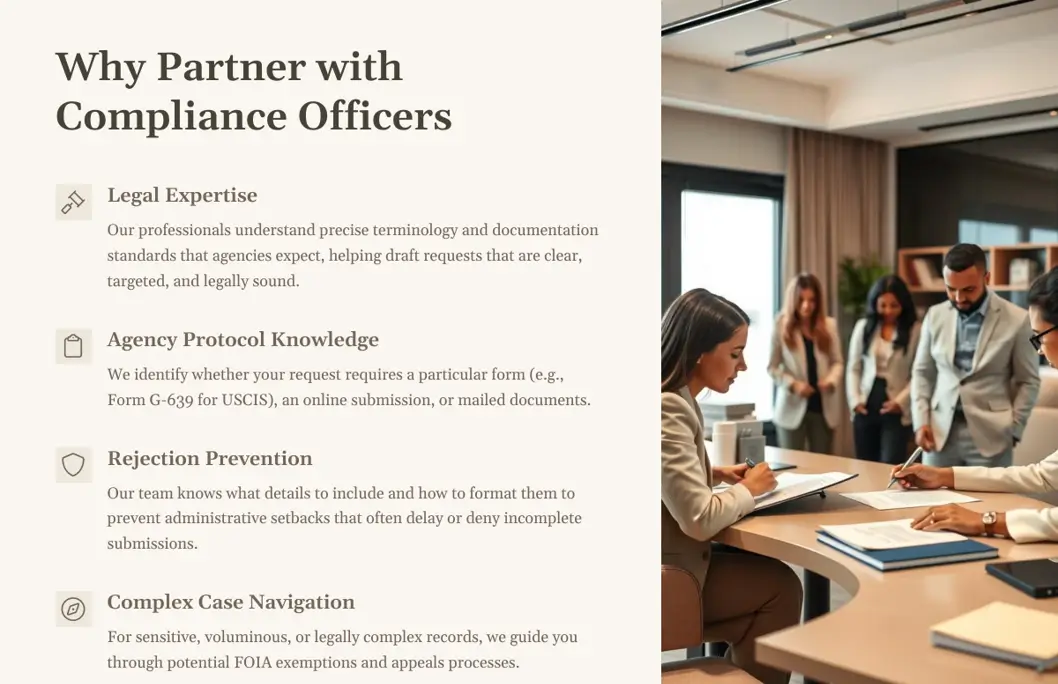
While it’s possible to submit a FOIA request on your own, working with Compliance Officers—a professional FOIA and regulatory compliance consulting firm—can significantly enhance your request’s quality and effectiveness. Here’s why:
For a deeper look at specific FOIA scenarios, see our guides on the 9 exemptions to a FOIA request and why non-U.S. citizens might need a USCIS FOIA request.
Final Thoughts: Streamline Your FOIA Process
While there’s no single «FOIA request form» for all agencies, understanding the core elements of a proper request—and leveraging the expertise of Compliance Officers—can make a significant difference.
Whether you’re seeking immigration files from USCIS or case records from the FBI, submitting a well-crafted FOIA request is the key to receiving timely and accurate information.
Need help submitting a FOIA request?
Contact Compliance Officers today to avoid delays and ensure your rights under the Freedom of Information Act are exercised effectively.
Legal Disclaimer:
This article is provided for informational purposes only and does not constitute legal advice. The content herein is not intended to substitute professional legal consultation. For specific guidance regarding your individual circumstances, please consult directly with a qualified attorney licensed to practice in your jurisdiction.
FAQ
Where can I find the official FOIA request form?
There is no single official form for all federal agencies. While some agencies have their own specific web portals or standard forms (like USCIS Form G-639 for immigration records), most simply require a properly formatted written letter that adheres to their specific regulatory guidelines.
Can anyone submit a request under the Freedom of Information Act?
Yes. Any person, including U.S. citizens, foreign nationals, organizations, and corporations, can submit a request for federal agency records. However, accessing records about specific individuals requires proper privacy waivers.
How much does it cost to submit a FOIA request?
There is no initial fee to file a request. However, agencies are permitted by law to charge for search time, document review, and duplication costs. Commercial requesters are typically charged for all search, review, and duplication time.
Why was my DIY FOIA request denied?
Requests are most commonly denied or delayed because they are overly broad, fail to reasonably describe the records sought, lack the proper notarized identity certifications (for personal records), or because the requested information falls under one of the nine statutory FOIA exemptions.
Do I need to explain why I want the records?
Generally, no. The Freedom of Information Act does not require you to state your purpose for requesting the documents. The only exception is if you are requesting an expedited processing timeline or a fee waiver, which requires detailed justification.