FOIA exemptions are nine specific legal categories outlined in the Freedom of Information Act that allow federal agencies to withhold, redact, or completely deny access to requested government records. While the fundamental purpose of the FOIA is to ensure public access to information, these exemptions act as a protective shield for sensitive government data, ranging from national security matters to personal privacy.
If you have ever received a requested document filled with thick black marker lines (redactions) or a letter stating your request was denied, you have experienced FOIA exemptions in action. Federal agencies frequently over-apply these exemptions, leaving applicants with incomplete or useless information. This guide explains what each of the nine exemptions protects, how to read the response you were actually sent, and when a denial is worth challenging — the same checklist Compliance Officers works through on a client request.
Understanding the 9 Statutory FOIA Exemptions
To successfully retrieve federal records—such as immigration files, border apprehension reports, or corporate background checks—it is crucial to understand what the government is legally allowed to keep secret. The Freedom of Information Act (5 U.S.C. § 552) categorizes these secrets into nine specific exemptions:
Exemption 1: National Security and Foreign Policy
Information that is properly classified to protect national defense or foreign policy falls under Exemption 1. This includes military strategies, intelligence activities, and sensitive diplomatic communications. If disclosing the record could threaten the security of the United States, the agency will withhold it entirely.
Exemption 2: Internal Agency Rules and Practices
This exemption covers records related solely to the internal personnel rules and practices of a government agency. It is generally used to withhold trivial administrative matters, such as employee parking guidelines, or internal guidelines that, if released, would allow individuals to circumvent agency regulations or law enforcement procedures.
Exemption 3: Information Exempted by Other Federal Statutes
Also known as the «statutory exemption,» Exemption 3 applies when another federal law explicitly prohibits the disclosure of specific information. For example, the Immigration and Nationality Act (INA) strictly prohibits the release of consular officers’ notes pertaining to visa denials.
Exemption 4: Trade Secrets and Commercial Information
Designed to protect corporate interests, Exemption 4 shields trade secrets and confidential commercial or financial information obtained from a person or corporation. If a company submits proprietary formulas or confidential profit margins to a federal agency, the government cannot release that data to the public or competitors.
Exemption 5: Privileged Communications and Deliberative Process
Exemption 5 protects inter-agency or intra-agency memorandums or letters that would not be available by law to a party in litigation with the agency. It primarily covers the «deliberative process privilege,» meaning the government can withhold drafts, recommendations, and internal debates that occur before a final agency decision is made. The privilege is not permanent: it does not protect records created 25 years or more before the date of your request.
Exemption 6: Personal Privacy
One of the most frequently cited FOIA exemptions, Exemption 6 protects personnel and medical files, and similar files the disclosure of which would constitute a clearly unwarranted invasion of personal privacy. If you request documents that contain the names, social security numbers, or addresses of third parties, the agency will redact that information unless you have their notarized consent.
Exemption 7: Law Enforcement Records
Exemption 7 protects records compiled for law enforcement purposes, but only if their release would cause specific harms. The statute breaks this down into six sub-categories (7A through 7F), which prevent disclosures that could:
Interfere with active law enforcement proceedings.
Deprive a person of a right to a fair trial.
Endanger the life or physical safety of any individual.
Disclose the identity of a confidential source.
Reveal sensitive law enforcement techniques and procedures.
Exemption 8: Financial Institutions
This exemption protects records contained in or related to the examination, operating, or condition reports prepared by, on behalf of, or for the use of an agency responsible for the regulation or supervision of financial institutions. It ensures stability and trust within the national banking system.
Exemption 9: Geological Information
A highly specific category, Exemption 9 protects geological and geophysical information and data, including maps, concerning wells (often related to oil and gas exploration).
FOIA Exemptions in Real-World Cases
To illustrate how these exemptions work, here are some practical examples:
- Case Study 1: A journalist investigating national security requested details about counterterrorism efforts. The agency denied the request under Exemption 1 to protect classified information vital to ongoing operations.
- Case Study 2: A company sought a competitor’s government contract proposals, but the request was rejected under Exemption 4 to safeguard proprietary trade secrets.
- Case Study 3: A researcher asked for FBI files on a living individual, but the agency denied access under Exemption 6 to protect personal privacy.
The Full FOIA Request Process, Step by Step
Knowing the exemptions is one thing, but navigating the request process is another challenge. This complete guide walks you through every step of filing a FOIA request efficiently: FOIA Process: A Complete Guide to Understanding and Navigating the Freedom of Information Act.
Who Can File a FOIA Request and How
One of the most misunderstood aspects of the Freedom of Information Act is who is allowed to use it. The answer is broad: any person—a U.S. citizen, a foreign national, a journalist, a business, or a nonprofit—can file a FOIA request with a federal agency. You do not need to explain why you want the records, and you do not need a lawyer to submit a request. A valid request generally must do three things: reasonably describe the records you are seeking, be addressed to the correct agency that holds them, and follow that agency’s stated procedures for submission. Sending a request to the wrong agency is one of the most common reasons people wait weeks only to be told to start over.
Response Timelines You Should Expect
By law, federal agencies are generally required to respond to a FOIA request within 20 business days. That response does not always mean the records arrive in that window—it means the agency must tell you whether it will comply and inform you of your right to appeal. Agencies can invoke a short extension in «unusual circumstances,» such as when they must search a large volume of records or consult with another agency. If your matter is urgent, you can request expedited processing, but you must show a compelling need, such as an imminent threat to life or safety or an urgent need to inform the public on a matter of current interest.
Exemptions Versus Exclusions
The nine exemptions are not the only way information can be withheld. FOIA also contains three special exclusions that apply to especially sensitive law enforcement and national security records. When an exclusion applies, an agency may respond as if the records do not exist. This is a narrow and rarely used provision. Do not confuse it with an ordinary no-records response: in the ordinary case the agency is telling you its search found nothing, which is a search question, not a withholding. Knowing the difference between an exemption (records exist but are withheld) and an exclusion (the agency treats the records as outside FOIA entirely) helps you interpret an agency’s answer correctly.
How FOIA Exemptions Affect Your Requests
When a federal agency identifies that requested records fall under one of these nine categories, they utilize a process known as «segregability.» By law, the agency cannot withhold an entire 100-page document simply because one paragraph contains exempt information. They must release all reasonably segregable non-exempt information.
This is why requesters often receive documents with heavy black redactions. In the margins next to these redactions, the agency will list the specific FOIA exemptions (e.g., «b(6)» for personal privacy or «b(7)(c)» for law enforcement privacy) utilized to justify the censorship.
The Four Outcomes of a FOIA Response
A FOIA response is rarely a simple yes or no. Before you decide whether to challenge anything, identify which of these four answers you actually received — each one calls for a different next step.
| What you received | What it means | What to check |
|---|---|---|
| Full release | Responsive records, released with no exemption-based redactions. | That they match the scope and the date range you asked for. |
| Partial release | Records released, with protected information blacked out. | The exemption codes printed in the margins. |
| Full withholding | Nothing released: the agency says the material is protected in full. | The legal basis given, and the appeal instructions. |
| No-records response | Not an exemption. The agency is answering about its search, not withholding anything. | Which component was searched, with which terms, over which dates. |
The distinction matters because the remedy differs. A redaction is challenged on the exemption; a no-records answer is challenged on the adequacy of the search.
What to Do When Records Are Redacted
It is common to receive documents with portions blacked out. When an agency redacts material, it must cite the specific exemption that justifies each withholding, and it must release any reasonably segregable non-exempt information rather than withholding an entire document. If you believe a redaction is too broad, you have the right to file an administrative appeal, and if that fails, to seek review in federal court. Agencies are also required to indicate the amount of information withheld and the exemption applied, which gives you the foundation to challenge an overreaching redaction. Reviewing the cited exemptions carefully—rather than accepting the redactions at face value—is often the difference between a partial disclosure and a full one.
Common FOIA Mistakes That Cost Time
Requesters frequently slow themselves down with avoidable errors: sending a vague request that an agency cannot reasonably process, addressing the wrong agency, ignoring the requester-category and fee-waiver sections, or missing the deadline to appeal a denial. Each of these can add weeks or months to a process that is already deliberate. Treating a FOIA request like a precise legal instrument—clear scope, correct recipient, stated category, and a calendar for appeal deadlines—turns the law into the powerful transparency tool it was designed to be, and keeps your request moving instead of stalling in a queue.
How Long You Have to Appeal, and What Counts as a Denial
Agencies must give you at least 90 days from the date of an adverse determination to file an administrative appeal. The exact deadline and the submission method are the ones stated in your response letter and in that agency’s regulations — those control.
An adverse determination is broader than most requesters assume. It includes:
- a full or partial withholding;
- a no-records or inadequate-search determination;
- a denial of expedited processing;
- a fee category or fee-waiver decision;
- any other procedural decision that affects your access.
There is also a standard worth knowing before you concede a redaction. Unless another law prohibits disclosure outright, an agency must reasonably foresee that release would harm an interest the exemption protects. Speculation, potential embarrassment or administrative convenience are not, on their own, grounds to withhold.
Four questions to ask of any response
- Did the agency search the office or component most likely to hold the records?
- Does the response cover the full subject matter and the date range you requested?
- Which exemption or exemptions were cited, and where?
- Does the letter explain how and by when to appeal?
Do You Need Fingerprints for a FOIA Request?
Requesting records about yourself adds an identity-verification step, and that step is where a common misconception starts.
Fingerprinting is not a universal FOIA requirement. It belongs to particular processes and record systems — typically those built on fingerprint-based files, such as an FBI Identity History Summary — and not to the ordinary request. The requirement varies by agency and by record system, so confirm what your agency’s process actually asks for before you go and get printed.
Turning Transparency Into Action
The FOIA exemptions exist to balance the public’s right to know against legitimate needs for privacy, security, and effective government. Understanding them is not just academic: it tells you what to expect, how to frame a request that survives scrutiny, and when a denial is worth challenging. Whether you are seeking your own records, researching a matter of public interest, or supporting a compliance process, a well-prepared request and a clear grasp of these nine exemptions put you in the strongest possible position to obtain the information you are entitled to receive.

The Severe Risks of the DIY Approach
With the availability of public submission portals like FOIA.gov, many individuals and business owners attempt to file requests on their own (the Do-It-Yourself approach). However, lacking an understanding of FOIA exemptions can be a costly mistake:
Broad Requests Trigger Heavy Censorship: If your request is poorly worded or overly broad, agencies are more likely to apply Exemption 5 (deliberative process) or Exemption 7 (law enforcement) to withhold massive blocks of information, leaving you with useless paperwork.
Improper Consent Leads to Denials: If you are trying to obtain records that involve other individuals (like a business partner or a family member) and fail to provide the exact federal certification of identity, Exemption 6 will ensure the request is entirely blocked to protect personal privacy.
Inability to Challenge the Agency: If an agency improperly applies an exemption to hide information, an untrained individual rarely knows how to draft a compelling administrative appeal to fight the decision.
Trust Compliance Officers to Secure Your Records
Acquiring your official government files is a critical first step for addressing U.S. entry issues, conducting corporate due diligence, or resolving federal compliance matters. You cannot afford to let your request get buried in bureaucracy or heavily censored due to easily avoidable mistakes.
At Compliance Officers, our experts manage the entire federal record retrieval process. We know how agencies apply FOIA exemptions and, more importantly, how to draft precise, narrow requests that give agencies less to withhold. We handle the targeting, the identity verifications, and the follow-ups, ensuring that you receive the most complete and unredacted versions of your files possible.
Do not accept a denied request or a blacked-out document as the final answer. Contact Compliance Officers and we will start from the response letter you already have.
FAQ
What are FOIA exemptions?
FOIA exemptions are nine specific categories outlined in the Freedom of Information Act that legally permit federal agencies to withhold, redact, or deny the release of requested information to protect sensitive data such as national security, trade secrets, and personal privacy.
Can an agency withhold an entire document because of one exemption?
Generally, no. Under the principle of segregability, federal agencies are required to release any portion of a document that does not fall under an exemption. They must redact (black out) only the specific exempt information and provide the rest of the document to the requester.
Which FOIA exemptions are used most often by federal agencies?
Exemptions 6 (Personal Privacy) and 7 (Law Enforcement Records) are among the most frequently cited, particularly by agencies like the Department of Homeland Security (DHS) and the FBI, as they process thousands of requests involving individuals’ immigration files and background checks.
Can I appeal a decision if my FOIA request is denied due to an exemption?
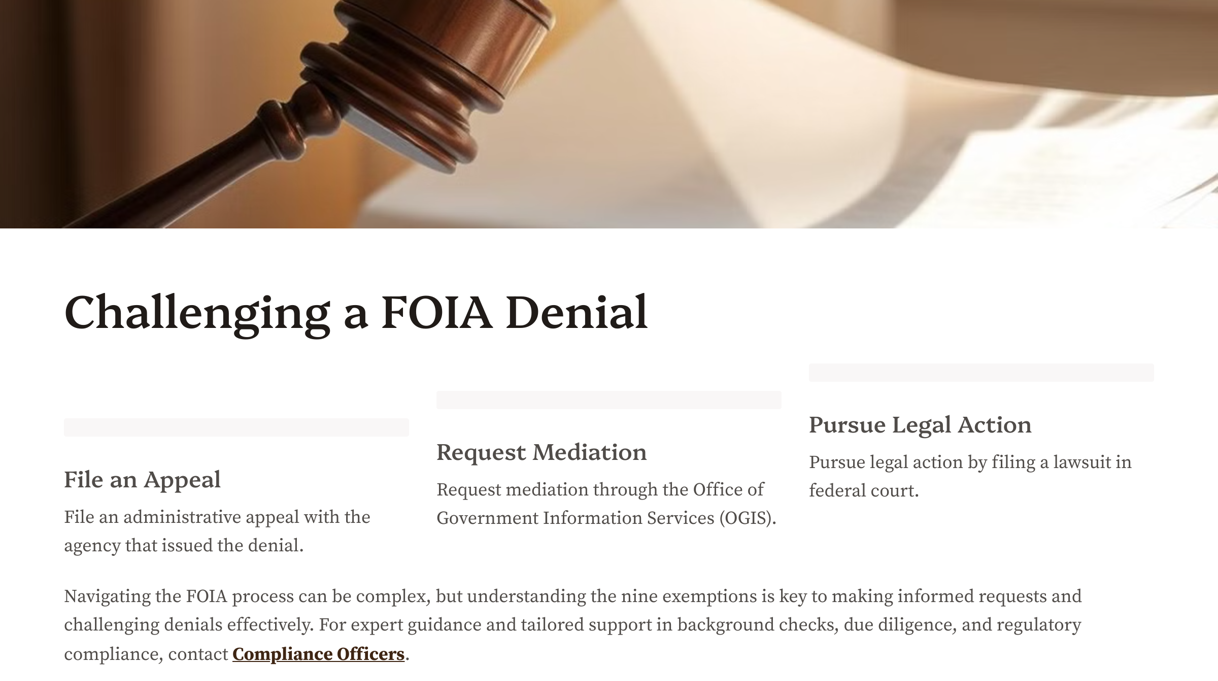
Yes, and you have at least 90 days from the agency’s determination to do it. If an agency denies your request or heavily redacts documents citing FOIA exemptions, you have the legal right to file an administrative appeal. If the agency upholds its decision, the law allows you to challenge the withholding in a U.S. federal district court.
How can I avoid having my FOIA request blocked by privacy exemptions?
To avoid Exemption 6 (Personal Privacy) blocks when requesting your own records or records involving a third party, you must submit a properly formatted and notarized Certification of Identity or a specialized consent form (such as Form G-28 for DHS agencies) to prove you have the legal right to access the data.
Does an exemption automatically require withholding?
No. An exemption is permission to withhold, not an instruction to. If the response letter cites an exemption number but never identifies what releasing the information would actually harm, that gap is what an administrative appeal can press on.
Is a no-records response a FOIA exemption?
No, and the difference decides your next move: you challenge a withholding on the exemption, but a no-records answer on the adequacy of the search — the component, the search terms and the date range.
Does every request for personal records require fingerprints?
No. Identity-verification requirements vary by agency and by record system. Fingerprints should be prepared only when the applicable process actually calls for them.
Legal Disclaimer:
This article is provided for informational purposes only and does not constitute legal advice. The content herein is not intended to substitute professional legal consultation. For specific guidance regarding your individual circumstances, please consult directly with a qualified attorney licensed to practice in your jurisdiction.