A due diligence checklist helps you identify the documents to request before an acquisition, investment or significant business agreement. However, receiving a file does not establish that its contents are accurate. The review must also consider where the information came from, what it covers and which questions remain unanswered.
The 25 items below provide a starting point for that discussion. Some transactions need additional records; others do not justify every request. Compliance Officers can help define the scope, review available information and document findings. Legal, tax and accounting questions may also require the relevant professional.
What a due diligence checklist should establish
A useful review separates the company’s existence, ownership and authority to act. These questions overlap, but one document rarely answers them all. For example, a current state status certificate does not establish who owns every interest in the entity.
Similarly, a financial statement does not resolve whether a particular person can sign a purchase agreement. A title in an email signature may identify a role, but the underlying authority depends on the company’s governance and other applicable requirements.
Therefore, each request should serve a specific purpose. The reviewer needs to understand what the document supports and what it leaves open. Our overview of company due diligence explains how that assessment fits a broader transaction review.
A complete folder can still contain outdated information, inconsistent names or documents concerning a related company. Resolving those differences matters more than simply counting uploaded files. In addition, the report should distinguish documents received from facts independently confirmed.
Set the scope before requesting sensitive records
The scope should reflect the deal, the parties and the jurisdictions involved. An asset purchase raises different questions from a distribution agreement. Likewise, a credit commitment may require more financial analysis than an initial vendor relationship.
Access also matters. Tax returns, identity documents and confidential contracts do not become public merely because someone requests them. The parties should establish appropriate authority, confidentiality protections and a secure method of delivery before sharing sensitive information.
Moreover, the review may need limits on personal data, retention and access. Redaction or a targeted confirmation can sometimes address a question without distributing an entire file. The appropriate approach depends on the purpose and the applicable requirements.
A missing document is not automatically evidence of misconduct. The company may not have that record, may lack permission to disclose it or may propose another source. Record the explanation and assess whether the alternative answers the question.
Due diligence checklist: corporate identity and ownership
Start with the entity that will actually sign. A trade name, parent company and operating subsidiary can refer to different legal persons. Consequently, records should identify which company they concern and the period they cover.
| No. | Document or record | Question it helps address |
|---|---|---|
| 1 | Filed articles of incorporation or organization | What entity formed, where and under which identifying details? |
| 2 | Current certificate of status, existence or good standing | What status does the issuing authority certify on that date? |
| 3 | Bylaws or operating agreement, including amendments | Which internal governance and approval rules apply? |
| 4 | Annual reports, registered agent information and relevant foreign registrations | Do the records correspond to the entity and its activities? |
| 5 | Capitalization table or member and shareholder ledger | Who does the company identify as its current equity holders? |
A good-standing certificate has a limited purpose. It does not establish solvency, the absence of litigation or complete compliance in every jurisdiction. Also, an internal ownership ledger requires evaluation; an officer’s signature does not make every entry independently verified.
Ownership history and authority to sign
The next group connects ownership claims with supporting records and transaction approvals. In particular, the review should distinguish the person negotiating the deal from the person who can commit the company.
| No. | Document or record | Question it helps address |
|---|---|---|
| 6 | Equity issuance, transfer, subscription and option records | How did the current interests arise, and what rights remain outstanding? |
| 7 | Ownership structure chart and relevant supporting documents | Which entities and individuals sit within the ownership structure? |
| 8 | Board, member or shareholder approval for the transaction | What action did the relevant decision-makers authorize? |
| 9 | Current officer or incumbency records | Who holds the relevant office or position? |
| 10 | Delegations, powers of attorney and applicable consent provisions | What limits or additional approvals may affect the signature? |
These records can require legal interpretation. For example, a resolution may approve a transaction with terms different from the final contract. Our article on the beneficial owner also distinguishes ownership from management and other formal roles.
Financial and tax records in the due diligence checklist
Financial requests should match the size and history of the business. A newly formed company may not have three years of statements. Therefore, absence of a particular record requires context rather than an automatic adverse conclusion.
| No. | Document or record | Question it helps address |
|---|---|---|
| 11 | Financial statements for relevant periods, with reports and notes | What financial position and results do the statements report? |
| 12 | Interim accounts and receivables and payables aging | What has changed since the latest reporting period? |
| 13 | Debt schedule, loan agreements and guarantees | Which payment obligations and covenants require review? |
| 14 | Relevant federal tax returns and taxpayer identification records | What filing information and entity details can authorized reviewers compare? |
| 15 | Relevant state tax records, notices and available clearance certificates | What obligations or assessments fall within the records' stated scope? |
An audit, review and compilation provide different levels of assurance. Management accounts can still contain useful evidence, although they do not carry an audit opinion. Similarly, a tax clearance certificate answers only the questions covered by its issuing authority and terms.
Contracts, assets and intellectual property
The next documents help identify the rights on which the business relies. However, possession of an asset does not establish ownership, and ownership does not establish that the asset can transfer without restrictions.
| No. | Document or record | Question it helps address |
|---|---|---|
| 16 | Material customer, supplier and distribution agreements | Which obligations, dependencies and termination rights affect the business? |
| 17 | Leases, property agreements and relevant consent clauses | What rights continue or require approval after the proposed transaction? |
| 18 | Relevant UCC and other lien records, with supporting releases or payoff information | Which recorded claims require further investigation? |
| 19 | Asset register and relevant title documents | What supports the company's ownership or right to use material assets? |
| 20 | Intellectual property registrations, assignments and licenses | Who holds the rights, and what restrictions affect their use or transfer? |
A UCC filing does not, by itself, establish the current debt balance or resolve every issue concerning a security interest. In addition, the relevant filing locations depend on the debtor, collateral and governing rules. Qualified counsel should assess the legal effect of identified claims.
Litigation, licenses, insurance and integrity
The last group covers exposures that corporate and financial records may not reveal. Searches need clear dates, identity matching and coverage limits. A similar name or an allegation in a news article does not establish wrongdoing.
| No. | Document or record | Question it helps address |
|---|---|---|
| 21 | Litigation disclosures and relevant court, judgment and lien records | What proceedings or recorded matters require legal review? |
| 22 | Licenses, permits and material regulatory correspondence | What authorizations and restrictions affect the proposed activity? |
| 23 | Insurance certificates, relevant policies and claims information | What coverage, exclusions and reported losses require assessment? |
| 24 | Relevant management credentials, key-person arrangements and professional licenses | What roles and qualifications does the business rely on? |
| 25 | Appropriately scoped sanctions, PEP and adverse-media screening | Which potential matches or ownership issues need further review? |
An insurance certificate summarizes information; it does not replace the policy or expand coverage. Likewise, a professional license may belong to an individual or an entity, depending on the regime. Verify the relevant holder and permitted activity.
A commercial due diligence checklist differs from bank CDD
FinCEN’s Customer Due Diligence Rule applies to specified covered financial institutions. It does not impose this 25-item commercial list on every company buying a business. Other laws, contracts or sector requirements may nevertheless create obligations.
For covered legal entity customers, the rule generally uses an ownership threshold of 25 percent and a separate control prong, subject to exclusions and exemptions. In February 2026, FinCEN granted relief concerning repeated identification and verification at each new account opening. Ongoing, risk-based obligations still apply.
Therefore, a commercial reviewer should not treat a bank threshold as a universal screening boundary. The transaction may call for a broader ownership review. Also, a bank’s acceptance does not establish that a counterparty meets every requirement relevant to your agreement.
BOI reporting and sanctions require separate analysis
Under FinCEN’s final rule effective August 14, 2026, U.S.-created entities remain exempt from federal BOI reporting. Qualifying foreign entities can still have reporting obligations, subject to exemptions. The federal BOI database is not a public company-ownership search tool.
State filings and corporate documents can contain ownership information, but coverage varies. Consequently, no single public search guarantees a complete ownership picture. The review must identify its evidence and any unresolved links.
OFAC’s 50 Percent Rule addresses a different issue. An entity can be blocked when blocked persons own 50 percent or more of it, directly or indirectly, in the aggregate, even without a separate listing.
Moreover, OFAC can impose civil penalties on a strict-liability basis for sanctions violations. Specific restrictions, authorizations and jurisdictional questions require analysis. PEP status, adverse media and a sanctions designation have different meanings; none should substitute for careful identity matching and review.
Turn the due diligence checklist into a usable report
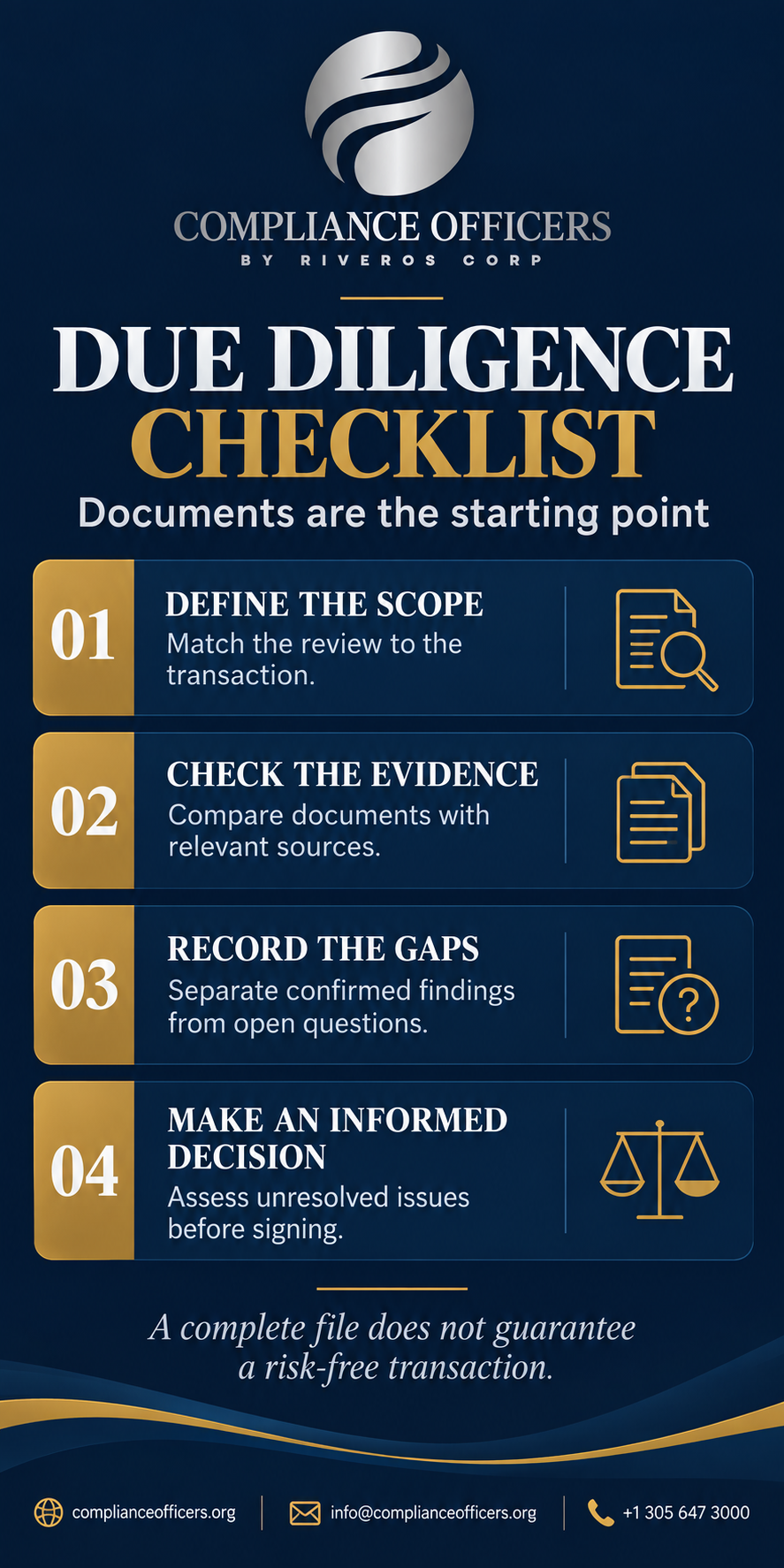
The final assessment should explain what the reviewer checked, when the check occurred and what the source supports. It should also distinguish confirmed findings from unresolved questions. A document marked “received” should not automatically appear as “verified.”
For example, a record may establish an entity’s status on a particular date while leaving a later development unknown. A court search may cover one jurisdiction without addressing another. Those limits belong in the report because they affect the decision.
Missing information can lead to additional requests, revised terms or further professional review. However, no generic checklist determines which risks a buyer should accept. Legal counsel and the relevant decision-makers must evaluate the proposed response.
Our explanation of a due diligence report describes how findings and limitations can support that discussion. The purpose is to make the evidence understandable, rather than promise an error-free transaction.
How Compliance Officers can support the review
Compliance Officers can help define an appropriate review, organize available records and assess inconsistencies within the agreed scope. The work may include corporate information, ownership questions and relevant screening. Confirm the services and permitted sources before the engagement begins.
Timing depends on access, record availability and the response of the parties involved. Some issues require certified documents or specialist interpretation. Therefore, a signing deadline should inform the scope without turning an incomplete search into a claim of certainty.
The same distinction matters in vendor due diligence. Initial review and later monitoring serve different purposes. A satisfactory finding on one date does not guarantee that circumstances will remain unchanged.
Frequently asked questions about a due diligence checklist
Is every item mandatory for every transaction?
No. Scope depends on the transaction, applicable obligations and available records. Some deals require additional documents, while others justify a narrower, clearly documented review.
Does good standing establish financial health?
No. The certificate addresses the issuing authority’s stated requirements and date. It does not establish solvency, freedom from litigation or complete compliance in other jurisdictions.
Can I search a public federal ownership database?
FinCEN’s BOI database is not a public search tool. Ownership review may draw on state records and corporate documents, with access and coverage limits stated clearly.
What if the counterparty withholds a document?
Record the reason and assess lawful alternatives. A refusal is not automatically misconduct, but an unresolved material question may affect the terms or decision to proceed.
How long does the review take?
The timeframe depends on scope, jurisdictions and document access. Confirm the expected work and limitations before relying on a completion date or making a signing commitment.
Discuss your review with Compliance Officers
Tell Compliance Officers what transaction you are considering, which entity is involved and when you expect to decide. We can discuss the scope of the due diligence checklist and the information needed to assess your request.
Contact us by WhatsApp at +1 305 647 3000, call +1 305 647 3000 or email info@complianceofficers.org. Confirm the secure delivery method before sending confidential records.
This article provides general information and does not constitute legal, tax or accounting advice. Requirements vary by transaction and jurisdiction. A review cannot guarantee the absence of undisclosed facts or future problems.