Document authentication can mean very different services. A website may use the term for checking a digital file. Banks use it when they review identity evidence. A foreign authority may use it when it asks for an official certification attached to a public record. Before arranging a service, confirm what the requesting institution means by authentication. This article deals with documents issued in the United States that will be presented to an authority, institution or business outside the country.
In that setting, whether the document looks genuine is only part of the question. What matters is whether the required official signature or seal can be recognized through the right certification process, and whether the finished file meets the recipient’s other requirements. Apostille de la Haya reviews both points together. Knowing the difference keeps you from arranging digital verification when the recipient needs legalization, or from getting a notarial stamp when the real requirement is a certified record issued by a government office.
Document authentication verifies a specific official act
An authentication certificate covers a signature, an official capacity or a seal. It is tied to an identifiable act by an official. It does not make every statement in the document true, it does not settle a dispute over the information, and it does not guarantee that the document will be enough for a particular application. So the question to ask is whose signature is being authenticated, and why the recipient wants it.
On a certified vital record, the official involved may be the registrar or another authorized custodian. With a private declaration, the relevant act may be a notarization. On a federal certification, it may be a federal official’s signature. The same person can own all three documents, yet the certification process attaches to different authorities and different records in each case.
The U.S. government’s overview of authentication explains that the country where the document will be used determines whether an apostille or an authentication certificate is appropriate. You cannot skip that country information. A request for “international authentication” with no destination leaves a central part of the decision open, even when the applicant already holds a complete and genuine document.
Document authentication, notarization and digital verification answer different questions
Notarization records a notarial act under the applicable rules. That act may be a person’s acknowledgment, an oath or another permitted act. It is not a general review of the document’s legal effect. And a notary is not automatically the right person to certify a copy of a public record just because one happens to be nearby.
Digital verification may confirm an electronic signature, pull up a record through a verification link or check whether a file has been changed. That can be useful evidence, but it does not automatically meet an international authentication requirement. A receiving authority may accept an official electronic record in one procedure and ask for a different certified format in another. A QR code on the page does not mean every foreign institution will accept the document.
International authentication links the official act on a record with the authority abroad that is asked to recognize it. Translation deals with language. Recognition deals with the legal or administrative effect the recipient gives the document. All of these can show up in one file, yet each solves a different problem. If a service description or checklist calls all of them “certification,” ask for clarification before you choose a service.
Suppose a university issues a verifiable electronic transcript. The recipient can check it online and may still require a specific authenticated academic document for a licensing application. On the other hand, a different recipient may expressly accept a direct electronic transcript without the extra certification you assumed you needed. Let the written requirement drive the plan. Collecting as many stamps as possible is not a plan.
Confirm where in the U.S. the document comes from before you choose an office
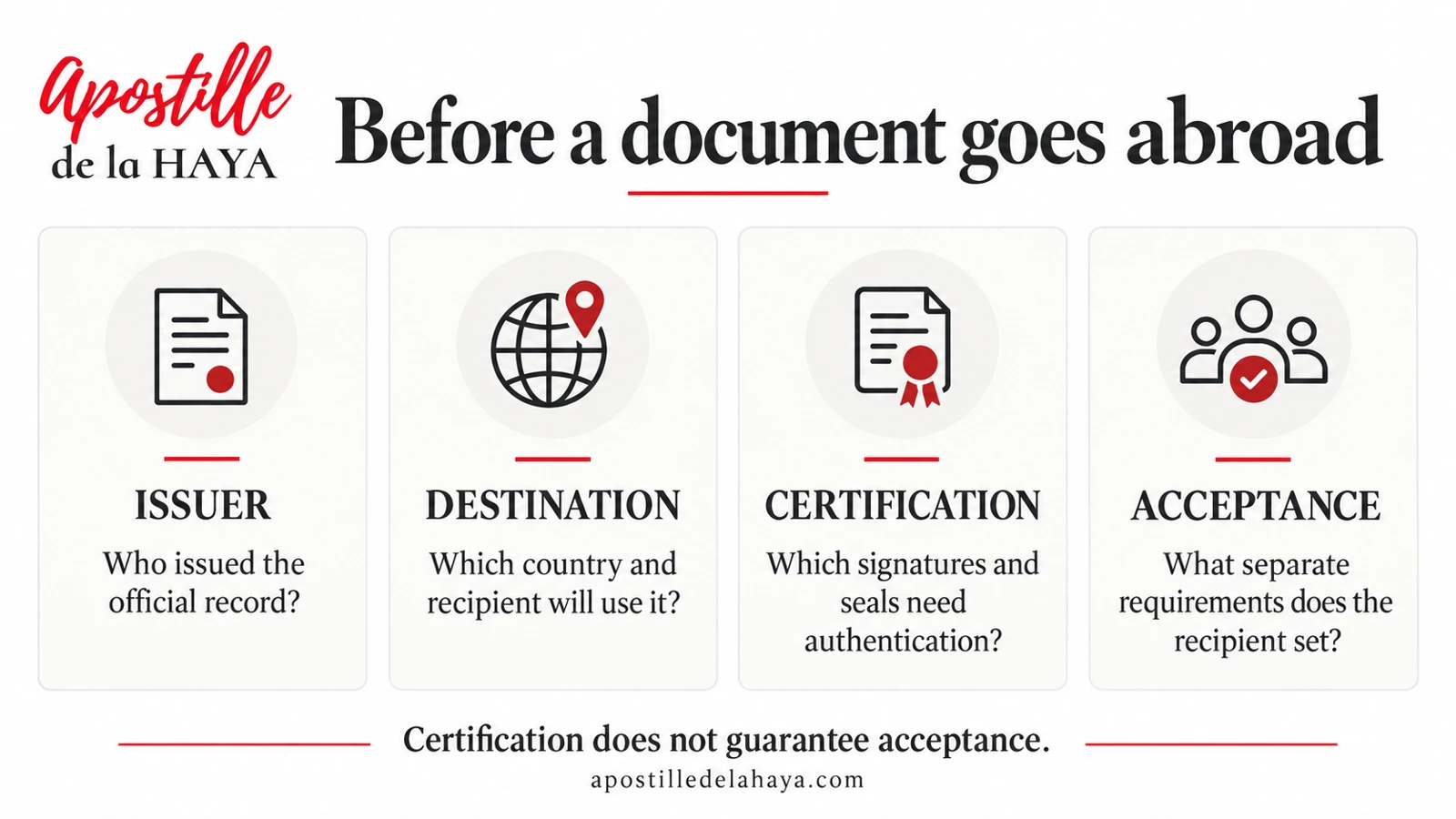
The phrase “American document” can hide important differences. A U.S. state record, a federal agency record and a foreign record held by someone living in the U.S. are not the same thing. Living here does not give a U.S. state office authority over a foreign issuer’s signature. Start by identifying the institution or public authority that actually issued the record.
For a birth or marriage record, read the issuing authority printed on the certified copy. With an academic document, identify the institution and the official who supplied it. For a power of attorney, separate the person granting authority from the notary before whom the act took place. If there are several certification pages, read the whole chain instead of drawing conclusions from the first page.
Checking the origin also helps you avoid unnecessary changes. Don’t add a notarization, detach an existing certificate or change a printed name so the file looks like an example you saw online. An alteration can create a new problem and still leave the original requirement unmet. If some information is wrong, the issuer or a qualified professional should fix it before the certification route is settled.
Examples of why the recipient matters
A U.S. birth certificate headed to a foreign civil registry raises questions about the certified copy, the destination and the information that registry needs. A birth certificate for a school application may have a different presentation requirement. Both involve the same event, but the two institutions are not necessarily asking for the same evidence or the same version of the record.
A signed authorization for a property transaction shows another difference. The certification chain can cover the signature without deciding whether the authorization contains the powers the deal needs. That legal question belongs to the recipient or to a properly qualified legal professional. Authentication cannot repair a power that names the wrong person or leaves out authority the transaction requires.
With a company document, an overseas counterparty may want evidence of a filed corporate record, a current statement or an officer’s signed declaration. Those are three different records. The discussion of articles of incorporation certification helps sort out one corporate-record situation. Make sure the document name matches what the recipient actually asked for before you arrange certification.
A destination review then points to the right service. A file for UAE document attestation should be checked against UAE requirements. Any file for Qatar document attestation needs its own assessment. Similar wording on two application forms does not prove that the same mission, delivery channel or supporting evidence applies.
A document authentication review that answers the right questions
Before you send the physical record, gather the recipient’s instructions and a complete picture of what you already hold. The review should establish the document type, the issuer, whether it is state or federal, the country of use, the receiving organization and the certifications already on it. If you don’t know the document type, describe what the record says and who issued it. Selecting a category without checking the record may leave the actual requirement unresolved.
Check whether what you have is the issuer’s certified record, a plain copy, a scan or an original digital document. Also find out whether the recipient needs the full record or a specific official extract. The question here is format. Whether the text is readable is a smaller part of it. A readable copy can still be missing the official certification that the requested process depends on.
Ask the recipient to put any translation or recency requirement in writing. Don’t turn “recent” into a made-up expiration period that supposedly applies everywhere. If the recipient wants a newly issued copy, identify the required date or age and which document it applies to. The date of the underlying event, the issue date, the certification date and the submission date all mean different things.
Last, decide where the finished file should be delivered. The applicant’s home, the place where the document is processed and the receiving authority’s address may be in three different countries. A clear delivery plan keeps you from getting the right certification and then having the record sent to an address where nobody can use it for the submission.
Errors that can leave the recipient’s requirement unmet
One avoidable mistake is ordering a service by its label alone. Someone selects “authentication” and gets a technical verification report, when the recipient expected an official certificate. Someone else notarizes a statement when the recipient asked for a certified public record. Both services may be legitimate, and neither one meets the original requirement.
Another mistake is treating authentication as approval of the contents. A misspelled name, a missing page or an unsuitable authorization is still a problem after the signature has been certified. Certification should not be used to cover up doubts about the record. Settle substantive questions with the issuer or the relevant professional, and keep the corrected document in its official form.
A third mistake is relying on someone whose document came from a different country. Their advice may describe their own case accurately and still not fit yours. Comparing procedures only helps once the origin and destination match. Even then, the document category and the recipient’s current requirements may differ.
How Apostille de la Haya turns your request into a defined service
The document legalization service starts with a specific document and a stated use. Apostille de la Haya can help identify the preparation questions and explain which documentary stages the proposed assistance includes. You should get a clear description of what we will handle and what still depends on the issuing authority, the receiving institution or your own participation.
The goal is fewer avoidable submissions and less repeated shipping. That takes a useful intake conversation. We don’t assume every file is ready. If a copy has to be replaced, a recipient’s instruction is unclear or a question about the legal content is still open, we point it out before treating the record as ready for certification. The service is more predictable when those dependencies are out in the open.
Service conditions depend on the nature, complexity and requirements of the assignment. Consult Apostille de la Haya directly and describe the record, destination, existing certifications and deadline. A clear scope identifies the documentary work, any translation and the final delivery point, while distinguishing those tasks from the recipient’s decision on acceptance.
Frequently Asked Questions
Does document authentication prove that everything in a document is true?
No. It covers the relevant official signature, capacity or seal. It does not investigate every statement on its own. If the content is wrong or legally insufficient, that has to be resolved separately. Apostille de la Haya can help you identify the documentary certification question, while corrections to the substance belong with the issuer or the appropriate professional.
Is notarization enough for a document used abroad?
It depends on the document and on what the receiving authority requires. Some files need an additional certification of the notarial act. Public records may call for an official certified copy instead of a new notarization. Share the recipient’s instructions and the complete document with Apostille de la Haya so the right route can be reviewed before you arrange further certification.
Does a QR code remove the need for authentication?
Not automatically. A verification feature is one question, and acceptance in a particular foreign procedure is another. The recipient has to accept both the record’s format and the certification route used for it. Apostille de la Haya can review the stated requirement and help you tell an original digital record apart from a scan that simply shows a printed verification code.
Can a document issued outside the United States use the U.S. route?
Don’t assume so just because the owner lives in America. The issuer and the signature determine which authority is responsible for the record. A foreign record may need to be prepared through the system of the country where it was issued. Identify the issuer at the start, and Apostille de la Haya can tell you whether the U.S. document authentication service you asked about is relevant to your case.
What should I send for an initial review?
Through the agreed intake channel, send the document type, the issuing authority, the destination, the receiving organization’s instructions, your deadline and a full view of the existing certifications. Don’t alter or detach any pages beforehand. With those details, Apostille de la Haya can assess the preparation and explain the service scope without depending on a word as broad as “authentication.”
Clarify the document authentication requirement before you ship
Contact Apostille de la Haya to review your U.S. record and the purpose it will serve abroad. We can help separate the certification you need from other services with similar names and explain the next documentary decisions.
Contact Apostille de la Haya by phone or WhatsApp: +1 305 500 0185.