
In legal, academic, and international processes, presenting original documents isn’t always practical or safe. That’s where a Certified and True Copy comes in — a notarized, legally recognized copy of your original document that proves it’s authentic and unchanged.
At Notary Public Center, we specialize in helping individuals and businesses obtain Certified and True Copies quickly, legally, and correctly. Whether you’re applying for a visa, opening an account overseas, or submitting academic credentials abroad, we can help ensure your documents meet all requirements.
In this article, you’ll learn what a Certified and True Copy is, when and where it’s used, and how Notary Public Center makes the process simple and secure.
What Is a Certified and True Copy?
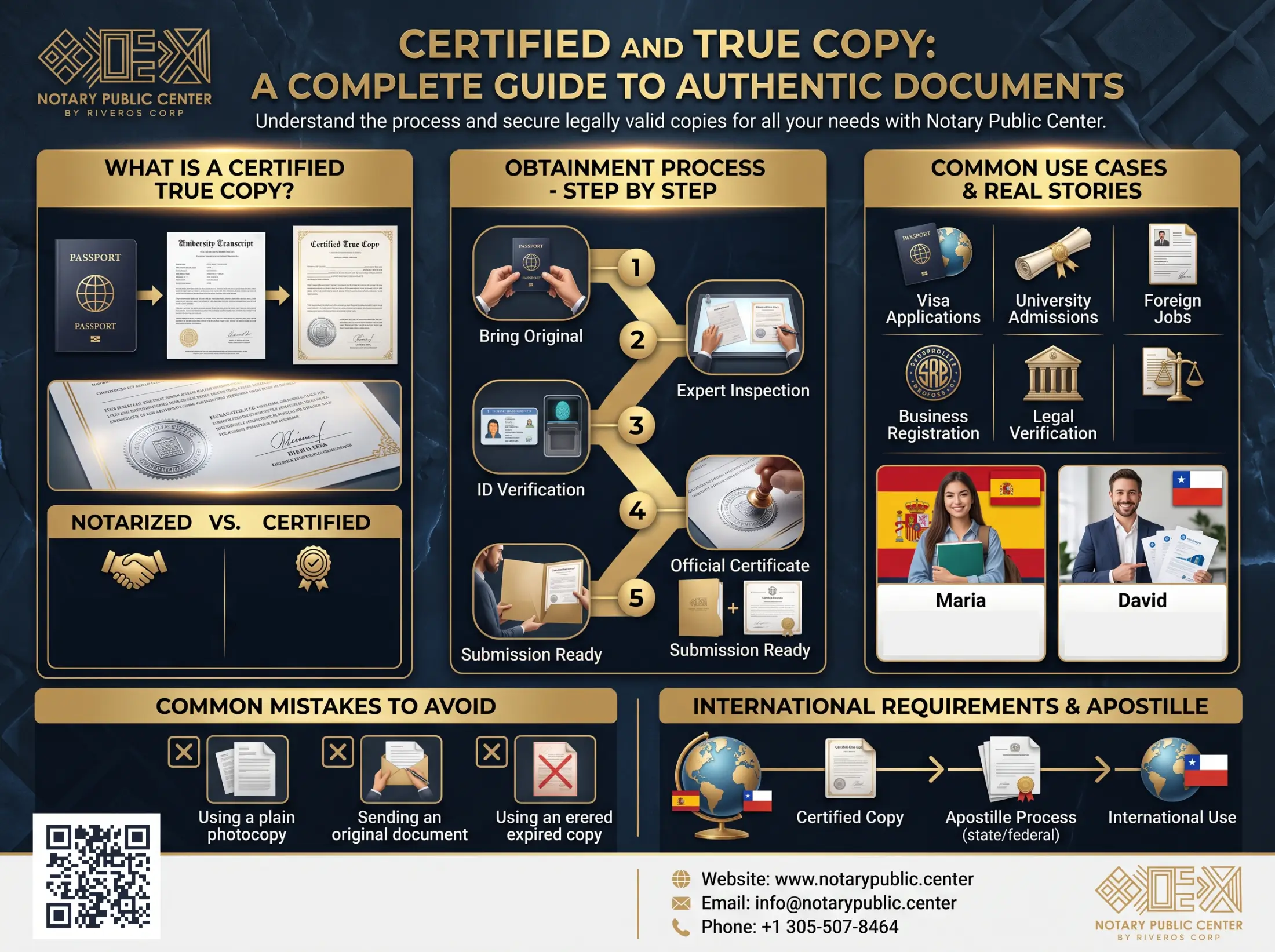
A Certified and True Copy is a reproduction of an original document, officially verified by a notary public or other authorized professional as being an exact, unaltered replica of the original.
In other words, it’s not just a copy — it’s a legally recognized version of the original that includes:
A notarial certificate
The notary’s seal or stamp
A declaration stating the document is a true and correct copy of the original
What It Is NOT:
It is not an original document
It is not a self-declared photocopy
It is not valid if altered, edited, or incomplete
Only certified copies issued properly by recognized authorities or notaries carry legal weight.
Common Documents That Require Certified Copies
At Notary Public Center, we handle Certified and True Copies for a wide range of documents, including:
🔹 Academic Documents
Diplomas
Transcripts
Language proficiency certificates
Degree evaluations
🔹 Legal & Business Documents
Power of attorney
Bank letters
Professional licenses
📌 Note: Some documents (like vital records) can only be certified by the issuing authority. In those cases, we’ll help you request the correct version.
When Do You Need a Certified and True Copy?
Certified copies are often needed when submitting documents to governments, courts, universities, or employers who require a valid, reviewed version — but not the original.
Common Use Cases:
Visa and immigration applications
University admissions abroad
Foreign job applications
International business registration
Banking or financial processes overseas
Legal filings or identity verification
Certified Copy vs. Notarized Copy: Is There a Difference?
Yes — and it matters.
| Term | Description |
|---|---|
| Certified Copy | A copy verified by the original issuing authority (e.g., civil registry) |
| True Copy Notarized | A photocopy that a notary confirms matches the original, often used for private or international purposes |
In many international contexts, especially under the Hague Apostille Convention, a Notarized True Copy is accepted — and Notary Public Center can provide this service.
Can All Documents Be Certified by a Notary?
No. In the U.S., notaries are not always allowed to certify copies of certain documents, depending on state law.
For example:
In some states, notaries can’t certify copies of vital records (birth, death, marriage certificates).
However, notaries can often certify passports and private documents.
📌 At Notary Public Center, we know exactly what can and cannot be certified under your state’s laws — and we help guide you accordingly.
How to Get a Certified and True Copy – Step by Step
With Notary Public Center, the process is simple and secure:
1: Bring the Original Document
We need to see the original document to compare it to the copy.
2: We Make or Inspect the Copy
We’ll either make the copy ourselves or examine a copy you provide to ensure it’s identical.
3: Identity Verification (if required)
Depending on the document and use case, we may also verify your ID.
4: Notarial Certificate Applied
We attach a certificate stating the copy is true and correct, sign it, and affix our official stamp or seal.
5: You Receive the Certified Copy
You receive a document ready for submission to foreign governments, universities, or other institutions.
Common Mistakes to Avoid
Many people attempt to create their own certified copies and make critical errors:
Using a photocopy without notarization
📌 Only official certification adds legal validity.
Sending the original without making a certified copy
📌 We help you keep the original safe while using the certified version.
Using an outdated or expired copy
📌 Always certify the most recent and accurate version.
Not checking international requirements
📌 We guide you based on your destination country or institution.
Does a Certified and True Copy Need an Apostille?
If the certified copy will be used in a foreign country, and that country is part of the Hague Apostille Convention, then yes — the notarized copy may also require an apostille to be valid abroad.
At Notary Public Center, we assist with both:
Obtaining the Certified Copy
Real-World Cases We Handle
Maria – Student applying to a university in Spain
We certified her diploma and transcript, then processed apostilles for both.
David – Opening a business in Chile
We provided true copies of his articles of incorporation and board resolution with apostilles.
Why Choose Notary Public Center?
At Notary Public Center, we do more than stamp documents — we provide legal peace of mind. With our certified and true copy services, you get:
- Proper certification
- Compliance with local and international standards
- Notarization when applicable
- Apostille support
- Document translation (if needed)
- Fast, secure handling
Whether you’re preparing for immigration, education, or global expansion, our team is here to make sure your paperwork is correct, complete, and court-proof.
Ready to Certify Your Documents?
Let us help you get it right the first time.
Contact Notary Public Center today to schedule your certified and true copy appointment and ensure your documents are legally valid — wherever they’re going.

Certified copy vs. notarized document: why the difference matters
People often use «certified copy» and «notarized document» as if they meant the same thing, but they are two different legal instruments, and confusing them is a frequent cause of rejected paperwork. A notarized document is one where a notary witnessed a signature or administered an oath—the notary is vouching for the signing event. A certified (or true) copy is a reproduction of an original document that an authorized official confirms is a faithful, complete copy of that original.
The distinction becomes critical when an institution—an embassy, a university, a foreign government—asks specifically for a «certified true copy.» Handing them a notarized photocopy when they need a copy certified by the record’s official custodian, or vice versa, sends the request back. At Notary Public Center we make sure the copy you submit is exactly the kind the receiving party requires.
Who can certify a true copy?
Not everyone can certify a copy, and the rules depend on the document type:
- Vital records (birth, marriage, and death certificates) can only be certified by the government office that holds the original—typically the state’s vital statistics bureau. A notary cannot certify a copy of a birth certificate.
- Private documents (diplomas, contracts, passports in some contexts) can, in many states, be certified by a notary through a «copy certification» process, where the notary compares the copy to the original and attests they match.
- Court and government-issued records are certified by the issuing clerk or agency.
Knowing which authority must certify your specific document is the single most important step. Requesting the wrong kind of certification wastes both time and money.
When you need a certified true copy
Certified true copies are most commonly required for:
- Immigration and visa applications, where authorities want proof of authenticity without keeping your original.
- Foreign use of documents, often paired with an apostille for international recognition.
- Academic admissions and credential evaluations abroad.
- Legal and financial transactions where the original must stay in your possession.
- Corporate filings that require verified copies of formation or governance documents.
In each of these, the receiving institution wants assurance that the copy truly reflects the original—without surrendering the irreplaceable original itself.
Certified copies and apostilles: the international layer
If your certified copy will be used outside the United States, it will usually need an apostille as well. The apostille is a Hague Convention certificate that validates the document internationally, and it is issued by a state’s Secretary of State (for state and notarized documents) or by the U.S. Department of State (for federal documents)—never by the notary.
The order matters: for a vital record, you obtain the certified copy from the vital statistics office first, then apostille it. For a notarized copy certification of a private document, the notarization comes first, then the state verifies the notary and issues the apostille. Getting this sequence right is what keeps the document from being returned at the destination.
How to request a certified true copy the right way
Requesting a certified copy correctly saves you from paying twice. Start by identifying the exact office that holds the original: for vital records, that is the state or county vital statistics bureau; for court records, the clerk of court; for a private document eligible for notary copy certification, an authorized notary. When you order, ask specifically for a «certified copy» or «certified true copy,» not a simple photocopy, and confirm the copy will carry the official seal and the signing official’s signature—without those elements it cannot later be apostilled. If the receiving institution abroad specified a maximum age (many require copies issued within the last three to six months), note that date before ordering. Finally, order more than one certified copy if you anticipate needing the document for several purposes; each institution often wants to keep its own certified copy, and ordering extras up front is faster and simpler than repeating the request later.
Common mistakes with certified copies
- Assuming a notary can certify a birth certificate: vital records must be certified by the issuing government office, not a notary.
- Submitting a plain photocopy where a certified copy with seal and signature is required.
- Using an outdated copy when the destination requires a recently issued one.
- Skipping the apostille when the certified copy will be used internationally.
- Requesting the wrong certification type for the document at hand.
Each of these turns a simple request into weeks of delay. Confirming the correct authority and certification type before you order is the single best way to keep your document on track—and it is exactly where Notary Public Center’s guidance makes the difference.
Frequently Asked Questions (FAQ)
1. Can I notarize a copy of my birth certificate?
Not directly. Vital records must be certified by the issuing government. We help you request the right version.
2. Is a certified copy the same as a notarized document?
Not exactly. A certified copy is a notarized replica of an original, while a notarized document typically refers to the signer’s declaration.
3. Can I use a certified copy internationally?
Yes — and in many cases, you’ll also need an apostille. We handle both.
The information contained in this publication is provided for general informational purposes only and does not constitute legal advice. Reading or using this content does not create and is not intended to create an attorney-client relationship. No reader or user should act or refrain from acting based on the information presented herein without first consulting an attorney duly licensed to practice law in their jurisdiction.