
Amended and restated articles of incorporation bring a corporation’s charter into one document and include new changes where applicable. They can make a long filing history easier to read. However, the proposed text must preserve the provisions still in force and carry the approvals required for any new amendment.
A corporation may have changed its name, increased its authorized shares and revised other terms over several years. Its current charter may therefore consist of the original articles plus several amendments. A restatement combines that record. It also requires care: a missing paragraph can affect rights that the corporation intended to retain.
This guide explains the distinction between amendment, restatement and correction, using Florida business corporations as the main example. Other states and entity types have their own rules. Riveros Corp can coordinate the records and filing work, with licensed legal advice where the proposed terms require it.
What amended and restated articles of incorporation contain
A restatement sets out the corporation’s charter as an integrated text. Existing provisions carry forward, subject to any properly approved changes. Once a duly adopted restatement takes effect, it becomes the charter used to assess the corporation’s current provisions.
The words “amended and restated” usually indicate that the document also introduces a new amendment. For example, the corporation may consolidate its filing history while changing its authorized-share structure. A restatement without new substantive changes serves a different purpose: it brings existing provisions together.
Neither label proves that the work is complete or correct. The filed text, its legal effect and the supporting approvals matter. A document headed “restated articles” should not conceal a new change that requires a separate approval process.
For context, our guide to what articles of incorporation contain explains the original formation document. The restatement should remain consistent with the corporation’s actual charter history.
Amendment, restatement and correction compared
An amendment changes identified provisions. The reader generally needs the earlier charter record to understand everything that remains in force. By contrast, a restatement presents the integrated charter in one document. It may also include new amendments.
| Document | Main purpose | Point to review |
|---|---|---|
| Articles of amendment | Change specified charter provisions | Earlier provisions may remain in separate filings |
| Restated articles | Consolidate the current charter | Carry forward all effective provisions accurately |
| Amended and restated articles | Consolidate the charter and introduce changes | Obtain the approvals required for each new amendment |
| Articles of correction | Address a qualifying defect in a filed document | Use the applicable correction rules and effective-date provisions |
A correction has a separate legal function. Florida’s section 607.0124 addresses inaccuracies and specified defects in filed documents. The appropriate instrument depends on what happened, including whether the corporation approved the text that was filed.
Consequently, a restatement should not serve as an assumed cure for every earlier mistake. If a filing contains an unauthorized change, a missing approval or a disputed provision, legal review should address that problem directly. Renaming the document does not resolve it.
When amended and restated articles may help
A consolidated charter can help when several effective amendments make the existing record difficult to follow. It may also be useful during financing, a sale or another review that requires a current charter. The number of amendments alone does not determine whether restatement is necessary.
For example, one short name-change amendment may be easy to read with the original articles. Several changes to stock classes, voting rights and preferences may require more work. A reviewer then needs to know which text remains effective and which text a later filing replaced.
The corporation should also consider the recipient’s request. A lender may want a certified current charter, while another recipient wants proof of state status. Those requests call for different records. Restating the articles may be unnecessary if the existing documents already meet the stated purpose.
Our guide to amending articles of incorporation discusses narrower changes. A targeted amendment can remain appropriate where the charter history is short and the proposed change is limited.
Florida approvals for a restatement
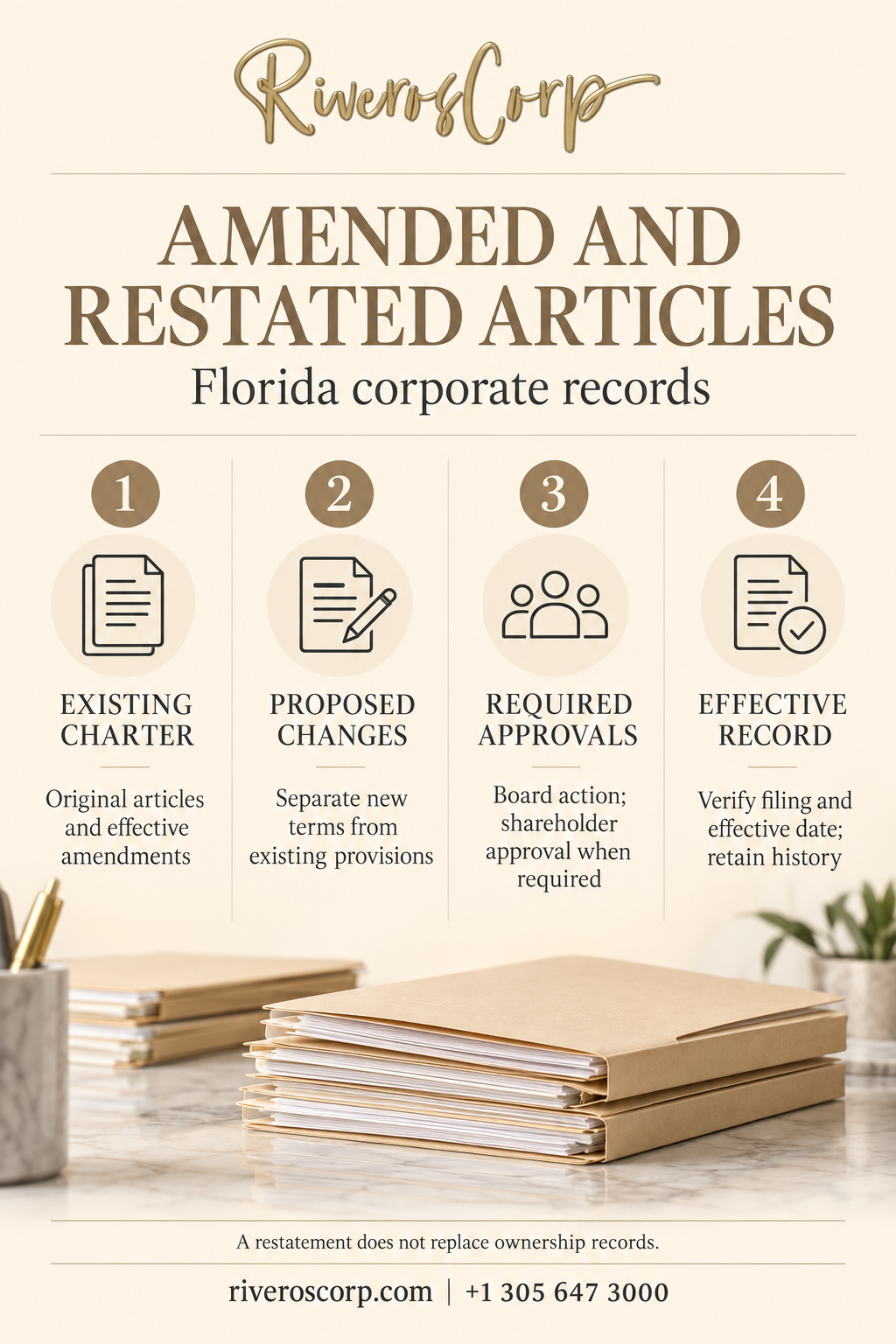
Under Florida Statutes section 607.1007, the board may restate the articles without shareholder approval, subject to the statute’s rules for new amendments. If the restatement includes a new amendment requiring shareholder approval, the amendment must receive the applicable approval.
This distinction matters when the corporation adds financing terms. Consolidating existing language and creating new rights are separate decisions. The new provisions may require shareholder action even though the board could approve a pure restatement.
Florida also specifies notice requirements when the board submits a restatement for approval at a shareholder meeting. The filing must contain the required statements, including the consolidation statement and applicable statements concerning new amendments. Corporate records should support those representations.
The approval analysis should account for the charter, relevant voting groups and the proposed change. A service provider’s receipt or a state filing confirmation does not establish that the corporation obtained every necessary internal approval.
Reconciling the charter before filing
The review begins with the effective charter history. That includes the original articles, amendments, prior restatements and other filings that affected charter provisions. Drafts and abandoned proposals should remain distinguishable from adopted and effective documents.
Next, the proposed restatement needs comparison with that history. The comparison should show which provisions remain unchanged, which prior amendments are incorporated and which terms are new. Otherwise, a reader may mistake a substantive change for routine consolidation.
Names, purposes, stock provisions and optional governance clauses all deserve attention. A change made years earlier can remain relevant even if it appears in a separate filing. Similarly, a clause absent from the original articles may have become effective through an amendment.
If documents conflict, the discrepancy needs an explanation before the corporation relies on a consolidated text. Choosing whichever version looks newer is not enough. The filing date, effective date, adopted text and corporate approvals can each matter.
Authorized shares and ownership records
Authorized shares describe what the charter permits the corporation to issue. They do not, by themselves, identify the shares actually issued or the owners of those shares. Therefore, the restated charter and the stock ledger answer different questions.
A capitalization review should distinguish authorized classes and their rights from actual issuances, transfers and outstanding holdings. A restatement should not be used to reconstruct missing ownership records by assumption. Any discrepancy should remain visible until the supporting records resolve it.
Effective date and historical records
Florida law provides that duly adopted restated articles supersede the original articles and amendments. However, submission, filing and effectiveness are not always the same event. The corporation should verify the effective date that applies to its document.
Section 607.0123 addresses effective dates and times, including permitted delayed effectiveness. A document sent for filing may still await review. Likewise, a filed document may specify a later effective date.
Keeping the older record remains useful. A transaction completed before the restatement may depend on the charter then in force. Directors, shareholders or reviewers may also need to understand when a provision changed and what approval supported the change.
For that reason, the consolidated charter should sit alongside a preserved history. It gives readers a current text without erasing the record of earlier corporate actions. The effective version should be clearly identified when records are shared.
A hypothetical financing example
Consider a corporation that has filed a name change and an increase in authorized shares. It later discusses an investment that would introduce a preferred-stock class. Its existing charter is spread across several documents, and the proposed investment would add another change.
The parties may decide to use amended and restated articles of incorporation. The document would bring forward the effective name and share provisions while incorporating properly approved new terms. Counsel would review the rights and approvals associated with the proposed financing.
This is an illustrative example, rather than a client result. A financing does not always require restatement, and a restatement does not guarantee that an investor will proceed. The transaction documents and the applicable law determine what the corporation needs.
The example also shows why consolidation should begin with records. If the earlier share amendment is missing, the proposed charter may rely on the wrong authorized amount. That question needs resolution before anyone treats the new text as complete.
What a restatement does not establish
Amended and restated articles of incorporation address the charter. They do not replace bylaws, shareholder agreements, stock records or required corporate approvals. Those documents may need separate review when the charter changes.
They also do not prove current state status. Florida offers a certificate of status separately from a certified copy of a filing. The Division of Corporations explains those options on its certification page.
A recipient may request both records for different reasons. A certified charter copy addresses the filed instrument; a status certificate addresses the matters it certifies about the corporation. Our guide to certified copies of articles explains that distinction further.
Finally, a restatement does not automatically update every bank, contract file or third-party record. If the charter changes the corporate name or another relevant fact, the corporation should review which recipients require notice or supporting documentation.
Frequently asked questions about restated articles
What are amended and restated articles of incorporation?
They combine the corporation’s charter into one text and include new amendments where applicable. In Florida, duly adopted restated articles supersede the original articles and prior amendments. The document still requires proper adoption, filing and verification of its effective date.
Does every Florida restatement need shareholder approval?
No. The board may approve a restatement without shareholder approval under section 607.1007. However, new amendments that require shareholder approval must follow the applicable approval rules. The content of the proposed change determines the analysis.
Can a restatement fix an earlier filing error?
The appropriate remedy depends on the error. A qualifying defect may call for articles of correction, while a new substantive change may require an amendment. A restatement should not be assumed to cure unauthorized provisions or missing approvals.
Should the corporation keep the original articles?
Yes. Preserve the historical charter documents and supporting corporate records. They may explain provisions that applied before the restatement and help document earlier transactions. The current restatement and historical records serve different purposes.
Will restated articles prove ownership or active status?
Not by themselves. Ownership requires the relevant stock and transaction records. A certificate of status serves a separate state-record function. Ask the recipient which documents it needs instead of assuming that a current charter covers every request.
Discuss your corporate records with Riveros Corp
Riveros Corp can coordinate the document collection and filing work for a corporate restatement. The scope should identify the corporation, state of formation, available charter history and proposed changes. Questions about investor rights, disputed provisions or required legal approvals should involve licensed counsel.
To discuss amended and restated articles of incorporation, visit Riveros Corp, call +1 305 647 3000 or contact the team through WhatsApp. Provide the purpose of the review and any transaction deadline so the team can assess the requested work.
This article provides general information about corporate records, with Florida examples. It is not legal or tax advice. Requirements depend on the corporation’s governing law, documents and circumstances.