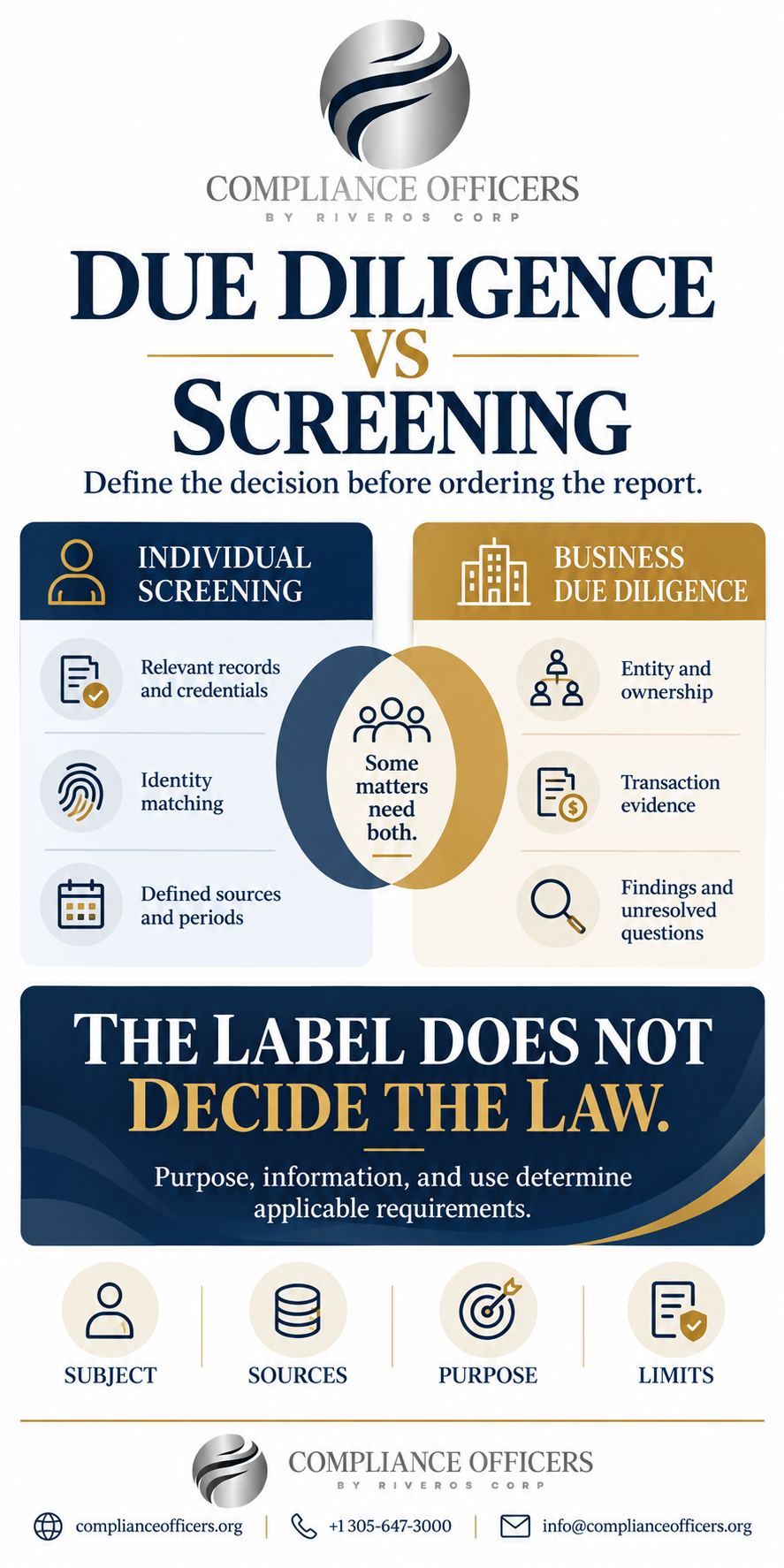
Due diligence vs screening is a useful comparison when a business needs information before making a decision. A background check may examine an individual’s records or credentials. A broader review may also assess a company, its ownership, and the proposed transaction.
These services can overlap. Their names do not create a fixed legal boundary or determine whether a particular law applies. Instead, the subject, sources, purpose, and intended use define the work and its requirements.
Compliance Officers helps identify the questions a file needs to answer and organize the appropriate records. This article compares individual screening with business due diligence, explains important legal distinctions, and describes the limits of common search products.
Due diligence vs screening: start with the decision
Before ordering a report, identify the decision it will support. Hiring an employee, checking a professional license, and evaluating a supplier can require different information. Consequently, a broad request to check someone’s background may leave the actual scope unclear.
Next, identify the subject. The person negotiating a contract may represent a company, while a different affiliate will perform the work or receive payment. A review should make those roles clear before searching records.
Finally, identify any required report or process. A licensing authority may prescribe a fingerprint-based procedure. A bank may request particular ownership evidence. Neither requirement necessarily calls for the same service as an ordinary commercial background search.
What a background check may cover
A background check commonly examines information about a person within an agreed scope. Depending on the lawful purpose, it may address criminal records, employment history, education, professional licensing, or other relevant matters. Different products cover different sources and periods.
Identity matching remains essential. A name match alone may refer to someone else. Therefore, the provider should use appropriate identifiers and explain any unresolved discrepancy before attributing a record to the subject.
The result should identify what the search actually covered. A statement that no record was found only has meaning within those limits. It does not establish that the person has no relevant history anywhere or will perform a role safely in the future.
What business due diligence may cover
Business due diligence can examine an entity, its owners, the people acting for it, and the proposed relationship. Relevant questions may concern legal existence, authority, licensing, financial exposure, disputes, or sanctions. The scope should reflect the decision and applicable duties.
Unlike an unlimited investigation, a useful engagement has a defined starting scope and a process for additional work. A new discrepancy may justify expanding the review. However, the client should understand what that expansion will address and which questions remain outside the engagement.
Our guide to reviewing a U.S. company discusses common sources. Registration records, financial statements, and court files answer different questions. A single certificate cannot establish all of those matters.
Due diligence vs screening: compare the scope
The table below describes common uses, rather than rigid definitions. A provider may combine several types of work in one engagement. The actual scope and use matter more than the label on the report.
| Question | Individual background screening | Business due diligence |
|---|---|---|
| Typical focus | A person's relevant history or credentials | An entity, ownership structure, transaction, or business relationship |
| Possible sources | Court records, licensing boards, education and employment verification | Corporate filings, contracts, ownership documents, financial and court records |
| Key scope issue | Which sources, jurisdictions, names, and periods the report covers | Which questions the evidence must answer and what further work may be necessary |
| Legal review | FCRA, privacy, nondiscrimination, and other applicable requirements | Applicable transaction, regulatory, privacy, contractual, and reporting requirements |
| Useful output | Accurately matched findings with source and scope information | Supported findings, analysis, limitations, and unresolved questions |
Due diligence vs screening under the FCRA
The Fair Credit Reporting Act can apply when a consumer reporting agency provides information for a covered purpose. Employment, housing, credit, and insurance decisions are common examples. The law also contains definitions, exclusions, and other permissible purposes.
Calling a report due diligence does not place it outside the FCRA. Similarly, using only public records does not automatically remove consumer-reporting duties. The provider’s activities, the information, and its expected or actual use require assessment.
A report solely about a corporation differs from a report about an individual consumer. However, a mixed engagement may involve both. Therefore, a business should identify the applicable framework before requesting personal information or reusing a report.
Employment reports have specific advance requirements
For employment-purpose consumer reports, the FCRA generally requires a clear written disclosure in a stand-alone document and the individual’s written authorization. The employer also makes required certifications to the reporting agency. Additional rules may apply to investigative consumer reports based on personal interviews.
These employment procedures should not be described as identical requirements for every credit, insurance, or housing report. Those uses have their own rules and permissible-purpose analysis. State and local laws may add requirements.
Using employment information lawfully
Before an adverse employment action based on a consumer report, the employer must provide the report and the required summary of rights. This gives the person an opportunity to review and respond. If the employer then takes adverse action, the final notice must contain the required information.
Federal nondiscrimination law also applies to employment decisions, regardless of how the employer obtained the information. Consequently, a direct search by the employer does not remove every legal obligation. State and local restrictions can further affect criminal-history inquiries and their use.
The precise process depends on the facts and applicable law. A report provider does not make the employer’s hiring decision simply by supplying records. Counsel can assess the decision process, notices, and any questions about legal compliance.
Due diligence vs screening: companies and individuals
A person-level report may reveal relevant information about a founder or representative. However, it does not necessarily establish the contracting company’s assets, liabilities, registrations, or authority. Those questions may require separate corporate evidence.
Companies can have litigation, regulatory actions, licenses, and criminal proceedings. Therefore, it would be incorrect to say that there is nothing to check about a corporate entity. The appropriate records and legal analysis differ from an individual’s employment screening.
A relationship centered on one person may justify both types of review. For example, a founder’s credentials and an entity’s authority can matter to the same transaction. The scope should explain why each category is relevant and how the information may lawfully be used.
Ownership requires its own evidence
State filings may identify managers or officers without disclosing every beneficial owner. Company records and other appropriate evidence may therefore be necessary. A registered agent is not automatically an owner or the person controlling the transaction.
FinCEN’s BOI database is not a public ownership directory. Its August 2026 rule exempts U.S. companies and U.S. persons from BOI reporting. However, other relevant records can exist, and the exemption does not eliminate separate bank or sanctions requirements.
Database coverage and record accuracy
Commercial products described as national searches may combine information from multiple sources. The label does not guarantee complete coverage of every jurisdiction or current information about every case. Therefore, the review should identify the actual sources and update limitations.
Official criminal-history systems also have access rules and defined purposes. An unrestricted public search is different from a fingerprint-based check through an authorized channel. The required route depends on the legal purpose and receiving organization.
Our explanation of a U.S. police certificate and related records addresses that distinction. Before ordering, confirm whether the destination needs a local record, a state record, an FBI response, or another specified document.
Sealed, expunged, and incomplete records
A copied database entry may become outdated when a court seals, expunges, or corrects a record. Consumer reporting agencies have accuracy obligations, and reporting restrictions may apply. Consequently, a provider must assess more than whether an old entry exists somewhere online.
The absence of a result also needs context. A source may lack older material, use a different name, or omit a relevant jurisdiction. An accurate report distinguishes a completed search with no match from a source that the provider did not search.
The FBI Identity History Summary
The FBI provides individuals with an Identity History Summary based on information associated with fingerprint submissions. It may include arrest information and dispositions where available. It is distinct from a commercial report assembled from public databases.
The FBI states that its personal-review process allows individuals to review, correct, or update their own records. That process is not the route for employment or licensing checks. Those requests must follow the appropriate authorized procedures, often through the relevant state identification bureau.
For a document intended for use abroad, the receiving authority’s requirements still matter. The applicant should confirm the required record, certification, and translation. A private service cannot substitute a different report merely because it is easier to obtain.
Identity matching before conclusions
Names can change through marriage, divorce, or other legal processes. Spelling variations, compound surnames, and transliteration can also affect searches. Therefore, the relevant name history may matter as much as the current name on an identity document.
A potential match needs appropriate corroboration. Depending on the record, dates of birth, addresses, case details, or other identifiers may help distinguish people. A similar name alone should not support an adverse factual conclusion.
Our discussion of identity and civil-status records explains their limits. Such records may help resolve a particular identity question, but they do not authorize unrestricted collection or use of personal information.
Due diligence vs screening for sanctions risks
Sanctions compliance is a separate consideration that may affect either review. U.S. persons and businesses must comply with applicable OFAC restrictions. Civil penalties can arise on a strict-liability basis, although the relevant program, transaction, exceptions, and authorizations matter.
A name search may miss ownership-based blocking. OFAC’s 50 Percent Rule concerns aggregate direct or indirect ownership of at least 50 percent by blocked persons. Therefore, a company can face blocking restrictions even without a separate list entry under its own name.
This does not mean every business must use an identical screening product or checklist. The process should reflect applicable restrictions and risk. Our explanation of customer review requirements provides related regulatory context.
Due diligence vs screening: mistakes to avoid
One mistake is buying a report before defining the decision. Another is assuming that information obtained for one purpose can support any later use. A consumer report requires an appropriate permissible purpose; it is not a general-purpose personal file.
Also, a review should distinguish allegations from established findings. A filed complaint does not prove its allegations, and an arrest is not the same as a conviction. The case outcome and applicable reporting rules can materially affect the analysis.
Finally, avoid treating a favorable report as a guarantee. A search describes findings within a scope and time period. It cannot predict every future event or establish that a counterparty will meet every obligation.
Make the report useful to its reader
The file should identify the subject, sources, dates, and relevant limitations. Where the evidence supports a conclusion, explain the connection. Where it does not, describe the uncertainty and any additional work that could address it.
This approach also helps prevent duplicated requests. A later reviewer can understand what the earlier engagement covered. However, a new recipient may still need different evidence or its own required procedures.
How Compliance Officers supports the review
Compliance Officers helps define whether the matter concerns an individual, an entity, or both. The team can identify relevant records and coordinate the review within an agreed scope. Any regulated screening must follow the requirements appropriate to its purpose.
Corporate work may address formation history, ownership, licensing, disputes, and other relevant records. Personal-record coordination may involve identity matching or the appropriate official request route. Translation or authentication needs should form part of the initial discussion.
Much of the coordination can occur remotely. However, fingerprints, signatures, identity checks, or issuing-office requirements may need the client’s participation. Timing depends on scope, access to records, and unresolved questions; no provider can guarantee every source’s response.
Due diligence vs screening: frequently asked questions
Are these services completely separate?
No. Background screening can form part of a broader review, and terminology varies among providers. The useful distinction concerns the questions, sources, and intended use. Therefore, the engagement should define its actual scope.
Does calling a report due diligence avoid the FCRA?
No. The legal analysis depends on the information, provider, and purpose, along with the statutory definitions and exceptions. A label alone does not remove consumer-reporting duties. Mixed personal and corporate work needs particular care.
Is written permission always required?
Employment-purpose consumer reports generally require written authorization and a stand-alone disclosure. Other purposes have different rules, and state or local law may add requirements. The provider and user should assess the lawful basis before ordering the report.
Can a background search examine a company?
Yes, providers may use that phrase for corporate research. Companies can have licensing, litigation, regulatory, and criminal records. However, the agreed scope should specify the corporate questions and avoid implying that an individual’s screening covers them all.
Can a personal FBI summary replace an employment check?
The FBI states that its personal-review Identity History Summary process is not for employment or licensing checks. Those purposes require the appropriate authorized route. The requesting organization should identify its specific requirements before the applicant orders a report.
What affects timing and the need for further work?
The jurisdictions, record types, identity questions, and evidence gaps affect delivery. Some files also need fingerprints, certified copies, or international authentication. An initial assessment should identify those steps and the limits of any estimated schedule.
Discuss the decision your report must support
Contact Compliance Officers to discuss the person or company, intended use, and documents already available. Call +1 305-647-3000, use WhatsApp, or email info@complianceofficers.org. The team can assess which records and review scope fit the matter.
This publication provides general information and does not constitute legal advice. Requirements vary by purpose, jurisdiction, and applicable law. Professional support cannot guarantee an outcome or replace the decision-maker’s legal responsibilities.