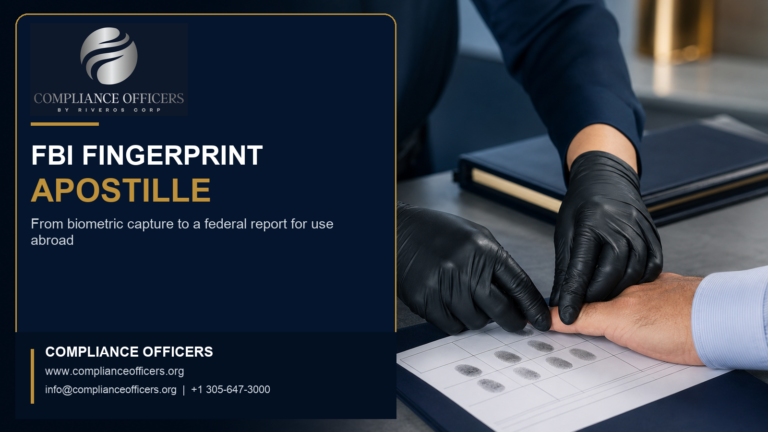
A person searching for an FBI report for use abroad often begins with the fingerprints. The card, live-scan appointment or inked impressions feel like the official document because they contain the biometric information that starts the search. Legally and administratively, however, the fingerprints are only the identifying input. They are not the public document that receives the federal apostille.
The FBI uses the submitted prints and identifying data to conduct the search and issue an Identity History Summary response. The FBI authenticates that response at issuance with an FBI watermark and the signature of a division official. When a Hague apostille is required for foreign use, the relevant federal document can then be presented to the U.S. Department of State. The receiving authority abroad still controls whether it wants that record and how recent it must be. It also decides whether you need a translation and whether the complete package fits the intended purpose.
This guide to the FBI fingerprint apostille process explains the distinctions that help protect the file. It compares fingerprint card versus FBI result and ink versus electronic capture. The comparison covers direct FBI submission versus a channeler and FBI authentication versus the Department of State certificate. It is not a filing script and does not promise a government completion date or foreign acceptance. Its purpose is to explain what Compliance Officers reviews with the client before biometric capture becomes part of an international document package.
What Actually Gets Apostilled After Fingerprint Capture
The underlying public document is the FBI Identity History Summary, also commonly called an FBI background check or rap sheet. The FBI describes the summary as a record of information associated with fingerprint submissions that it maintains. If the search finds no identity-history information, the FBI issues a response communicating that result. In either case, the operative document is the agency response—not the fingerprint card, appointment confirmation, payment receipt or private cover sheet.
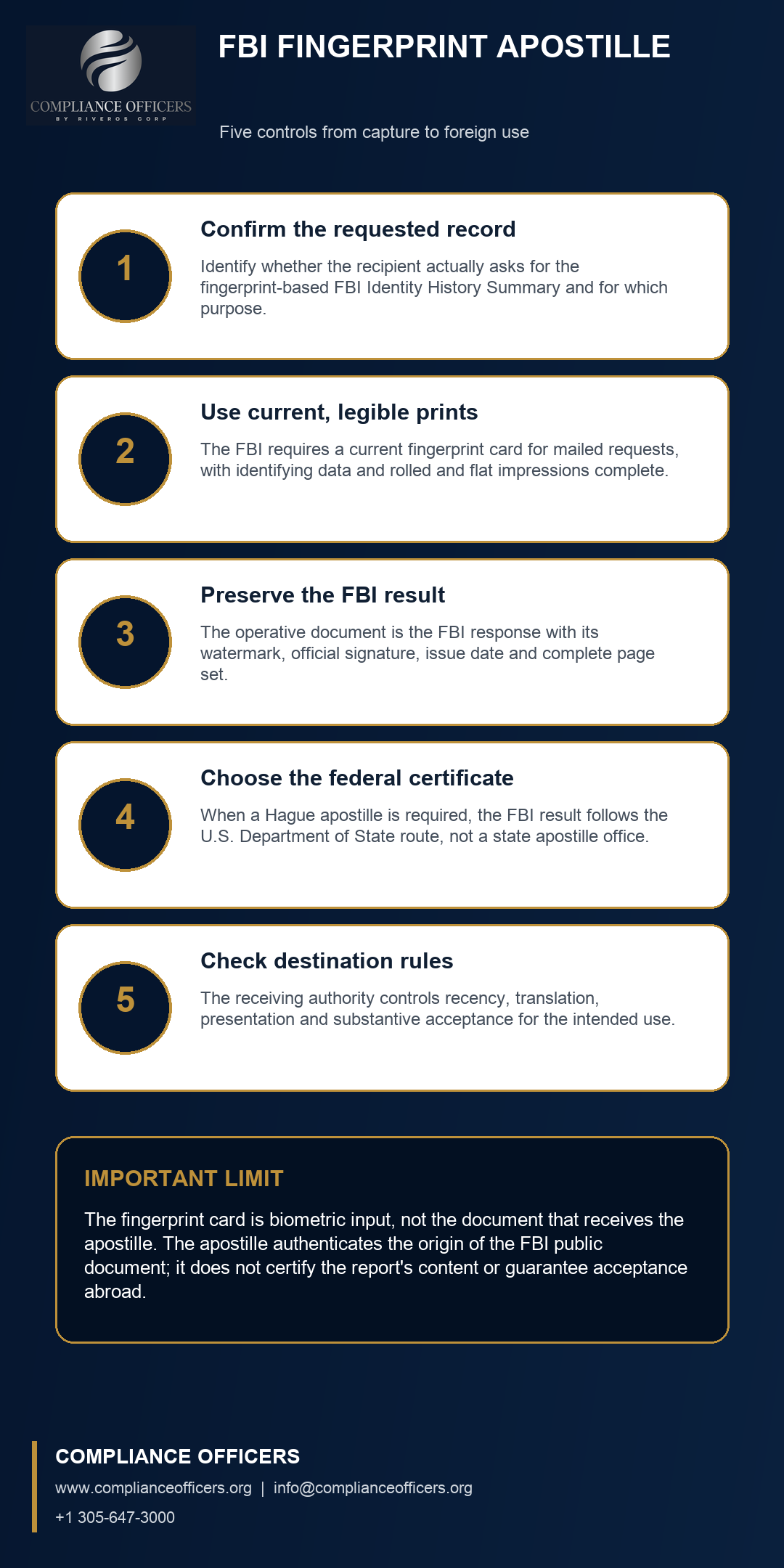
The fingerprint card serves a different function. It contains the identifying data and impressions used to conduct the search. Current FBI instructions for a mailed individual request require a current fingerprint card, not a previously processed card. They also require the person’s name, date of birth and signature. The card needs rolled impressions of all ten fingers and plain or flat impressions taken at the same time. The FBI warns that it rejects illegible cards, causing delay and possible additional cost.
Why the Apostille Goes on the FBI Report, Not the Card
That distinction corrects a common misconception: attaching an apostille to a fingerprint card does not make it internationally effective. The FBI’s own FAQ states that it authenticates fingerprint-search results by placing the watermark and a division official’s signature on the result, and that the authenticated result may then be sent by the requester to the U.S. Department of State for an apostille if necessary. The certificate follows the public document created by the FBI, not the biometric input used to create it.
The article title uses the familiar phrase “a report that is valid abroad,” but that phrase needs a legal limit. An apostille authenticates the origin of the public document—such as the signature, official capacity and seal or stamp within the certificate’s scope. It does not certify the truth of every entry in the criminal-history record, determine eligibility or erase an entry. It cannot compel a foreign consulate, court, licensing body, employer or immigration authority to accept the package.
What to Confirm Before the Fingerprints Are Taken
The first question is not where the nearest fingerprinting counter is. It is what the receiving authority has requested. Some foreign checklists ask specifically for an FBI Identity History Summary. Others ask for a national police certificate, state records, local police letters, records from every country of residence or a combination of documents. Fingerprints sent to the FBI cannot broaden the geographic or legal scope of the resulting summary. The FBI only reports the record it has authority to provide.
You must also separate the purpose from the route. Under federal law, an individual may obtain an Identity History Summary to review, correct or update a personal record. The FBI cautions that domestic employment and licensing checks may need a different path. These often proceed through a state identification bureau, requesting federal agency or another authorized channel. A foreign employer or government may nevertheless ask the individual to provide an FBI summary for an international file. Do not describe those uses as one universal background-check process.
Location, Status and Submission Route
Location and status affect the available submission choices. The FBI offers a direct electronic request, a direct mail request and the option of an FBI-approved channeler. A participating U.S. Post Office can capture fingerprints electronically for a direct electronic FBI request after you complete the online application. Eligibility and location requirements may vary by FBI-approved channeler and submission route. Compliance Officers reviews the applicant’s citizenship or immigration status, physical location, and the current conditions of the selected provider before recommending a route. Applicants outside that rule need an appropriate alternative route rather than a claim that every electronic provider can process every person from every country.
Confirm the fingerprint form for the selected workflow. Current public FBI instructions for a mailed individual request identify the FD-1164 and allow it on standard white paper stock. They also note that a law-enforcement or private fingerprinting agency may prefer its own acceptable card. Other authorized or provider-managed workflows may use different card stock or identifiers. The important control is not repeating a form number from an old article. It is confirming the current form, fields, routing and capture method that apply to the actual request.
Names and Identifying Data on the Card
Identifying data deserves the same care as ridge detail. For a mailed request, the FBI states that the name on the response letter will match the name shown on the fingerprint card. Therefore, review the card against the person’s identity documents and the recipient’s instructions. Pay attention to middle names, compound surnames, prior names or aliases when relevant. The apostille cannot correct a name that someone entered inconsistently at the beginning of the file.
Ink, Live Scan and the Quality Controls That Matter
The FBI accepts fingerprints taken in ink or by live scan. Neither method automatically creates the apostille, and neither is universally superior. The useful question is whether the selected method produces a current, complete and legible submission for the chosen route. Some requests use a live-scan device but still require mailing a physical card. In that case, the FBI instructs the applicant to obtain a hard copy.
For direct mailed requests, the FBI recommends using a fingerprinting technician when possible. The impressions should include the required rolled and flat sets, appear in the correct sequence and remain clear enough for processing. The FD-258 card instructions apply in various civil fingerprint contexts. They also emphasize complete fields, data within the designated blocks, nail-to-nail impressions and no stray marks. Those quality principles help, but you still need to match the exact card and route to the request.
Rejected Prints and Quality Control
Do not convert a rejection into a fixed statistic or a promised retry time. The FBI says that it will reject an illegible card. It advises people with repeated rejections to have a fingerprinting technician take multiple sets. Then mail the cards with the request. The practical effect depends on the submission route, shipping, the applicant’s location and the government queue. A responsible timeline therefore accounts for the possibility of recapture without claiming that one provider can eliminate every rejection.
Privacy and document control also begin at capture. Fingerprint cards contain personally identifiable and biometric information. Limit copies, scans, courier handling and access to what the authorized request actually needs. Once the FBI issues the response, preserve the agency watermark, official signature, issue date, page sequence and legibility. Cropped screenshots, retyped summaries, detached pages and private summaries are not substitutes for the identifiable FBI response.
How the FBI Result Reaches the Federal Apostille Stage
The FBI authenticates its own fingerprint-search result at issuance, but it does not issue the Hague apostille. The next authority depends on the destination country and the certificate requested. When the document will be used within an applicable Apostille Convention relationship and the receiving entity asks for an apostille, the competent U.S. authority for the federal FBI document is the U.S. Department of State.
A state secretary of state cannot authenticate the signature of the FBI division official. Living in that state, or having a local notary sign a copy, does not change that. A notarization of a private statement or printout does not convert it into an FBI-issued public document. Our guide to the federal State Department route for FBI background checks explains why the origin of the signature—not convenience or proximity—controls apostille jurisdiction.
Apostille or Authentication: Check the Destination
Check the destination before selecting the certificate. The Department of State issues an apostille certificate for documents going to countries within the 1961 Hague Convention framework. For destinations outside that framework, it issues an authentication certificate. Treaty status, entry into force and the relationship applicable between the United States and the destination can matter. A country name copied from an old list is not enough when the legal relationship or the receiving institution’s instruction may have changed.
Current Department of State guidance for federal documents also identifies the official features that should be present and warns against notarizing the original federal document as a substitute. Our overview of the U.S. Department of State authentication process describes the federal office’s role. The article does not reproduce the filing sequence. Addresses, forms, access rules and operational requirements can change, so verify them for the intended submission date.
The recipient retains control after the Department issues the federal certificate. It may impose a recency period on the underlying FBI report or require a particular translation credential. It may also request an original and copy, prohibit damaged or detached attachments, or demand additional records from other jurisdictions. There is no universal three-month or six-month life for every FBI report. Do not treat the apostille as an expiration date. It does not guarantee that the underlying record remains recent enough for a specific application.
Common Errors from Fingerprint Card to Foreign Submission
The first critical error is trying to apostille the fingerprint card. That card is only biometric input. The FBI-issued response is the federal public document. It proceeds to the Department of State when you need a federal apostille.
The second error is reusing a previously processed card or relying on incomplete impressions. The FBI requires a current fingerprint card for an individual Identity History Summary request. It also warns that it rejects illegible prints. Do not treat a prior card as a reusable credential merely because the person’s fingerprints have not changed.
The third error is assuming that any live-scan vendor, channeler or fingerprint card works for every applicant. The direct FBI route, participating Post Office capture and approved-channeler route have different conditions. Citizenship or lawful permanent residence and physical location limit channeler eligibility. Domestic employment or licensing requests may follow a different authorized process.
More Costly Errors: Document, Authority and Promises
The fourth error is confusing the FBI result with provider paperwork. An invoice, appointment receipt, fingerprint card, transmission confirmation or channeler cover page is not the Identity History Summary. The operative document should retain the FBI watermark, division official’s signature, issue date, agency identity and complete pages.
The fifth error is using the wrong apostille authority. An FBI response is federal. A state apostille attached to a notarized copy does not authenticate the federal official’s signature. It can create a package that does not match the receiving authority’s request.
The sixth error is promising universal acceptance or completion by a fixed date. The FBI controls issuance of the summary, the Department of State controls the federal certificate, and the recipient controls substantive acceptance. Shipping, government workload, biometric quality and destination rules remain variables. Professional coordination can reduce avoidable mismatches and provide tracked handling; it cannot guarantee a government or foreign decision.
How Compliance Officers Coordinates the Administrative File
Compliance Officers begins with the receiving authority’s written request, the destination country, the intended use, the filing date and the applicant’s location and status. That review helps determine whether the requested document is the FBI Identity History Summary. It also clarifies whether you need another criminal-record document and which fingerprint and submission options exist.
For applicants using an in-person service, Compliance Officers offers fingerprint capture options in Miami and Colombia. For remote files, the team can coordinate card-based handling and review the identifying information and visible quality controls before the request proceeds. The exact route remains subject to the FBI’s rules and the applicant’s circumstances. The service is not the FBI, a government office or a guarantee of acceptance for every set of prints.
From FBI Response to Federal Certificate
When the FBI response arrives, the administrative review separates the operative agency result from receipts or provider paperwork. It also checks that the visible federal features and complete pages remain intact. If the client requests foreign certification, Compliance Officers evaluates the apostille or authentication route against the destination’s current written instruction. Translation and presentation questions follow the recipient’s requirements rather than a universal package.
The FBI controls the fingerprint search and the Identity History Summary. The U.S. Department of State controls issuance of the apostille or authentication certificate. The receiving employer, consulate, court, licensing body or immigration authority controls substantive acceptance. Compliance Officers coordinates document review, preparation and tracked handling to reduce avoidable routing, identity and document-integrity problems without promising a criminal-history result, government processing time, eligibility or acceptance abroad.
To begin an FBI fingerprint apostille review, send the destination, purpose, relevant deadline, the receiving entity’s written instructions and a legible copy of any document already available. Learn more through the Compliance Officers FBI Background Check service. This allows an assessment of the administrative route before anyone treats fingerprints, report and certificate as the same document.
Frequently Asked Questions
Can I apostille the fingerprint card itself?
No. The fingerprint card is the biometric input for the FBI search. The FBI response—with the watermark and official signature—is the federal public document. It goes to the U.S. Department of State for an apostille when required.
Which fingerprint card does the FBI require for an Identity History Summary?
Current FBI instructions for a mailed request identify the FD-1164 and require a current card with complete data and impressions. A fingerprinting agency or another authorized workflow may use an acceptable provider-specific card. Confirm the current form for the selected route.
Are ink fingerprints or live scan better for an FBI apostille?
The apostille applies to the FBI result, not the capture method. Both ink and live-scan fingerprints are acceptable to the FBI. The appropriate choice depends on location, route and whether the request needs a hard-copy card. What matters is a current, complete and legible submission.
Can I obtain the FBI report and apostille while outside the United States?
A person abroad may use a direct FBI request with a physical fingerprint card, then coordinate the federal certificate. An FBI-approved channeler has narrower rules. It may process only qualifying U.S. citizens or lawful permanent residents in the United States or its territories. Review the available route against the applicant’s facts.
Can a state office apostille an FBI fingerprint report?
No. The FBI Identity History Summary is a federal document. When you need a Hague apostille, the U.S. Department of State issues the relevant certificate. A state apostille cannot authenticate the signature of the FBI division official.
Does the apostille make the FBI report valid everywhere?
No. The apostille authenticates the origin of the public document. It does not certify the report’s content, determine eligibility, satisfy every recency or translation rule, or compel acceptance. The receiving authority’s current requirements remain controlling.
Get Help With Your FBI Fingerprint Apostille
Do you need fingerprints coordinated and an FBI report reviewed for foreign use?
Compliance Officers reviews the request, helps identify the appropriate fingerprint and FBI route, and coordinates the federal certificate stage when required to reduce avoidable document and jurisdiction mismatches.
Call: +1 305-647-3000
WhatsApp: +1 305-647-3000
Email: info@complianceofficers.org
Legal disclaimer: This article provides general information and does not constitute legal advice or a promise of acceptance. Requirements can vary by submission route, applicant status and location, destination country, receiving authority, intended use, document version and date. Confirm current substantive requirements with the authority that will receive the document.