If a foreign consulate, immigration office, employer, licensing body, or other institution has asked for an FBI Identity History Summary apostille, the wording matters. An Identity History Summary is the official FBI response produced after a fingerprint-based search. Many people call it an “FBI background check” or “rap sheet.” Still, it differs from a state police check, a county court search, and a commercial database report.
The apostille is a separate federal certificate. You need it when you present a qualifying FBI document in a country that follows the 1961 Hague Apostille Convention. It confirms the origin of the public document. It does not certify that every statement in the report is correct. The certificate also cannot erase a record or guarantee that a foreign institution will accept the document for every purpose.
That distinction is where many applications go wrong. A person can order the correct FBI result but send it to the wrong authority. Others use a document that lacks the necessary federal authentication features or ignore a destination-specific recency rule. Some request an apostille when the destination demands an authentication certificate instead. Compliance Officers helps clients identify the correct document and coordinate the administrative route before those avoidable problems consume time and money.
What an FBI Identity History Summary Is—and Is Not
The FBI describes an Identity History Summary as a listing of information associated with fingerprints submitted to the FBI and maintained in its systems. The response depends on the records available. It may contain arrest information and related dispositions from authorized agencies. It may instead state that no Identity History Summary exists for the fingerprints searched.
The report relies on fingerprints, not only on a name. That allows the FBI to make a positive identification, but it does not make the result a universal “national background check” for every legal purpose. The FBI’s own request form warns about two limits. A personal-review summary may not include information that sits only in state repositories. It also may not substitute for the specialized process that employment, licensing, or adoption within the United States requires.
This limitation is important. A foreign authority may specifically request an FBI Identity History Summary because it wants the federal fingerprint-based result. A U.S. employer or licensing agency, however, may require a different statutory channel. Confirm the intended use before the request begins.
The FBI authenticates fingerprint-search results at issuance by placing an FBI watermark and the signature of a division official on the response. Those features are critical when the document will be submitted to the U.S. Department of State. A screenshot, an altered file, a third-party summary, or a commercial background report is not the same document simply because it contains similar information.
For a broader comparison of the federal report and other record searches, see our article on FBI background checks versus other criminal-record certificates.
What the FBI Identity History Summary Apostille Certifies
An apostille is a certificate issued under the 1961 Hague Apostille Convention. Its legal effect stays narrow. It verifies the authenticity of the signature on the underlying public document and the capacity in which the signer acted. When applicable, it also verifies the identity of the seal or stamp. It does not verify the report’s substantive content and does not give the underlying document extra evidentiary weight.
For a qualifying FBI Identity History Summary signed by a federal official, the competent U.S. authority is the U.S. Department of State’s Office of Authentications. A state Secretary of State generally handles documents tied to officials or notaries from that state, not the federal signature on an FBI result. The applicant’s residence does not change the origin of the document: living in Florida does not turn an FBI response into a Florida document.
The destination country also controls the route. If the destination country follows the Hague Apostille Convention, you may request an apostille. If the destination sits outside that framework, the federal office may issue an authentication certificate instead. You may also need extra consular steps. Our overview of the U.S. Department of State apostille process explains why federal and state documents follow different paths.
Even when an apostille is the correct certificate, the receiving authority remains responsible for deciding whether the underlying report is acceptable for the intended procedure. It may require a recent issue date, a translation, a particular presentation format, or additional supporting documents. The apostille removes a traditional legalization formality; it does not replace the destination’s substantive requirements.
What to Confirm Before Requesting the Federal Certificate
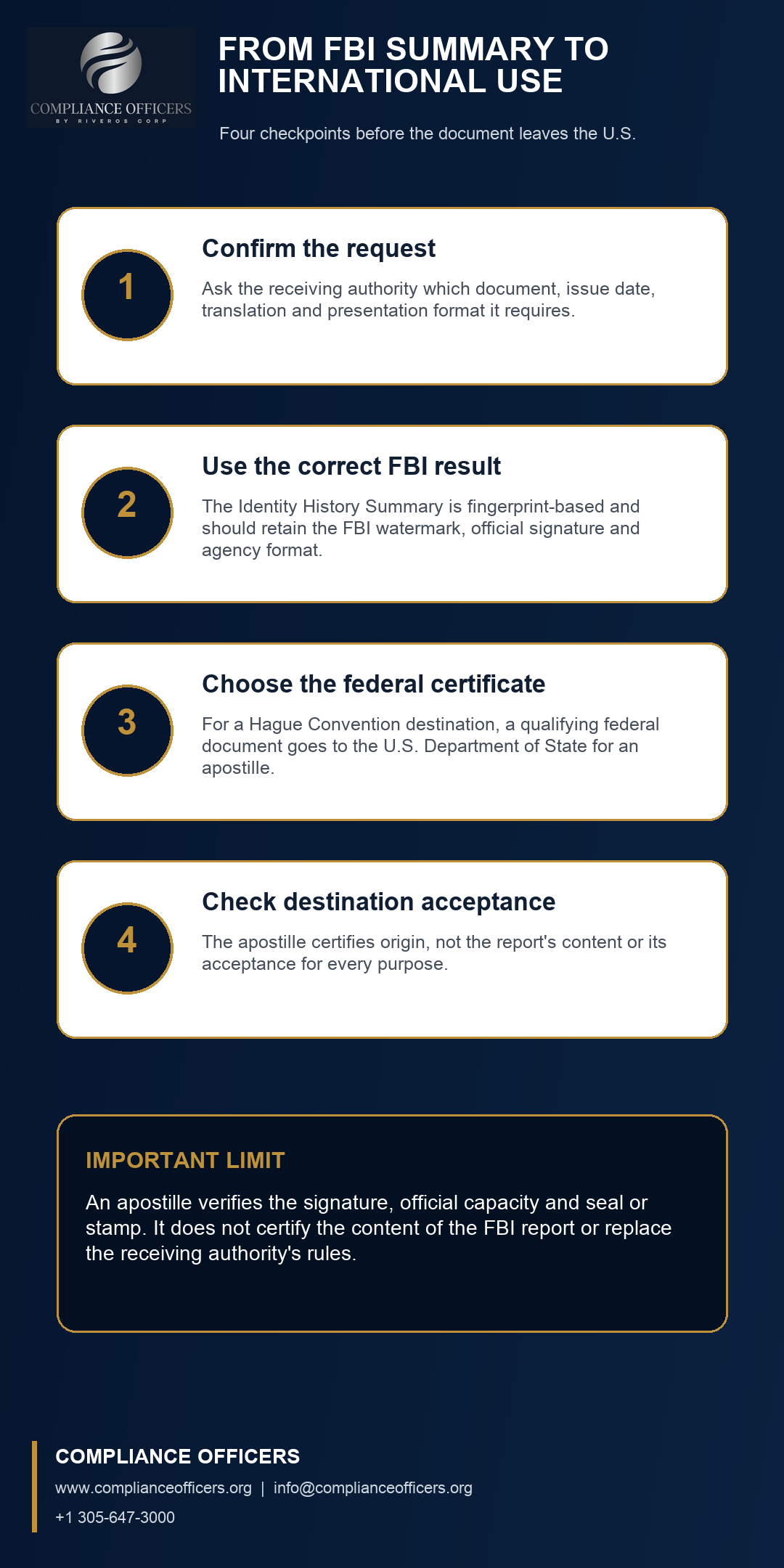
Before ordering or submitting anything, identify four facts:
- The exact document requested. Confirm whether the institution wants an FBI Identity History Summary, a state background check, a police clearance, a court record, or another document.
- The country and receiving institution. Country-level rules matter, but a consulate, immigration agency, university, court, or employer may impose its own requirements.
- Permitted issue date. The FBI result does not carry a universal expiration date, but the receiving authority may accept only reports issued within a defined period.
- The required language and format. Confirm what the receiver expects: an original paper response, an electronic response, a translation, or a specific attachment method.
Answer these questions before the fingerprint appointment and before you request the federal certificate. A correct apostille cannot repair the wrong underlying document. If the report or certificate changes later, you may also need to redo an early translation.
What Official Instructions Do Not Always Make Obvious
Official instructions explain eligibility and submission requirements, but several operational details still require careful attention:
- A channeler is a transmission service, not a different government record. The FBI states that approved channelers forward fingerprints and receive the electronic Identity History Summary result for delivery to the individual. What matters for the federal certificate is whether the document submitted retains the FBI authentication features and satisfies the Department of State’s document requirements. Do not assume that every item delivered by an intermediary is automatically eligible or automatically ineligible; inspect the actual result.
- The destination may impose a freshness window. There is no single international rule that every FBI report is valid for three or six months. The accepting authority establishes the date rule. Ordering too early can leave a correctly apostilled report outside the permitted window by the appointment date.
- An electronic result and a random printout are not equivalent. The FBI allows electronic delivery and printing of results. However, the federal authentication request still must include a document that meets the Department of State’s requirements. That means the official signature, title, seal or agency features, and date of issuance.
- The FBI does not offer an official expedited Identity History Summary service. The FBI says electronic requests move faster than mail requests, but staff handle each file in order of arrival. Private coordination can reduce avoidable administrative delay; it cannot compel a federal agency to move a file ahead of its queue.
Paper Fingerprint Cards and Image Quality
Applicants using paper fingerprints should also plan for image quality. The FBI requires a current fingerprint card and recommends having multiple sets taken, preferably by a fingerprinting technician, to reduce the risk of rejection. Our article about the FD-258 fingerprint form explains the role of the fingerprint card without turning it into the document that receives the apostille.
Common Mistakes and Their Consequences
Using a state apostille route for a federal report
The relevant signature on an FBI Identity History Summary is federal. Sending it to a state office can lead to rejection or return of the package. It can also produce a certificate attached to a different notarized act rather than to the FBI official’s signature. That detour may not satisfy the receiving authority.
Submitting the wrong kind of background check
A state police report, county search, private “instant check,” or name-based database result never becomes an FBI Identity History Summary. Notarization or an apostille does not change that. If the foreign authority named the FBI document, the underlying record must match that request.
Assuming the apostille validates the record
The apostille does not declare that a person has no criminal history. It does not confirm that every disposition is current. It also does not decide how a foreign authority should evaluate an entry. If the FBI summary appears inaccurate or incomplete, the FBI provides a separate challenge procedure. Apostilling the document does not correct it.
Ignoring the receiving authority’s date or translation rule
A technically valid federal apostille may still fail at the counter. That happens when the report is older than the institution permits or when the required translation is missing. Confirm acceptance with the entity that will receive the document.
Changing or separating the document after certification
The certificate and underlying public document form one authenticated package. Removing pages, altering the file, replacing the report, or disturbing the attachment can undermine the link that the certificate establishes.
These errors do not always appear until the file reaches the destination. By then, the applicant may face another fingerprint submission, another FBI request, another federal certificate, and new shipping or appointment costs.
How Compliance Officers Can Coordinate the Process
Compliance Officers provides administrative support designed around the document’s intended use. We begin by reviewing the request from the receiving institution, the destination country, the applicant’s available identity information, and the format of any FBI result already obtained.
Depending on the case, our support may include:
- coordinating fingerprint capture and reviewing the identifying information for consistency;
- helping the client distinguish an FBI Identity History Summary from state or commercial background checks;
- checking whether an existing result retains the federal authentication elements needed for the next stage;
- preparing and organizing the administrative submission for the appropriate federal certificate;
- coordinating translation and delivery when requested and applicable;
- tracking the file and communicating procedural updates during processing.
Our role is to reduce avoidable errors and unnecessary back-and-forth. Government processing times, the content of the FBI result, and the final decision of a foreign institution remain outside any private provider’s control. We do not promise a record outcome or guarantee acceptance. We do provide a documented, destination-aware process so the correct file reaches the correct authority in the proper order.
If you are comparing the stages and possible timing variables, read our overview of FBI background check apostille processing time. Contact Compliance Officers to coordinate your fingerprint capture, FBI Identity History Summary, and federal apostille through a documented process tailored to the destination and receiving authority. FBI background check apostille processing time.
Frequently Asked Questions
Is an FBI Identity History Summary the same as an FBI background check?
It is the fingerprint-based FBI response commonly called an FBI background check or rap sheet. It differs from other checks sold under that general label. The FBI also notes that a personal-review summary is not a universal national check.
Who issues an apostille for an FBI Identity History Summary?
The U.S. Department of State’s Office of Authentications issues the apostille for a qualifying, federally signed FBI result. This applies when the destination country follows the Hague Apostille Convention. State offices cannot authenticate the federal official’s signature.
Does the apostille confirm that the FBI report is accurate?
No. The apostille certifies the origin of the public document—its signature, the signer’s capacity and, when applicable, the seal. It does not certify the report’s content. Address errors through the FBI’s challenge process.
Can an electronic FBI Identity History Summary be apostilled?
An electronically delivered FBI result may work. The document must keep the required FBI watermark, official signature, agency format, and issue date. It must also meet the Department of State’s requirements. Review the actual file first; a screenshot or altered copy is not equivalent.
How long is an apostilled FBI report valid abroad?
The apostille creates no universal expiration period. The receiving country or institution decides how recent the FBI result must be. Confirm that date rule before ordering, so processing and delivery fit the intended filing date.
What happens if the destination country is not covered by the Hague Convention?
An apostille may not be the correct certificate. The document may need a federal authentication certificate plus legalization through the destination country’s embassy or consulate. The route depends on the country and receiving authority.
Can Compliance Officers coordinate the process if I am outside the United States?
Yes. Compliance Officers can coordinate fingerprint instructions, review the FBI result, organize the federal certificate request, and arrange translation or delivery. We confirm availability and timing after reviewing the destination requirements.
Get Help With Your FBI Apostille
Do you need an FBI Identity History Summary prepared for use abroad?
Compliance Officers can review the destination requirements and coordinate the appropriate administrative route.
Request an evaluation
Phone and WhatsApp: +1 305-647-3000
Email: info@complianceofficers.org
Legal disclaimer: This article shares general information only and does not constitute legal advice. Requirements may vary by country, institution, document version, and date. An apostille does not certify the content of the underlying document or guarantee its acceptance. Confirm the current requirements with the authority that will receive the document.