How to find articles of incorporation depends first on where the corporation was formed. The state filing office holds the official formation record, even when the company operates elsewhere. Its public database may show the filed articles, provide document-ordering options or direct you to another records service.
The search also depends on your purpose. Reading a charter for background research differs from obtaining a certified copy for a bank or an international transaction. A company profile, a filed image and a certificate of status can each answer a different question.
This guide explains what those records show and where their limits lie. Riveros Corp can coordinate a corporate-record request, including identifying the appropriate jurisdiction and the document required by the recipient. Legal interpretation and transaction advice may require a licensed adviser.
How to find articles of incorporation in the correct state
A corporation’s state of incorporation can differ from its headquarters, mailing address and principal market. For example, a business operating in Florida may have formed in Delaware. A Florida search could then show its registration to operate there rather than its original formation filing.
State filing offices use different names and systems. The relevant office may be called the Secretary of State or the Division of Corporations. The record should identify the corporation’s legal name and jurisdiction, with a document or file number where available.
Before requesting a copy, establish which legal entity the review concerns. A familiar brand can belong to a group with several subsidiaries. The company named in a contract may differ from the parent company or the name displayed on a storefront.
Our guide to what articles of incorporation are explains the formation document itself. An LLC, nonprofit or other entity may use a different document or follow different rules.
When the state of incorporation is unknown
Contracts, company disclosures and official registrations can provide a starting point. A registration as a foreign corporation may identify the home jurisdiction. In this context, “foreign” can mean formed in another U.S. state, rather than another country.
However, the absence of a record in one state does not establish that the business does not exist. The search may use the wrong legal name, entity type or jurisdiction. It may also encounter a former name or a record that requires a separate request.
For companies with SEC filings, public securities records can provide additional clues. The SEC’s EDGAR system provides access to filed reports and related documents. Those records can support the search, although they do not replace the state’s certified record when a recipient requires one.
How to find articles of incorporation through official records
The filing office’s own records are the main source for the state-filed charter. Public search tools vary: one state may display document images, while another provides basic information and a separate ordering process. Access to an entity profile does not necessarily include access to every document.
Florida’s Corporation Records guide describes searches by entity name and document number, among other fields. It also explains the corporate-detail page and access to available filed documents.
By comparison, the Delaware entity search states that its results include active and inactive entities. It directs requests for plain copies, certified copies and status certificates through separate services. Appearing in search results therefore does not, by itself, establish active status.
Third-party directories can help identify possible records, but their information may be incomplete or outdated. A records review should distinguish a directory entry from the official filing it references. Preserve the source and retrieval date when documenting the result.
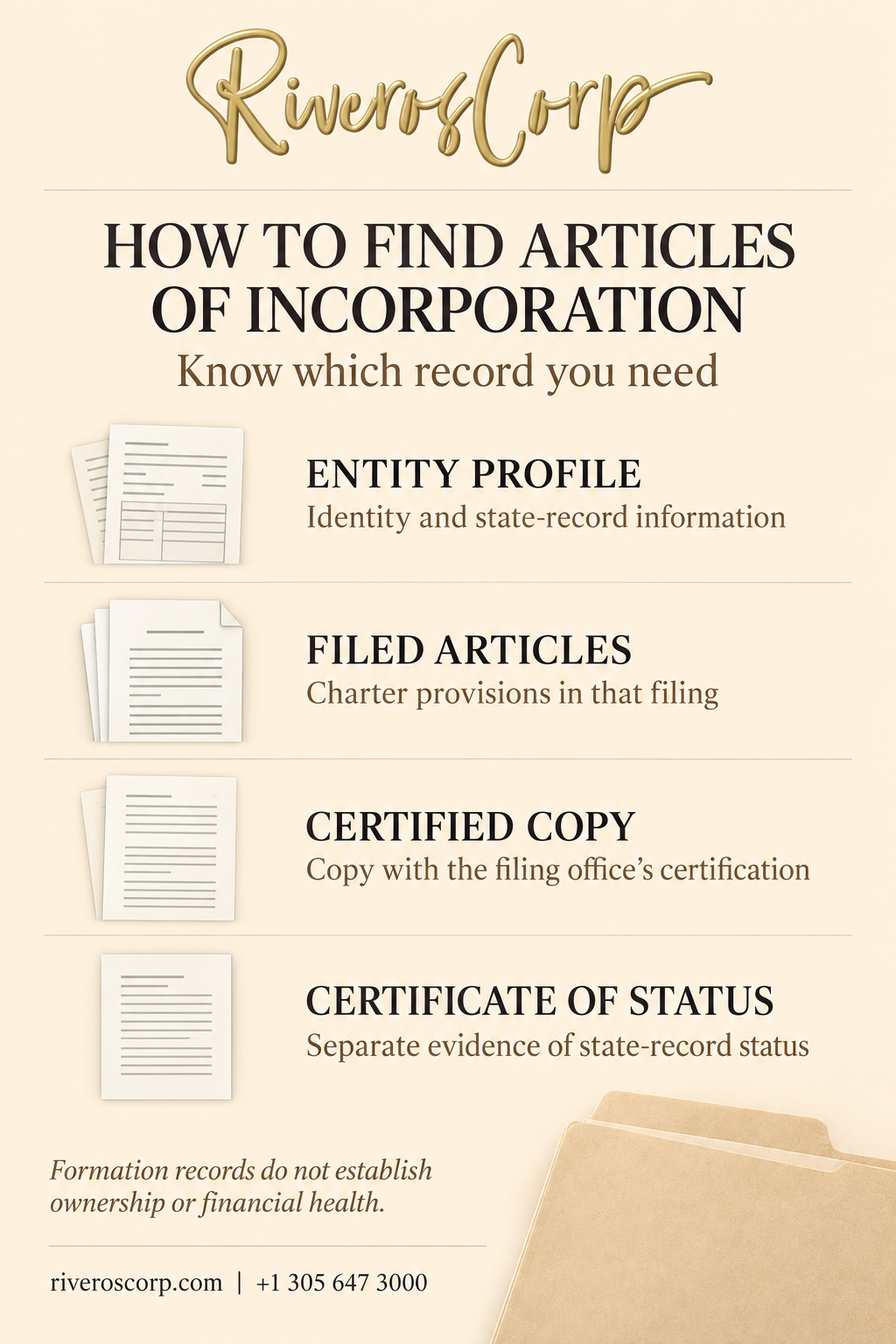
Which corporate record do you need?
A request for “the company documents” can be too broad to identify the right record. The recipient may need the original charter, the current charter after amendments, an official certified copy or proof of state-record status. Clarifying that purpose helps avoid ordering an unsuitable document.
| Record | What it helps establish | Important limit |
|---|---|---|
| Entity profile | Identity and information displayed by the state | It is not the complete charter or ownership record |
| Filed articles | Provisions contained in that charter filing | Later amendments or restatements may affect the current text |
| Certified copy | A copy with the filing office’s certification | Certification does not establish every underlying business fact |
| Certificate of status | The state-record matters certified by the issuing office | It does not establish financial health or contract authority |
Florida lists certified copies and certificates of status as separate services on its certification page. The wording of the recipient’s request should guide which document is appropriate.
A copy suitable for informal review may not meet a bank’s certification requirements. Likewise, the original formation filing may be insufficient when a transaction calls for the charter currently in effect. The request should identify that distinction.
What the articles can tell you
The filed articles can show the corporation’s legal name and charter provisions, along with the information required or permitted by its governing law. Depending on the jurisdiction and filing, that may include the incorporator, registered agent, authorized shares and optional provisions.
Read each fact in the context of the document’s date. An original filing describes information supplied at formation. A later annual report may identify different officers or addresses. Those later details should not be attributed to the original articles unless they actually appear there.
The distinction is especially useful when comparing a company’s statement with its record. A name shown in an older filing may have changed through an amendment. The discrepancy may have an explanation, but that explanation needs support in the record.
Similarly, a filing date can differ from an effective date. Where the record identifies both, preserve both. Replacing one with the other in a report can give a misleading account of when a corporate action took effect.
What the articles cannot establish alone
Authorized shares describe the charter’s permitted share structure. They do not identify every share actually issued or its owner. Ownership review may require the stock ledger, issuance records, transfer documents and other relevant evidence.
A registered agent has a designated role in receiving specified legal and state communications. A professional registered-agent service may represent many unrelated businesses. Therefore, a shared agent or address does not by itself prove common ownership or management.
The articles also do not establish the corporation’s complete finances, contracts, internal bylaws or legal compliance. An active state-record label has its own limited meaning. It should not be treated as proof of solvency, creditworthiness or authority to sign a particular agreement.
These limits matter in due diligence. A clean-looking formation record can answer a formation question while leaving important business questions unresolved. The review should state which conclusions the documents support and which require other evidence.
Finding the current charter after changes
Learning how to find articles of incorporation also means identifying the version needed. The first filing in a document history may be the original charter, but it may no longer contain every provision currently in force.
Amendments can change individual provisions. A duly adopted restatement can consolidate the charter and supersede earlier articles and amendments under the applicable law. Merger or conversion records may also affect which entity or charter the review concerns.
For that reason, the original filing should be considered with the relevant later record. A reviewer should distinguish an amendment from an annual report rather than treating every dated document as a replacement charter.
Our guide to amended and restated articles explains the consolidated document. Historical records can still matter for transactions completed before a later change took effect.
Certified copies and use outside the United States
A document image available online is useful for review, but it is not automatically a certified copy. A state-certified copy includes the issuing office’s certification concerning the document represented by that copy. Our guide to certified copies of articles of incorporation covers that record in more detail.
For use abroad, the recipient should specify the underlying document and any authentication requirement. An apostille may be appropriate for an eligible document used between applicable Hague Convention jurisdictions. Other circumstances may involve a different authentication route.
The competent authority depends on the document’s origin and certification. Florida explains its process on the apostille and notarial certification page. A commercial coordinator does not replace the official issuing authority.
An apostille authenticates the relevant signature, capacity and seal or stamp; it does not certify the business claims contained in the articles. It also does not guarantee acceptance for every transaction. Translation and recipient-specific requirements may remain separate.
How to assess an incomplete or conflicting result
A search can return several similar names or a profile with only part of the expected history. Before drawing a conclusion, the reviewer should compare the legal name, jurisdiction, file number and relevant dates. Similar names alone are not enough to identify the correct entity.
A missing document image may require a records request rather than a conclusion that no filing exists. Older records, document availability and ordering methods differ among jurisdictions. The scope of the search should remain clear in any report.
Conflicting information also deserves a precise description. For example, a contract may name one corporation while a website names an affiliate. The difference calls for clarification about the contracting party, rather than an unsupported claim of fraud.
Where an investment, acquisition or significant contract depends on the result, a licensed adviser may need to assess the legal implications. Record retrieval provides evidence; the transaction may require a broader review.
Frequently asked questions about finding corporate articles
How do I find articles of incorporation for a company?
Identify the legal entity and state of incorporation, then use the official filing office’s records or document-request service. Available search fields, images and copy services vary. Confirm whether the recipient needs the original filing, current charter or a certified copy.
Are articles of incorporation public records?
They are ordinarily accessible through the state filing office’s public-record process. However, online availability and ordering requirements differ. Access to a company profile does not necessarily provide every filed document or the certification needed for a transaction.
What if the company operates in a different state?
The formation state remains the starting point for its charter. A registration in another state may identify the home jurisdiction. A missing result in the operating state does not, by itself, prove that the company does not exist.
Does a Sunbiz image prove current status?
No. A filed image shows the document represented by that image. Current status information and a certificate of status serve separate purposes. Later filings may also affect the charter or explain changes since formation.
Can I use a downloaded copy for an apostille?
Do not assume that an ordinary download meets authentication requirements. The competent authority may require a properly certified state record. Confirm the underlying document, destination and recipient’s requirements before arranging the certification and authentication work.
Discuss your records request with Riveros Corp
Riveros Corp can help identify how to find articles of incorporation for the entity and purpose involved. The team can coordinate record retrieval and the appropriate certified-copy or authentication request, subject to the issuing office’s requirements.
Visit Riveros Corp, call +1 305 647 3000 or use WhatsApp. Share the company’s legal name, any known jurisdiction and the recipient’s request so the team can assess the scope.
This article provides general information about corporate records. It is not legal or tax advice. Requirements depend on the entity, jurisdiction, document and intended use.