Marriage certificate legalization starts with the certificate you already hold and what it will be used for abroad. A document issued in the United States may need an apostille, or it may need a separate authentication and consular route. That depends on the destination and the requirements that apply. Before you order any service, confirm who issued the record, what kind of certified copy you have, and which institution will receive it.
This article deals with an existing U.S. marriage record. It does not cover how to get married, how to apply for a marriage license, or how to register a relationship in another country, since those are separate processes. Apostille de la Haya can review how the document is prepared for international use. The receiving authority sets its own filing and recognition requirements.
Marriage certificate legalization starts with the correct record
Take the document out of its folder and read the issuing office and the certification statement. A ceremonial keepsake, an unexecuted license, a photocopy, and an official certified record are four different things. Looks can mislead. Decorative paper may seem formal and still lack the public official’s certification needed for international authentication.
USA.gov separates a marriage license from a marriage certificate. The license authorizes a marriage, and the certificate records that the marriage took place. State terminology and record formats vary, so look at the actual completed record. Don’t reject it or accept it just because the heading says “license.” If you’re not sure which version you have, ask the issuer.
Write down the state or jurisdiction, the county if there is one, the issuing office, the certification date, the official signature, and the seal. If the copy is incomplete or the official certification is missing, fix that before legalization. Don’t assume that a notary’s statement on an ordinary photocopy can replace a certified copy issued by the lawful custodian of the marriage record.
Identify the recipient and how the record will be used abroad
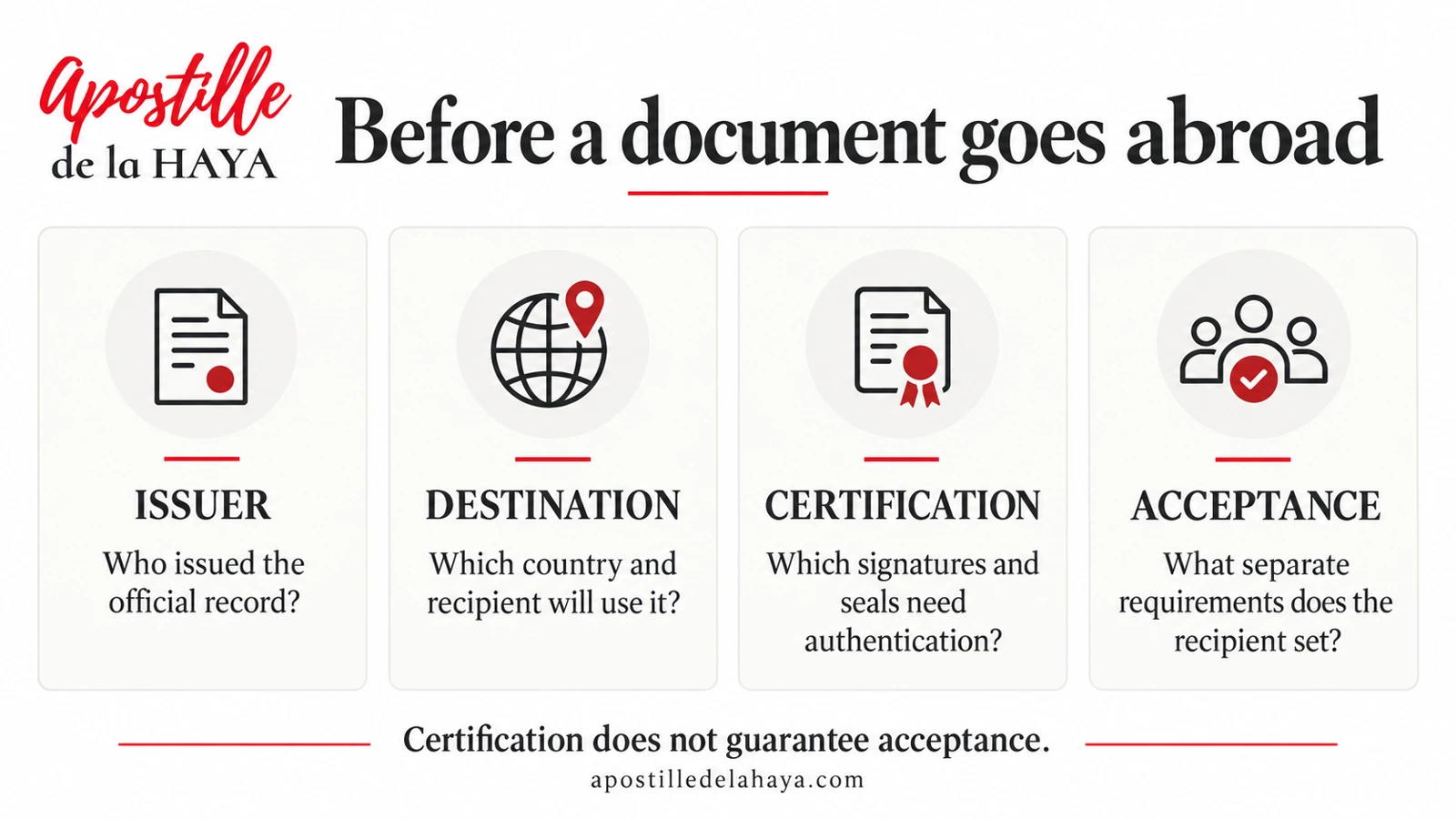
You need to know the destination country, but that alone won’t tell you enough. Identify the government office, employer, court, bank, or other organization asking for the certificate, and get its current instructions for that specific filing. A family residence application and a private benefits enrollment may both ask for the same marriage record and still want different supporting documents.
Ask what form of copy it accepts, whether the copy must have been issued within a set period, which language it requires, and which certifications must come with it. Nothing supports a blanket rule that every U.S. marriage certificate must be recently issued. If a recipient does require a recent copy, note that requirement and plan for it. It doesn’t mean the marriage itself has expired.
Find out whether the office only needs evidence of the marriage or also runs a separate registration or recognition procedure. Marriage certificate legalization supports the authenticity of relevant signatures and official acts. On its own, it does not enter a marriage in a foreign civil register, make anyone eligible for a visa, or settle every legal consequence of the relationship. The competent authorities decide those questions.
Match the copy to the issuing state’s requirements
The signature on your copy can affect whether it’s ready for the next office. Check the issuing state’s authentication instructions for that version. The state where you live now does not automatically become the authority that certifies a record issued somewhere else. If the certificate came from another state, begin with that state’s rules and the official signature that actually appears on it.
Florida’s accepted-document instructions, for example, list eligible marriage records and the relevant official signatures. The takeaway is to look at the issuer and the certification. Adding a private notarization to a public record should not be your default. And Florida’s requirements shouldn’t be applied to a certificate from another state.
New York’s authentication guidance shows another distinction. Qualifying records issued by the state Department of Health can have different preparation requirements from records issued locally. The exact signature and office matter. With a complete preliminary copy, a reviewer can tell whether your version works or whether you should consider more official preparation or a replacement.
Apostille or consular route for marriage certificate legalization
An apostille is used for covered public documents within the framework of the Apostille Convention. Where that framework doesn’t govern the intended use, a different authentication and consular route may apply. Before you order a certificate, check the HCCH information on the Apostille Convention and ask the authorities responsible for the document and the destination.
This has real consequences. If you request an apostille for the wrong route, you may end up with an official certificate that doesn’t meet the foreign filing requirement. Going the other way, adding consular legalization where the Convention removes that step can create work you didn’t need. So ask which certification framework applies to this record for this destination. Which stamp sounds more complete is beside the point.
For background on the apostille option, see the marriage certificate apostille guide. If the required route includes state authentication, federal authentication, and an act by a foreign mission, check each stage against current instructions. That sequence is not a universal rule for every destination. A copy that already has an apostille is not automatically ready for consular submission either.
Confirm the federal and mission stages when they apply
The U.S. Department of State’s authentication requirements explain how to prepare documents sent to the federal office. A marriage record issued by a state does not become a federal vital record because one spouse is a U.S. citizen or because the couple now lives overseas. Its state origin still matters for the earlier certification requirements.
For the foreign stage, identify the competent mission and confirm its document category, jurisdiction, application channel, and return arrangements. A mission may use an authorized service channel, or it may treat personal records differently from commercial documents. Don’t bring over requirements from an embassy in another country into the U.S. submission process without confirming them.
The UAE is a current example. Its embassy in Washington publishes guidance that sends personal documents through VFS after U.S. Department of State authentication. The UAE attestation service overview can help you discuss that destination. The example shows why a current, country-specific channel matters. It is not the route for every foreign marriage filing.
Compare names and dates before translation
Check both spouses’ names, the marriage date, the place, and the record details against what the recipient’s application requires. A certificate may correctly show the name a spouse used at the time of the marriage, while the passport shows a later name. That doesn’t automatically make the record defective. Ask the recipient what evidence it needs to link the names before you request a correction that may not be appropriate.
Tell a genuine record error apart from a legitimate name change or a transliteration difference. Corrections to the official record are up to the issuing authority. Don’t edit a scan, cover a name, or ask a translator to quietly replace source information. If the issue affects identity, get guidance on the acceptable supporting document or the official correction process before you spend more on certification.
Keep dates clear across forms and translations. A numeric date can be read differently depending on the format, and an anniversary date should never be confused with the date the certified copy was issued. The translation should reflect what each field actually means. If a form asks for information the certificate doesn’t contain, ask how to support that field. Don’t make it up.
Treat translation as a separate requirement
Confirm whether the recipient accepts the English certificate, needs an official translation, or accepts a particular bilingual format. Find out who may translate and whether a translator’s declaration or separate certification is needed. A translation prepared for one institution may not satisfy another, even when both are in the same country.
Plan when the translation happens. If the recipient wants the complete legalized packet translated, a translation done before the official certificates are attached may be incomplete. If the translation itself has to be certified, that changes the order of steps. Answer these questions before you order services, so nobody has to translate the same pages twice.
A translation doesn’t authenticate the underlying record, and marriage certificate legalization doesn’t automatically certify that a translation is accurate. Keep the purpose of each item clear. The marriage certificate, its official attachments, the translation, and any translator declaration should each be recognizable as a separate part of one organized file. Otherwise you risk a packet where nobody can tell which certificate goes with which document.
Prepare delivery and final presentation with care
Keep a complete, legible copy for your records and for a preliminary review. Leave the original certified record and all official attachments intact. Don’t detach certificates or remove fasteners just to fit a scanner or a courier sleeve, because the connection between pages may be part of how the certification identifies the document it covers.
Right before you send it, confirm the required submission form, delivery address, document category, and return method. Build your schedule around every required stage, including transit and possible corrections. A carrier’s delivery message doesn’t mean an office has finished its examination. And one authority’s processing estimate is not the total time before the foreign recipient can use the certificate.
Before final presentation, compare the finished packet with the recipient’s original instructions. Check both spouses’ details, the required certifications, the translation, the number of copies, and any case reference. Track immigration, benefits, and registration requirements separately from the document preparation checklist. A fully legalized certificate is one part of the recipient’s review. It does not promise that the wider application will be approved.
Frequently Asked Questions
Can I legalize the marriage certificate I have kept for years?
It may be usable if it is an eligible certified copy in acceptable condition and it meets the recipient’s requirements. Age alone doesn’t prove it has to be replaced. Check the issuer, the signature, the certification, and any rule the recipient has about recent issuance. A preliminary review can show whether your current copy is a good place to start.
Is a notarized photocopy enough for international use?
Don’t assume it is. A public marriage record generally has to be in the official version the relevant authorities accept. A private statement about a photocopy is a different act from certification by the record’s custodian. Confirm the required format before you notarize anything, especially if you can get a certified copy from the official issuer.
Does legalization register my marriage in the destination country?
No. Legalization and registration have different purposes. Certification supports the authenticity of the relevant official signatures, while a foreign registration or recognition procedure may need its own application and evidence. Ask the receiving authority whether that procedure applies to your purpose and what role the legalized certificate plays in it.
Should the certificate show my current married name?
It depends on the record and on what the recipient requires. A marriage record may correctly identify a spouse by the name that spouse used at the time of the marriage. Compare it with your current ID and ask what evidence links the names. Don’t change the certificate or the translation just to force a match with a later passport.
What if the certificate was prepared for a different country?
Have the whole existing packet reviewed against the new destination and recipient. The earlier apostille, authentication, consular certificate, or translation may not fit the new requirement. Keep those attachments in place while the route is assessed. You may be able to reuse the record, but successful use in another country doesn’t mean it will be accepted here.
Request a review of your existing marriage certificate
The marriage certificate legalization service can help assess your U.S. record and how to prepare it for the intended destination. Send a complete copy, the issuing state, the country of use, the recipient’s instructions, and your deadline. Include any certification or translation you already have, so the review accounts for work that is already done.
Contact Apostille de la Haya on WhatsApp +1 305 500 0185. Tell us whether you already hold the certified copy and whether the receiving authority has pointed out a specific problem. Those details let us review the marriage certificate legalization requirements for your record and identify what remains to be done.