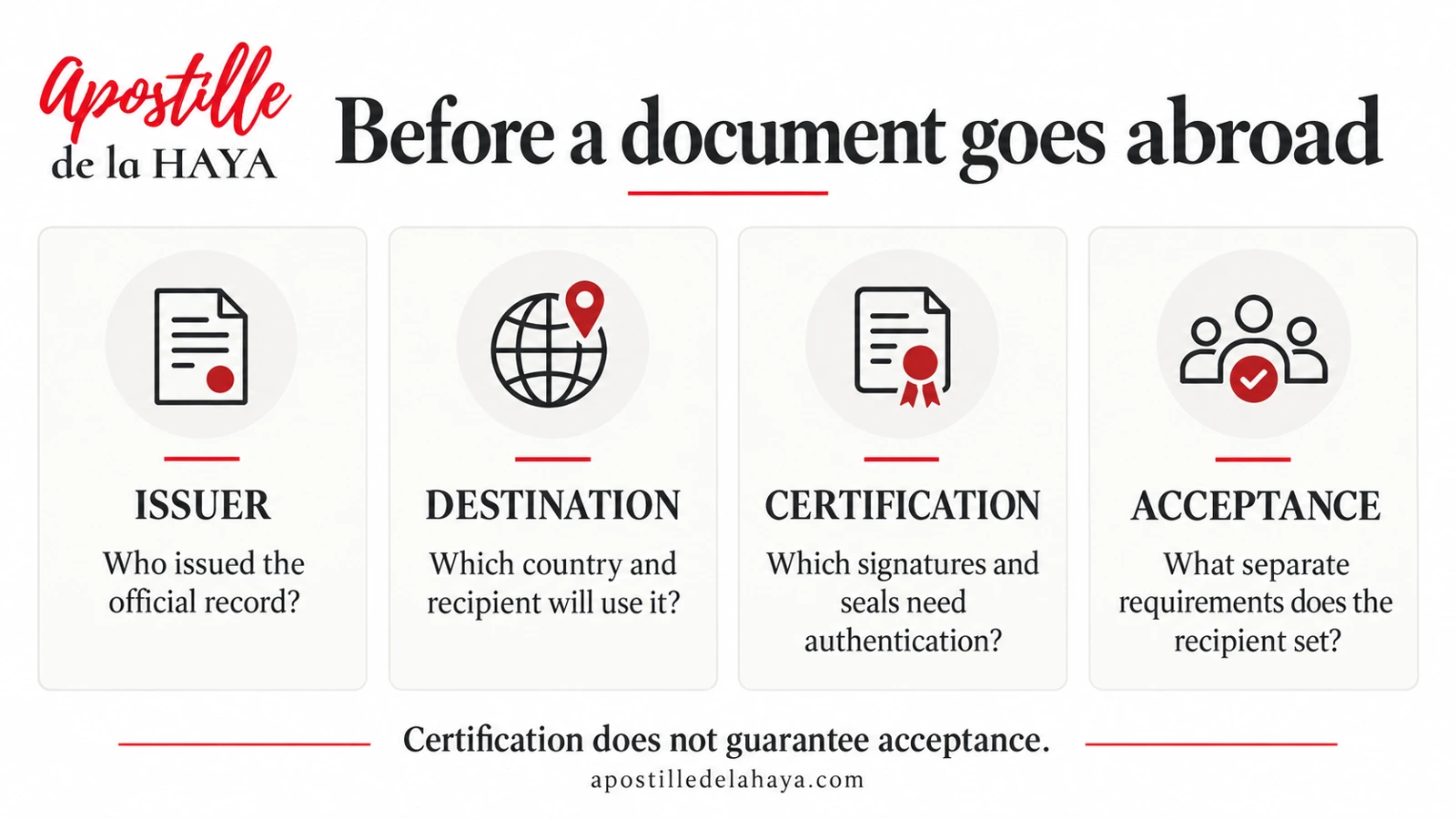
Power of attorney attestation can mean several different things, and the difference matters when a power signed in the United States is headed abroad. The recipient may be asking for notarization of the principal’s signature, a certificate of the notary’s authority, legalization by a foreign mission, or a final attestation in the destination country. Before arranging certification, ask which official act is required and whose signature it must authenticate.
This guide is about reading a U.S. power of attorney that already exists, along with its certification history. It shows how to tell evidence about signatures apart from approval of the authority given to an agent. Apostille de la Haya can review the document and the proposed certification route with you. Whether the wording and the signing fit the intended transaction is a question for the receiving institution or a qualified legal professional.
What power of attorney attestation can prove
A power of attorney usually names a principal and an agent and lists the powers granted. It may cover a particular property, a banking transaction, company representation, or some other defined matter. Attestation cannot turn an incomplete description into sufficient legal authority. If the receiving office needs a specific account number, property description, or limitation, a certificate attached later won’t supply the missing language.
Read the statement next to each stamp. A notarial acknowledgment deals with the acknowledgment of a signature under the applicable rules. With a jurat, the concern is a sworn or affirmed statement and the signing requirements that go with it. A governmental authentication may identify an official whose signature appears on another certificate. Each act answers its own question. A stack of seals does not, by itself, prove that the foreign transaction’s requirements have been met.
So the useful question for each certificate is simple: whose signature does it support? It might be the principal’s acknowledgment before a notary, the notary’s official signature, or a state official’s signature. Trace those links through the attached pages. If a certificate seems disconnected or refers to a different signer, get it clarified before the packet moves on.
Identify where the power was signed and how it will be used
The principal’s nationality doesn’t necessarily decide the certification route. A U.S. citizen might sign a document in another country, and a foreign citizen might sign before an authorized notary in a U.S. state. Write down where the relevant act took place and which authority performed it. A document written in English or drafted by a U.S. lawyer is not automatically a U.S. public document for every certification purpose.
Next, identify the real destination and recipient. A bank may ask for something different from what a land registry, court, commercial registry, or administrative office asks for. Get the recipient’s document requirements in writing. Find out, too, whether it accepts a privately prepared power or insists on its own form. A relative’s experience with a different transaction is useful background, but it can’t set the rules for yours.
Take someone who wants an agent to complete a property transaction. A general request for “an attested POA” is not enough for that person. The recipient should spell out the authority it needs, the language it will accept, the signing formalities, and the identity information that has to accompany the power. This is a planning example and does not mean any particular form will be accepted. What it shows is that the transaction has to be defined before certifications are arranged.
Keep legal review apart from signature certification
Legal review looks at what the instrument does: who may act, what they may do, whether restrictions apply, and when the authority starts or ends. Certification work looks at whether the relevant signatures and official acts are authentic. Both can matter, and finishing one does not finish the other. A correctly certified power can still give authority to the wrong person or leave out a power the transaction requires.
Settle the material wording before anyone signs. Adding a property, replacing an agent, or changing a limitation after signing may affect the integrity or validity of the instrument and its attachments. Don’t edit a signed document just because the change looks minor. Ask the appropriate professional whether you need a revised instrument and a fresh signing, and then plan certification around the approved version.
The guide to the special power of attorney can help you frame questions about a narrowly defined transaction. It is no substitute for advice on the governing law or on the destination’s requirements. Keep in mind that power of attorney attestation does not establish the principal’s continuing capacity. It also doesn’t settle disputes between agents or guarantee that an institution must honor the document.
Power of attorney attestation starts with the notarial act
Begin with the signed instrument, not its newest attachment. Check that the principal’s name and the notarial certificate refer to the right person, that the venue identifies the jurisdiction where the act took place, and that the certificate is complete. Whether witnesses or other execution requirements apply depends on the relevant legal rules and the recipient’s instructions. Never assume witness requirements are the same in every jurisdiction or for every document type.
Florida’s notary education FAQ draws a line between performing authorized notarial acts and giving legal advice. Having a notary involved does not allow the notary to choose legal powers for the principal. If a certificate looks incomplete or unsuitable, get guidance on the proper correction or execution process. Don’t add language to the notary’s certificate yourself.
Remote notarization needs its own acceptance check. Even if the law governing the notary authorizes it, that alone does not mean every foreign recipient will accept it. Confirm two things: that the notary performed the act lawfully, and how the destination treats that form. An electronically signed document, a printed electronic record, and a paper original are not automatically interchangeable at every stage of an international certification process.
Work out which government certificates apply
For U.S. documents, the responsible authority depends on where the certified signature comes from and what kind of signature it is. A privately signed power notarized under state authority generally raises a state certification question. It doesn’t become a federal instrument because it mentions a federal ID or will be used outside the country. USA.gov’s authentication overview separates the state and federal document routes.
The destination then helps decide whether an apostille or an authentication and legalization process is the right fit. To confirm the country relationship and document category involved, check the HCCH information on the Apostille Convention and the relevant authorities. Don’t order an apostille just because the term is familiar. And don’t assume an authentication certificate always has to be added after an apostille.
If federal authentication is part of the confirmed route, review the U.S. Department of State’s certificate requirements. That federal office does not rewrite the power or decide whether an agent overseas has enough authority for a transaction. Its role in the packet is certification, and you have to meet its preparation requirements before submission.
Ask the foreign mission which service it will provide
Consular terms need careful reading. Signing or acknowledging a document directly before a consular officer may be a different service from legalizing a document already signed before a U.S. notary. Eligibility, attendance, identification, language, and jurisdiction can differ between the two. Ask which service fits the principal and the existing document before you treat one as a stand-in for the other.
Egypt is a good illustration. Its mission in Washington publishes separate information on legalization of signatures, including requirements tied to how the document was signed and how the signer is identified. Read those instructions for the actual applicant and the competent consulate. They are not a general rule for every foreign mission or for everyone who signs a power in the United States.
If the document is going to Egypt, the Egypt legalization service overview is a place to start the conversation about preparation. Any assistance has to stay within the mission’s rules. It cannot replace a required personal appearance, and it cannot put a representative in place where the authority requires dealing directly with the citizen. Confirm what is permitted before you arrange delivery or appointments.
Handle translations as their own part of the file
Find out which language the recipient requires and whether it accepts a bilingual form. The translator should work from the version that will actually be presented and handle signatures, seals, and attachments the way the recipient requires. Timing matters here. A translation done too early may leave out certificates added later. One done too late can hold up submission if the translation itself needs certification.
Ask who may translate, whether a translator’s declaration is needed, and whether that declaration needs its own notarial or certification route. Notarizing a translator’s signature does not validate the underlying power. Likewise, power of attorney attestation on the original instrument does not automatically extend to every separate translation attached afterward. Keep clear which document is which and what each one is for.
Compare names, agent details, property references, and dates across versions. Transliteration differences can be legitimate, but the recipient decides what explanation or evidence it will accept. Never quietly change the original wording to match a passport spelling. If the discrepancy affects who may act or what property is covered, send it for legal review before certification goes any further.
Check the whole packet before it leaves your hands
Keep the instrument and its attached certificates together as one set. Don’t remove staples, separate official attachments, or swap pages to make a scan look better, because the physical connection between pages may matter for the certification. A clear copy of the whole packet can support a preliminary review while the original stays intact and safely stored.
Record the document version, the date of signing, the notarial jurisdiction, the attached certificates, the intended recipient, and the requested final use. Note what is still outstanding and which office is responsible for it. That gives the next person who handles the packet a practical handoff record. They can see what has actually been completed instead of guessing from the number of stamps.
Before shipping, check the competent office’s current submission channel, whether it takes originals or copies, its application requirements instructions, and return arrangements. Delivery confirmation shows that a carrier delivered the package. It says nothing about examination or acceptance. Leave time for a correction in case the authority finds a problem, especially when the foreign transaction has a fixed closing or filing date.
Frequently Asked Questions
Does attestation confirm that my agent can sell property abroad?
It can support the authenticity of the relevant signatures. It does not decide whether the power gives your agent enough authority for that sale. The receiving registry or institution, or a qualified legal professional, should review the wording and signing requirements for that specific transaction. Settle those questions before you get certifications on a version that may have to be replaced.
Can I reuse a power that was already attested for another country?
Possibly, but someone needs to review the earlier destination and certificates first. Different recipients may require different forms, languages, signing methods, or certification routes. Send the whole existing packet for assessment. Don’t remove certificates, and don’t assume that a route completed for one country automatically meets the requirements of a new destination.
Is a consular signature service the same as legalization?
Not necessarily. Signing directly before a consular officer and legalizing a document signed earlier may come with different eligibility and attendance rules. The relevant mission should tell you which service applies. This matters most when the principal’s nationality, current residence, or available ID affects the consular service.
Can a translator correct an error in the signed power?
A translation should faithfully reflect the source document. It shouldn’t quietly change the principal, the agent, the property description, or the legal powers. Ask the appropriate professional how to correct the underlying instrument. If a new version has to be signed, plan the translation and the certifications around that approved version.
What should I send for an initial document review?
Send a complete, legible copy along with the country where it was signed, the notarial jurisdiction, the destination, and the receiving institution’s written instructions. Include every attached certificate and tell us the intended transaction and deadline. Share identity documents only when they are needed, through an appropriate channel. Keep the original intact while the preparation route is being assessed.
Get a focused review of your power of attorney attestation route
A good review separates what the instrument needs legally from the signatures and certificates it still needs. The power of attorney legalization service can help organize the U.S. preparation question around your actual destination and recipient. Bring the complete version and any instructions you already have, so the review deals with your specific file.
Contact Apostille de la Haya on WhatsApp +1 305 500 0185 to talk through your document. Tell us whether it is unsigned, already notarized, or already carries government certificates. Knowing where you are starting helps show what to review next, and whether the legal wording, the signing, the translation, or the certification needs attention first.