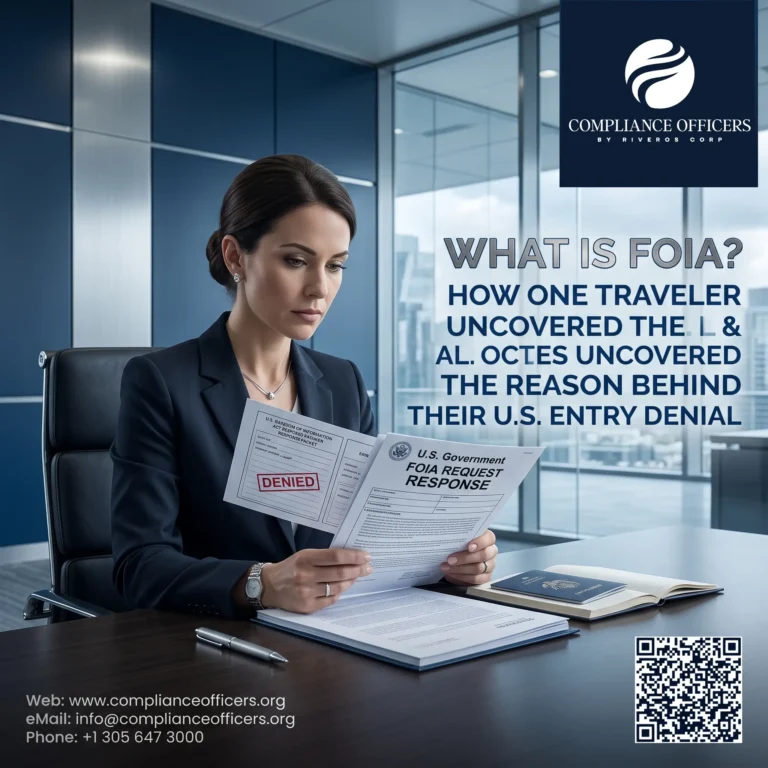
If you have ever been turned away at a U.S. border, had a visa unexpectedly revoked, or faced prolonged immigration delays, you might be asking yourself: what is foia, and can it help me find out what the government knows about me?
The Freedom of Information Act (FOIA) is a federal law that grants you the right to request access to records held by U.S. government agencies. While the law itself is meant to promote transparency, navigating the actual process of requesting federal records is far from transparent. Requesting your sensitive immigration, border patrol, or background check files on your own is highly risky. Submitting a request to the wrong agency, using incorrect terminology, or failing to provide the proper identity certifications can result in your request being rejected, heavily censored, or delayed for over a year. At Compliance Officers, our federal compliance specialists replace the guesswork with a structured request. We precisely target the correct agencies, structure your request to bypass bureaucratic delays, and secure the official records you need to clarify your status in the United States.
What is FOIA? A Brief Definition
Enacted in 1966, the Freedom of Information Act (FOIA) generally provides that any person has the right, enforceable in court, to obtain access to federal agency records. This means that the executive branch of the U.S. government must disclose requested information unless it falls under one of nine specific statutory exemptions (such as national security, personal privacy, or active law enforcement investigations).
In the context of international travel and compliance, a FOIA request is the primary legal mechanism used to obtain a copy of your «alien file» (A-File), border apprehension reports, sworn statements made at ports of entry, and comprehensive background checks. FOIA is a tool to help you get answers.
Who Can File a FOIA Request?
A common misconception is that only U.S. citizens can utilize this law. In reality, the statute applies to «any person». This includes U.S. citizens, foreign nationals, non-resident aliens, corporations, and universities. Regardless of your current location in the world or your immigration status, you possess the legal right to request federal records concerning yourself.
What Kind of Records Can You Request?
While the FOIA applies to all executive branch agencies, individuals facing U.S. entry issues typically need records from the Department of Homeland Security (DHS) and its sub-agencies. Through a properly executed request, you can obtain:
Customs and Border Protection (CBP) Records: If you were denied entry at an airport, questioned in a secondary inspection room, or issued an expedited removal, CBP holds the transcript of your sworn statement and the officer’s notes.
U.S. Citizenship and Immigration Services (USCIS) Records: USCIS maintains the complete A-File, which contains the entire history of your visa applications, petitions, approvals, and denials.
Immigration and Customs Enforcement (ICE) Records: If you were detained within the United States or faced deportation proceedings, ICE holds these specific law enforcement records.
Department of State (DOS) Records: While consular officers’ notes on visa denials are generally exempt from disclosure under the Immigration and Nationality Act, you can still request copies of the applications and documents you previously submitted to a U.S. Embassy.
Case Study: How One Traveler Used FOIA to Get Clarity
Let’s look at a real example from 2023. A traveler—we’ll call them “Alex”—was stopped at a U.S. airport and denied entry. The border officers didn’t provide much explanation. Wanting answers, Alex turned to FOIA and got help from a consulting firm that guides people through regulatory processes.
Step 1: Filing the Request
With Compliance Officers support, Alex:
- Identified the correct agency: U.S. Customs and Border Protection (CBP).
- With Compliance Officers‘ guidance, the detailed request was written: «All supporting documents related to the case were delivered.»
- Compliance Officers helped Alex submit the request
Step 2: What Came Back
After about 30 business days, CBP sent back:
- A report with some redacted sections
- A note stating Alex was denied under “Section 212(a)(7)” for missing proper documents
- An explanation that some details were withheld for privacy and security reasons
Step 3: Making Sense of It
The records showed Alex’s denial stemmed from a paperwork issue. It didn’t change the outcome, but it offered peace of mind and a path forward. With guidance, Alex avoided delays and confusion.
The Pros and Cons of Using FOIA for Information Requests

Benefits
- Access your records: See what the government has on you.
- Understand decisions: Learn why something happened to you.
- Promote transparency: Hold agencies accountable.
Limitations
- It takes time: Responses may exceed 20 business days.
- Not all info is available: Exemptions apply.
- It doesn’t fix problems: It informs but doesn’t change decisions.
- There may be fees: Especially for large or complex requests.
Even with these downsides, FOIA remains a powerful tool for clarity.
Conclusion: Take Control with FOIA
If you’ve ever been puzzled by a government decision—like a denied entry or visa issue—FOIA can help you uncover the “why” behind it. It won’t always change the outcome, but it gives you the facts to move forward.
For a smoother process, consider seeking help from professionals. They can guide you through crafting a strong request and avoiding common pitfalls.
Need support? Contact Compliance Officers today to get expert help with your FOIA request and make sure your voice is heard. Our dedicated team collaborates closely with Notary Public Center and Apostille de la Haya to provide comprehensive support throughout your immigration and document certification needs. Reach out to Compliance Officers directly to get started.
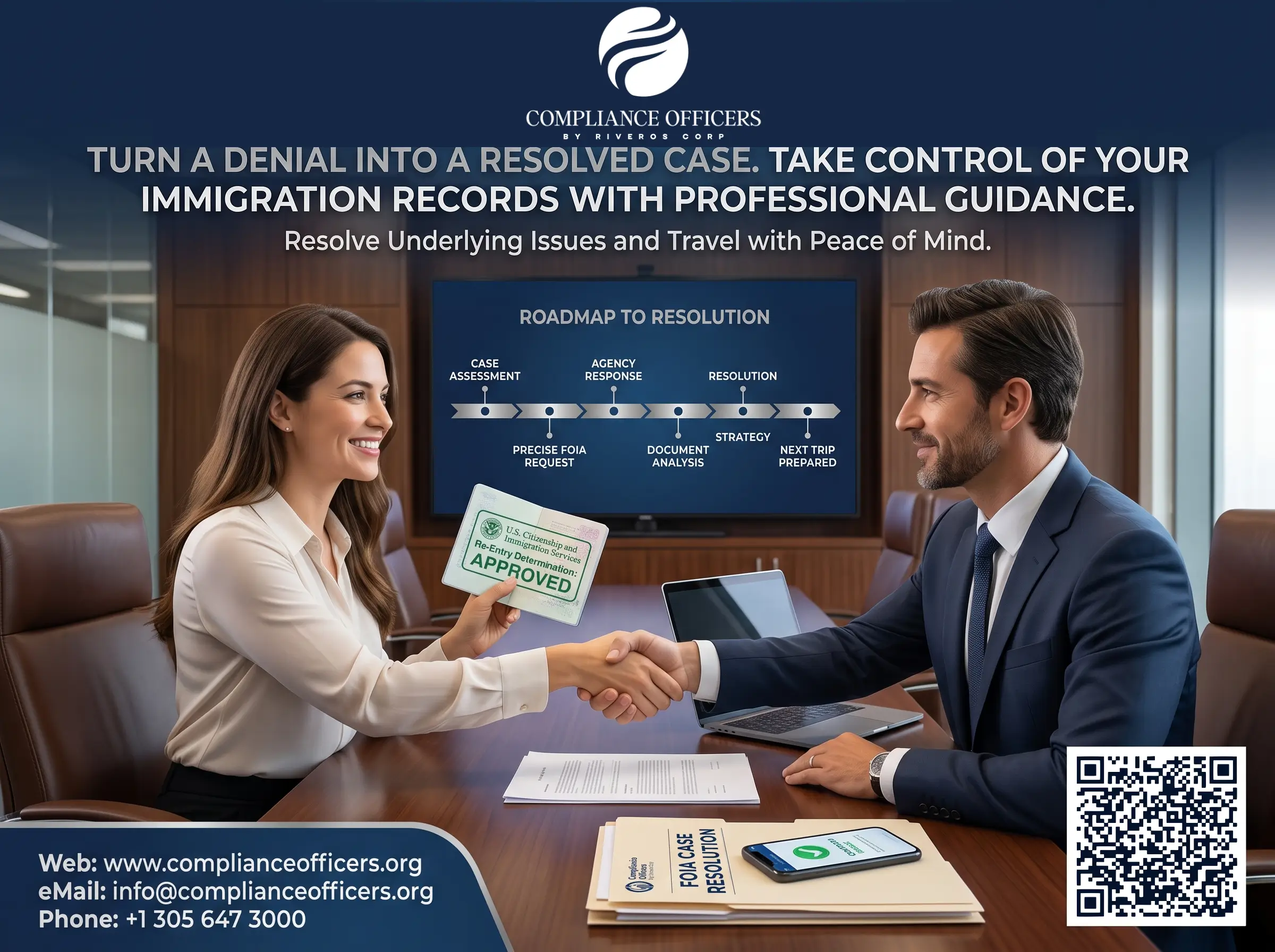
What a CBP or Entry-Denial FOIA Request Can Reveal
When a traveler is denied entry or subjected to extended questioning at a port of entry, the officer’s notes and any flags placed on the traveler’s record are rarely shared in full at the time. A FOIA request directed at Customs and Border Protection can surface those internal notes, the specific basis cited for the denial, and whether any prior flags in government databases contributed to the decision.
The Risks of the DIY Approach: Why You Shouldn’t Do It Alone
The federal government offers public portals (like FOIA.gov) to submit requests, which leads many travelers to believe they can easily handle the process themselves. Unfortunately, this «Do It Yourself» (DIY) approach frequently ends in frustration.
1. Targeting the Wrong Agency
The U.S. immigration system is highly decentralized. If you were denied entry at the border but submit your request to USCIS instead of CBP, you will wait several months only to receive a «No Records Found» response. Our specialists know exactly which agency has jurisdiction over the specific event in question.
2. Broad and Ambiguous Requests
If you ask an agency for «all records pertaining to me,» your request is classified as «complex.» Complex requests are placed at the bottom of the queue and can take well over a year to process. Professionals know how to draft «narrow» requests, specifying dates, ports of entry, and specific document types, keeping your case on the fast track.
3. Improper Identity Verification
Because you are requesting sensitive, personally identifiable information, the government requires strict proof of identity. If a third party (like a family member) submits a request on your behalf without a properly executed consent form (such as Form G-28 or a notarized certification of identity), the agency will deny the release of the documents citing the Privacy Act.
Processing Times: How Long Does It Take?
By law, federal agencies have 20 business days to respond to a FOIA request. However, due to massive backlogs, particularly within DHS agencies, this deadline is rarely met.
A meticulously drafted, narrow request managed by a professional can take anywhere from 1 to 4 months. Conversely, a poorly structured DIY request can languish in the system for 8 to 12 months, or longer if it triggers a multi-agency search.
Frequently Asked Questions
What is FOIA and how does it affect me?
The Freedom of Information Act (FOIA) is a federal law allowing any person to request access to records held by U.S. government agencies. It affects you by giving you the legal right to obtain your own immigration, border, and background check files to understand exactly what information the government holds about you.
Can a non-U.S. citizen file a FOIA request?
Yes. The statute explicitly allows «any person» to file a request, which includes foreign nationals and non-resident aliens, regardless of where they currently reside.
Are there any records the government will refuse to release?
Yes. The law includes nine specific exemptions. The government may withhold or censor (redact) information related to national security, active law enforcement investigations, internal agency rules, or information that would violate the personal privacy of a third party.
Does it cost money to file a FOIA request?
The U.S. government generally does not charge a fee for standard, personal requests that require minimal search and duplication time. However, the professional structuring, agency targeting, and technical management provided by the specialists at Compliance Officers do incur service fees.
What should I do if my FOIA request is denied or heavily censored?
If an agency denies your request or heavily redacts the documents, you have the right to file an administrative appeal. If the appeal is unsuccessful, the law allows for judicial review in a federal district court. A compliance specialist can evaluate the redactions to determine if an appeal is warranted.
Legal Disclaimer:
This article is provided for informational purposes only and does not constitute legal advice. The content herein is not intended to substitute professional legal consultation. For specific guidance regarding your individual circumstances, please consult directly with a qualified attorney licensed to practice in your jurisdiction. regarding your individual circumstances, please consult directly with a qualified attorney licensed to practice in your jurisdiction.