The FOIA process allows any person to request access to records from any federal agency, provided the documents are not protected by specific exemptions. However, successfully obtaining these files requires submitting a highly specific, perfectly drafted request to the exact government department that holds the information.
Whether you are requesting your personal immigration file from U.S. Citizenship and Immigration Services (USCIS), a background check file from the FBI, or corporate regulatory documents from a federal oversight committee, navigating the Freedom of Information Act (FOIA) can be overwhelming. Federal agencies are facing historic backlogs, and any procedural error in your request can result in months of delays or outright rejection.
At Compliance Officers, we specialize in federal due diligence and records retrieval. Our team understands the nuances of the FOIA process. We help individuals and corporations formulate precise requests, identify the correct agencies, and follow up relentlessly, ensuring you get the critical records you need without the frustration of the standard bureaucratic maze.
If you’re new to the concept of FOIA or want a clearer understanding of its foundations, we recommend starting with our guide on what FOIA means and what it’s used for, which explains the core principles behind this powerful law.
What is the Freedom of Information Act (FOIA)?
Enacted in 1966, the Freedom of Information Act is a federal law that gives the public the right to request access to records from any federal agency. It is often described as the law that keeps citizens in the know about their government.
However, FOIA applies only to federal executive branch agencies. It does not apply to Congress, the federal courts, or state and local governments (though states have their own open records laws). Understanding jurisdictional limits is the first hurdle in the foia process.
What Is the FOIA Process?
The FOIA Process (Freedom of Information Act) was created to ensure government accountability by giving the public the right to access information held by federal agencies. It applies to all executive branch departments, agencies, and offices, but excludes Congress, the federal courts, and state governments.
Key Objectives:
Promote government transparency
Hold public institutions accountable
Empower citizens with access to federal information
Historical Context:
Passed in 1966, the FOIA was a response to growing demands for openness in government. Over the decades, it has become a cornerstone of democratic engagement, allowing watchdog organizations, investigative journalists, researchers, and ordinary citizens to uncover important truths about federal operations. It was later strengthened by amendments, notably the FOIA Improvement Act of 2016, which reinforced the default principle of disclosure and imposed stricter deadlines for agencies.
Understanding the FOIA Request Process
The FOIA process involves identifying the appropriate federal agency, submitting a written request for records, and receiving a formal agency response. While the steps may appear straightforward, the reality is that each agency has its own policies, requirements, and technical nuances. For many individuals and businesses, navigating these complexities without specialized guidance can lead to delays, denials, or incomplete disclosures.
Rather than attempting to manage the process independently, working with professionals ensures that your request is correctly structured and directed, maximizing the likelihood of a successful and timely outcome.
How the FOIA Process Works: A Step-by-Step Breakdown
The federal government does not have a single, centralized office that handles all FOIA requests. Instead, there are over 100 different agencies, each with its own FOIA office, specific rules, and processing times.
Here is how the standard process unfolds:
1. Identifying the Correct Federal Agency
This is the most critical step. If you send a request to the Department of Homeland Security (DHS) for a record actually held by the Department of State (DOS), your request will be delayed and eventually closed. You must pinpoint the exact sub-agency that maintains the documents you are seeking.
2. Drafting the Request
There is no universal FOIA form. A request is typically a formal letter outlining exactly what you are looking for. To trigger a successful foia process, your description must be reasonable and highly specific. Using broad terms like «send me all files related to my name» usually results in a rejection because the agency will deem it «too burdensome» to fulfill.
3. Agency Review and Processing
Once received, the agency will log your request and assign it a tracking number. Under the law, agencies have 20 business days to respond. However, due to massive backlogs in 2026, most complex requests enter a «complex queue» and can take several months—or even years—to process.
4. Receiving the Records or Filing an Appeal
If successful, the agency will release the records. Often, parts of the documents will be redacted (blacked out) if they fall under certain legal exemptions. If the agency denies your request entirely, or you believe they improperly withheld information, you have the right to file an administrative appeal.
The Risks of the «Do It Yourself» (DIY) FOIA Approach
Many individuals attempt to submit FOIA requests on their own using free online templates. Unfortunately, the DIY approach frequently leads to «administrative closures,» meaning the agency simply shuts down the request without providing any documents.
Here is why handling the foia process without specialists is risky:
Vague Descriptions: If you do not use the correct federal terminology to describe the records, the agency will claim they conducted a «reasonable search» and found nothing.
Missing Identity Proof: When requesting personal records (like immigration files or FBI data), you must provide specialized consent and identity verification forms. Failing to include these leads to instant rejection.
Fee Category Errors: The FOIA allows agencies to charge search and duplication fees. If you do not properly declare your fee category or agree to a fee limit in your initial letter, your request will be paused indefinitely.
Ignored Timelines: Without a professional following up, agencies often let DIY requests languish at the bottom of the pile.
FOIA Exemptions and Limitations
While FOIA promotes access, it is not absolute. There are nine key exemptions that agencies can use to withhold information:
Common Exemptions:
National Security – Classified information.
Internal Personnel Rules – Administrative procedures.
Statutory Exemptions – Protected by other laws.
Trade Secrets – Confidential business information.
Inter-agency Memoranda – Deliberative processes.
Personal Privacy – Medical and personal data.
Law Enforcement Records – Sensitive investigations.
Financial Institutions – Bank regulation information.
Oil and Gas Well Data – Geological and geophysical data.
Understanding these exemptions is essential to preparing effective FOIA strategies and crafting appeal responses when information is unjustifiably withheld. Expert assistance is often necessary to interpret exemption justifications and challenge them appropriately.
FOIA Reform and the 2016 Improvement Act
The FOIA Improvement Act of 2016 introduced critical changes that further reinforced transparency:
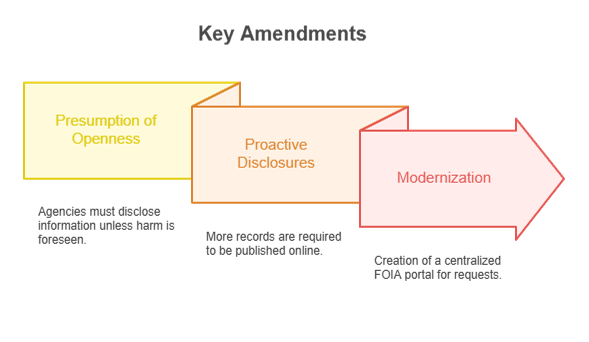
These reforms were part of a broader trend toward digital government and open data, pushing agencies to adopt technologies that facilitate public access. FOIA.gov now allows consolidated tracking of requests, significantly improving user experience and transparency.
FOIA in Numbers: Key Statistics and Trends
The latest data from Fiscal Year 2024 shows that FOIA demand has reached an all-time high, with over 1.5 million requests received—representing a 25% increase compared to FY 2023. Federal agencies processed 1,499,265 requests, a 34% increase year-over-year, setting a new record for processing volume.
While the backlog remains a persistent challenge, there are signs of progress. In FY 2023, the government-wide backlog decreased by nearly 3%, reflecting efforts to reduce pending cases. Additionally, more than two-thirds of federal agencies closed FY 2023 with no pending appeals, indicating improved administrative efficiency.
Nevertheless, the historic surge in request volume during FY 2024 places renewed pressure on agencies. Despite the record-breaking number of processed cases, there is concern that the backlog may rise again unless current capabilities are expanded.
The Department of Justice’s 2024 Chief FOIA Officer Report highlights several initiatives to tackle this issue, including process optimization and cross-agency collaboration. These efforts have led to significant improvements when compared to FY 2022, even though the growing demand continues to test federal response capacity.
How Compliance Officers Streamlines Your FOIA Process
When you need federal records for employment, immigration history, corporate due diligence, or personal clarity, you cannot afford to wait a year only to receive a rejection letter.
By trusting Compliance Officers, you gain a team of experts dedicated to cutting through the red tape. Our comprehensive service includes:
Agency Targeting: We identify the precise federal agency and sub-department holding your data.
Precision Drafting: We draft your FOIA request using the exact statutory language required by federal agencies to prevent them from claiming the request is «too broad.»
Identity Verification: We ensure all privacy waivers and identity proofs are formatted correctly.
Relentless Follow-Up: We track your request, negotiate with FOIA officers, and manage fee approvals to keep your file moving forward.
Stop guessing and let the experts handle the bureaucracy. Contact Compliance Officers today to initiate your foia process with confidence and speed.
Case Studies and Real-World Applications
FOIA has been used successfully in numerous scenarios:
Journalists exposing governmental mismanagement, such as internal reports on public health crises or military conduct.
Nonprofits tracking public spending on environmental policies, lobbying disclosures, or education funding.
Corporations vetting potential partners through regulatory compliance records, environmental violations, or litigation history.
Compliance Officers has supported clients across these use cases by ensuring their requests are processed efficiently and effectively. In one case, a client pursuing a business partnership leveraged a FOIA request to uncover prior sanctions against a potential vendor—information that ultimately influenced a critical decision.
Conclusion
The FOIA Process remains a foundational element of democratic accountability in the United States. However, obtaining the right information from federal agencies requires more than just submitting a form—it demands legal precision, administrative expertise, and persistent follow-up.
With expert guidance from Compliance Officers, the FOIA process becomes not only manageable but strategically valuable. Whether you are an individual seeking immigration records, a journalist investigating public policy, or a business conducting due diligence, our team is here to support you every step of the way.
Contact Compliance Officers today and ensure your FOIA request is handled with accuracy, speed, and professionalism.
Frequently Asked Questions (FAQ)
1. How long does the FOIA process take?
By law, agencies have 20 business days to respond. However, this response is often just an acknowledgment. Actual processing times vary wildly depending on the agency’s backlog and the complexity of the request, ranging from a few weeks to well over a year. Professional filing can help avoid unnecessary delays.
2. Can anyone use the FOIA process?
Yes. U.S. citizens, foreign nationals, organizations, and corporations can all submit FOIA requests to federal agencies. There is no citizenship requirement to use the Freedom of Information Act.
3. What records are exempt from the FOIA process?
The FOIA contains nine exemptions. The most common ones protect classified national security information, internal agency rules, trade secrets, personal privacy of third parties, and ongoing law enforcement investigations.
4. Do I have to pay fees during the FOIA process?
It depends. Agencies can charge for the time spent searching for records and the cost of duplication. However, if you are requesting your own personal files, you usually only pay for duplication beyond the first 100 pages. Our team helps negotiate or cap these fees in advance.
5. Can I appeal if my FOIA request is denied?
Absolutely. If an agency denies your request, claims they cannot find the records, or redacts too much information, you have the right to file an administrative appeal. If the appeal fails, the final step is federal litigation.
Legal Disclaimer:
This article is provided for informational purposes only and does not constitute legal advice. The content herein is not intended to substitute professional legal consultation. For specific guidance regarding your individual circumstances, please consult directly with a qualified attorney licensed to practice in your jurisdiction.