A request for document attestation often shows up as one short line in an employer’s email or on a foreign authority’s checklist. The request may still leave several questions unanswered: which document, issued where, certified by whom, and accepted for what purpose? This article covers U.S.-issued documents that will be used outside the United States. It explains how to read an attestation request without assuming that every international document needs the same stamps.
This matters most when you already have a birth record, marriage certificate, degree or signed authorization and want to know what is left to do. When a recipient writes “attested,” that word alone does not tell you which U.S. office is responsible for the document. Apostille de la Haya can review the complete file and the recipient’s instructions, then explain which documentary service fits the case. The review should identify the required documentary work and explain what each certification contributes to the file.
Document attestation only makes sense once you know the country and the document
Attestation usually means an official confirmation tied to a document, signature or seal. Its exact administrative meaning depends on the authority using the word. A ministry, consulate, academic office or employer may each use it inside its own process. Before you treat an instruction as complete, find out which authority is asking for which confirmation.
For U.S. documents going to another country, the record’s origin comes first. A diploma from an American institution is not prepared the same way as a diploma from another country just because both graduates now live in Dubai. The graduate’s address does not replace the location of the issuing institution as the starting point for the file.
The destination matters just as much. Don’t copy instructions for a UAE process into a Qatar, Kuwait or Egypt submission without checking them. Even when two recipients use the same English wording, the document categories, the authorized submission channels and the later requirements may differ. “Embassy attestation” is incomplete until you know which embassy is involved and what its jurisdiction covers.
Confirming where a document came from is different from accepting it
A certification chain can confirm the relevant signature or seal without deciding whether the document serves its intended purpose. An attested degree does not automatically grant a professional license. An attested marriage record does not approve a residence application on its own. A power of attorney with properly certified signatures may still need legal review of the authority it grants.
Keeping this in mind helps you ask better questions. Instead of asking only whether a record can be attested, ask whether the recipient has named that record and that format. If an employer wants a degree and a transcript, a missing transcript is still a separate issue. If a registry needs a specific official extract, a different certificate may not satisfy it, even after certification.
Attestation and translation are also different things. A translation lets the recipient read the document in the language it requires. It does not necessarily authenticate the issuing official. Depending on the process, the translator’s declaration may need its own certification. Treat the original record, its certifications and any translation as related parts that do different jobs.
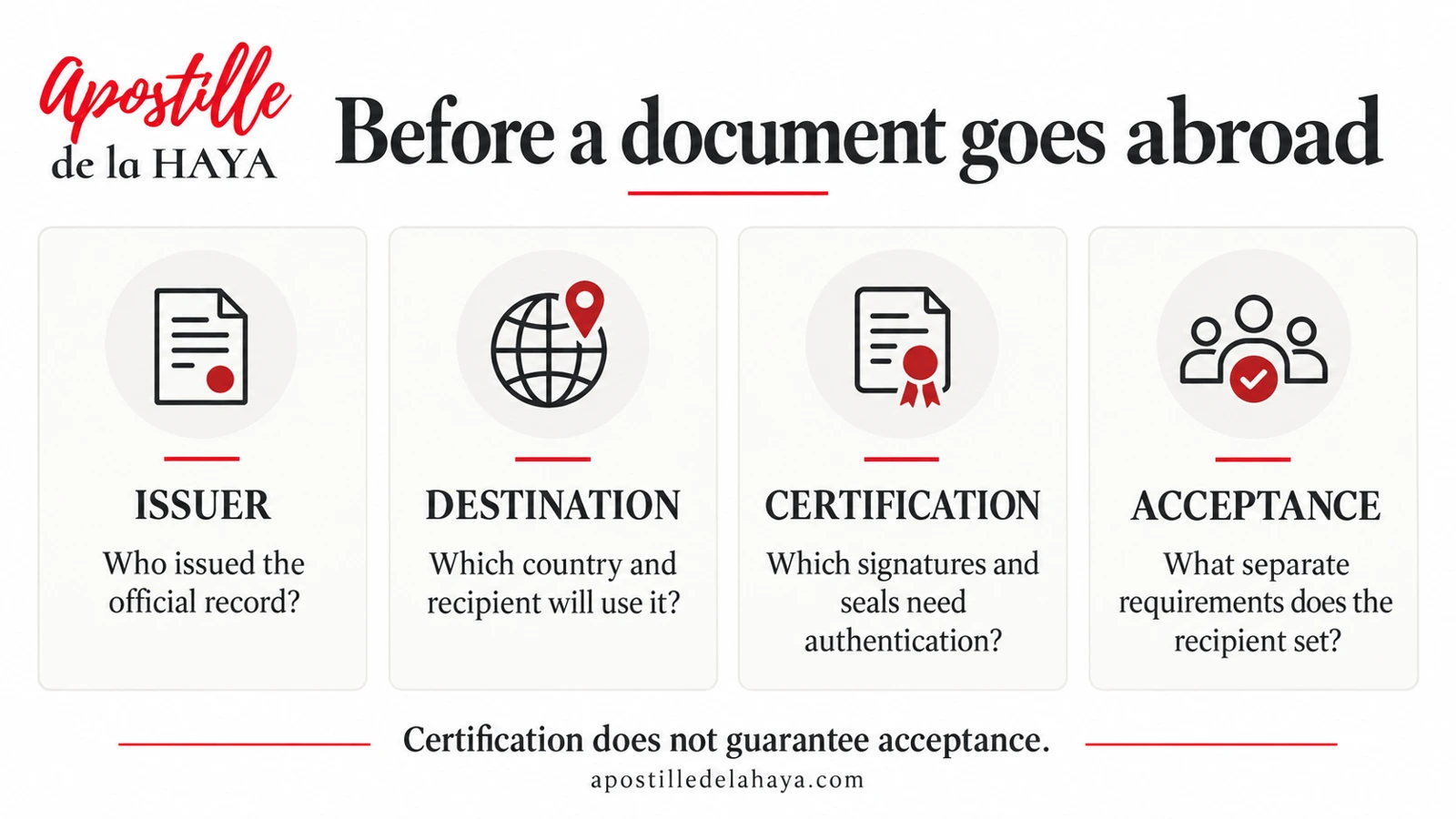
Three parts of an international document attestation file
The first part is the document in its country of origin. For a U.S. file, establish whether it is a public record issued by a state, a federal document, or a private instrument that enters the process through a notarial act. Identify the specific signature and the authority responsible for recognizing it. This step prevents a common mistake: choosing an office only because it is convenient for the applicant.
The second part is any foreign mission involved in the destination’s process. A mission may require a particular prior certification, document category, application channel or supporting item. Its own current instructions are the reference that counts. A blog post about a different country’s embassy, or an old walk-in procedure, should not decide where the record goes.
The third part is presentation at the destination. The receiving authority may require further foreign affairs attestation, a translation, a digital submission or additional evidence. When a mission returns the document, that does not mean every later requirement is done. Ask what the final recipient will receive and what it still expects the applicant to do.
These are areas to check, not a fixed three-stop route that fits every case. Some files follow a different path, and where an apostille process applies, it may replace consular legalization. The HCCH Apostille Section describes the Convention framework. A country’s membership in the wider HCCH organization is not the same as taking part in the specific Apostille Convention relationship that matters for your file.
A U.S. document example: an academic record for the UAE
Take a hypothetical graduate with a degree from a U.S. university and a UAE employer asking for attested academic documents. The first step is to confirm exactly what the employer wants: the degree, the transcript, supporting verification, or a separate recognition of the qualification. Don’t fold those items into one unspecified “certificate.”
The UAE Embassy’s instructions for personal and educational documents name VFS as the handling channel from August 21, 2025. They also require the relevant U.S. Department of State authentication before those documents are submitted to VFS. The educational instructions add points about the U.S. institution and its accreditation. This reference is specific to U.S. documents. It is not a route for degrees issued anywhere in the world.
The example shows why an old instruction to mail documents straight to an embassy counter may no longer fit. It also shows why a graduate should not copy a friend’s process if that friend studied in another country. Before you commit to a service, compare the issuer, the destination, the recipient and the record type. The UAE document service page gives you the destination-specific point of contact for that review.
Digital document attestation: check eligibility first
An online application does not mean any scanned document qualifies for a fully digital process. A portal may accept your application details and still require a particular physical record or a specific prior certification. On the other side, an original digital record can carry verification features that a printed copy does not keep in the same way.
The UAE Ministry of Foreign Affairs attestation service sets different routes by issuing authority and document type. Its guidance treats documents issued inside the UAE separately from documents issued outside it. A feature described for eligible digital documents issued in the UAE should not be applied to a U.S. document just because both can be uploaded as PDFs.
Before you change the format of your record, identify the route assigned to that issuer and that document. Where relevant, keep the original digital files and their verification information intact. Don’t replace an official file with an edited scan, and don’t assume a photo of a stamp does the same job as the certification that was officially issued. Apostille de la Haya can help clear up the documentary question before the file is submitted.
Preparation mistakes that get files sent back
One mistake is sending only the latest certificate and leaving out the record it certifies. The reviewer needs to see how the underlying document and its attached certifications fit together. Keep the full set. If an earlier service returned several pages, don’t detach them to make the file shorter or easier to scan.
A second mistake is ignoring names and identifying details. A degree, a passport and an employer’s request may describe the same person differently because of a name change or a transcription problem. Don’t quietly edit the record to make everything match. Ask the recipient what evidence it needs to link the identities, and have any issuer error corrected through the proper channel before certification continues.
Another mistake is arranging certification before defining the whole assignment. A consular act does not automatically include translation, earlier U.S. preparation, return delivery or a later service at the destination. Ask which tasks the assistance includes. Apostille de la Haya can explain the service conditions once the document and its requirements are clear.
Timing also causes confusion. A published processing period may start only after a complete file is accepted, not when the applicant first asks for help. A missing academic record or the wrong certified copy can push back the start of that period. Plan around how ready the documents are and around the recipient’s deadline, not around a single number you found in a search result.
A practical document attestation checklist before the record travels
For an initial review, name the document and its issuer, say whether the original or a certified version is available, and list the certifications already on it. Give the destination and the organization that is asking for it. Include the recipient’s written request when you can, so the reviewer can tell a clear requirement apart from an assumption made during a phone call.
Also note the language requested, whether a translation already exists, the deadline and the delivery address. If you have several documents, describe each one on its own. A marriage certificate and a degree in the same envelope are still separate records, and their preparation requirements may differ. Sharing a destination does not make their issuing authorities interchangeable.
If your case involves another destination, use the matching service reference, such as Qatar document preparation, together with the general legalization service. For background on the federal office’s role, see the U.S. Department of State overview. Each link covers a different part of the decision.
How Apostille de la Haya helps clarify an attestation request
Apostille de la Haya can review the record’s origin, the recipient’s instructions and the preparation already done, and then explain the service scope that fits. That turns a vague request for “attestation” into specific documentary questions. If another authority has to confirm acceptance, or a legal professional has to review the substance of an instrument, we will say so clearly.
An organized review can identify unnecessary submissions and make the file’s status easier to follow. You should know what has been reviewed, what still needs preparation and which parts of the assignment are included. A private service cannot guarantee a government decision or a recipient’s acceptance of the substance. What it can do is keep you from treating unrelated certifications as substitutes for the evidence the recipient asked for.
Frequently Asked Questions
Is document attestation the same as an apostille?
Not necessarily. Attestation is used in several administrative settings, while an apostille is a particular certificate under the applicable Convention framework. The origin, the destination and the receiving authority determine what you need. Apostille de la Haya can review the wording of the request and help you tell the right certification apart from a broad service label.
Can I use instructions written for documents from another country?
Those instructions may describe a process in a different country of origin, so don’t adopt them for a U.S. record. Compare the actual issuer, destination, document category and recipient. If those details don’t match, the route needs its own review. Contact Apostille de la Haya with the details of your U.S. document to establish the right preparation.
Does attestation guarantee that my degree will be recognized?
No. Signature certification, academic recognition, employer acceptance and professional licensing are separate decisions. Find out which outcome the recipient is asking for and whether a separate recognition process applies. Apostille de la Haya can help with the documentary preparation and point out the questions that the receiving institution or the competent authority has to decide.
Can a digital scan replace the original record?
Only if the applicable route accepts that format. An original digital document, an ordinary scan and a certified paper copy are not automatically equivalent. The issuing authority and the service requirements both matter. Before you discard or change a file, ask Apostille de la Haya to review the document type and the format required for how it will be used.
What information is needed to define the service?
List each document, its issuer, destination, existing certifications, recipient requirements and deadline. These details establish the scope of preparation, translation, official certification and delivery. Conditions may vary with the nature, complexity and specific requirements of the case. Consult Apostille de la Haya directly about assistance for your actual assignment.
Get a clear answer to your document attestation request
Send Apostille de la Haya the document’s origin and the recipient’s instructions. We can review what “attestation” means for your U.S. file and explain the documentary help that fits how it will be used abroad.
Contact Apostille de la Haya by phone or WhatsApp: +1 305 500 0185.