To understand how to legalize documents, first identify the document, its U.S. issuer and the country where it will be used. A birth record, a federal report and a privately signed authorization can each need different preparation. The recipient may also want a translation or a specific certified version. This article walks through the decisions that shape the process for documents issued in the United States, so you know what has to be ready before anything is submitted.
You can deal with the relevant authorities yourself where their procedures allow it, or ask for help with preparing and handling the documents. Either way, the official acts your case requires stay the same. Apostille de la Haya can review the file and explain what the service would cover. The aim is to meet the right requirements in the right order. A universal checklist that sends every kind of record through the same offices does not do that.
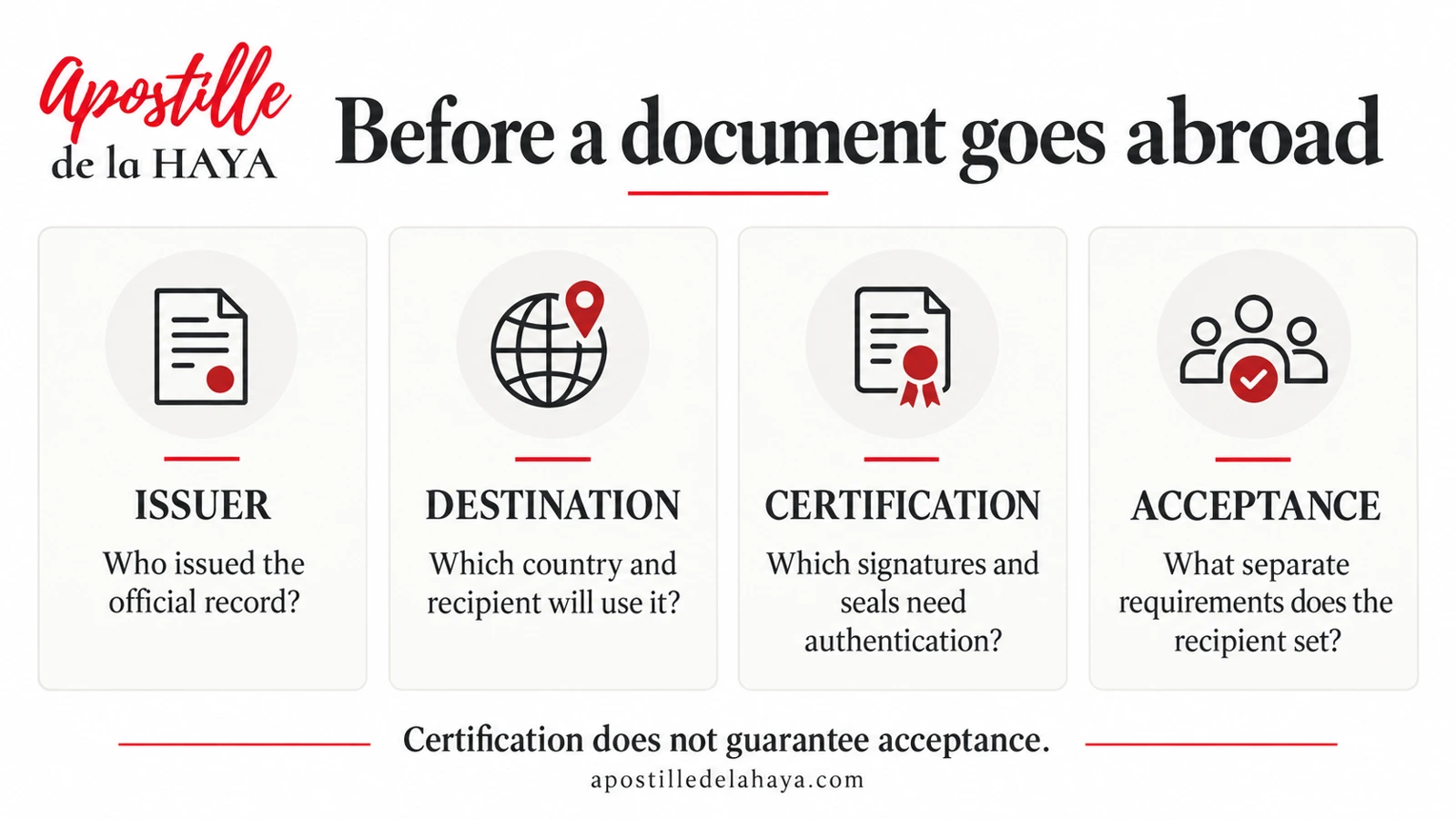
How to legalize documents starts with three facts
First, name the document precisely. “Certificate” could mean a birth record, a degree, a business certificate or an affidavit, and each of those has a different issuer and purpose. If you are not sure of the formal name, use the title printed on the document and identify the organization that gave it to you. Don’t pick a category just because it sounds like a service you saw advertised online.
Second, find its official origin. The state that issued a public record may not be the state where you live now. A document from a federal agency has a different origin again. A private document signed before a notary enters the certification review through that notarial act. The office responsible for one signature may have no authority over another document in the same envelope.
Third, identify the real destination and recipient. The country where the document will be used may differ from the address where the finished package is sent back. Where possible, ask the receiving organization for its requirements in writing. With a clear requirement, it is easier to tell whether it wants legalization, an apostille, direct verification by an institution or some other service.
Decision one: confirm what the recipient needs
Start with the intended use. Is the record evidence for a civil registry, an employer, a bank, a court, a university or a licensing body? The same document can serve more than one purpose, and each recipient may ask for its own format or supporting item. A version that one institution accepted will not necessarily satisfy another.
Note the document the recipient asks for, the certification, the language and any condition on the issue date. If the recipient says “recent,” ask what that means for this particular record. There is no universal expiration period for all certificates, so don’t assume one. The date of the underlying event, the date the copy was issued and the date of authentication are three different facts.
If the requirement is unclear, sort it out before you arrange later stages. For example, a request to prove a marriage may call for a certified civil record and not a ceremonial certificate. A request to prove educational achievement may include both a degree and a transcript. Certifying one of them does not produce the other. Once the recipient’s real requirement is known, Apostille de la Haya can review the documentary question.
Decision two: check the version you already have
Work out whether you hold an official certified copy, an original signed instrument, an original digital record, a photocopy or a scan. These formats are not equivalent just because they show the same text. An official certified record carries an act by the issuer or custodian that an ordinary copy may lack, and that difference can decide whether the next authority can process the file.
Look at every page, including attached certifications and anything relevant on the back. Keep them together. A photo of the front may be enough to describe the subject but not to evaluate the certification chain. Do not remove seals, staples or attached certificates to make a scan look tidier before you ask for a review.
State rules show why a generic instruction to notarize is risky. Florida’s guidance on accepted documents, for example, separates public records from documents that can be copied through a notarial act. A notary’s involvement does not replace getting the right certified public record from its official source.
Decision three: identify the certificate and the competent office
The destination decides whether an apostille route applies or whether a different authentication and legalization route is relevant. Next, the document’s origin points to the competent U.S. authority. The U.S. government’s published overview of document authentication explains the basic distinction, but each file still has to be checked against the recipient’s instructions.
For a state-issued document, the relevant state authority is tied to the signature on the record, not to the applicant’s mailing address. Federal documents raise a different question about authority. Where a federal stage is required, the Department of State overview gives related background. Do not send every American document straight to the federal office before you have worked out its origin.
If the route involves a foreign mission, confirm its jurisdiction and its instructions for that service. A mission may have rules on prior certifications, personal attendance, document categories or a designated submission channel. Instructions written for a different country of origin should not be copied into a U.S. file just because the destination is the same.
Decision four: settle translation and supporting records
Plan the translation around the language and format the recipient accepts. Ask whether only the original record needs translating or whether the whole certified set has to be covered at a particular stage. The translator’s declaration may carry its own formalities. Settle these points first instead of treating the translation as something that gets added automatically at the end.
Names, dates and document numbers should match the evidence the recipient will review. If a name change or a transliteration creates a difference, ask which supporting record is needed to connect the identities. Do not quietly change the source record or the translated wording to make things appear to match. Mistakes made by the issuer are corrected through the issuer, and substantive questions go to the appropriate professional.
Each supporting document should answer a stated requirement. An employer asking for academic evidence may want something different from a ministry’s recognition process. A private service should not promise that legalization settles eligibility for employment, immigration or licensing. The relevant receiving authorities still make those decisions, even after the documents are fully prepared.
Decision five: choose how to submit and how to get documents back
When the file is ready, follow the authority’s current submission instructions for the service you need. Check the form, the document category method and the return arrangements together. Instructions for a walk-in request may differ from those for a mailed submission. An old address or an incomplete application can get the file sent back without anyone looking at the document itself.
For a federal stage, the official reference for submission and status information is the State Department’s own request page. Read it at the time you submit. Keep published processing times separate from transit, from the earlier record preparation and from any later consular or recipient stage. A courier’s delivery scan does not confirm that certification is complete.
Decide where the finished documents should go and who will receive them. An applicant abroad may need them delivered to a local representative, another authority or the final receiving organization. The return address should match the actual plan. Keep references and instructions organized so any status inquiry is about the right file and the right stage.
Decision six: check what remains after certification
Once a certificate is issued, compare the finished set with the requirement it is meant to meet. Confirm that the correct underlying document is there and that the relevant attachments are still connected. If a translation or an action in the destination country is still needed, name it clearly. The envelope coming back does not mean every process is over.
For example, the requirements reviewed for U.S. documents intended for the UAE are not automatically the same as those for documents intended for Qatar. The service scope should say which documentary stages are included for the chosen destination and which later submission stays with the applicant or the recipient.
If the recipient objects, keep the notice and the complete file. Work out whether the problem is the certificate, the version of the document, the translation or a substantive requirement. Repeating the same legalization without understanding the objection can simply reproduce it. A targeted review helps more than restarting every stage.
How to legalize documents yourself or with private help
Government offices set their own requirements and decide whether a file qualifies for the act requested. A private service does not replace that authority or create exceptions to it. Where direct submission is available, applicants can use the official procedure, and they remain responsible for providing a suitable file and following the applicable instructions. That is the direct answer for anyone asking how to legalize documents without outside help.
Apostille de la Haya’s document legalization service can help review the preparation, organize the handling of documents and explain the assignment. What it offers is fewer avoidable mistakes and less administrative work. It should never be described as special access, government priority or a guarantee that an incomplete document will be accepted.
Some services need the applicant’s own signature, appearance, identity verification or action through an official account. Those requirements should be spelled out. The scope is clearer when you know which tasks can be done for you and which need you in person. This matters most with consular acts and legal instruments.
Scope and deadlines should follow the actual file
Describe the document type, issuer, destination, existing certifications, language needs and deadline. Confirm whether the assignment includes obtaining records, translation, authentication, delivery or only part of that work. Conditions may vary according to the nature, complexity and requirements of the case. Consult Apostille de la Haya directly about the appropriate scope.
If a deadline is close, explain what event it is tied to and which documents you already have. A file waiting for a correction is in a different position from one that is ready to submit. Apostille de la Haya can assess the documentary work and explain the proposed service. Urgency does not remove official requirements, and no one can control the recipient’s final decision, so we will not promise otherwise.
Frequently Asked Questions
Can I legalize a document without knowing the destination?
Anyone asking how to legalize documents needs the destination first, because it decides which international certification route applies. If you prepare a file for an unspecified country, you may end up with a certificate that does not answer the request that comes later. Find out where and how the document will be used, then contact Apostille de la Haya so the preparation can be checked against a concrete requirement.
Does every document need a notarization before legalization?
No. Public records, federal documents and private instruments can need different treatment, and adding a notarization to everything may be inappropriate. Start with the issuer and the version of the record you have. Apostille de la Haya can review those facts and tell you whether a notarial act belongs in the preparation, instead of assuming it is always the first step.
Can I handle the official submission myself?
Where the authority allows direct submission, you can follow its current instructions. Private assistance is a separate choice for preparation and handling within what is allowed. Apostille de la Haya can explain what help it offers and which actions stay with you, including any required signature, personal appearance or clarification from the recipient.
How do I know the process is finished?
Compare the finished document set with what the recipient actually asked for. Delivery, certification, translation and final acceptance are separate milestones. If the agreed service covers only some stages, later steps may still be pending. Apostille de la Haya can explain the documented completion point and the scope of any documentary work still outstanding.
What should I do if an office sends my documents back?
Keep the return notice and the complete file. Find out what the stated problem is before you change or resend anything. An unsuitable copy, the wrong jurisdiction and a missing certification each call for a different response. Contact Apostille de la Haya to review the recorded reason so the next submission fixes the problem instead of repeating it.
Prepare the right file before arranging the next stage
If you are still working out how to legalize documents for your case, contact Apostille de la Haya with the U.S. document, the issuing authority, the destination and the recipient’s instructions. We can review the preparation decisions and explain the service scope that fits your file and its intended use.
Contact Apostille de la Haya by phone or WhatsApp: +1 305 500 0185.