How to authenticate a birth certificate depends on who issued it. Identify the issuing authority before choosing the certification office. One state can issue more than one type of certified birth record, and the official signature can change the preparation. A certificate from a local health office is not automatically handled like one signed by a state registrar. This article deals with U.S.-issued birth records for use abroad, and with finding the competent authority for the specific copy you have.
That matters in several situations. You may be helping organize a family document or comparing instructions from different offices. Or you may be trying to understand why one copy was accepted and another was returned. Apostille de la Haya can review the certificate and the destination’s requirement before explaining the service scope. A reliable assessment follows the issuer, the signature, the document version, and the receiving authority. It does not build a nationwide procedure from one state’s checklist, and it does not assume that the applicant’s residence decides where the certificate belongs.
How to authenticate a birth certificate: issuer and signature
Read the office name and certification statement on the record. Identify the official who certified it and the capacity shown with the signature. When you are deciding which authority can recognize the official act, those details tell you more than the owner’s mailing address. Judge an old record by its actual features. Its age alone is no reason to accept it or to set it aside.
The record’s title matters too. A hospital certificate, an official vital record, an informational copy, and a Consular Report of Birth Abroad are different documents. They all relate to a birth, but that does not make their certification routes interchangeable. If the issuer is outside the United States, do not assume a U.S. state process applies just because the owner is an American citizen.
The CDC vital records directory points you to the relevant state or area. It helps establish the issuing system, but the copy in your hands still needs review. The directory does not replace a state’s authentication requirements. It also does not decide which version the foreign recipient will accept for its particular purpose.
Example one: New York state and local records
New York’s instructions treat certain state-issued vital records apart from local documents. Its apostille and authentication guidance names qualifying state official signatures that need no county clerk certification, and describes local records that do. What decides the route is the issuer and the signature. The words “New York” on the certificate are not enough.
In practice, do not add a county-level step automatically. Do not skip it automatically either. First establish which version you were given. A correctly identified state-issued record and a locally issued record can need different preparation even when both concern the same kind of event.
New York City has its own birth-record instructions. The NYC birth certificate service explains how to request a record intended for apostille use, including the exemplification documentation that goes with it. A generic New York checklist that ignores the city record can miss the preparation the document actually needs.
These are examples of reviewing a specific issuer. They are not instructions for a birth record from Florida, California, or any other jurisdiction. What carries over is the habit of identifying the actual office and certification before choosing the next authority. Copying every detail of the New York process into an unrelated file does not help.
Example two: California signature differences
California’s apostille FAQs discuss birth and death certificates that carry different official signatures. Certificates signed by a health officer or a county registrar can raise an additional county clerk verification question. Other accepted official signatures are treated differently. Inspect the record itself before choosing the route.
This is why a certificate can be genuine and still not be ready in the form first presented. The birth information is not necessarily wrong. The state authentication process may require a recognizable official signature or an intermediate verification. Replacing the record and adding an appropriate certification are two different options, and each has to be weighed against the actual instructions.
If you already have a California certificate, keep the complete version for review. Do not assume a notary can stand in for the public official whose signature the authority needs to recognize. Identify the copy you have and the recipient’s requirement first. Then work out which official preparation applies to that record.
Example three: Florida public records and notarial copies
Florida’s accepted-document guidance lists acceptable official sources for birth records. It also discusses restrictions on notarial copies of public records. The key difference is between a certified record issued by its official custodian and a copy produced through some other act.
Some people think notarizing a photocopy is the fastest way to make it official. That assumption can produce a file that does not meet the intended requirement. Start with the eligible record and its signature, even if another certification is easier to get locally.
Again, Florida’s rules are not the procedure for every state. Taken together, the three examples show that the issuing authority matters. Apostille de la Haya can review the actual certificate and check the relevant jurisdiction’s instructions. That is safer than running every U.S. birth record through the same sequence.
How to authenticate a birth certificate for its destination
Next, confirm where the document will be used, and by whom. An apostille route and an authentication followed by legalization are different possibilities. The right one depends on the destination’s framework and on the document. It does not depend on which certificate title sounds more complete.
Ask the receiving authority to state the record version, certification, language, and any recency condition it requires. A certificate for a foreign civil registry may face different requirements from one for a school application. If the request just says “authenticate the birth certificate,” get it clarified before you choose an official service.
If the destination’s route includes a federal stage, keep it separate from the state issuing process. The Department of State birth-record discussion explains that narrower issue. A state-issued certificate does not become a federal document because it is going abroad. A federal submission also does not automatically replace the state preparation that is still needed. Working out how to authenticate a birth certificate means keeping those two layers apart.
Check the copy before arranging certifications
Review the complete certificate, certification pages, and relevant reverse-side text. Is the copy official, informational, scanned, or restricted in some other way? A photocopy may show the same wording as an official record. The certification act the process needs may still be missing, or not present in the same form.
The overview of certifying a birth certificate separates getting an official record from the later question of how to authenticate a birth certificate. They are different parts of the file. Order a replacement copy only after you understand the form and purpose it has to serve, and not as a reflex whenever a question comes up.
If the record contains an error, ask the issuer about a correction. Do not edit the paper, swap a page, or change a translated name to hide the discrepancy. Authentication concerns an official signature. It does not amend the underlying facts, and once the corrected record is issued, it may need its own preparation.
A pre-submission review for the complete file
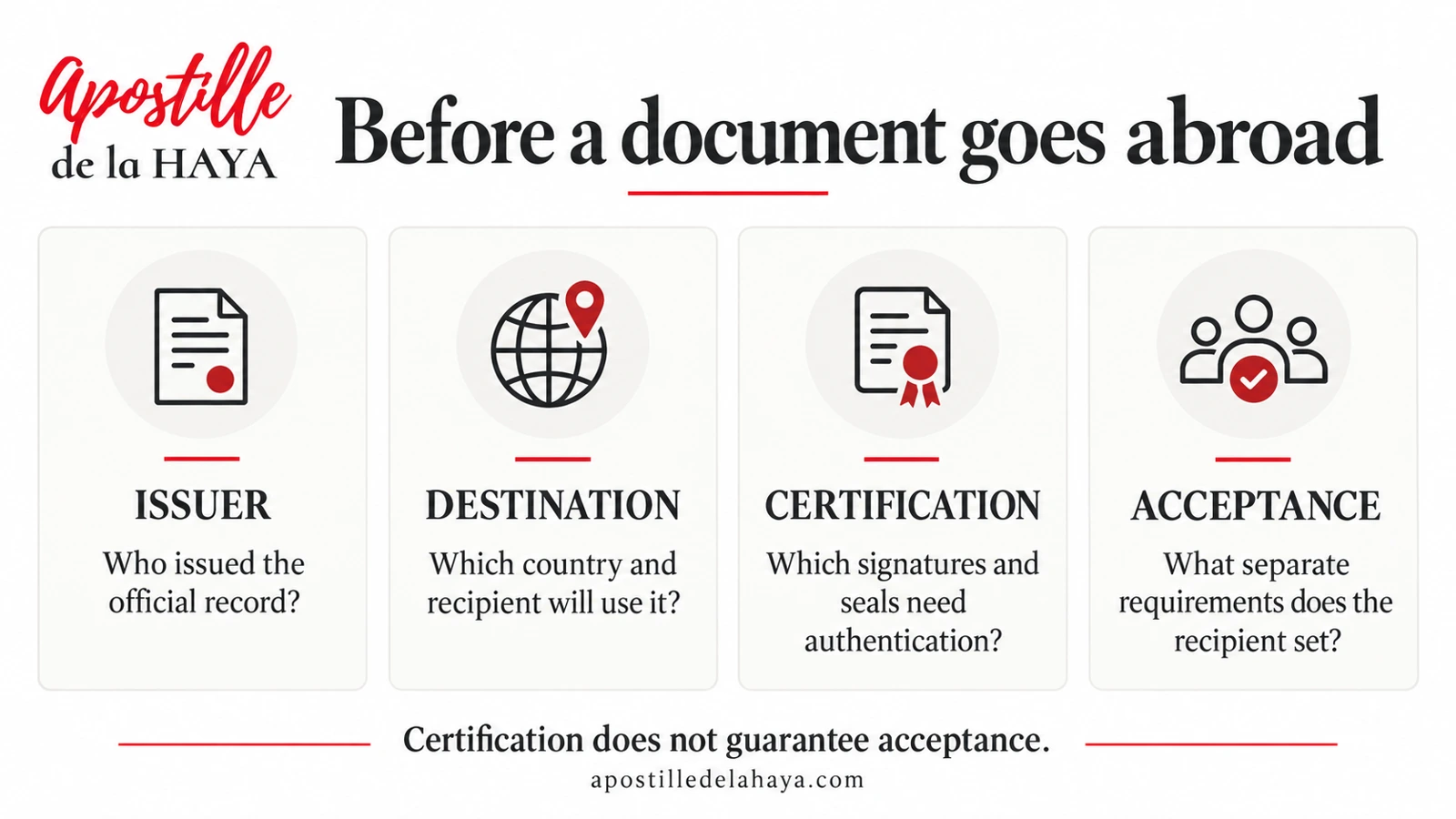
The review covers the record’s official title, issuer, and signature capacity. It also covers the available version, the destination, the recipient, and the intended purpose. Those facts point to the right authority. They also keep residence, citizenship, and record origin from being treated as if they were the same thing.
Add any existing certifications and the purpose they were obtained for. Keep attachments with the record. If the destination has changed, review the earlier preparation instead of assuming it can be reused. A certificate issued for one route should not be moved to another copy or altered to look like a different application.
Confirm the translation scope, if one is required, and the delivery plan. The applicant may be abroad while the record sits in the United States. Identify who can release it and where the completed file should go. The agreed handling should say whether the service ends with document delivery or includes another authorized documentary stage.
Mistakes that confuse the competent authority
One mistake is to send the certificate to the owner’s current state. That is the wrong office if the state has no authority over the issuing signature. The same problem comes up when a relative submits several certificates from different states as if they came from one issuing system. Each record needs its own origin review, even when all of them are going to the same destination.
Another mistake is mixing up New York State, New York City, and a local county process. Similar place names do not erase differences in the issuing office or signature. Ask what the particular copy requires under current instructions. Which version of the jurisdiction name sounds most familiar is beside the point.
A third mistake is expecting federal authentication to fix every missing state-level requirement. Each authority has its own role. If an earlier official act is required, a later submission does not necessarily supply it. Find the missing preparation before you repeat the application and arrange another shipment.
How Apostille de la Haya organizes the authority review
The birth certificate authentication service starts with your actual copy. Apostille de la Haya can review it together with its intended use abroad. The aim is to identify the issuer and certification questions before defining the documentary assistance. That helps most when different websites seem to give conflicting instructions for records with different signatures.
The general document legalization service ties the issuer review to the destination’s requirements. The proposed scope should explain which stages are included and which actions stay with the issuer, the applicant, or the receiving authority. It should not promise an immigration, nationality, or other substantive outcome just because a certificate has been prepared.
Send the complete record details, existing certifications, destination, language requirements and deadline. A preparation review should distinguish work already completed from any missing official act. Conditions depend on the nature, complexity and specific requirements of the case. Consult Apostille de la Haya directly before arranging the remaining assistance.
Frequently Asked Questions
Does my current address determine the authentication office?
Not usually, by itself. The issuing authority and the official signature are central to identifying the competent office at origin. A birth record from another state should not automatically go to the state where you live now. Apostille de la Haya can review those facts before explaining the appropriate documentary route.
Why do two certificates from the same state have different requirements?
They may carry different official signatures or come from different issuing offices. The applicable procedure can also treat state and local records differently. Show Apostille de la Haya the complete certificate, so the assessment works from the actual issuer and certification and not just the state name.
Does every certificate have to go through a county clerk?
Do not assume a universal rule. Some records and jurisdictions require a county-level certification, and others do not. The issuing state’s current instructions and the official signature decide the question. Apostille de la Haya can review the copy before recommending a step that one record may need and another may not.
Can a notary certify the copy instead of the issuing office?
Do not assume a notarial copy can replace an official certified vital record. Public-record rules and the recipient’s requirements both matter. Apostille de la Haya can help you tell whether your version is suitable or whether the certified copy has to come from the official custodian.
What if I have certificates for several family members?
Treat each record separately: its issuer, signature, available version, and intended recipient. Sharing a family or a destination does not make the origin requirements identical. Send Apostille de la Haya the details for each certificate, so the documentary preparation can be reviewed one by one within the proposed service.
Match the certificate to the authority that can process it
Need help with how to authenticate a birth certificate for use abroad? Contact Apostille de la Haya with the U.S. birth record and the destination’s requirement. We can review the issuing signature, the copy you have, and the appropriate documentary assistance before the file goes to the next authority.
Contact Apostille de la Haya by phone or WhatsApp: +1 305 500 0185.