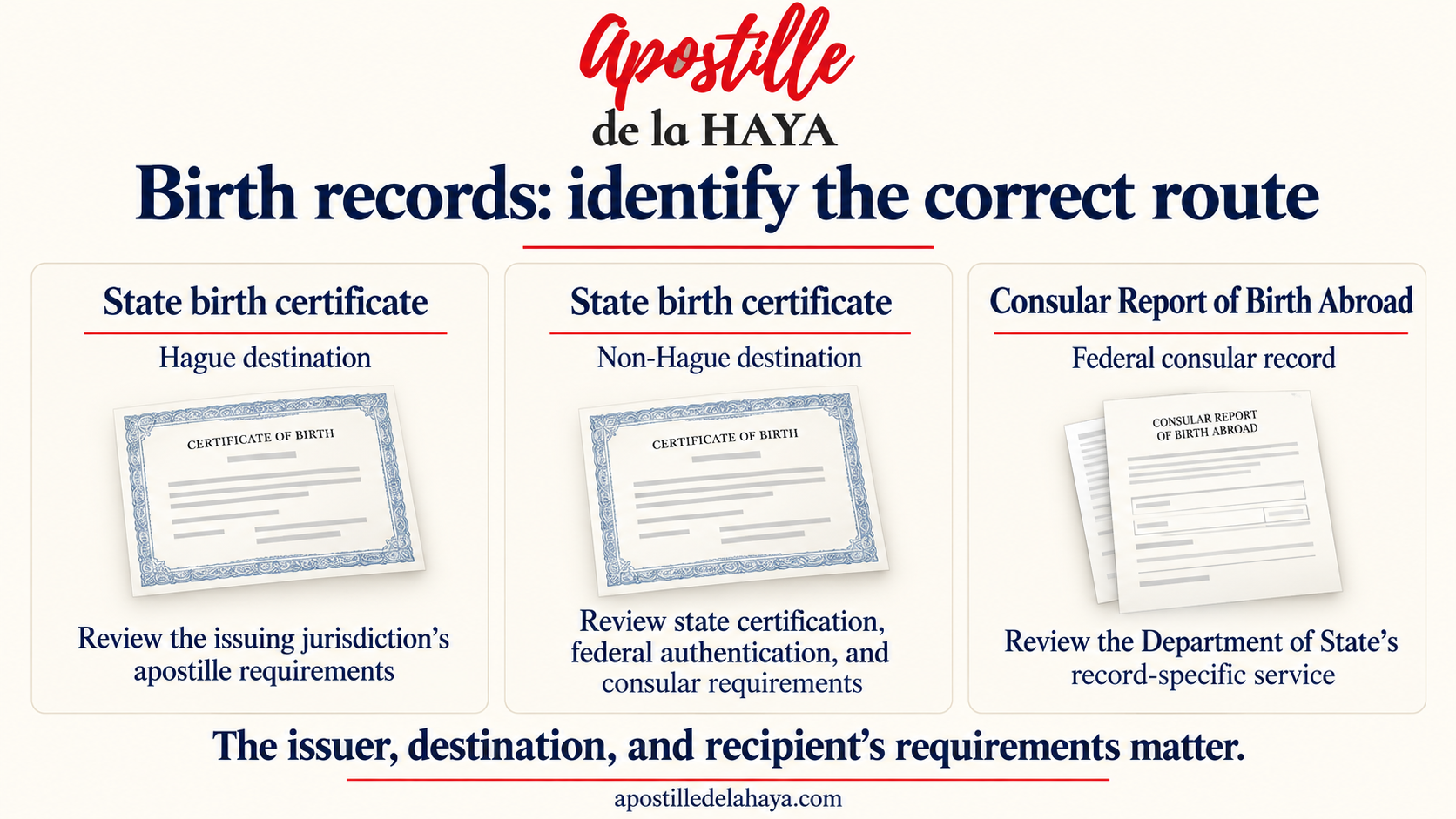
US Department of State birth certificate authentication applies to particular document routes. It is not an extra federal stamp that every U.S. birth certificate needs. A state-issued record usually follows its issuing jurisdiction’s apostille route for Hague use. However, a non-Hague destination may require federal authentication after the appropriate state certification.
A Consular Report of Birth Abroad presents a different question. That record comes from the U.S. Department of State, and its specific federal service matters. Therefore, the first review should identify the actual document, rather than rely on the phrase “birth certificate” alone.
Apostille de la Haya reviews the issuer, destination, and receiving institution’s instructions before coordinating the applicable service. This helps distinguish a state apostille from a federal authentication or a consular-record request. You can ask the team to review the route before sending your record or arranging an appointment abroad.
US Department of State birth certificate authentication: when it applies
Most birth certificates for births in a U.S. state come from that state’s vital-records system or an authorized local office. For Hague use, the designated authority in the issuing jurisdiction generally provides the apostille. Consequently, a Florida record does not become a federal record because the person named on it lives overseas.
The federal Office of Authentications may enter the process when a state record requires authentication for a non-Hague destination. Its guidance requires the relevant state authentication before the federal request. Any subsequent consular requirements depend on the destination and document.
The word “authenticated” can describe several different acts. For example, a recipient may mean an apostille, a state authentication certificate, or consular legalization. Ask for the written requirement when the wording is unclear. Our comparison of apostille and authentication explains why those terms should not be treated as interchangeable.
Birth certificate authentication starts with the issuer
A state birth certificate and a Consular Report of Birth Abroad can concern similar personal facts, but different authorities issue them. That difference controls which office can verify the relevant signature or seal.
A Consular Report of Birth Abroad, or CRBA, is Form FS-240. It records acquisition of U.S. citizenship at birth abroad. The Department of State provides a specific apostille request service through Passport Vital Records. Therefore, a CRBA should not automatically enter the general Office of Authentications queue simply because it is federal.
The CRBA apostille instructions refer to Form DS-5542. By contrast, general Office of Authentications requests use DS-4194. These are separate services with different intake requirements. The review should confirm which service applies before preparing an application.
Federal authentication of a state birth certificate
For a non-Hague destination, the required certification can involve more than one authority. The federal office checks the appropriate state authentication as part of its review. However, that federal certificate does not change who issued the underlying birth record.
The relevant embassy or consulate may then have its own legalization requirements. For that reason, the complete file should reflect the destination’s instructions. A federal authentication is not automatically the final requirement for every foreign use.
Our overview of the US Department of State’s certification services discusses the office’s broader role. The distinction matters when a person requests an “apostille” but the actual destination calls for authentication and legalization.
Why the state certification still matters
Each authority needs a signature or certification within its remit. Therefore, a federal submission cannot replace a state certification that the route requires. Similarly, sending a document to an embassy does not resolve missing prerequisites at an earlier stage.
The precise review depends on the record and destination. Avoid assuming that every incomplete file receives the same response or that every document needs the longest possible chain. The appropriate route should include the certifications that apply to the intended use.
What birth certificate authentication can establish
An authentication or apostille concerns the origin of the document and the relevant official signature, capacity, or seal. It does not decide citizenship eligibility, inheritance rights, or whether a foreign registry should approve an application.
A receiving institution may need the birth record to evaluate parentage, identity, or a family relationship. However, that evaluation remains separate from certification. If the record contains an error or lacks information the institution requires, an additional seal does not correct that problem.
For example, a recipient may require a particular form of birth record or a translation that meets local rules. The initial review should identify those requirements alongside the certification route. Otherwise, a correctly authenticated record may still leave the application incomplete.
Which birth certificate copy should be reviewed?
The review should start with the actual copy available, including its issuing office and certification. A household photocopy or hospital keepsake is different from an official certified record. Therefore, the fact that a paper lists a person’s birth details does not establish that it suits the proposed authentication.
A notary’s signature on a photocopy also does not automatically substitute for the issuing office’s certified vital record. The receiving institution and authenticating authority may require the registrar’s certification. Confirm that distinction before paying for an unnecessary notarization.
Our article on certifying a birth certificate discusses record formats. If you need a replacement, the request must follow the issuing office’s eligibility and identification requirements. A service provider cannot override access restrictions simply because the record will go abroad.
Does an older certificate automatically need replacement?
No universal rule makes every older birth certificate unsuitable. The relevant authority may impose conditions about the record’s format, date of issuance, or official signature. Likewise, a receiving institution may require a recently issued copy for its particular procedure.
Consequently, review the stated requirement before ordering another certificate. The date of the birth, the date when the office issued the copy, and the date of authentication answer different questions. They should not be treated as a single measure of document age.
US Department of State birth certificate authentication: names and translations
A difference between the record and the recipient’s application can require clarification. For example, a married name may differ from a birth name without making either record incorrect. The institution reviewing the application determines what supporting evidence it needs to connect them.
By contrast, a genuine error in the birth record may require correction through the issuing authority. Authentication does not amend the record. Therefore, identify the concern before requesting a certificate that would simply accompany the same unresolved information.
Translation requirements also vary. A recipient may require a particular translator qualification or certification format. Confirm those requirements before arranging the service, especially when more than one language or jurisdiction is involved.
State requirements are not identical
Even within one state, the issuing office can affect preliminary certification. In New York, for example, the published instructions distinguish New York City records, local records elsewhere in the state, and records bearing particular state vital-records signatures.
New York City birth records require the specified county-clerk certification before the state apostille or authentication. By contrast, qualifying records bearing the signature of the state Director of Vital Statistics or NYS Registrar can follow a different preliminary route. Therefore, the label “New York birth certificate” alone is not enough.
This example illustrates why reviewing the actual document matters. It does not mean that every state requires a county-clerk step. The applicable state instructions and the certificate in hand should determine the assessment.
Errors to resolve before a federal birth-record request
A US Department of State birth certificate authentication review should address the following concerns before submission:
- The wrong issuing authority. A state vital record, a foreign civil record, and an FS-240 require different assessments.
- An unclear destination. The country of use helps distinguish the Hague apostille route from authentication and legalization.
- Missing state certification. A state record may need that certification before a federal authentication request.
- An unsuitable copy. A photocopy may lack the registrar’s certification that the authority or recipient requires.
- Unresolved recipient instructions. Translation, record format, or supporting evidence may remain outstanding after authentication.
These concerns do not predict the same result for every file. Instead, they identify questions that need a documented answer. Resolving a specific uncertainty is more useful than adding another stamp without knowing what it certifies.
Planning the authentication timeline
US Department of State birth certificate authentication is one possible stage in a larger document request. Obtaining the certified record, completing applicable certifications, and arranging delivery can each take time. Therefore, a federal processing estimate should not be presented as the timeline for the whole file.
A consular-record request may also follow a different schedule from a general authentication request. Review the current service instructions for the record involved. An urgent appointment abroad does not automatically create eligibility for accelerated government processing.
If a deadline matters, share the appointment date and the recipient’s written requirements during the initial assessment. The team can discuss the relevant route and outstanding dependencies. However, public authorities control certification and receiving institutions control their own acceptance decisions.
Coordinating birth certificate authentication from abroad
Living outside the United States can add delivery and authorization questions. Before sending a document, confirm which office needs it and what return arrangements are available. Also establish whether the request concerns an existing eligible copy or obtaining a replacement.
Access to records remains subject to the relevant office’s rules. For CRBA requests, the current instructions restrict who can request the record and specify authorization requirements for another person. Therefore, a commercial service should not promise unrestricted retrieval on anyone’s behalf.
Apostille de la Haya can assess the available administrative support and explain what you must provide. The agreed scope should identify responsibility for records, supporting instructions, and delivery. This is particularly useful when several offices or countries are involved.
How Apostille de la Haya reviews your birth-record file
The team reviews the document’s issuer, certification, destination, and intended use. This establishes whether US Department of State birth certificate authentication belongs in the proposed service. It also identifies questions about the copy or recipient’s requirements before the request proceeds.
Depending on the file and agreed scope, support may include document review, administrative preparation, coordination with the relevant offices, and tracked delivery. Any consular legalization or translation requires a separate assessment of the applicable requirements.
You should know what the service includes before approving it. For example, obtaining a replacement record is different from arranging authentication of a suitable copy you already hold. Contact the team for an assessment based on the actual file and destination.
Apostille de la Haya is a private service provider. The competent authority decides whether to issue the certificate. Careful preparation and coordination can reduce avoidable errors, but they do not guarantee certification or acceptance abroad.
US Department of State birth certificate authentication: common questions
Does every state birth certificate need federal authentication?
No. A state record for Hague use generally follows its issuing jurisdiction’s apostille route. Federal authentication may form part of a non-Hague legalization request. Therefore, identify the destination before selecting the service.
Is a Consular Report of Birth Abroad a state record?
No. The Department of State issues the FS-240 as a federal consular record. Its specific apostille service uses Passport Vital Records instructions. A state office does not become responsible because the holder lives there.
Can authentication correct an error in the certificate?
No. Authentication concerns the relevant signature or seal. A correction to the underlying record requires the issuing authority’s procedure. However, a name difference may instead require supporting evidence, depending on the recipient’s instructions.
Must every birth certificate be newly issued?
No universal age limit applies to every use. The authority and recipient may set format or issuance-date requirements. Therefore, review the actual instructions and available copy before assuming that a replacement is necessary.
Can the team help if I live abroad?
Contact the team to assess the document, eligibility rules, and available delivery arrangements. The service scope depends on the record and destination. However, assistance cannot bypass restrictions on who may request a vital record.
Review your birth certificate authentication route
Contact Apostille de la Haya with the issuing office, document type, destination country, and recipient’s instructions. We can assess the applicable service and any requirements that need clarification.
Call +1 305 500 0185 or send your inquiry through WhatsApp.
This article provides general information, not legal advice. Requirements can change. Public authorities control certification, and the receiving institution determines the records and supporting materials it will accept.