Plan power of attorney legalization before the signed instrument goes overseas. Often it should be planned before the final version is signed, too. The recipient may require particular wording and a specific form of execution. It may also require an accepted language and a particular international certification route. Each of those requirements touches a different part of the file. A U.S. notarial act does not, by itself, show that the authority granted in the document is enough for a transaction abroad.
This article covers powers signed or notarized in the United States for use outside the country. It explains how preparing the legal instrument differs from certifying the official acts connected to it. Apostille de la Haya can review the documentary preparation and explain the legalization service that fits the destination. Questions about the powers granted, their legal effect, or suitability for a transaction should be resolved with the recipient or a qualified legal professional. Resolve those questions before certifying a document that may not authorize the intended transaction.
Power of attorney legalization does not draft your powers
A power of attorney names the principal and the agent. Its substantive provisions determine what the agent may do, subject to the applicable law and the recipient’s requirements. Choosing the right powers, limits, and form is a question of legal content. Legalization answers a different question, about the relevant signatures and certifications.
Before signing, get the recipient’s requirements or appropriately qualified advice on the instrument. A bank, property registry, court, or other organization may expect a particular form or sufficiently specific authority. A document labeled “general” is not automatically accepted for every transaction. The discussion of special powers of attorney gives more background on why scope matters.
Do not assume an embassy or authentication office will rewrite the instrument if the powers are unsuitable. A certification office may perform its act without deciding whether the document achieves the intended legal result. Settling the content first can save you from repeating signing, certification, translation, and transport after the recipient points out a missing provision.
Separate drafting, execution, notarization, and legalization
Drafting deals with the instrument’s language and authority. Execution covers the required signing formalities, which may include witnesses or other conditions under the applicable rules. Notarization records a permitted notarial act. International certification deals with recognition of the relevant official signature or seal for foreign use. The stages are related, but one cannot stand in for another.
The overview of power of attorney notarization covers the notarial stage. Do not read it as a guarantee that any notarized power will be accepted abroad. Beyond certification of the notarial act, the intended recipient and destination may require a particular form, language, or method of execution.
A new notarial stamp cannot add powers the text leaves out. A translation cannot turn an unsigned draft into an executed instrument either. Whenever a service or authority uses the broad word “certification,” ask which part of the file it means. That makes the proposed assistance clearer and keeps one stage from being mistaken for all the others.
Confirm the destination and the receiving institution
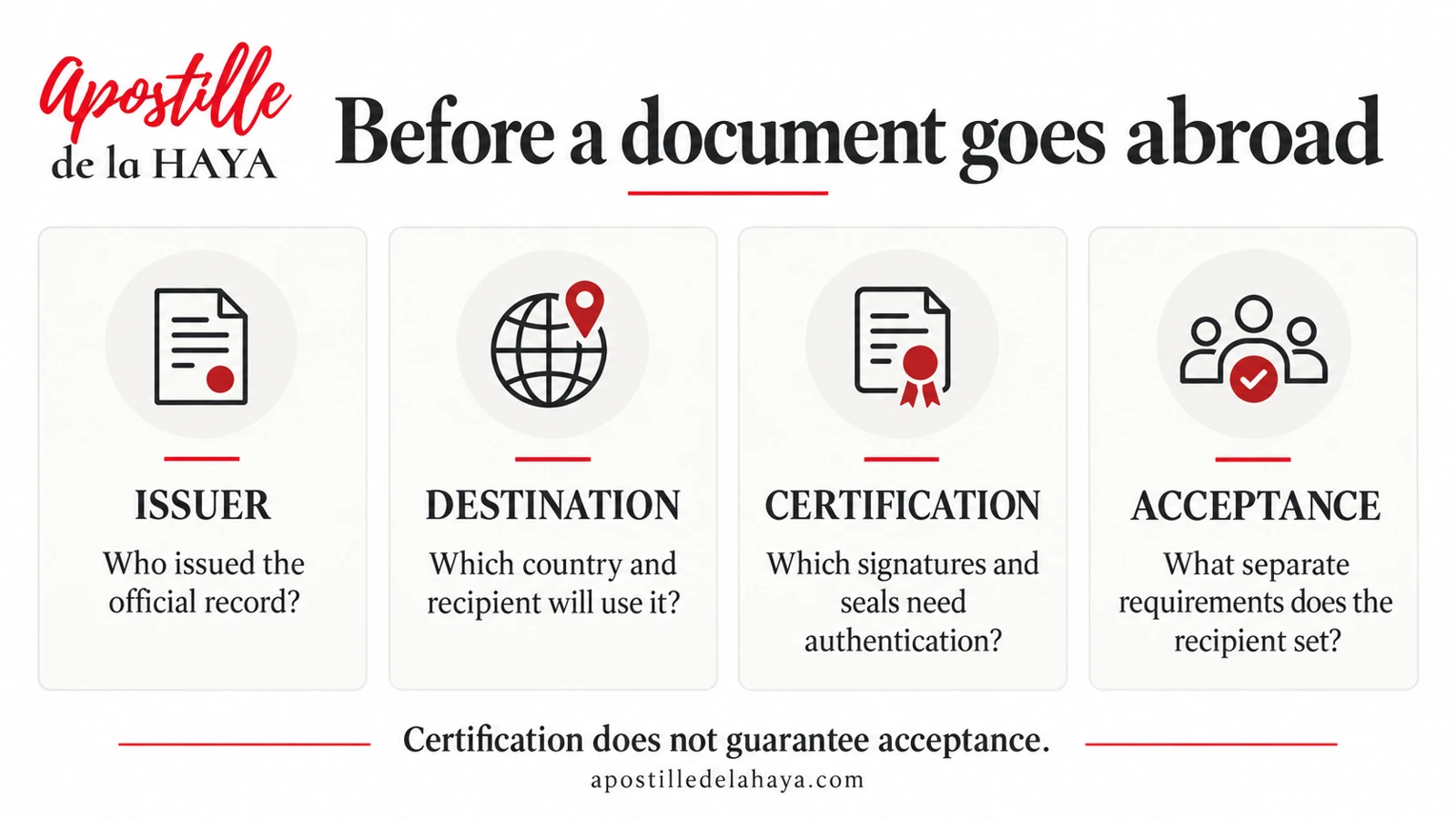
Identify the country where the agent will use the power. Then identify the institution or authority that will receive it. The agent’s residence, the principal’s location, and the receiving country may all differ. The actual place of intended use is central to the international certification route, while the place and manner of execution help establish the preparation on the origin side.
Ask the recipient to confirm the required form, language, identity details, signing method, and supporting evidence. If the transaction involves legal rights or property, get the appropriate professional review before execution. Do not swap the recipient’s specific requirement for a template found online just because its title says “power of attorney.”
The applicable apostille relationship or consular legalization requirement also needs review. The U.S. document authentication overview explains how the destination decides which certificate applies. Settle the correct route before sending the file off for a certificate that may not fit the intended country.
Review the signed document as a complete instrument
If the power is already signed, review all of it. That means the full text, the signature pages, the notarial certificate, and any attachments the instrument refers to. A scan of the last signature page alone may not show whether it belongs to the document being used. Keep the full set together so the link between the instrument and its certification stays clear.
Check that names and identity references match the intended principal and agent. If information is wrong or incomplete, ask the appropriate professional or the recipient how to correct the instrument. Do not edit the signed record, replace a page, or informally attach a new signature sheet. A changed instrument may need new execution and new preparation.
Review the notarial wording, date, venue, official signature, and seal for completeness under the applicable requirements. A documentary reviewer should flag a concern, not invent a missing act or fix the notary’s certificate on their own. Any correction has to go through the appropriate authorized process.
A U.S. notarial act and a direct consular power are different routes
Some applicants can use the destination country’s consular service. They sign or prepare the power there. In other cases, the power is executed before U.S. authorities. These are not the same service with different mailing addresses. Eligibility, identification, attendance, and legal form can differ.
Egypt’s signature legalization guidance separates direct consular signature acts from powers prepared before U.S. authorities. Its requirements cover the instrument, identity, jurisdiction, and prior certifications. It also stresses that applicants deal directly with the consulate for the services it describes. A private service should not promise to replace a required personal appearance.
For that destination, the Egypt documentary service can help frame the preparation review. The applicant still has to establish whether the consular route or U.S. execution suits the intended transaction. The recipient’s legal-content requirements stay separate from the certification of the official acts.
Power of attorney legalization: state, federal, and mission steps
A privately signed power often reaches authentication through its notarial act. The exact preparation, though, depends on how it was executed and where it is going. Identify the notary’s jurisdiction and the authority responsible for recognizing the official signature. Do not choose a state office only because the principal lives there now.
Where a federal authentication stage is required, the State Department’s document requirements are the relevant reference on the origin side. Read them together with the mission’s actual instructions. A generic list of state, federal, and embassy stamps cannot tell you which acts this particular file requires.
If the destination is the UAE, the UAE service reference gives a country-specific starting point for discussing the documentary work. Do not assume the requirements for a personal power match those for a commercial instrument. Describe the document’s purpose so the right category can be reviewed before submission.
Translation and bilingual text need legal and documentary review
The recipient may require a particular language or a bilingual instrument. Settle the accepted form before signing. A translation made after execution may serve a different function from a bilingual instrument executed as one document. The recipient or a qualified professional should decide which arrangement suits the transaction.
For a translation, identify the required scope and formalities. Relevant seals, notarial wording, and later certification pages may need to be covered. Do not assume that translating only the operative powers produces a complete file. The service scope should separate translation of the instrument from any certification the translator’s declaration requires.
Names, dates, property references, and other identifiers must be carried over accurately. A translation should not quietly correct or expand the authority granted in the signed text. If the source contains an error or ambiguity, resolve it through the appropriate legal or issuing process before relying on the translated version abroad.
Errors that can force a second signing
One mistake is signing before the recipient confirms the needed powers or format. If the institution later asks for different wording, the applicant may need a new instrument, not another stamp. That can mean repeating execution and documentary preparation, especially if the principal has already traveled.
Another error is sending only a copy. The receiving authority may require an original executed instrument or a specific officially acceptable version. Clarify that before the only signed document ships. A plain scan can be useful for review and still not be acceptable for the actual transaction.
A third mistake is assuming a remote notarial act is accepted for every foreign use. Whether the notarial process is lawful on the origin side and whether the destination accepts it are separate questions. Confirm the intended recipient’s requirements before choosing how to execute. Do not promise that online signing removes every attendance or original-document requirement.
Finally, keep existing certifications where they are. Do not detach a certificate or move it to a revised power. A certification belongs to the actual document and act it was issued for. If the instrument changes, have the new file reviewed instead of assuming the old stamps carry over.
How Apostille de la Haya helps with the documentary assignment
Start with the power of attorney legalization service. It gives you a point of contact for reviewing a U.S.-executed power and its destination requirements. Say whether the instrument is a draft or already signed, and where it was executed. Add what certifications exist and who will receive it abroad.
The proposed assistance should list the documentary stages included and any actions that remain with the principal, the agent, a legal professional, or the receiving authority. That helps reduce avoidable administrative work without confusing legalization with legal advice. A service can organize preparation and handling, while the legal sufficiency of the instrument remains a separate matter.
Give the deadline, existing certifications and intended delivery point for a case-specific assessment. The service scope should distinguish document preparation from legal drafting and from the transaction itself. Conditions may vary with the nature, complexity and requirements of the case. Consult Apostille de la Haya directly about the assistance appropriate to your file.
Frequently Asked Questions
Does power of attorney legalization make my document legally sufficient abroad?
It should not be treated as a guarantee of substantive validity or acceptance. The recipient and the applicable law decide whether the instrument grants suitable authority and meets execution requirements. Apostille de la Haya can help with documentary preparation. Legal-content questions should be resolved with the recipient or a qualified professional.
Should I sign before asking about legalization?
Whenever possible, confirm the recipient’s form and execution requirements first. Changing the legal text after signing may require a new execution and repeated certifications. Contact Apostille de la Haya to review the documentary route, and get appropriate advice on the instrument before you commit to a signing method.
Can an online notarization always be used overseas?
Do not assume universal acceptance. Authorization on the origin side and acceptance at the destination are different questions, and a recipient may require a particular format or method. Apostille de la Haya can review the documentary requirements while you confirm the intended recipient’s acceptance before arranging remote execution.
Can I reuse certifications after changing the power?
Do not assume they carry over to a revised instrument. Existing certificates relate to the document and official acts actually certified. Keep the old set intact and have the new version reviewed. Apostille de la Haya can explain the preparation the revised file requires instead of moving attachments between documents.
What should I provide for a document review?
List the destination, recipient, purpose, signing status, execution jurisdiction, existing certifications, language needs, and deadline. Those details define the documentary assignment. Contact Apostille de la Haya for a case-specific scope. Any drafting or legal-effect question stays with the recipient or an appropriately qualified professional.
Review the power before its international certification
Contact Apostille de la Haya with the U.S.-executed instrument and the recipient’s requirements. We can review the documentary preparation and explain the power of attorney legalization assistance that fits the intended use abroad.
Contact Apostille de la Haya by phone or WhatsApp: +1 305 500 0185.