
If you are looking for a power of attorney notary, the direct answer is that you must have your document signed in the physical or digital presence of a commissioned notary public who will verify your identity, ensure you are signing willingly, and apply their official seal. Attempting to manage this crucial administrative process on your own or relying on inexperienced retail clerks often leads to improperly executed documents. A single missing stamp or incorrect notarial block can cause hospitals, banks, or government agencies to reject your document entirely.
To minimize these risks and ensure your paperwork is processed smoothly, Notary Public Center provides specialized notarial services. Our team of professionals ensures that every administrative requirement is flawlessly executed, positioning us as the premier option for your notarization needs.

What Is a Power of Attorney
A Power of Attorney (POA) authorizes someone (the agent) to make decisions or take actions on behalf of another person (the principal). This can include signing documents, managing bank accounts, or making healthcare decisions.
In most cases, for the POA to be legally binding and accepted by banks, hospitals, or government agencies, it must be:
- Signed voluntarily by the principal
- Notarized by a certified notary public
- Possibly witnessed, depending on your state’s requirements
Why a Power of Attorney Requires a Notary
A Power of Attorney (POA) is a powerful document that grants another person (the agent or attorney-in-fact) the authority to make decisions on your behalf (the principal). Because this document transfers significant authority over your financial, medical, or personal affairs, institutions require absolute certainty that the document is authentic and was not signed under duress or through fraud.
This is exactly where a power of attorney notary steps in. The notary acts as an impartial, state-commissioned witness. Their primary administrative duties include:
Identity Verification: Ensuring the person signing is exactly who they claim to be by inspecting valid, government-issued photo identification.
Willingness Assessment: Confirming that the principal is signing the document voluntarily, without any visible signs of coercion.
Administering Oaths or Acknowledgments: Executing the specific notarial act required by the state statutes for a POA, which is typically an acknowledgment.

Where to Notarize a Power of Attorney
Depending on your location and preferences, you have several options:
- At a Notary Public Center office
- Online via a remote online notary (if allowed in your state)
If you’re searching for “where to notarize a power of attorney near me”, Notary Public Center can set up a virtual session if your state allows.
Do You Need a Notary for a Power of Attorney?
In most states, yes. A notarized POA:
- Confirms the identity and intent of the signer
- Makes the document legally valid for use in financial institutions, courts, and other entities
- Protects against fraud or disputes
- Without notarization, many organizations will not accept the POA even if it’s legally valid under state law.
How to Prepare for Your Notary Appointment
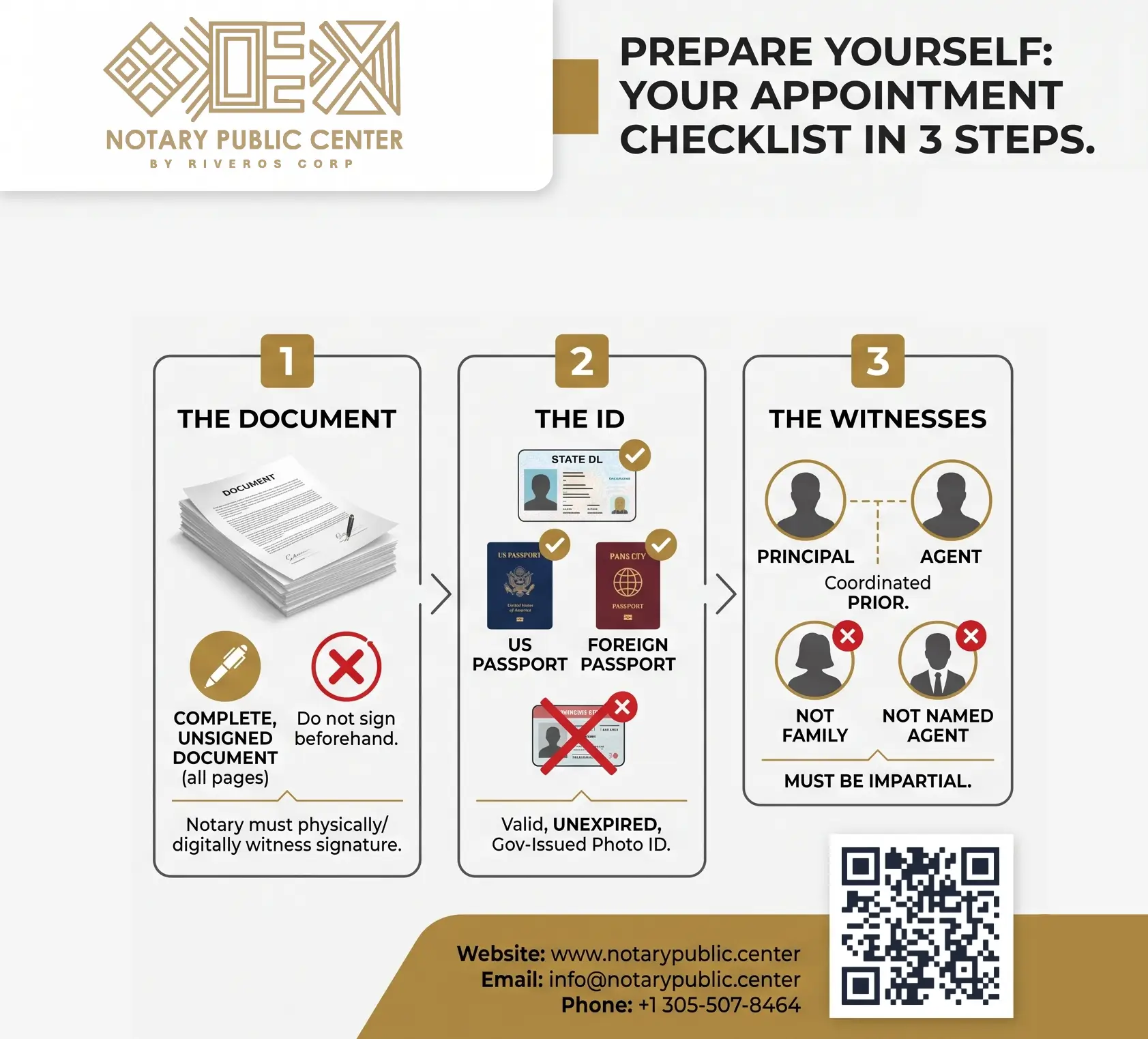
To ensure a seamless and efficient process, you must arrive at your appointment—whether online or in-person—fully prepared. Missing just one administrative requirement can halt the entire process. Here is what you need:
1. The Complete, Unsigned Document
You must present the entire document, not just the signature page. More importantly, do not sign the document beforehand. The power of attorney notary must physically or digitally witness you signing the paper.
2. Valid Identification
All signers must present an unexpired, government-issued photo ID. Acceptable forms of identification typically include:
A state-issued driver’s license or ID card.
A United States passport.
A foreign passport (must be valid and stamped if required by state rules).
3. Required Witnesses
Depending on the state where the POA will be used, you may need one or two impartial witnesses in addition to the notary. These witnesses cannot be named in the document (they cannot be your designated agent) and cannot be family members who might benefit from the document. You must coordinate these witnesses prior to the notarial ceremony.
Types of POA Documents We Can Notarize
While we are not legal advisors and do not draft these documents or provide guidance on which one you should choose, our administrative experts are fully equipped to perform the notarial acts for all types of POA forms, including:
General Power of Attorney: Grants broad authority to your agent for various administrative and financial tasks.
Durable Power of Attorney: Remains in effect even if the principal becomes incapacitated.
Medical / Healthcare POA: Grants authority to make medical decisions.
Special / Limited Power of Attorney: Grants authority for a very specific, isolated transaction, such as closing a real estate deal.
Online vs. In-Person: Choosing Your Notary Method
At Notary Public Center, we offer flexible solutions tailored to your specific circumstances, ensuring you never have to navigate this process alone.
Remote Online Notarization (RON)
Thanks to modern technology, you no longer need to travel to find a professional. Through Remote Online Notarization (RON), you can connect with our commissioned notaries via a highly secure, state-approved video conferencing platform. You will undergo knowledge-based authentication (KBA) and credential analysis to verify your identity. RON is fast, highly secure, and perfect for individuals traveling abroad or managing busy schedules.
Explore your options here.
How Long Does It Take to Notarize a Power of Attorney?
An in-person appointment typically takes fifteen to thirty minutes once the document is ready to sign, and an online session runs about the same or slightly less. The variable that actually eats up time is preparation: gathering two eligible witnesses, confirming the durability language is correct, and making sure the document matches your state’s requirements. Documents drafted or reviewed with a notary service familiar with Florida’s specific power-of-attorney rules tend to close in a single session; documents drafted elsewhere sometimes need a second visit to fix a formatting issue the signer had no way of knowing about in advance. We check for that issue before you sit down to sign, not after. That single step saves most clients a second appointment entirely. Contact us and we will review your draft before you book anything. No cost, no obligation. Just clarity before you commit to an appointment.
Notarize Your Power of Attorney Today
New to notarization? See our plain-English guide to what «notarized» actually means, and if you want the full walkthrough of our remote process, check the online public notary guide.
Why Choose Notary Public Center?
Your vital documents deserve the attention of dedicated professionals, not a quick stop at a retail counter. Our team focuses exclusively on the administrative and notarial correctness of your paperwork. We ensure that your notary blocks are compliant, your identity verification is meticulously logged, and your final document is ready for its intended use.
Do not leave your important affairs to chance. Contact Notary Public Center today to schedule your power of attorney notary appointment—either online from anywhere or via our specialized service in Miami. Learn more here.
Frequently Asked Questions
Can a notary public draft my Power of Attorney?
No. A notary public who is not a licensed attorney cannot draft documents, choose the type of POA you need, or provide any advice regarding its contents. Our role at Notary Public Center is strictly administrative: to verify identity, witness signatures, and execute the proper notarial act.
Does a Power of Attorney have to be notarized to be valid?
In the vast majority of jurisdictions, yes. Financial institutions, real estate agencies, and healthcare providers generally require a POA to be formally notarized to prevent fraud and authenticate the principal’s signature before they will honor the document.
Can I notarize a Power of Attorney online?
Yes. Remote Online Notarization (RON) allows you to legally sign and notarize your Power of Attorney digitally using a secure video connection, provided your receiving agency accepts electronically signed and notarized documents.
Do I need to bring my own witnesses for the notarization?
If your specific POA document requires witnesses (which is common for durable and medical POAs), you are generally responsible for providing impartial witnesses. The notary cannot act as both the notary and a witness simultaneously for the same signature.
What happens if the principal is physically unable to sign?
If the principal is conscious and willing but physically unable to sign their name, many states allow them to direct another person to sign on their behalf in the presence of the notary, or to sign by making a mark (such as an «X»). Specific administrative protocols must be followed in these cases.
The information contained in this publication is provided for general informational purposes only and does not constitute legal advice. Reading or using this content does not create and is not intended to create an attorney-client relationship. No reader or user should act or refrain from acting based on the information presented herein without first consulting an attorney duly licensed to practice law in their jurisdiction.