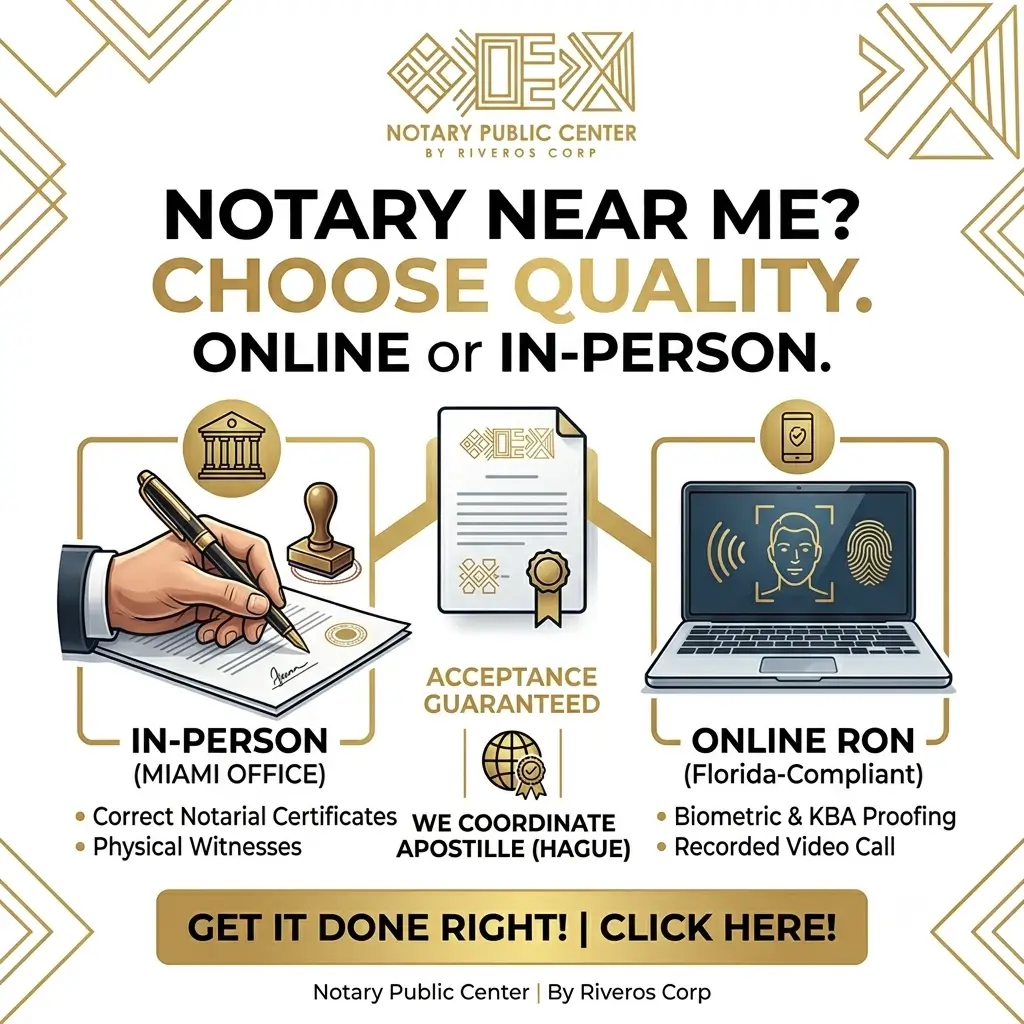
When you type notary near me, you want a quick, clean signing with zero surprises. Distance helps, of course. Yet what truly determines success is how well the notarial act is performed and whether the receiving office accepts the result—a bank, a court, a county recorder, a consulate, or a private company. At Notary Public Center, you can notarize in person at our Miami office or online through Florida-compliant Remote Online Notarization (RON). We use rigorous identity controls, deliver tamper-evident files, and—if the document travels abroad—coordinate the apostille (Apostille de la Haya) and obtain vital records when you don’t have them. If your business has compliance needs, ask about our specialized corporate services (Compliance Officers)
“Notary near me” today: proximity is helpful, but quality is essential
A nearby notary makes scheduling easy. However, a “quick stamp” that skips the correct notarial certificate, witnesses, or identity checks can cause rejections. Therefore, lead with quality and acceptance; then decide if online or in person fits. We focus on compliance first, so the document works where you’ll present it.
What we do at Notary Public Center
1) In-person notarization (Miami)
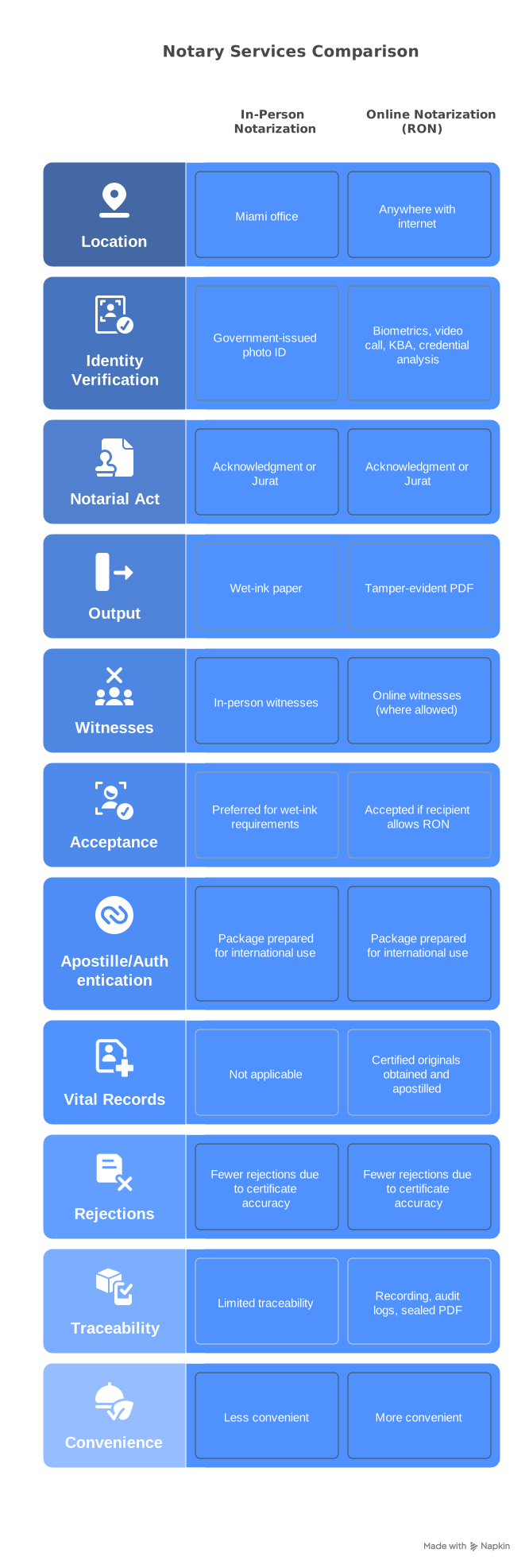
Visit our office with a current, government-issued photo ID. We confirm identity and willingness, and we apply the proper certificate:
Acknowledgment: you acknowledge you signed voluntarily (you may have signed earlier).
Jurat (affidavit): you swear/affirm and sign in the notary’s presence.
This is ideal when a recipient demands wet-ink paper or in-person witnesses.
2) Online notarization (RON) with tree identity layers
If you searched “notary near me” but prefer not to travel, RON is your best ally. Our online flow includes:
Biometrics & liveness — confirms a real person is present and matches your face to your ID.
Recorded live video call — the entire session (two-way audio/video) is recorded, capturing identity checks, the oath for jurats, and the signing ceremony.
KBA (Knowledge-Based Authentication) — time-boxed questions based on public/credit data tied to your identity.
Credential analysis — automated checks of your passport or driver’s license.
Result: a tamper-evident PDF; any post-signing change marks the signatures invalid in standard PDF viewers. If the receiver won’t accept RON, we confirm that early and schedule you in person.
Quality vs. proximity: how acceptance is earned
Acceptance first: It is important to verify who will receive the document and what they accept (RON vs. paper).
Certificate accuracy: We draft or correct the notarial block (venue, date, exact names, jurat vs. acknowledgment).
Evidence package: With RON, you get the sealed PDF plus the recording and audit trail that back up identity proofing.
Witnesses: We coordinate witnesses online (where allowed).
International chain: If the document goes abroad, we prepare the package for apostille or authentication, based on the country of use.
In short, “notary near me” should really mean “a notary my recipient accepts.”
Acceptable identification documents (practical guide)
We work with valid, government-issued, photo IDs. Commonly accepted:
U.S. passport (book or card)
U.S. driver’s license or state ID
Foreign passport (preferably with Latin characters and machine-readable zone)
U.S. permanent resident card (where rules permit)
Foreign national ID cards (case by case; must be official and legible)
U.S. military ID (some platforms do not scan these—ask us first)
Good habits that prevent rejections:
Make the name on the document match your ID exactly (include middle names/initials).
Use an unexpired, undamaged ID.
Prefer machine-readable IDs (barcode/MRZ) to streamline credential analysis.
If your ID uses non-Latin script, bring a passport with Latin characters as well.
If your only ID is expired, or if your name changed recently, tell us up front. We’ll align the notarial certificate and, if you’ll need an apostille, we’ll avoid future mismatches.
When it truly makes sense to pick a nearby notary
Choose a nearby, in-person appointment when:
The recipient requires wet-ink signatures.
A signer may not pass KBA (for example, very thin U.S. credit history).
The document calls for physical witnesses or complex paper packets.
Otherwise, RON delivers speed, traceability, and convenience, with quality equal to—or better than—traditional appointments.
Apostille: when your document goes abroad
If you’ll present your document in a Hague Convention (1961) country, you will likely need an apostille; if not, the route is authentication (and often consular legalization). We handle:
Country check: We confirm whether the destination is Hague or non-Hague and set the correct path.
Form review: We ensure your notarization meets intake rules (original, complete notarial certificate, correct names).
Filing: We submit to the competent authority (e.g., a Secretary of State for state/notarial documents).
Return: We ship back your apostilled original and, on request, provide a scan for your records.
Timeframes may vary by office and season.
Vital records: we obtain them, then apostille them
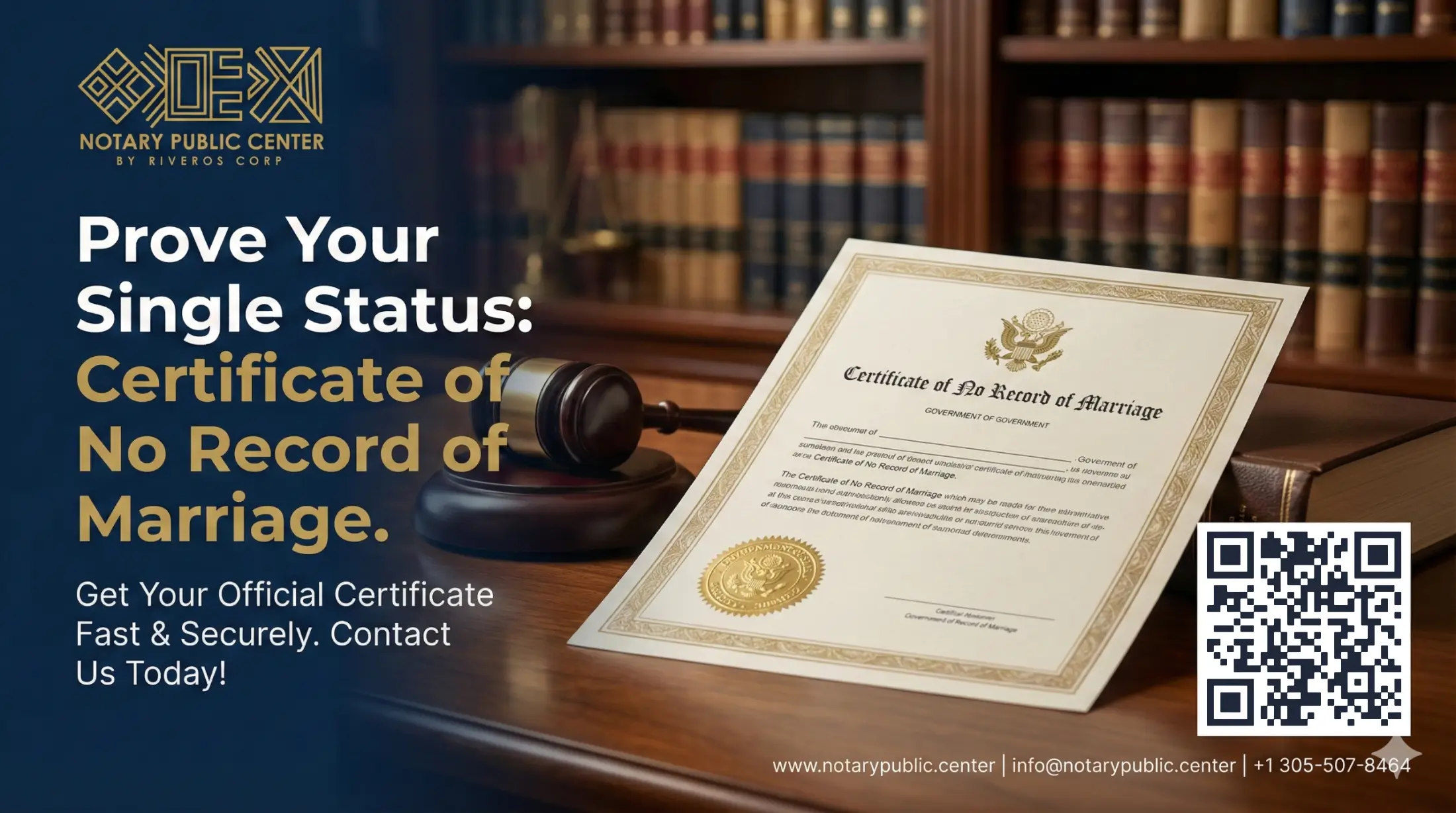
Birth, marriage, and death certificates are not notarized. You must use certified originals from the state/county/city where the event occurred. If you don’t have them:
We request the certified copy from the correct office (many destinations prefer the long-form version).
After we receive the original certified record, we obtain the apostille over the registrar’s signature.
We return the physical original and, if you wish, a courtesy scan.
This saves weeks and avoids the common mistake of trying to apostille a simple photocopy.
Checklist to keep everything smooth
Recipient and country of use (tell us both).
Do they accept RON or require paper? We confirm on your behalf.
Notarial act type: jurat (you swear/affirm and sign during the session) or acknowledgment (you acknowledge a prior signature).
Valid ID and exact name on the document.
Witnesses (if the form requires them).
Translations: if needed, we decide whether the apostille goes on the base document, on the translator’s notarized statement, or on both.
Vital records missing? We obtain them before the apostille.
Our step-by-step process
Intake & validation — We gather the goal, the recipient, the country of use, and any formatting rules.
Mode selection — Online (if the recipient accepts RON) or in person (if they require paper).
Session —
RON: biometrics + recorded live video call + KBA + credential analysis of your ID.
In person: ID check, oath/affirmation if needed, and signing.
Delivery — Tamper-evident PDF (RON) or original with physical seal (in person).
Apostille/authentication (optional) — We prepare and submit the packet. Timeframes may vary.
Vital records (if applicable) — We obtain them and then apostille the certified originals.
Why “quality > proximity” (and how it protects you)
Fewer rejections: the right notarial certificate and exact name/ID alignment.
Traceability: RON provides a recording, audit logs, and a sealed PDF that reveals tampering.
International readiness: we structure the file for apostille or authentication according to the destination.
Real savings: you avoid re-signing, reshipping, and last-minute scrambling.

Ready to stop browsing “notary near me” and get it done right? Contact Notary Public Center. We notarize in Miami or online with robust identity checks, and we coordinate apostille (Apostille de la Haya) and vital records when your document is headed abroad. For complex document authentication and background checks, remember that Compliance Officers is part of Riveros Corp. and can assist.
And if what you need is not a notary but an apostille, our guide to finding an apostille near me explains why the office that issues it is rarely the one closest to you.
FAQ
1. What is the fastest way to find a notary near me?
The fastest and most reliable method is utilizing Remote Online Notarization (RON). Instead of driving to a physical location, you can use Notary Public Center’s secure digital platform to connect with a certified e-notary instantly from your computer or smartphone, anywhere you have internet access.
2. Why did my local bank refuse to notarize my document?
Most local banks have strict internal risk management policies. They frequently refuse to notarize complex legal documents, out-of-state real estate deeds, or powers of attorney because they do not want to assume corporate liability if the document is contested. Specialized services like Notary Public Center handle these documents daily.
3. Do I need to provide my own witnesses for a notarization?
It depends on your state’s laws and the type of document. For instance, Florida law requires two witnesses for deeds and powers of attorney. Because local retail stores will not provide witnesses, using Notary Public Center ensures that necessary witness coordination is handled correctly and legally.
4. Can a local notary public help me fill out my legal forms?
No. A notary public who is not a licensed attorney is strictly prohibited by law from drafting legal documents, helping you choose which form to use, or providing any legal advice. Your documents must be completely drafted before your notarization session.
5. What forms of ID are accepted for online and in-person notarization?
You must present a valid, unexpired, government-issued photo ID. Acceptable forms typically include a U.S. state driver’s license, a state non-driver ID card, or a valid passport. For online notarizations (RON), your ID will undergo a secure digital credential analysis.
The information contained in this publication is provided for general informational purposes only and does not constitute legal advice. Reading or using this content does not create and is not intended to create an attorney-client relationship. No reader or user should act or refrain from acting based on the information presented herein without first consulting an attorney duly licensed to practice law in their jurisdiction.