A power of attorney in Spanish may serve different needs. A Spanish-speaking principal may need to understand a document for use in the United States. Alternatively, the document may travel to an institution in another country.
Those situations can overlap, but they do not always require the same paperwork. The language, legal authority, signing procedure, and destination requirements all matter. A bilingual layout alone does not settle them.
Notary Public Center coordinates eligible notarizations and related document services. A licensed attorney should advise on the legal wording and powers. This article explains how translation, execution, and authentication fit together without treating any one step as a guarantee of acceptance.
Power of attorney in Spanish: start with its destination
Before arranging the signing, identify who will receive the document and what the agent needs to do. A bank transaction, property transfer, and court matter can raise different requirements. The receiving office may also prescribe a particular form or supporting records.
Next, establish where the principal will sign. Applicable law determines the execution requirements, while recognition rules may affect use elsewhere. Therefore, a form acceptable in one setting may need further legal review in another.
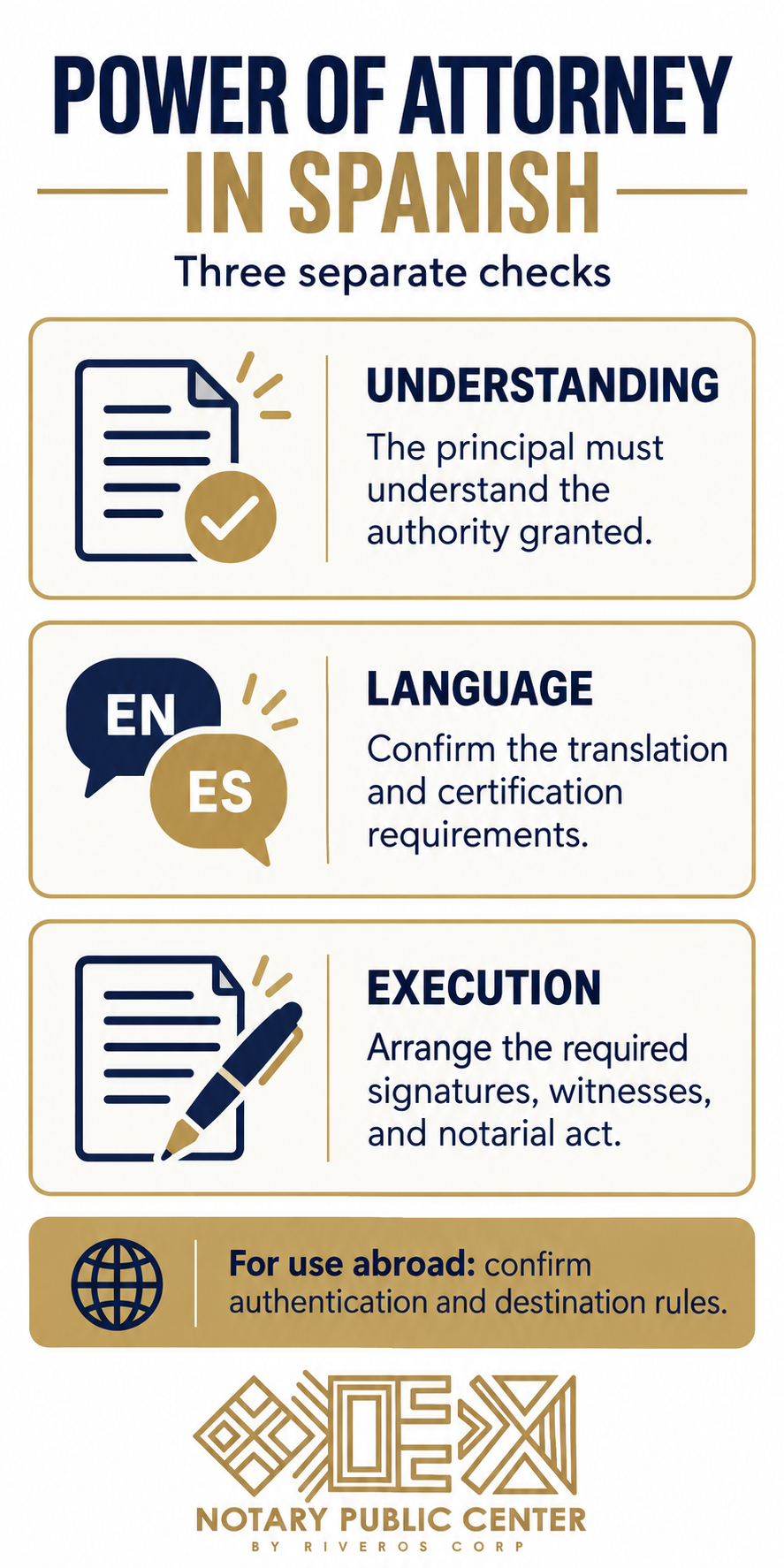
Also identify the language the principal understands. Understanding the authority granted is a separate issue from the recipient’s ability to read it. The preparation should address both.
The signer must understand the authority
Florida section 117.107 addresses acknowledgments involving people who do not speak or understand English. The nature and effect of the instrument must reach the signer in a language the signer understands. A signature obtained without that understanding does not solve the language problem.
The statute does not make a written translation mandatory in every such acknowledgment. However, the arrangement must meet the legal standard and allow the notary to perform the act properly. The document or recipient may impose additional requirements.
Consequently, discuss language needs before the appointment. If a translator or interpreter will participate, confirm the role and process in advance. The notary must also address identity, capacity-related concerns, and other applicable duties.
Power of attorney in Spanish for a U.S. institution
Spanish wording does not automatically make a document invalid. Nevertheless, no single nationwide statement resolves every power of attorney or filing. State law, the particular instrument, and the rules for its intended use control.
In Florida, section 709.2119 expressly allows a receiving party to request a certified English translation in good faith. That provision covers a power containing any non-English language, including a bilingual document. Therefore, English text on the same page does not always eliminate a translation request.
Institutional review also has legal limits. Florida restricts improper rejection and demands for a different power when the presented instrument grants the authority. If a dispute arises, counsel should assess the document and the reason for rejection.
Bilingual instrument or separate translation?
A bilingual instrument contains both languages within the document the principal executes. A separate translation accompanies an existing or newly prepared source document. Either arrangement may be useful, depending on the legal and receiving-office requirements.
However, a parallel-column layout does not guarantee that the two versions grant identical powers. The preparer must address discrepancies and any provision identifying the controlling language. An attorney should advise on the legal effect of those choices.
A translation should accurately reproduce its source. It should not quietly add powers, correct legal defects, or replace missing execution requirements. Our article on a carta poder translated into English discusses that distinction.
Compare the document formats
| Format | Possible purpose | Question to resolve |
|---|---|---|
| Single bilingual instrument | Let the principal and recipient read the proposed authority in different languages | Do both versions match, and does the recipient require a separate certification? |
| Spanish source with English translation | Help an English-reading recipient review the executed Spanish document | What translation certification and evidence of execution are required? |
| English instrument with Spanish language support | Address the principal's understanding while using an English operative document | Does the language-support arrangement satisfy the signing and recipient requirements? |
The appropriate format follows the requirements of the matter. It should not depend only on appearance or convenience. A bilingual document may still need witnesses, multiple acknowledgments, or further authentication.
Certified translation of a power of attorney in Spanish
A translator’s certification addresses the translation under the standard required by the recipient. It is different from a notarial certificate. The certification should clearly identify the source document and the translation it covers.
For documents submitted to USCIS, 8 CFR 103.2(b)(3) requires a full English translation. The translator must certify its completeness and accuracy and their competence to translate into English. That rule does not establish an identical standard for every bank, registry, or court.
Other recipients may require particular qualifications, wording, or an official translator recognized in the destination country. Consequently, confirm those requirements before commissioning the work. A certification acceptable for one filing may not satisfy another.
Translation and interpretation are different tasks
Translation concerns written material; interpretation concerns spoken communication. A person assisting at the appointment does not automatically provide the certified written translation a recipient may require. Similarly, a written translation does not resolve every communication issue during execution.
The service plan should identify which task is necessary and who will perform it. If the principal asks a legal question, the appropriate attorney should answer. A translator should not invent an explanation of powers beyond their role.
What the notary certifies
The notarial act has a defined function. An acknowledgment concerns the identified signer’s acknowledgment of execution. An oath or affirmation serves a different function and requires the corresponding procedure.
Neither act, by itself, certifies that every translated word is accurate or that the underlying power is legally sufficient. If a translator signs a certification before a notary, the notary performs the act for that signature. The translator remains responsible for the translation statement.
Also, Florida prohibits a notary from notarizing their own signature. A notary who separately works as a translator cannot authenticate their own translation certification through self-notarization. Our guide to notarizing a power of attorney explains the signing role.
Notary public and civil-law notary are different roles
An ordinary U.S. notary commission does not by itself authorize legal advice or document drafting that constitutes legal practice. That distinction matters to clients familiar with civil-law notaries abroad. Similar terminology can conceal different qualifications and powers.
Florida prohibits literal translation of “Notary Public” in advertisements for notarial services. It also requires specified notices when a non-attorney advertises those services in another language. These rules address misleading impressions about legal qualifications.
However, it would be incorrect to say that civil-law notarial acts never exist in the United States. Florida has a separate civil-law notary appointment under chapter 118 for qualified Florida attorneys. Clients should confirm the professional’s actual appointment and role.
Execution rules still apply
A power of attorney in Spanish needs the appropriate execution, just as an English instrument does. For a Florida execution under section 709.2105, the principal signs with two subscribing witnesses and acknowledges the document before an authorized officer.
Other states differ. New York’s financial-power rules require an acknowledged principal signature and two qualified witnesses, with acknowledgment of the acting agent’s signature as well. California’s general rule permits acknowledgment or two qualified witnesses and requires a dated document.
Those summaries do not cover every exception or intended use. Recognition rules may also preserve a document validly executed elsewhere. Therefore, translating an older or foreign instrument calls for legal review rather than an automatic assumption that it is invalid.
Remote execution requires separate review
A bilingual document does not automatically qualify for remote online notarization. Identification, communication, technology, and witness requirements still apply. Florida also restricts remote witnessing of certain powers and documents.
Consequently, provide the proposed document before reserving an online appointment. The team should know where the signer and witnesses will be. Any required language support must also fit the permitted process.
Power of attorney in Spanish for use abroad
For use outside the United States, the destination may require particular authority, wording, or a locally recognized form. It may also require an apostille, another authentication route, or a translation meeting local standards. These requirements vary by country and transaction.
An apostille authenticates the origin of a covered public document. For a notarized instrument, it generally addresses the relevant official signature, capacity, and seal. It does not certify the substance of the powers or the accuracy of a translation.
Therefore, authentication cannot cure missing authority or guarantee registration abroad. Confirm the destination’s requirements before signing. Counsel in the relevant jurisdiction may need to review the proposed document.
Confirm the order of translation and authentication
Some recipients need a translation of the complete authenticated package, including certificates attached after signing. Others specify a different sequence or a translator recognized locally. The order can therefore affect whether the finished package meets the request.
Ask for written requirements when available. Then coordinate the source document, translation certification, and authentication as one file. Avoid assuming that an apostille on one signature covers every attachment.
Check consistency before anyone signs
Review names, identification details, dates, property descriptions, and references across both language versions. A mismatch can create an identity or scope question even when the sentences read fluently. Therefore, the review should include details as well as legal terminology.
Also check that the version presented for signing matches the version reviewed by counsel and the translator. A last-minute change to one language may leave the other version outdated. Any substantive change needs corresponding review before execution.
For a Spanish-language overview, see our guide to a poder notarial en Estados Unidos. If the question concerns the extent of authority, our comparison of types of power of attorney provides additional context.
Common mistakes with a power of attorney in Spanish
One mistake is treating translation as a way to repair an unsigned or otherwise defective source. Another is assuming that a notary’s seal certifies the translator’s work. Each issue requires the appropriate professional and procedure.
Also avoid assuming that every U.S. office uses the USCIS standard. A bank may apply a state-law translation provision, while a foreign registry may require an official local translator. Identify the actual recipient rather than relying on a generic certification package.
Finally, do not promise that bilingual wording guarantees acceptance. The document can still lack a necessary power or supporting record. A clear preparation process reduces avoidable problems but cannot control every receiving authority’s decision.
How Notary Public Center coordinates the file
Notary Public Center can review the practical requirements for an eligible notarization and coordinate related translation or authentication services. The team needs the destination, proposed document, signer location, and known receiving-office instructions.
Legal drafting and advice remain the responsibility of appropriately licensed counsel. The principal must understand and voluntarily grant the authority. Where a document already exists, the team should preserve it and identify what additional work is actually required.
Timing depends on the document, participants, translation scope, and authentication route. Consequently, an estimate should account for unresolved requirements. No service provider can guarantee that every office will accept the finished instrument.
Power of attorney in Spanish: common questions
Is Spanish wording automatically invalid in the United States?
No, but validity and use depend on the applicable law and document. A recipient may lawfully require an English translation or other supporting material. Confirm the requirements of the particular transaction.
Does a bilingual document avoid translation certification?
Not necessarily. A recipient may require certification even when both languages appear in the instrument. Florida law allows a good-faith request for a certified English translation when a power contains non-English language.
Does notarization certify the translation?
No. The notarial certificate records the particular notarial act. A translator’s certification addresses the translation, and the applicable recipient decides which standard it must meet. These are separate functions.
Must every translator hold the same U.S. credential?
No single credential answers every recipient’s requirements. USCIS specifies competence and a certification of completeness and accuracy. Other institutions or countries may require additional qualifications, so confirm the standard for the intended use.
Can someone sign without speaking English?
That can be possible when the applicable requirements are met. Florida requires the nature and effect of the instrument to reach the signer in a language they understand. Arrange appropriate language support before the acknowledgment.
Does an apostille guarantee acceptance abroad?
No. An apostille authenticates the covered public signature, capacity, and seal. The destination still applies its requirements concerning the document, powers, and translation. Obtain those requirements before finalizing the signing plan.
Plan the language and signing requirements
Contact Notary Public Center with your document and intended destination. Call +1 305-507-8464 or use WhatsApp. The team can assess the notarial arrangements and coordinate the relevant document services.
This publication provides general information, not legal advice. A licensed attorney should advise on authority, drafting, and legal recognition. Translation, notarization, and authentication do not guarantee acceptance or a particular result.