
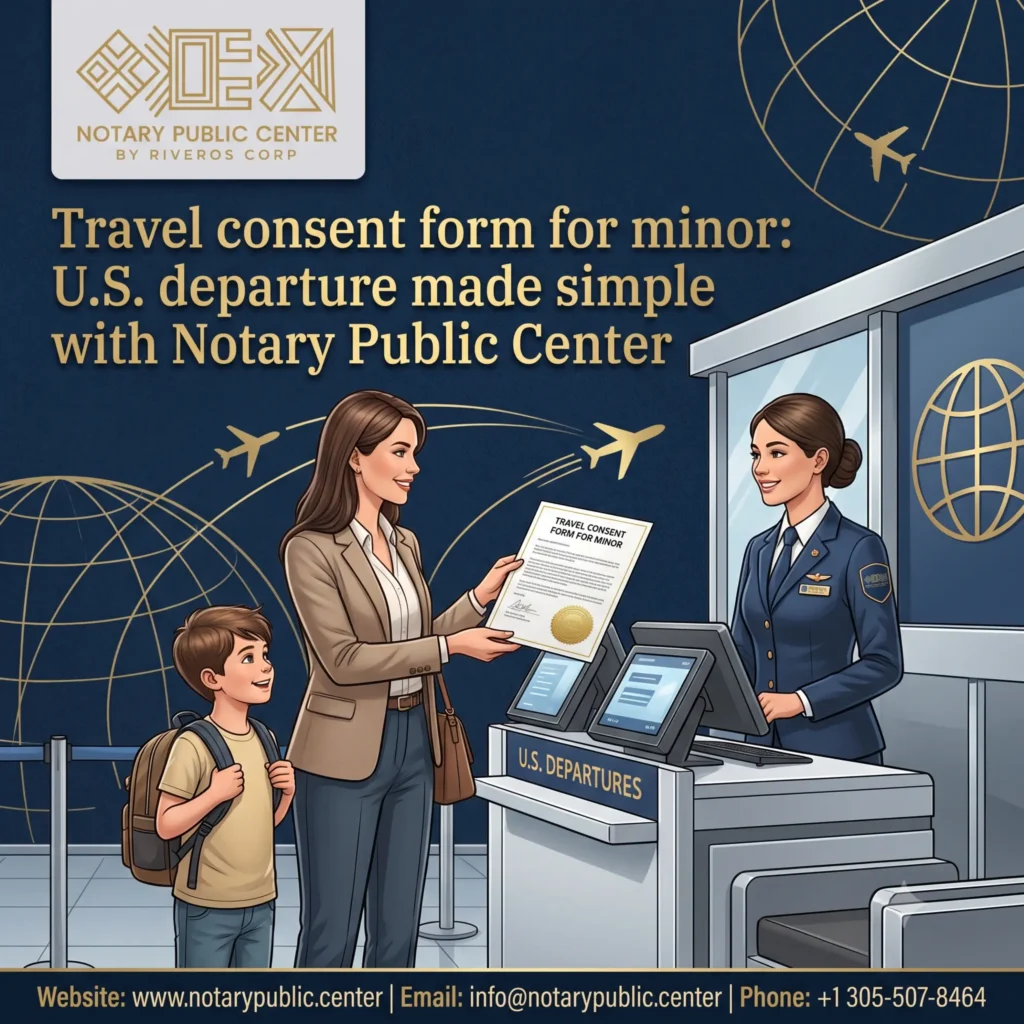
A travel consent form for minor is a vital document demonstrating that a child has permission from their parents or legal guardians to travel domestically or internationally. Consequently, without this properly executed paperwork, airlines, cruise ships, and border officials can legally deny boarding or entry.
However, simply printing and signing a template at home is incredibly risky. US Customs and Border Protection (CBP) strongly recommends that this form be officially notarized. An unverified signature holds almost no weight at a border crossing. For instance, a single oversight can lead to severe travel delays, missed flights, or denied entry. At Notary Public Center, our specialists provide seamless, fully compliant notarization services to ensure your child’s travel documents are accepted flawlessly, protecting your family’s travel plans.
When is a Travel Consent Form for Minor Required?
Border security agencies worldwide operate under strict protocols to prevent international child abduction. Therefore, providing clear, verified proof of parental consent is mandatory in several common scenarios.
Specifically, you must have a notarized consent form if the minor is:
Traveling with only one parent: The non-traveling parent must grant explicit legal permission.
Traveling with a non-parent adult: This includes grandparents, aunts, uncles, or adult siblings.
Traveling with a group: School trips, church groups, or sports teams require individual consent forms for every minor.
Traveling solo: Unaccompanied minors always need verified consent from both legal guardians.
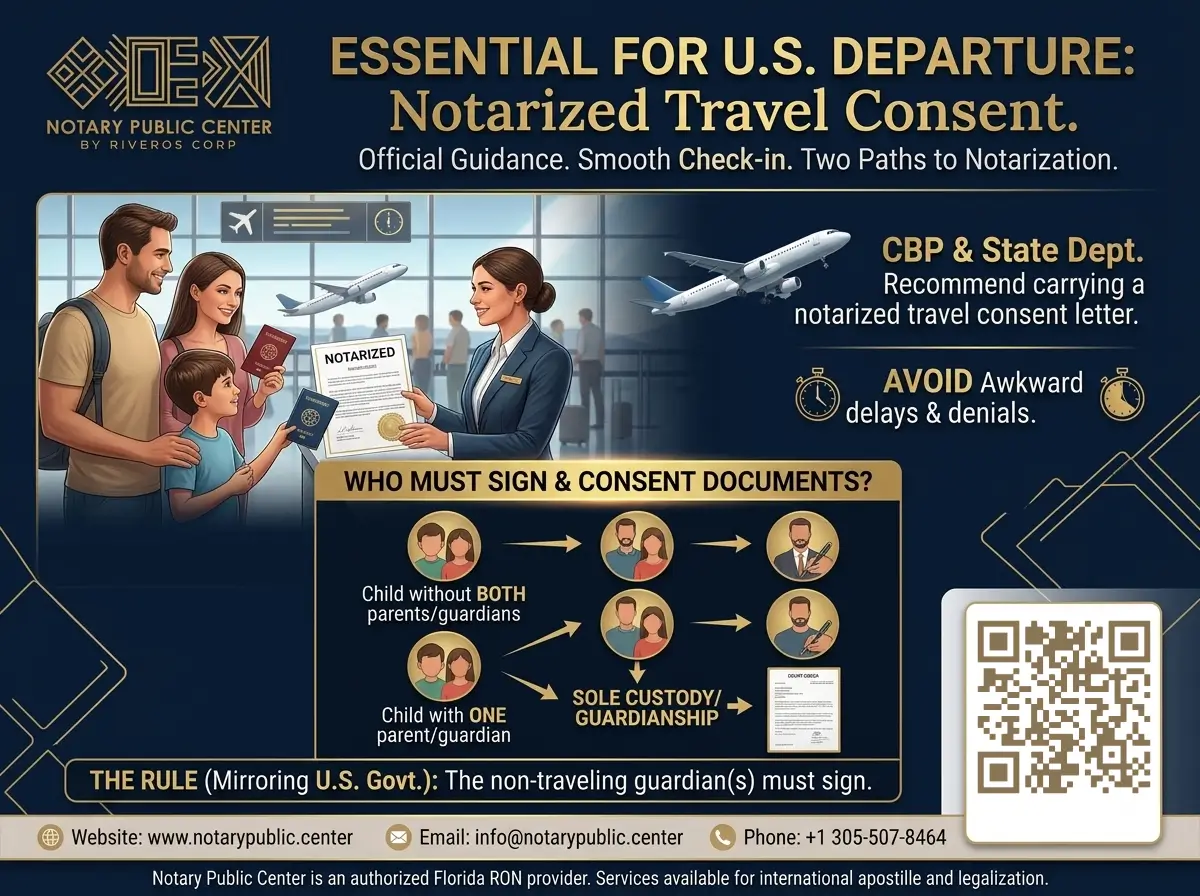
Who must sign the travel consent form for minor (keep this rule handy)
Child traveling without either parent/guardian → Both parents/guardians sign.
Child traveling with one parent/guardian → the non-traveling parent/guardian signs.
Sole custody/guardianship → the custodial parent/guardian signs; bring the relevant court order, if requested.
The USA gov’s official guidance mirrors this approach and suggests the letter be in English and notarized to avoid delays before departure.
Why notarization matters for leaving the U.S.
CBP and the State Department say a notarized consent letter is the prudent choice for children traveling without both guardians. Notarization substantiates identity and signature so agents don’t have to rely on a plain PDF. This single step often means the difference between boarding and being stuck at the counter.
For the full mechanics of our remote process — identity verification, video session, and digital certificate — see our guide to the online public notary. If your situation calls for a sworn statement rather than a simple consent letter (for example, an affidavit confirming custody or guardianship), see our complete guide to the notarized affidavit. Either way, we prepare the correct document type from the start so it is accepted at the gate the first time — not caught and corrected at the counter. A few extra minutes at intake save an entire trip at the airport.
Two notarization paths with Notary Public Center
In-person notarization (by appointment or on-site, where available).
Online notarization (Florida RON)—we connect via real-time audio-video, confirm identity, and record the session as required by law. Under Florida law, the act is deemed performed in Florida and must be recorded and retained.
Our end-to-end service for U.S. departures
1) Intake and route check
Tell us your flight details and who’s traveling with the child. We verify any airline-specific reminders that could be inspected at the U.S. airport (for example, notarized consent for particular routes).
2) Drafting the consent letter
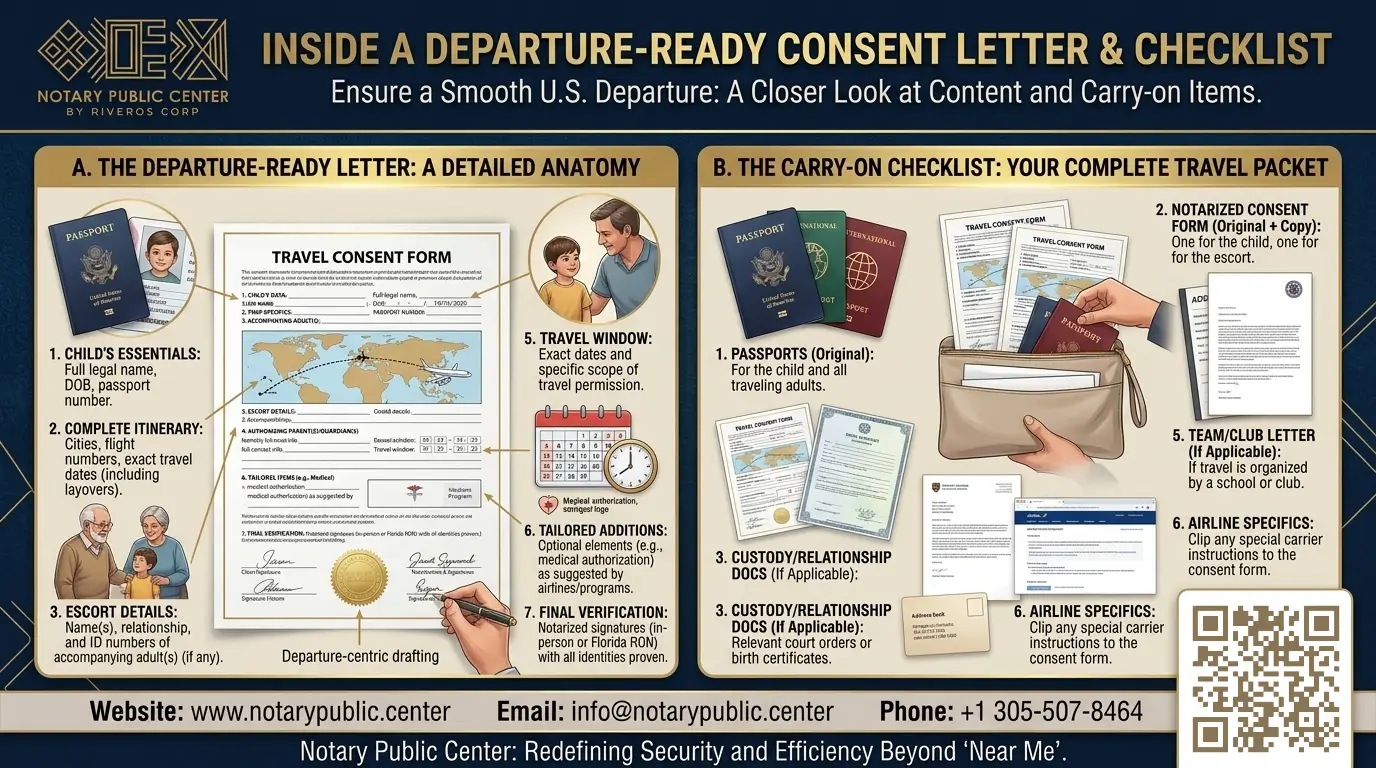
We prepare a clean, plain-English consent with the exact dates and flight numbers. If there’s sole custody, we add the right references so a gate agent isn’t left guessing.
3) Notarization (your choice)
In person: fast and familiar.
Online (Florida RON): identity proofing + recording + KBA + biometrics. If a signer can’t pass identity checks, Florida law bars us from completing RON—we’ll switch you to a compliant alternative before departure day.
4) Optional legalization (when requested)
If your consulate or school demanded extra legalization, we handle the apostille (Hague) or authentication (non-Hague). We’ll route the notarized consent through the correct Secretary of State or the U.S. Department of State as appropriate. Timelines may vary with office workload.
5) Delivery
You receive the notarized letter. If an airline agent needs assurance about the notarization, we provide the correct verification path (subject to recording-custody rules).
Departure-first scenarios we handle all the time
Child flying with one parent during school break
We draft a consent signed by the non-traveling parent, notarize it, and package copies so check-in is quick. Federal guidance favors notarized letters for kids traveling without both guardians.Child flying with grandparents from a U.S. hub
We prepare a consent signed by both parents, notarize it (often via RON the night before), and add a short medical authorization if the airline or program suggests it for boarding readiness.Team or school trip departing the U.S.
We create a uniform consent packet for multiple families so the airline’s departure counter can clear the group efficiently. If a carrier’s page lists special notes, we align the language and include a roster.
Common pitfalls (and how we keep you clear at the U.S. airport)
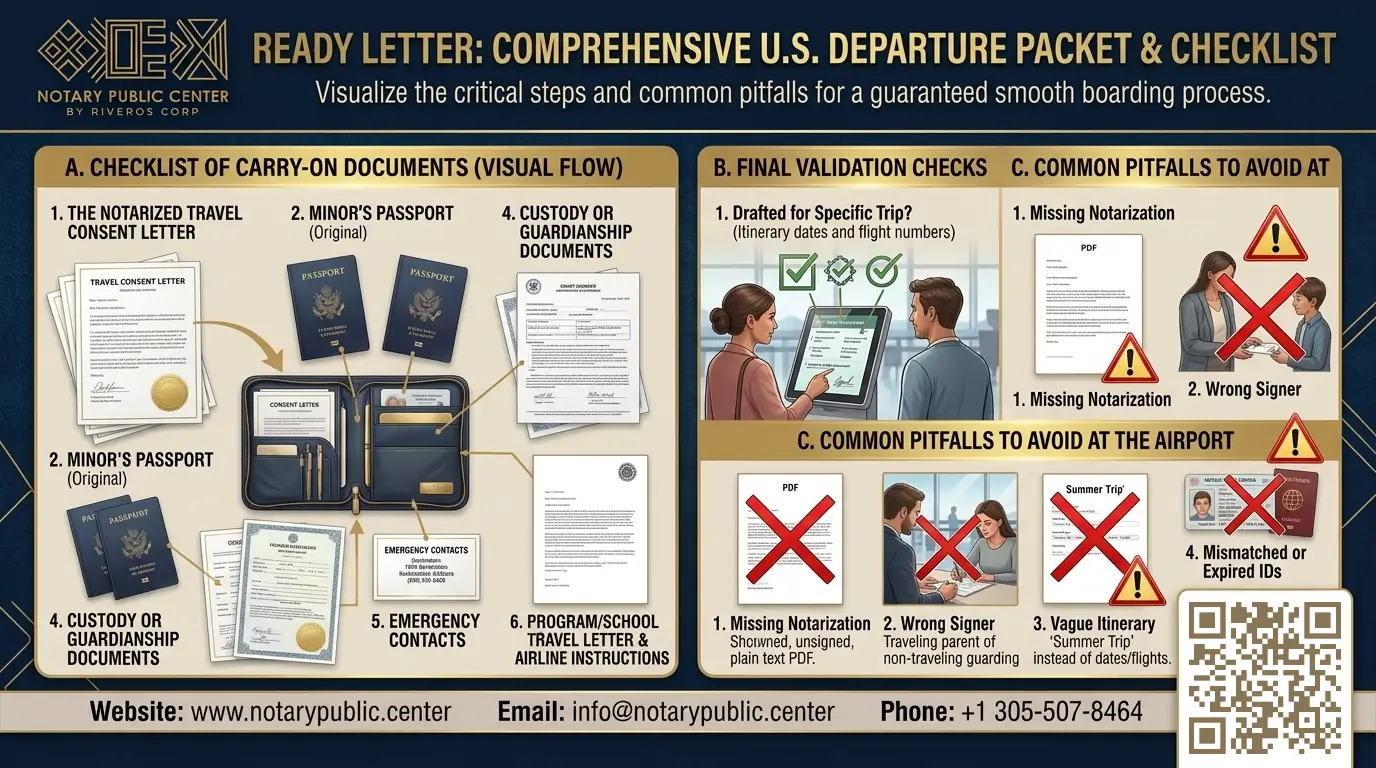
Missing the notarization: agents may question unsigned PDFs; notarized letters pass scrutiny faster. (CBP/State recommend notarized.)
Wrong signer: if the child travels with one parent, the other parent should sign. We confirm this up front.
Vague itineraries: “summer trip” isn’t enough; include dates/flight numbers.
Old or mismatched IDs: we check names exactly as shown on passports.
Late drafting: we start early so, if RON identity proofing fails, you still have time for an in-person notarization before departure.
Why DIY Forms Lead to Denied Boarding
In the age of digital downloads, many parents attempt a «do-it-yourself» approach by downloading a basic travel consent form for minor and signing it at the kitchen table. Unfortunately, this is a costly mistake.
Immigration officers and airline staff are trained to look for fraud. As a result, if you present an unverified letter, the officer has no way of knowing if the signature is genuine or forged. Ultimately, if they suspect any irregularity, CBP and foreign border agencies have the absolute authority to detain the child and deny departure until the non-traveling parent can be reached and verified. This process can take hours or even days.
Why choose Notary Public Center for a departure-ready consent
Departure-centric drafting: content tailored to what U.S. gate agents look for at check-in.
Dual notarization options: in-person or Florida RON with biometrics, recorded audio-video, and KBA checks.
Compliant tech: we operate on a DoS-listed RON platform—secure custody, exclusive seal control, auditable logs.
Legalization on request: apostille/authentication handled correctly when a consulate or institution asks. Timeframes may vary.
Clear English deliverables (bilingual available).
Ready to depart the U.S. without paperwork surprises? Contact Notary Public Center. We’ll draft your travel consent form for minor and notarize it—in person or online with biometrics, recorded video, and KBA—then package everything you need for a smooth U.S. airport check-in.
The Role of a Commissioned Notary Public
A notarized document completely changes how border officials view your paperwork. When an official from Notary Public Center notarizes your form, they perform a rigorous identity check.
In practice, the notary verifies your government-issued ID, confirms that you are signing willingly, and applies a legally recognized seal. Because of this, the notarized form becomes a highly trusted document, proving beyond a doubt that the consent is genuine.
Fast and Secure Remote Online Notarization (RON)
Getting your document notarized does not require taking time off work or searching for a local office. Through Remote Online Notarization (RON), you can complete the process securely from your smartphone or computer.
Moreover, our advanced platforms use Knowledge-Based Authentication (KBA) and credential analysis to verify your identity. You will connect with one of our commissioned notaries via a secure video call, sign your document electronically, and receive your legally sealed PDF in minutes.
Secure Your Travel Documents with Notary Public Center
Do not leave your family’s travel plans to chance or rely on unverified paperwork. Whether your child is flying domestically to visit family or embarking on an international school trip, ensuring their documents are executed flawlessly is your highest priority.
Contact Notary Public Center today. Our expert specialists are ready to notarize your travel consent form for minor with unmatched speed, security, and absolute compliance.
FAQ
Does a travel consent form for minor need to be notarized?
Absolutely. While some domestic airlines may have varying policies, U.S. Customs and Border Protection (CBP) strongly recommends that any child traveling without both parents carry a notarized consent letter. Without it, you face a high risk of delays or denied boarding.
Can grandparents travel with a child without this form?
No, they should not attempt it. Even close relatives like grandparents must carry a notarized travel consent form signed by the child’s legal parents. Additionally, they should carry copies of the child’s birth certificate to prove the family relationship.
What happens if the other parent is unreachable or deceased?
If one parent has sole custody, you should carry the original court custody document. Conversely, if the other parent is deceased, you must carry a certified copy of their death certificate alongside the child’s birth certificate to present to border officials.
Is an online notarization valid for a child travel consent form?
Yes. Documents notarized through a compliant Remote Online Notarization (RON) platform by a commissioned notary are legally valid. Furthermore, the digital seal applied by Notary Public Center is recognized across all 50 states and by federal agencies.
How long does a notarized travel consent remain valid?
The document is typically only valid for the specific dates and destinations listed within the text. Therefore, you cannot use a single notarized letter for multiple, unrelated trips. You must execute a new form for each specific journey.
Legal Notice
The information contained in this publication is provided for general informational purposes only and does not constitute legal advice. Reading or using this content does not create and is not intended to create an attorney-client relationship. No reader or user should act or refrain from acting based on the information presented herein without first consulting an attorney duly licensed to practice law in their jurisdiction.