Apostille vs legalization is a comparison between two documentary routes. Where the applicable Convention framework covers the document and the countries involved, an apostille can replace the traditional legalization requirement. A consular legalization route comes with different requirements. The difference matters when you hold a U.S. record and need it accepted for a procedure overseas, and even more if the document was already prepared for another destination.
The review covers the certificate, any required consular involvement, translation and the recipient’s remaining requirements. It does not assume that every use abroad calls for the same formalities. Apostille de la Haya can review the U.S. issuer, the destination and the written request before explaining which service fits. That review helps you avoid arranging a consular stage you don’t need. It also keeps you from assuming that an existing apostille answers every question the next recipient might ask.
Apostille vs legalization: one certificate and a longer process
An apostille is a specific form of certification under the Apostille Convention. In everyday speech, “legalization” is sometimes used loosely to mean getting a document ready for use abroad. In the narrower consular sense, it means a different chain of official certifications. When the word shows up without further explanation, the recipient or the service provider should say which meaning it has in mind.
The HCCH Apostille Section describes the Convention’s purpose as making it easier to use public documents abroad. The framework deals with authenticating an official signature, the capacity of the person who signed or a seal. It should not be read as removing every substantive requirement a foreign institution may set for the underlying evidence.
That point sits at the center of the comparison. An apostille may complete the international certification requirement while a translation or a supporting document is still needed. A consular legalization route may involve several official acts and still not guarantee how the application ends. Count the requirements that are actually met, not the number of certificates attached.
Apostille vs legalization: compare the whole route
| Question | Applicable apostille route | Consular legalization route |
|---|---|---|
| What establishes the route? | The applicable Convention relationship, document and intended use | The destination's requirements for the document and competent mission |
| Which U.S. office is relevant? | The competent authority for the official signature, state or federal as appropriate | The authorities required for the actual certification chain |
| Is a foreign mission automatically an extra step? | Do not add it as an upgrade to an applicable apostille | Review the mission's jurisdiction and current service rules |
| Does it guarantee acceptance of the contents? | No; recipient requirements remain separate | No; certification does not decide every legal or administrative question |
Apply this apostille vs legalization table to a specific record and destination. If the document came from outside the United States, the assumptions about U.S. origin in this article do not automatically apply. If the country of use is still undecided, so is the certification route. Settle those facts before you arrange the service or shipping.
Verify the Convention relationship carefully
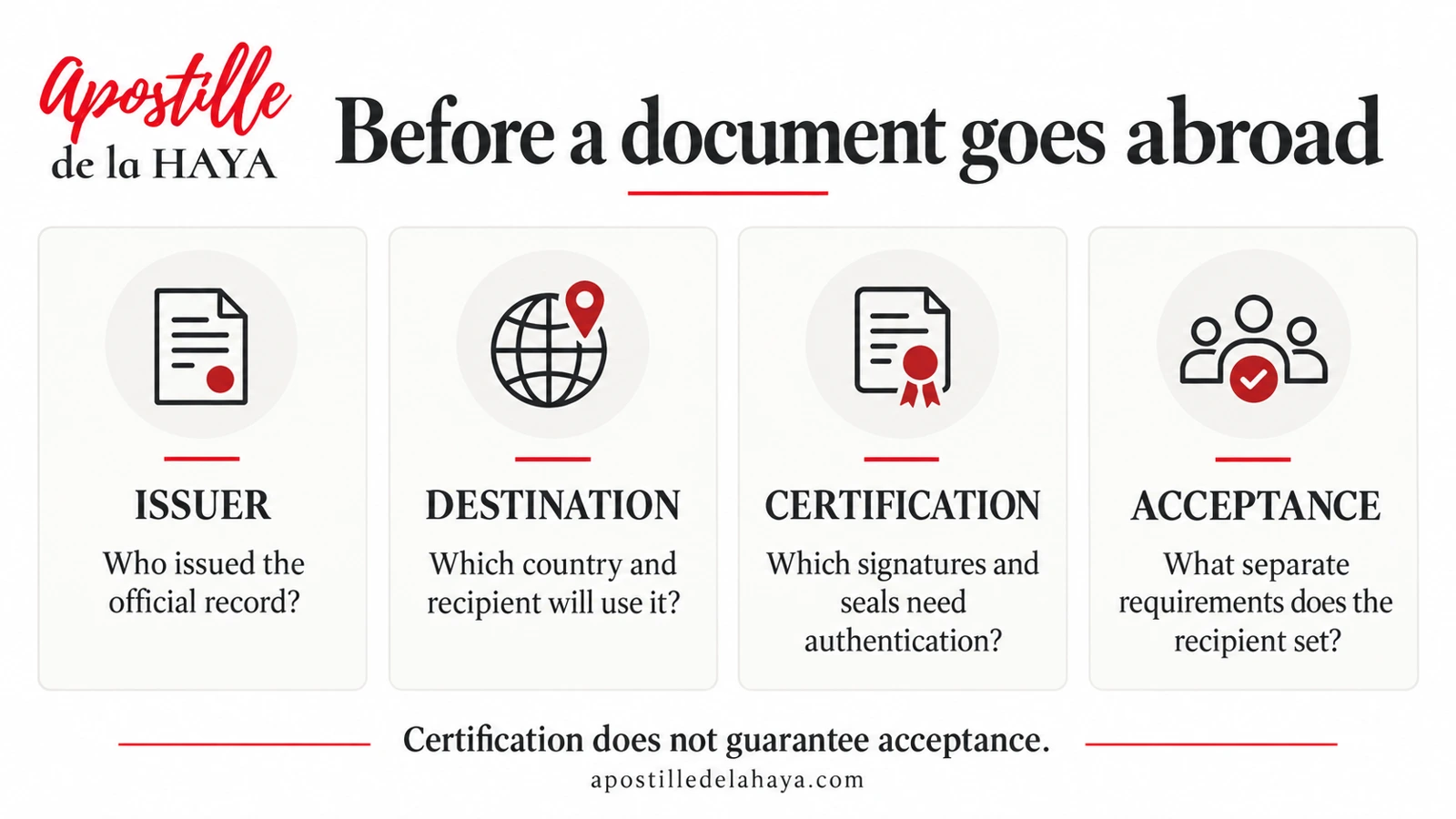
Use the Apostille Convention status table to check the countries involved, their entry-into-force dates and any declarations. Don’t rely on a list of HCCH member countries or on the status table of a different Hague convention. Those lists answer other questions and can lead you to the wrong conclusion about whether an apostille is appropriate.
Participation changes over time, so an old checklist may not suit a new submission. Entry into force matters as well. An accession may be deposited on one date and the Convention relationship may take effect on another. Where territorial coverage or relevant objections affect the case, take them into account. Base the certificate choice on the relationship that applies today.
The recipient’s own description of its requirement is still worth having. Sometimes it seems to ask for consular legalization even though an apostille route appears to apply. In that case, ask it to clarify the actual document and intended use. It may be a question of terminology, or something specific to that document. Neither a generic webpage nor a short email settles every detail, so look into the mismatch before assuming anything.
The U.S. issuer still matters under either route
A state birth record, a certification from a federal agency and a privately notarized document all have different official origins. The U.S. authority involved has to be one that can recognize the signature on the document. Where the applicant lives does not give the nearest state office authority over a record issued somewhere else.
For example, someone living in Florida may hold a certified public record issued by another state. Record the residence and the issuer separately. A U.S. citizen may also hold a record issued outside the United States. That record does not become a U.S.-issued document because of the owner’s nationality. Exact information about origin keeps the file from being sent the wrong way under either certification system.
The discussion of federal authentication for birth records explains a narrower situation, where a state document may need a federal stage. It is not a rule that every birth record needs federal authentication. The destination and the route requested decide whether that extra authority belongs in the preparation.
A document prepared for one country needs a fresh review for a new use
Take a hypothetical applicant who has an apostilled U.S. marriage certificate from an earlier foreign procedure. A new recipient in another country asks for the certificate for a family-related filing. The earlier preparation is useful to know about, but it does not decide the new requirement. The receiving country, the institution, the purpose and the accepted version of the record all have to be reviewed again.
Keep the original certified set intact. When you ask for a review, include the existing apostille and translation, and mention the earlier destination if you know it. Do not remove the certificate, edit a country name or combine pages from different certified copies. Doing any of that can hide what was officially certified and makes the file harder to assess.
The new recipient may accept the existing record, ask for a different certification route or want a newly issued copy for its own procedure. Don’t declare every old document unusable without checking, and don’t assume it will be accepted forever for every purpose either. Whether a record is still valid and whether a recipient wants a recent copy are two separate questions.
If the new request involves a destination that uses consular preparation, go to the service reference for that country, such as Egypt document legalization. The marriage certificate service covers the review specific to that document. Putting those facts together works better than picking a route from the word “marriage” alone.
Check translation and local presentation requirements
Neither route translates the document for you. Find out which language the receiving authority requires and what formalities it accepts for translators. The fact that a bilingual applicant understands the record does not decide what the institution can accept. Ask whether the translation has to include the relevant certification pages, seals and annotations.
When the translation is done can affect how complete it is. A translation of the original record alone may not cover certificates added later. On the other hand, the recipient may define a scope that does not require translating every administrative page. Clarify the actual requirement instead of ordering the widest possible translation by default.
After certification, there may still be a presentation or administrative step in the destination country. A ministry, a civil registry, an employer or a licensing authority can each have its own submission procedure. The service scope should separate preparing the document from filing it with the final recipient. Receiving a certified package does not mean the underlying application has been approved.
What the certificates cannot fix
An apostille or a legalization cannot correct an inaccurate record. If a name or a date is wrong, the issuer has to fix it. If a private instrument grants the wrong kind of authority, the recipient or a qualified legal professional should review the content. An official certificate on top does not make those problems go away.
Certification does not create missing evidence either. If the recipient asked for a complete academic file, authenticating one degree does not supply a transcript that is missing. If a family procedure needs an additional civil record, a certified marriage certificate cannot stand in for it just because it carries several stamps. Check the document list before you arrange certification.
Don’t make promises about immigration approval, employment, professional licensing or academic equivalence based on the certification route. Those outcomes depend on separate criteria and separate authorities. Apostille de la Haya can help with the documentary work and will make clear which questions are for the receiving institution to decide.
Apostille vs legalization: compare the scope of work
An apostille service and a consular legalization service may cover different work. Review their stated scope against the recipient’s requirement. The relevant questions concern the acceptable record, required certifications, translation and final delivery. Conditions vary with the nature and complexity of the case and should be discussed directly with Apostille de la Haya.
Involving more offices does not automatically improve the result. An unnecessary stage adds handling without resolving a documentary requirement. Equally, omitting a required act leaves the file incomplete. A useful apostille vs legalization comparison identifies the necessary work, explains which authority performs it and states where the service ends.
For a review of your case, send Apostille de la Haya the record and its issuer. Add the destination, any existing certifications and the deadline. If some preparation is already done, show us the complete file so the review can identify what is left. That way you are not comparing a full first-time service with a narrower completion service as if they were the same thing.
Timing depends on the route and on how ready the document is
An estimate should allow for several things. The underlying record may need to be obtained or corrected, and then come official processing, transport and any later required action. Published turnaround times for one authority do not tell you how long it will take until the final recipient accepts the document. The current condition of the file affects when processing can start.
If a deadline is close, spell out what has to happen by that date. An apostilled record coming back to the applicant is one event. Delivery to a foreign institution is another, and the institution making its decision is a third. A realistic review keeps these milestones apart and explains which documentary work can be handled within the proposed scope.
How Apostille de la Haya helps compare the right options
Through its document legalization service, Apostille de la Haya can review the U.S. record and its intended use, identify the certification question that applies and explain the documentary help available. We start from the facts of the case. A preference for one certificate name does not decide the apostille vs legalization question.
You should know which stages are included, what stays with you as the applicant and which decisions belong to the recipient or an official authority. With that clear, there is less avoidable paperwork. You can also tell a completed certification apart from a wider outcome that has not been decided yet.
Frequently Asked Questions
Is legalization stronger than an apostille?
There is no universal ranking between them. The right route depends on the applicable framework and the destination’s requirement. Extra stamps do not improve a document that already meets the relevant certification rule. Apostille de la Haya can review your case and explain which route fits the actual intended use.
Can an apostilled document still need translation?
Yes. Translation deals with language and presentation, and the apostille serves a different certification function. The receiving authority decides which translations it accepts. Share its instructions with Apostille de la Haya so the service can cover the required scope. The apostille does not settle every presentation issue.
Can I reuse a legalized document for another country?
It needs to be reviewed against the new destination and recipient. The existing certifications may or may not fit the new use. The version of the record or the translation may matter too. Keep the file intact and contact Apostille de la Haya with the new requirement before you remove attachments or arrange another certification.
Does either route guarantee a visa or professional license?
No. Those decisions involve separate eligibility requirements and competent authorities. Certifying a document should not be presented as approval of the underlying application. Apostille de la Haya can help with the documentary preparation and point out the questions that the receiving institution or a qualified professional has to resolve.
What details are needed to compare the services?
Identify the document, the U.S. issuer, the destination, the recipient, the version you have, existing certifications, translation needs and the deadline. With those facts, you can compare the work that actually remains. Then contact Apostille de la Haya for an explanation based on your case. Choose the service according to the document and the recipient’s verified requirement.
Review the complete route for your destination
Contact Apostille de la Haya with your U.S. record and the recipient’s instructions. We can compare the documentary requirements that apply and explain the service scope that fits the file you have and the use you have in mind.
Contact Apostille de la Haya by phone or WhatsApp: +1 305 500 0185.