Birth certificate legalization depends on the destination. A certified U.S. birth record may require consular legalization when that is the destination’s requirement and the apostille process does not apply. Acceptance of the certificate somewhere else does not tell you what the new recipient requires. This article covers the consular legalization question for a U.S.-issued birth certificate, including existing certifications, translation, and a change of destination.
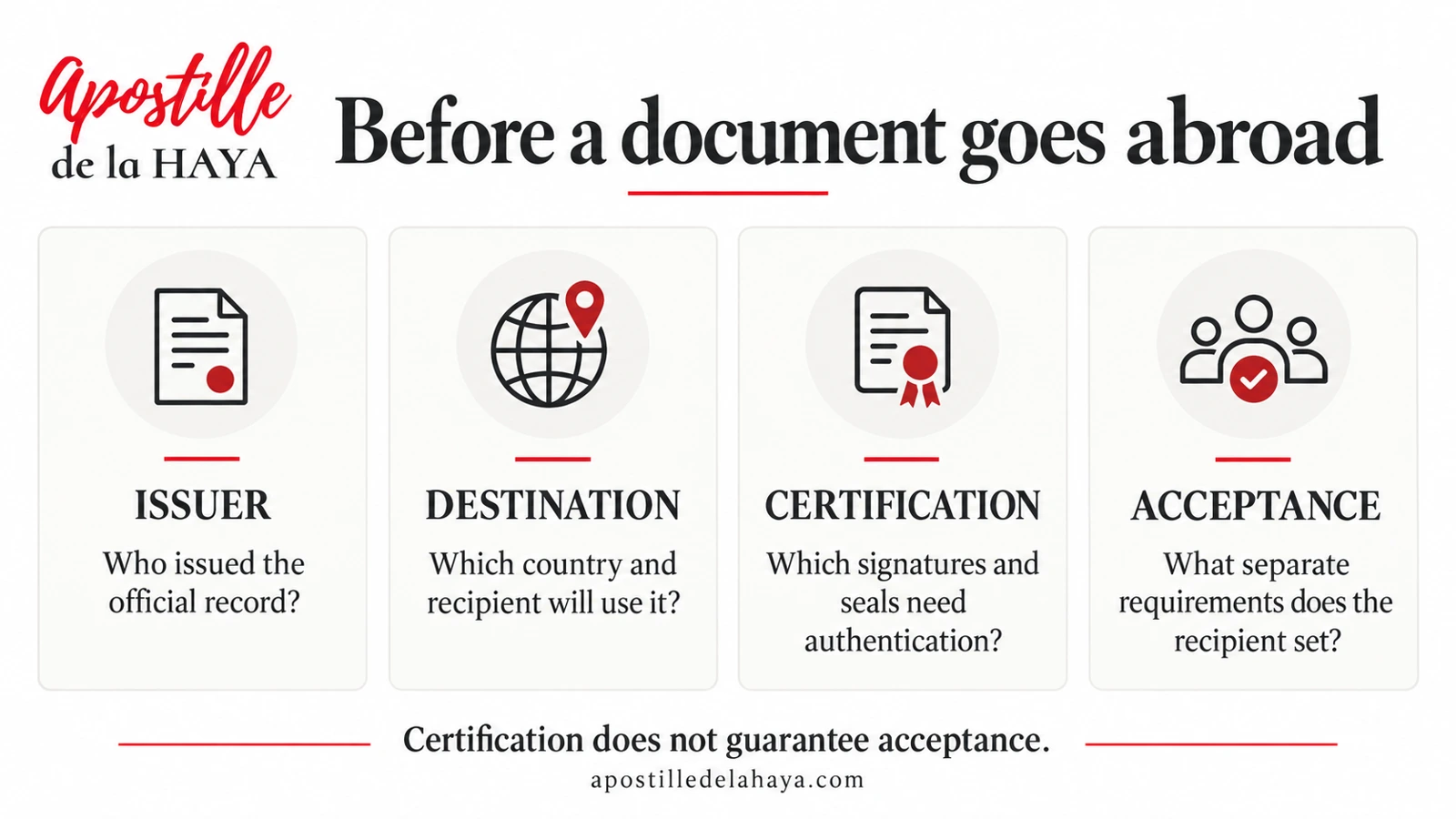
The first review should tie the exact record to its intended use. Identify the issuing authority, the certified version you have, the receiving country, and the organization asking for the certificate. Apostille de la Haya can review those facts before explaining the documentary assistance. That helps you avoid ordering a generic “international” stamp. It also keeps you from sending a previously apostilled record to a mission without checking whether the existing preparation fits the new requirement. What you want is a coherent file for the destination actually involved.
Birth certificate legalization depends on where the record will be used
Do not choose legalization just because the recipient is abroad. First establish whether the applicable certification framework calls for an apostille or for another authentication and consular route. The Apostille Convention status table is the source for participation and entry into force. Do not confuse it with a list of countries that belong to a different Hague convention.
The recipient’s own instructions then tell you which record version and presentation the procedure requires. A civil registry may ask for particular information or a recently issued copy. A school may have a different purpose. Record the destination country and the receiving institution separately, so the service deals with the actual use and not a broad country label.
If the recipient uses “legalized” as a general term, ask whether it means an apostille, a consular certification, or some other formal requirement. The English word is not always used consistently. A short written clarification can keep the wrong route from being chosen before the document leaves the applicant’s hands.
Start with the right certified birth record
Check what kind of copy you have. An official certified copy from the relevant public custodian differs from a photocopy, a scan, or a hospital record. The underlying birth information may look similar, but the official signature and certification the route needs can differ. Assess the document in its complete form before planning any later legalization stages.
Identify the issuer, signature, seal, certification statement, and any restriction printed on the copy. Include notes on the back and any attached pages in the review. Do not assume a later stamp lifts a limitation on the record’s use. Nor does it turn an informational copy into the version the recipient requires.
The discussion of certified birth records separates getting the proper copy from certifying it for use abroad. If you need a replacement, establish the required format first. A newly issued copy in the wrong version can cause the same problem as the old one.
Errors in the underlying information go through the issuing authority, because legalization does not amend the birth record. If a name difference comes from a later name change and not from an issuer error, ask the recipient what linking evidence it needs. Do not change the original or translated text to hide the difference.
State preparation and a federal stage are different functions
A U.S. birth certificate issued by a state or local office is not automatically a federal document. The official signature belongs to the issuing system shown on the record. State procedures can turn on which official certified the copy, and some records need a local verification before the state authority acts.
If the destination route includes federal authentication after state preparation, that is a separate stage. The Department of State birth certificate authentication article explains the narrower federal question. Do not read it as saying that every certificate goes straight to the federal office, or that the federal stage replaces required state preparation.
The State Department’s authentication requirements separate state and federal document preparation. Where its authentication-certificate process applies, state documents receive the relevant state authentication before the federal submission. Read that guidance together with the destination mission’s requirements to work out the actual complete route.
The foreign mission's requirements need their own review
Identify the destination’s competent mission and its current submission channel. An embassy or consulate may have service-specific instructions on jurisdiction, document versions, prior certifications, copies, translation,. Do not automatically apply instructions written for an unrelated personal document, or for another origin country, to a U.S. birth record.
For example, the UAE Embassy’s personal-document guidance refers to VFS handling and prior U.S. Department of State authentication for the U.S. documents it describes. That reference is specific to the UAE route. It does not mean Egypt or any other destination uses the same channel.
The UAE document service and the Egypt document service are separate, destination-specific points for discussing preparation. When you contact a service, name the actual recipient and purpose. The review can then tell the country route apart from the requirements of the birth record itself.
If a particular service requires personal attendance or direct action by the applicant, that stays part of the case. A private documentary service should not suggest it can stand in for every consular action. The proposed scope should set out those limits before the applicant relies on a completion plan.
When the birth certificate already has an apostille
Review the existing apostille as part of the complete record. Do not detach it automatically. If you know the country and purpose it was prepared for, note them. A new destination can change the certification question, but the right response depends on the actual file and the recipient’s requirement.
Do not change a country name, remove a certificate, or move an attachment to another copy. Those steps can hide what was certified. Keep the full set together for assessment. If another certified copy or a different certification is needed, the review should explain why, instead of simply declaring that every earlier stage has to be repeated.
A recipient may also ask for a recently issued birth record even when an older certified set exists. That condition is separate from the choice between an apostille and consular legalization. Find out which date and period the institution means before you order a replacement or assume the existing certificate has expired everywhere.
Take a hypothetical family that prepared records for one country and later receives instructions from a registry somewhere else. Each family member’s certificate should be reviewed on its own, including the issuer and any existing attachments. In birth certificate legalization, sharing a destination does not make records from different U.S. states identical for preparation purposes.
Translation must cover the required document set
The receiving authority may require a translation. It may also set the language and the accepted form. Confirm the translator formalities and whether the translation itself needs additional treatment. Being able to explain the record out loud does not show what the institution will accept as documentary evidence.
Ask whether the required scope covers the birth record, the information on the back, and the relevant certification attachments. If the file receives more certificates after the translation is done, that translation may no longer cover everything the recipient requires. Planning the scope up front avoids an incomplete version and an unnecessary second translation.
Names and place names should be translated faithfully. Transliteration differences can call for clarification or supporting evidence, but the translator should not quietly rewrite the source to create a convenient match. If the recipient needs an explanation linking records, find out its accepted form before submission.
Birth certificate legalization risks specific to the route
One risk is picking an apostille because it is familiar. The verified destination may require a different certificate. Another is assuming that a federal authentication completes a consular stage that never happened. Either mistake leaves the intended chain incomplete, even if an official office performed a valid act on the file.
An unsuitable copy causes a problem earlier on. A plain photocopy may not carry the official certification the first authority needs in order to act. Sending it again and again to later offices does not fix that. Confirm the admissible record at the start, and settle any issuer question before arranging transport.
Jurisdiction and channel errors can delay a file that is otherwise ready. The mission’s general address, a service location, and the proper intake channel may not be the same. Check current instructions before shipping. A faster courier does not change a mission’s authority or its document requirements.
Finally, legalization cannot guarantee acceptance of a substantive family, nationality, or immigration claim. The certificate can be part of the required evidence without deciding the result. Apostille de la Haya can help with the documentary work and direct recipient-specific legal questions to the appropriate authority or professional.
Plan delivery around the complete assignment
Start with where the record is held and who can release it. Then decide where it should be delivered once the agreed work is done. An applicant living abroad may need help coordinating a record held in the United States. The handling plan should keep those locations apart, without assuming the document starts and ends at the applicant’s current address.
For timing, separate record readiness, official processing, transport, and final action by the recipient. A posted period for one office is not the total time until a foreign institution accepts the file. If you have a deadline, explain the event behind it and which documents are already complete. The assessment can then focus on the work that actually remains.
Clarify whether the assignment includes obtaining a certified record, preparing its certifications, arranging a translation and returning the completed packet. Each task should meet a documented requirement. Conditions may vary according to the nature, complexity and scope of the case. Consult Apostille de la Haya directly about your file.
How Apostille de la Haya reviews the birth-record route
The birth certificate authentication and legalization service links the review of your U.S. record to the intended destination. Send the complete certificate, existing certifications, recipient instructions, and deadline through the agreed intake channel. With those details, the preparation can be assessed without guessing at the route.
The service scope should list the documentary stages included and any actions that remain with the applicant or the recipient. That clarity helps cut avoidable administrative work. It also keeps the completion of a certificate from being confused with approval of a broader legal procedure. In birth certificate legalization, the proposed assistance should fit the file you have and the requirement you need to meet.
Frequently Asked Questions
Is birth certificate legalization the same as an apostille?
The word legalization is sometimes used broadly, but consular legalization and an apostille are different certification approaches. The destination and the applicable framework decide which one is relevant. Apostille de la Haya can review the recipient’s wording and your U.S. record before explaining which documentary service fits.
Can I use a certificate already apostilled for another country?
It needs a review against the new destination and the recipient’s requirement. Keep the complete record and its attachments together instead of removing the apostille. The existing preparation may or may not fit the new use. Contact Apostille de la Haya with the full set so the remaining documentary work can be identified accurately.
Does every birth certificate require the federal stage?
No. The route for a state-issued record depends on the destination and the certificate requested. A federal authentication stage is relevant in particular circumstances. It is not automatic for every U.S. birth record. Apostille de la Haya can review the issuer and intended use before recommending preparation for a federal submission.
Does legalization include translation into the destination language?
Not automatically. Translation is a separate requirement and a separate service, and the recipient’s instructions set its scope. Certification attachments may also need to be included. Apostille de la Haya can review the language requirement and explain the relevant assistance instead of assuming any translated copy will satisfy the procedure.
Will the legalized record guarantee approval of my application?
No. Certification does not decide immigration, nationality, or other substantive eligibility. The receiving authority weighs those questions under its own requirements. Apostille de la Haya can help with documentary preparation and make clear which outcome falls outside the certification service and rests with the recipient.
Review the destination before reusing or sending the certificate
Contact Apostille de la Haya with your U.S. birth record and the foreign recipient’s instructions. We can review the existing preparation and explain the documentary assistance that fits the destination involved.
Contact Apostille de la Haya by phone or WhatsApp: +1 305 500 0185.