
If you’ve ever been asked to have a document “notarized,” you might wonder what that really means. Whether you’re dealing with legal forms, real estate contracts, or immigration paperwork, notarization plays an important role in validating documents.
In this article, you’ll learn what “notarized” means, why it’s important, how it works, and which types of documents usually require it.
What Does Notarized Mean?
To say that a document is notarized means it has been:
- Signed in front of a notary public,
- Verified for identity and willingness to sign, and
- Officially stamped or sealed by the notary.
The notarization confirms that the signature is authentic, the signer understood what they were signing, and they weren’t under pressure or being forced.
What Is a Notarized Letter?
A notarized letter is an ordinary letter that you sign in front of a notary public, who then confirms your identity and adds an official seal, signature and notarial certificate. The letter can say almost anything — granting permission, confirming a fact, authorizing someone to act for you — and it is the notarization that turns it into a document a third party is willing to rely on.
The distinction that matters most is this one:
- What the notary certifies: that you are who you say you are, that you appeared before them, and that you signed willingly.
- What the notary does not certify: that anything written in the letter is true, accurate or legally sufficient.
A notarized letter is therefore proof of who signed, not proof of what it says. Whoever asks you for one is protecting themselves against a forged signature — they are not verifying your account of events.
When You Are Asked for a Notarized Letter
The situations that come up most often are:
- Travel consent for a minor — one parent authorizing a child to travel with the other parent, a relative or an organized group.
- Proof of residence — confirming that someone lives at your address when no utility bill is in their name.
- Employment or income confirmation — an employer verifying a position, or a self-employed person confirming their own activity.
- Financial support or sponsorship — stating that you will cover someone’s expenses for a defined period.
- Authorization to collect or deliver — allowing another person to pick up a document, a package or a payment on your behalf. For broader or ongoing authority, what is normally required is a power of attorney rather than a letter.
- Caregiver consent — temporarily authorizing an adult to make everyday decisions for a minor.
What a Notarized Letter Should Include
A letter is easier to notarize — and far less likely to be rejected by whoever requested it — when it already contains:
- The date and the place where it is written.
- The full legal name of the person signing, exactly as it appears on their identification.
- The name of the person or institution it is addressed to, when there is one.
- A specific statement: what you are authorizing, confirming or declaring, and for how long it applies.
- A signature line — left blank until you are with the notary.
- Room at the end for the notarial certificate and the notary’s seal.
Do not sign it in advance unless you have been told to. If the notarization is a jurat, you must sign in the notary’s presence and a signature made beforehand invalidates it. If it is an acknowledgment, signing earlier is acceptable as long as you personally acknowledge that signature in front of the notary. When you are not sure which one has been asked of you, bring the letter unsigned — the difference is explained in the jurat and acknowledgment section below.
What a Notary Cannot Do With Your Letter
A notary public cannot draft the letter for you, tell you what it ought to say, or advise you on whether it will be accepted. Doing any of that would be practicing law without a license. The wording is yours; the notary’s role begins at the signature. If the letter carries legal consequences you are unsure about, the person to consult is an attorney.
Notary Public Center notarizes letters both in person and through Remote Online Notarization, so the signing can be completed without a trip to the office.
What Is a Notary Public?
A notary public is a state-appointed official authorized to witness signatures on important documents. They help prevent fraud and ensure legal validity by confirming:
- The identity of the person signing
- Their willingness to sign
- Their mental capacity to understand the document
Notary Public Center provides licensed notary services across the U.S., including in-person and online notarizations.
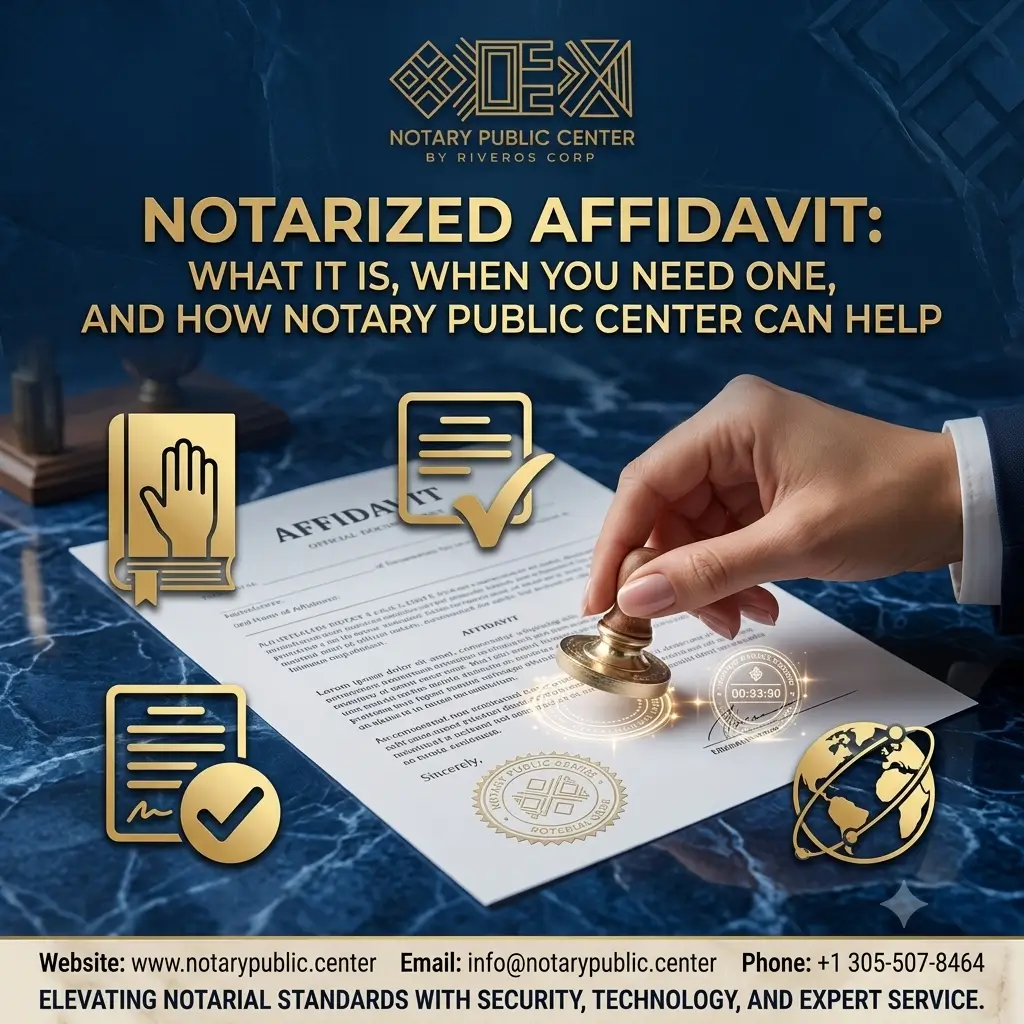
What Does a Notarized Document Look Like?
A notarized document typically includes:
- The signer’s original signature
- The notary’s seal or stamp
- A notarial certificate, which includes the notary’s name, commission number, and the date of notarization
This seal indicates the document has been properly executed and is now legally recognized.
Why Are Documents Notarized?
Notarization adds legal weight and credibility to documents. It protects against fraud, especially when the document involves:
- Property ownership or transfer
- Power of attorney
- Wills and affidavits
- Consent for minors to travel
- Immigration paperwork
Many institutions, courts, and government agencies require notarized documents to ensure that the information and signature are legitimate.
Do I Need to Notarize My Document?
It depends on the document type and where you plan to use it. Common documents that often require notarization include:
- Power of attorney
- Affidavits or sworn statements
- Real estate deeds
- Business agreements
- School permission letters
- Immigration forms (in some cases)
If you’re not sure whether your document needs to be notarized, Notary Public Center can help you find out and guide you through the process.
How Does the Notarization Process Work?
Step-by-step:
- Prepare the document (but don’t sign it yet)
- Present a valid photo ID to the notary
- Sign the document in front of the notary
- The notary adds their seal and completes the certificate
That’s it! You now have a notarized document that can be used for official purposes.
Can I Notarize Documents Online?
Yes! Many states in the U.S. allow online notarization, where you meet a notary via video call. This is fast, secure, and ideal for people outside the country or those with mobility restrictions.
Notary Public Center offers online notarization services that are 100% legal and accepted by U.S. and international institutions (in most cases, with apostille).
What Happens After a Document Is Notarized?
Once notarized, your document can be:
- Submitted to courts or government offices
- Used for legal transactions
- Apostilled (if required for use in another country)
If you’re planning to use your notarized document internationally, ask about our apostille service to make it valid abroad.
Jurat vs. Acknowledgment: The Choice That Changes Everything
Most notarizations fall into one of two categories, and picking the wrong one is one of the most common reasons documents get rejected: As a rule of thumb: if the document asks you to swear or affirm something is true, expect a jurat; if it simply needs your signature acknowledged, expect an acknowledgment.
- Acknowledgment: the signer appears before the notary and confirms (acknowledges) that they already signed the document, or are willingly signing it now, of their own free will. The document does not need to be signed in the notary’s presence beforehand.
- Jurat: the signer must sign the document in front of the notary and take an oath or affirmation that its contents are true. Affidavits and sworn statements almost always require a jurat, not an acknowledgment.
If you sign before your appointment and the document actually required a jurat, the notary cannot simply notarize what you already signed — you’ll need to sign again in their presence, which means rescheduling. Confirming which certificate your document needs before your appointment saves a wasted trip.
What Cannot Be Notarized
Not everything can go through a notary, and knowing this in advance avoids a rejected appointment:
- Vital records (birth, marriage, death certificates) — these are certified copies issued directly by a state, county, or city office; a notary cannot notarize a photocopy of one.
- Documents with blank spaces — a notary should not notarize a document that has incomplete sections, since it opens the door to fraud after signing.
- Documents the signer doesn’t understand — if there are signs the signer doesn’t grasp what they’re signing, or appears to be under duress, a notary is required to decline.
- A document the notary has a personal or financial interest in — notaries cannot notarize their own documents or those where they benefit directly from the transaction.
If your document falls into one of these categories, a notary should decline the request rather than notarize it improperly, since an invalid notarization can void the document entirely when it matters most.
How Notarization Connects to Apostille
If your notarized document will be used in another country, notarization is usually just the first step. Many countries that are members of the Hague Apostille Convention require an apostille, a certificate that authenticates the notary’s signature and seal so the document is recognized abroad. The type of notarial certificate matters here too: an incorrectly completed notarization (wrong certificate type, missing venue, or a name that doesn’t match the ID exactly) is one of the most common reasons an apostille request gets rejected later. Getting the notarization right the first time saves you from having to redo the entire document before it can be apostilled. At Notary Public Center, we coordinate both steps so the notarization is built correctly for apostille from the start, rather than discovering a problem after the document has already been submitted.
Common Documents That Require Notarization
Beyond the examples already mentioned, these documents are frequently notarized:
- Loan and mortgage documents
- Parental travel consent forms
- Adoption paperwork
- Trust and estate documents
- Vehicle title transfers
- Corporate resolutions and certificates of good standing
Some receiving institutions have their own additional formatting requirements on top of standard notarization, so it never hurts to ask before your appointment.
If you’re unsure whether your specific document needs notarization, the safest approach is to ask the institution that will receive it — requirements can vary even for the same type of document depending on the recipient.
Benefits of Remote Online Notarization (RON)
Online notarization has become a reliable, legally recognized option in most U.S. states, and it comes with real advantages over the traditional in-person process:
- Available from anywhere: you can complete the session from home, work, or even abroad, as long as you have a stable internet connection.
- Faster turnaround: no need to travel or wait in line — most sessions take 10-15 minutes.
- Tamper-evident record: the finished document includes a digital certificate, and the session itself is recorded and stored, creating an audit trail that traditional paper notarization doesn’t have.
- Same legal standing: a document notarized online carries the same legal weight as one notarized in person, as long as the notary is properly commissioned for RON in their state.
What Happens If a Document Isn’t Notarized (When It Should Be)
Skipping notarization on a document that requires it isn’t just a technicality — it can have real consequences. Courts, government agencies, and financial institutions may reject the document outright, forcing you to restart the process from scratch. In real estate transactions, an unnotarized deed can delay or invalidate a property transfer. In legal proceedings, an unnotarized affidavit may not be admissible as evidence. And for documents headed abroad, notarization is usually the first link in a chain that includes apostille — skip it, and the entire chain breaks. If you’re not sure whether your specific document legally requires notarization, it’s worth confirming with the receiving institution before submitting it. The cost of getting it wrong is almost always higher than the cost of doing it correctly the first time.
Conclusion: Notarized Means Trust and Legality
A notarized document is one that has been verified and sealed by a notary public, adding an extra layer of trust, security, and legal recognition. If you’re handling important paperwork, it’s always best to ask whether notarization is required.

Need a Notarized Document? We Can Help
At Notary Public Center, we make notarization simple. Whether you need your document notarized in person or online we’re here to help.
We offer:
- Online and mobile notarization
- Apostille and translation service
- Fast, professional service in English and Spanish
Can I sign my document before I see the notary?
It depends on the type of notarization. For an acknowledgment, you can sign beforehand as long as you confirm to the notary that it’s your signature. For a jurat, you must sign in the notary’s presence — signing early means you’ll have to sign again.
What kind of identification do I need to get something notarized?
A valid, unexpired, government-issued photo ID is required — typically a driver’s license, state ID, passport, or military ID. The name on the ID must match the name on the document being notarized.
Is a notarization valid across state lines?
Yes. A notarization performed by a notary commissioned in one U.S. state is generally recognized in all other states and, when apostilled, internationally as well.
Can a notary help me fill out or draft my document?
No. A notary’s role is limited to verifying identity and witnessing the signature — notaries cannot give legal advice, draft documents, or explain what a document means. For that, you need a licensed attorney.
Can I get my document notarized entirely online?
In most U.S. states, yes, through Remote Online Notarization (RON): a live video session where the notary verifies your identity and witnesses your signature remotely. Notary Public Center offers this alongside in-person notarization in Miami.
Does my document need a witness in addition to a notary?
Some documents, like certain wills or deeds depending on the state, require witnesses in addition to notarization. Check your state’s requirements or ask Notary Public Center before your appointment so you can bring the right people along.
Is a notarized letter the same as an affidavit?
No, and confusing the two is a common reason letters get rejected. A notarized letter is an ordinary letter whose signature has been verified by a notary; the notary makes no statement about its contents. An affidavit is a sworn written statement in which you swear that what it says is true, and swearing falsely to it carries legal consequences. If the person requesting the document expects you to swear to the truth of the facts, what they are asking for is an affidavit, not simply a letter with a seal on it.
The information contained in this publication is provided for general informational purposes only and does not constitute legal advice. Reading or using this content does not create and is not intended to create an attorney-client relationship. No reader or user should act or refrain from acting based on the information presented herein without first consulting an attorney duly licensed to practice law in their jurisdiction.