FOIA meaning starts with its full name: the Freedom of Information Act. This federal law provides a way to request federal agency records, subject to disclosure limits. It can help people examine government activity or obtain records relevant to a personal matter. However, it does not guarantee access to every document.
Before arranging a request, identify the records you need and the agency likely to hold them. Also distinguish a records request from a fingerprint-based background check. Compliance Officers can review the administrative support requested and confirm whether a separate fingerprinting service is relevant to your purpose.
FOIA meaning and the scope of federal records
Congress enacted FOIA in 1966, and the law took effect in 1967. It concerns federal agency records rather than every document associated with government. Congress and federal courts are outside its coverage. State and local records generally fall under their own access laws.
Understanding the meaning of FOIA matters when requesting a court filing, a state business record, or a federal administrative file. Those requests may involve different custodians and procedures. Calling every records search a FOIA request can obscure which process actually applies.
The law also concerns existing agency records. It does not require an agency to create a new report, conduct research for the requester, or answer a list of questions. A request should therefore relate to identifiable records rather than demand a new explanation of an event.
For example, wanting to understand a government action and requesting records about that action are related goals. They are not the same deliverable. The documents may provide useful context, but their release does not promise a complete explanation in the form you expected.
Who can use FOIA and why the purpose matters
Generally, a person can make a request regardless of U.S. citizenship. Journalists, researchers, businesses, and individuals use the law for different purposes. Access to a particular record still depends on the applicable rules and any protected information it contains.
A journalist may seek records about a government program. A business may want agency documents relevant to a transaction. An individual may seek records concerning their own interactions with a federal agency. These examples illustrate possible uses, rather than guarantees that specific files will be released.
Understanding your purpose helps define a useful scope. A broad interest in a subject can involve many offices and years of records. A specific question about an identified event may involve a smaller set of documents, although it can still raise complex disclosure issues.
Also consider what you intend to do with the response. A records release may support further review, but it does not itself resolve a legal dispute or approve an application. If your next decision has legal consequences, obtain advice about how the records should be interpreted.
FOIA meaning in journalism and business review
For journalism and research, agency records can provide material that goes beyond a public announcement. They may help document the history of a program or compare official statements with available records. The value of a release depends on what the documents actually establish.
For businesses, a request may complement a broader review of contracts, regulatory matters, or a proposed transaction. However, FOIA does not provide unrestricted access to a competitor’s confidential commercial information. A business purpose does not remove the law’s protections.
Documents also need context. An old inspection report may describe a condition that later changed. Correspondence may reflect one stage of a matter rather than its final outcome. A responsible review distinguishes those situations before drawing conclusions about a company or person.
When discussing a proposed request, explain the transaction or research objective. That allows the scope to focus on relevant records. It also helps identify when another source or a different type of professional review may be more appropriate.
Personal records and identity requirements
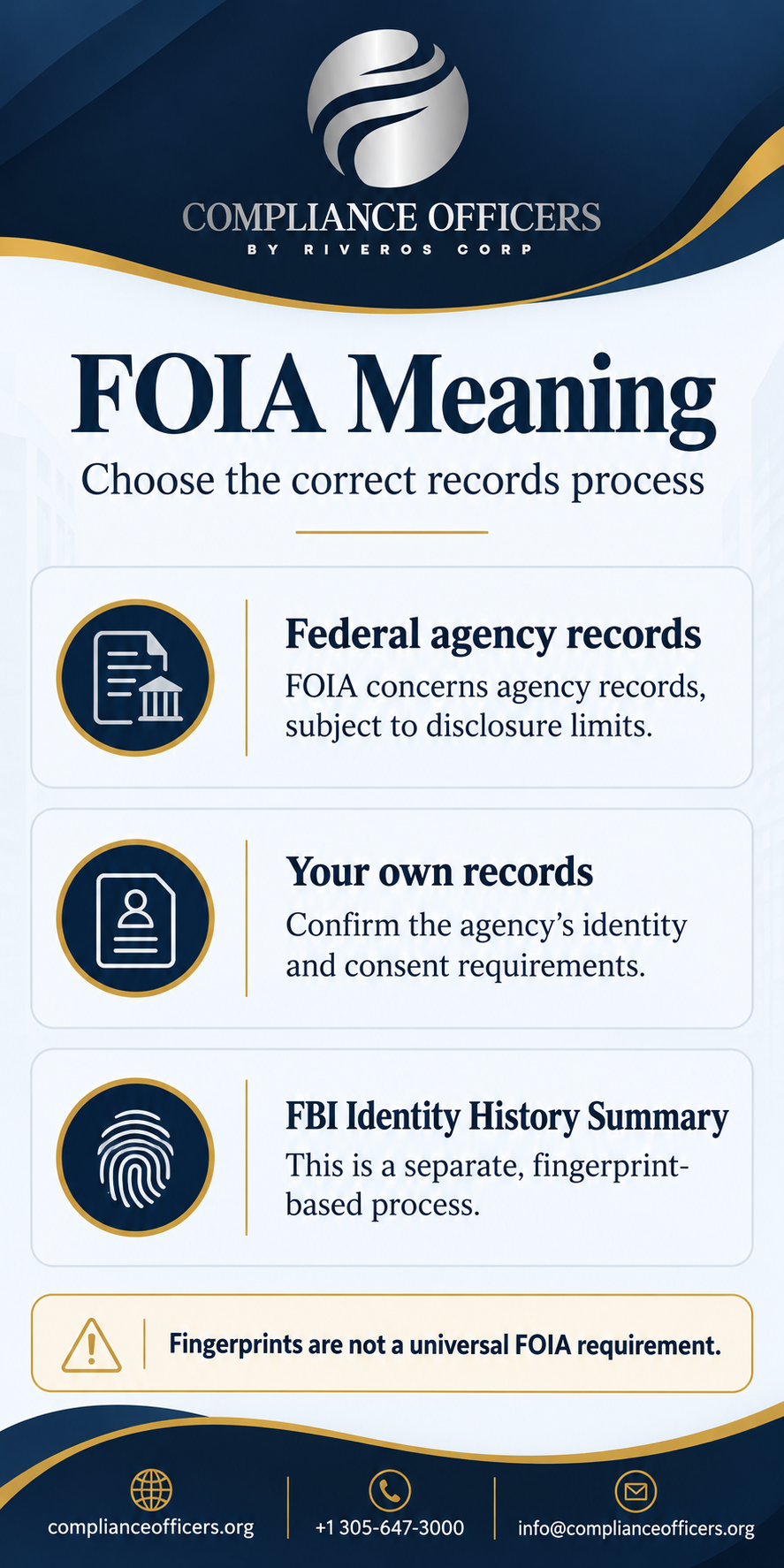
Requests involving your own records may require identity certification. Depending on the agency’s instructions, this can involve a notarized statement or a declaration signed under penalty of perjury. Fingerprints are not a universal requirement for a FOIA request.
The Privacy Act may also be relevant to requests for personal records. Its coverage and access provisions differ from FOIA. An agency may process a personal-record request under the applicable authorities, so it is important to review that agency’s current instructions.
When someone assists you, the agency may require authorization to disclose records to that person. Administrative support does not replace your consent. Similarly, requesting records about another individual does not create an unrestricted right to their private information.
Before sending identification documents, confirm which ones the agency or service provider needs. Agree on a suitable delivery method and the purpose of the request. Providing unnecessary personal information does not make a request stronger and can complicate the handling of sensitive material.
FOIA meaning compared with an FBI history check
The FBI expressly separates its FOIA and Privacy Act records process from an Identity History Summary request. An Identity History Summary, sometimes called a rap sheet, follows a different route through the FBI’s Criminal Justice Information Services Division.
That summary process uses fingerprints. The FBI requires current fingerprint submissions and does not substitute a name-only check for this service. Those requirements should not be described as rules for every request seeking federal records.
The meaning of FOIA helps explain why these services are separate. If you need a criminal-history document for a particular recipient, confirm which document that recipient accepts. A FOIA response is not automatically an acceptable substitute for an Identity History Summary or another required background check.
Compliance Officers can discuss fingerprint capture when it relates to the service you actually need. The purpose should be clear before you schedule it. Paying for fingerprints without identifying the required process can leave you with a service that does not address your records request.
What exemptions and exclusions can change
FOIA contains nine exemptions that protect specified interests, including personal privacy, national security, and certain commercial information. It also contains three narrow exclusions involving particular law-enforcement or national-security records. These are distinct legal concepts, rather than a general permission to withhold anything.
An agency may release part of a record while withholding protected portions. Therefore, receiving a document with redactions does not necessarily mean the whole request failed. The response should be reviewed together with the reasons given for withholding information.
Our explanation of FOIA exemptions and disclosure limits discusses the subject in more detail. The practical question is which rule applies to the specific information, rather than whether every page must be released without changes.
If the response affects a legal matter, ask a qualified attorney to assess its implications. A service provider can help organize documents and correspondence within an agreed scope. It should not promise that administrative preparation will overcome a valid exemption.
Choosing the agency and describing the records
There is no single office that processes every federal records request. The relevant agency or component handles the records within its responsibility. Identifying that custodian is different from choosing the government office most familiar to you.
The request needs to describe the records reasonably. Useful context can include the subject, relevant period, and known reference information. However, the appropriate detail depends on the records and the agency. A generic description may leave important ambiguities unresolved.
The article on FOIA request forms and essential information explains why the agency’s requirements matter. There is no single mandatory form for every federal request, although agencies may provide specific submission systems and instructions.
Before authorizing assistance, agree on the scope in plain language. Identify what the provider will prepare, what information you must supply, and who will receive agency correspondence. This helps keep administrative responsibilities clear without implying control over the government’s decision.
FOIA meaning for response times and fees
The familiar 20-working-day rule concerns an agency determination, subject to statutory timing rules and permitted extensions or pauses. It should not be advertised as a guaranteed deadline for delivery of all records. Processing can depend on the request’s complexity and the agency’s workload.
Similarly, a private service cannot promise that an agency will release records before your appointment or transaction deadline. Expedited processing has its own standards. Personal urgency should be explained accurately, without assuming it automatically qualifies for priority treatment.
There is no general filing charge simply to submit a FOIA request, but search, review, or duplication charges may apply under the relevant rules. Government charges should be distinguished from the fees charged by a private service provider.
Before accepting a service proposal, ask what it includes and how additional agency charges will be handled. A fee arrangement does not guarantee that releasable records will be found. The scope, expected administrative work, and limits should remain clear throughout the engagement.
Reading the response and any remaining gaps
An acknowledgement confirms receipt or processing information; it is not the final records release. Later correspondence may identify a need for clarification, describe the search, or explain a disclosure decision. Keep those communications with the material you receive.
If a response states that no responsive records were located, read that result in relation to the request and the search described. It should not automatically be treated as proof that an event never occurred. The agency, scope, and available records all matter to interpretation.
You may also receive documents that refer to other records or offices. Those references can raise further questions, but they do not establish that every related document is available. Consider the actual gaps before deciding whether additional administrative follow-up is useful.
Where a response includes appeal rights, review the instructions and deadline promptly. An appeal, a dispute-resolution request, and court proceedings are different options. Obtain legal advice when deciding how to protect rights or challenge an agency’s determination.
FOIA meaning and common misconceptions
One mistake is assuming that every government-related problem can be resolved by obtaining records. A request may provide information, but it does not reopen an application, reverse an immigration decision, or replace a separate legal procedure.
Another is treating fingerprinting as an automatic prerequisite. First identify the required records product and its identity rules. If the actual need is an FBI Identity History Summary, it should be handled as that distinct service.
It is also unhelpful to promise an unredacted file or a fixed government delivery date. Administrative preparation can make a request clearer and support organized follow-up. The agency still controls its search, processing, and disclosure decisions under the law.
Finally, keep the service description separate from the desired result. A proposal should explain what assistance will be provided. It should not describe a hoped-for government outcome as something the provider can guarantee.
FOIA meaning: common questions
Does FOIA apply to all government records?
No. Federal FOIA concerns federal agency records, with disclosure limits. It does not cover Congress, federal courts, or state and local agencies. Those institutions may have other access procedures that need to be considered separately.
Do I always need fingerprints?
No. FOIA identity requirements depend on the agency and request. The FBI Identity History Summary is a separate fingerprint-based process. Confirm which records product you need before arranging fingerprints or paying for related administrative services.
Will I receive everything within 20 working days?
Not necessarily. The statutory determination period is not a universal delivery guarantee. Timing rules, complexity, and workload can affect processing. A private provider cannot guarantee the agency’s release date or the amount of information it discloses.
Can Compliance Officers guarantee access to my file?
No. Compliance Officers can discuss administrative assistance and any relevant fingerprinting service. The agency determines what records can be released. Legal challenges, immigration strategy, and advice about rights require an appropriately qualified professional.
Discuss your request with Compliance Officers
Explain the records you need, the agency involved, and any deadline affecting your plans. Compliance Officers can review the requested administrative support and clarify whether fingerprinting belongs to a separate process.
Call +1 (305) 647-3000, contact us through WhatsApp, or email info@complianceofficers.org. Confirm the service scope and necessary documents before sending sensitive information.
This article provides general information and does not constitute legal advice. Consult a qualified attorney about your rights, appeals, litigation, or the legal use of released records.