How to legalize a birth certificate starts with a readiness check. Complete that review before sending the record. Each certification should respond to an actual requirement. What matters is whether the U.S. certificate is the right version and whether the correct authority can process its signature. The chosen route also has to satisfy the foreign recipient. This article covers those decisions for an existing U.S.-issued birth record intended for use abroad.
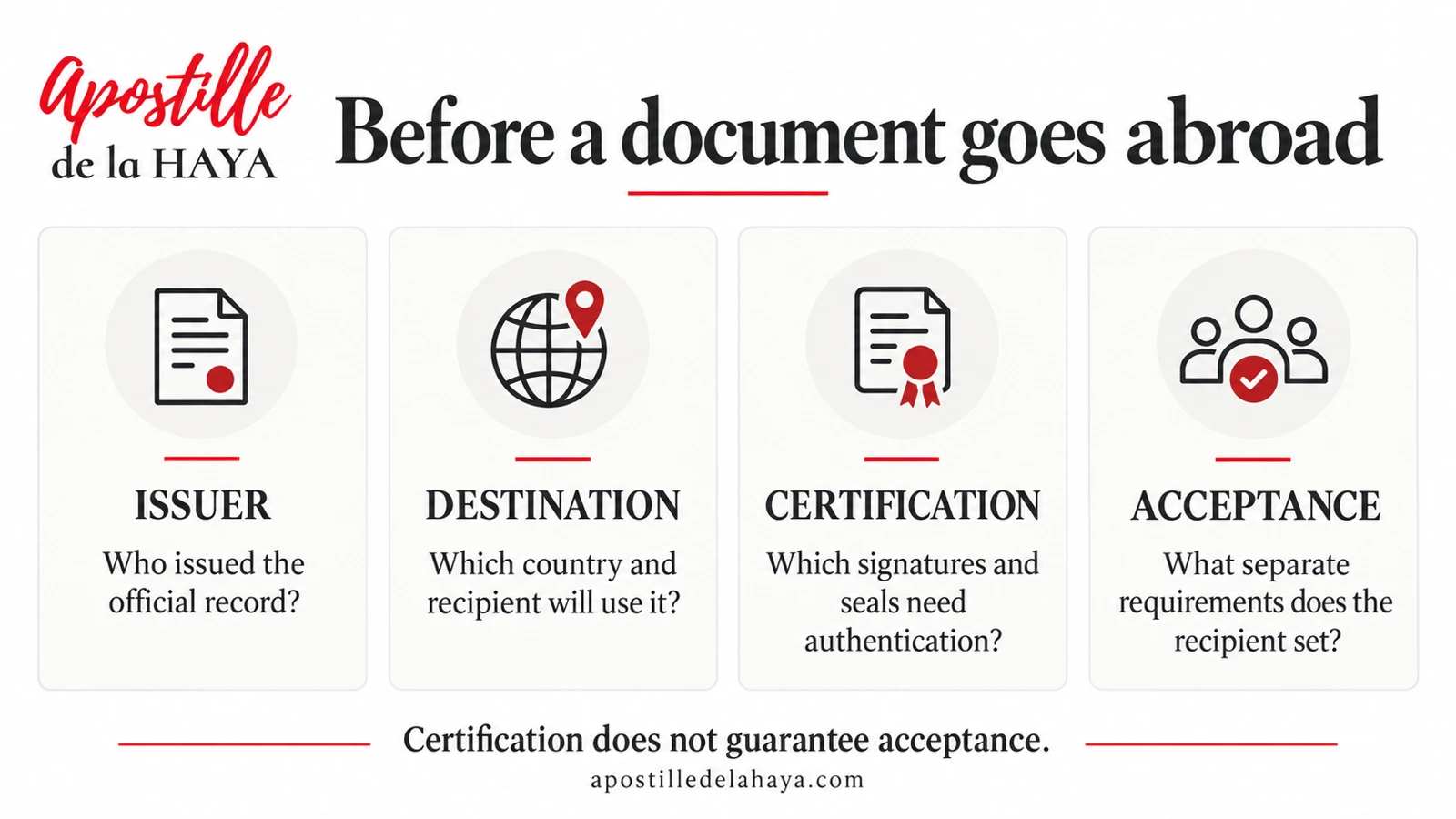
This review helps most when a deadline is close or someone else is helping with the document. A relative may have the paper, the applicant may be overseas, and the receiving authority may be in a third location. Apostille de la Haya can review the file and explain the appropriate documentary assistance. Before arranging transport, identify the certificate, issuer, destination, recipient instructions, existing certifications, and delivery plan. Those facts show whether the record is ready or whether an earlier issue has to be resolved first.
How to legalize a birth certificate: define the file first
Write a clear description of the record. A folder label is not enough. Note the name of the issuing public office, the state or jurisdiction, and the type of copy you have. Include the official signature or certification statement where it is visible. An application that only says “American birth certificate” leaves too much doubt about the authority involved.
Say whether you have the certified paper, an original digital record, a photocopy, or only a scan. These versions are not automatically interchangeable. A scan can serve for a preliminary assessment even though the official process calls for another form. Do not send your only certified copy just because the first review has not yet told it apart from an ordinary copy.
Also name the person responsible for the file at each point. Who holds the record now? And who can authorize its release? Who will receive the completed set? Settling these practical details keeps the preparation from stalling on a document that is available in theory but cannot actually be delivered to the next stage.
Checkpoint one: confirm the foreign recipient's request
Ask the recipient to name the required record, certification, language, and purpose. A foreign civil registry may want a particular form of birth evidence, while another institution may use the record for a different procedure. If the instruction just says “legalize it,” get it clarified before deciding that a consular route is necessary.
The destination matters because an applicable apostille process and an authentication followed by legalization are different routes. A U.S. government overview explains how the destination drives that distinction. The document’s issuer then determines the relevant authority at origin. You need both answers before a submission plan is complete, and together they are the core of how to legalize a birth certificate for a given country.
If the institution requires a recently issued copy, write down the actual condition. Do not turn the word “recent” into a universal rule that every birth certificate expires after a set period. Ask which date counts and what period the institution accepts. The answer tells you whether the existing copy needs replacing for this particular use.
Checkpoint two: confirm the certified version
Review the whole document, including text on the back and attached pages. Look for the issuer’s certification, signature, seal, and any restriction. A hospital keepsake, an informational copy, and an official certified civil record may all contain birth information. They do not necessarily meet the same documentary requirement.
Maybe the paper was accepted for a domestic purpose. Treat that as information about its past use, not as proof that it is ready for international use. The certified birth certificate discussion explains the difference between obtaining a record and preparing its official signature for foreign use. A later certification does not automatically cure an unsuitable underlying version.
Do not add a notarial copy as a shortcut without checking whether it is permitted and accepted. The appropriate record may have to come from its official custodian. If you need a replacement, identify the exact version before ordering. Otherwise the file can end up in the same uncertainty, with a newly issued document that still does not fit.
Checkpoint three: identify the competent issuing-state authority
The applicant’s home state may not be the record’s issuing state. Read the issuer and the official signature. If the record came from a local office, check whether the applicable state procedure requires an additional verification of that signature. Do not assume every state, or every local record, follows the same preparation.
New York’s apostille and authentication guidance is one example: it treats certain state and local vital records differently. California’s apostille FAQs also address what different official signatures mean. Both examples show why the certificate itself has to be reviewed before a route is chosen.
Use those sources only for the records they cover. A California signature issue does not create a New York requirement, and neither one supplies a national rule. Apostille de la Haya can review the actual issuer and copy, then explain the relevant preparation instead of sending every U.S. certificate through a standard list of offices.
Checkpoint four: determine any later federal or consular stage
Treat any federal authentication as its own stage. The verified destination route may call for it after the appropriate state preparation. A state birth record does not become federal just because it will be used abroad. The Department of State birth certificate article covers the circumstances behind that narrower federal question.
If a foreign mission is involved, confirm its current jurisdiction and submission instructions. The mission’s general location may differ from the correct service channel. Check the record category, prior certifications, forms, copies, requirements together before arranging transport.
The country-specific service should match the actual destination. For example, the review tied to UAE document preparation should not be copied into a file meant for another country. A neighboring country, or a similar English service term, does not make the official route the same.
Checkpoint five: resolve names, corrections, and translation
Compare the recipient’s needs with the certificate and related identity evidence. If a name changed after birth, find out which connecting record the recipient wants. If the issuer made an error, ask the issuer about a correction. Do not edit the certificate or tell a translator to hide a difference.
Find out whether a translation is required and which formalities the recipient accepts. Ask which parts of the completed file must be translated, including any relevant certification attachments. A translation finished before additional pages were issued may need a completeness check. Tie the scope to the actual requirement, not to a default assumption.
Substantive questions about nationality, family relationships, or the foreign procedure belong with the receiving authority or a qualified professional. Legalization does not decide them. The documentary service should explain the record preparation without presenting certification as a guarantee that the broader application will be approved.
Checkpoint six: review the submission package and return plan
Before dispatch, check the package against the selected authority’s current instructions. Confirm the requested service, the document set, any necessary supporting items, and the accepted submission method. An outdated form, or instructions meant for another channel, can trigger an administrative return even when the record itself is suitable.
Keep a clear inventory of what you are sending, and keep the certified document’s attachments in place. Do not split the set to cut the page count or to fit a preferred envelope. If the physical condition worries you, raise it before shipment. An unofficial repair can create another problem for the authority reviewing the record.
The return address should match the next intended use. If the applicant is abroad, sending the certificate back to an unattended U.S. address may delay the final presentation. Name the authorized recipient and the delivery needs before the official stage begins. Keep each tracking reference tied to the correct document and application.
Checkpoint seven: define completion
Official certification, delivery of the package, and acceptance by the foreign recipient are separate milestones. The agreed service should say which one it covers. If a destination-side submission or more translation remains, name it clearly. A returned envelope does not mean every requirement has been met.
When the file comes back, keep the certified set intact and compare it with the original request. If the recipient raises an objection, keep the written notice. Work out whether the issue is a missing certification, an unsuitable copy, translation, or another requirement. The fix should follow the stated problem instead of repeating every stage automatically.
For a record already prepared for another country, start with a review of the new use. The earlier certificate may give useful context without satisfying the new destination. Do not remove an apostille or move an attachment to another copy. Show Apostille de la Haya the complete existing file and the new requirement so the remaining work can be assessed.
How to legalize a birth certificate: scope and timing
Explain the deadline and the event it refers to. A document needed for an appointment has a different planning milestone from one that only has to come back to the applicant. Issuing the record, correcting it, translation, official processing, and transport can each affect the timeline. One office’s posted turnaround is not the total completion time for all of those tasks.
Define the work that remains: an eligible certified copy, any required authentication, translation and final delivery. Ask which tasks the proposed service includes and which remain with the applicant or recipient. Conditions vary with the nature, complexity and specific requirements of the case; consult Apostille de la Haya directly.
Apostille de la Haya can evaluate the preparation through the birth certificate authentication service. The assessment should show what is ready and what still needs attention. That tells you more than a fast completion promise that assumes the document version, route, and recipient requirements are already settled.
How Apostille de la Haya helps with the readiness review
Send the complete U.S. certificate, the issuing authority, the destination, the written recipient request, and any existing certifications through the agreed intake channel. Explain where the document is and where it needs to go. With those details, the proposed documentary assistance can be built around your actual circumstances.
By spotting preparation issues before transport, the service can help reduce avoidable administrative work. It should also make clear which actions stay with the issuer, the applicant, or the receiving authority. Record corrections, required personal acts, and substantive application decisions should be kept separate from the document-handling assignment.
Frequently Asked Questions
When working out how to legalize a birth certificate, what should I check first?
Identify the official issuer and the version you hold, then get the destination recipient’s requirement. Without those facts, the right certificate and the competent office cannot be chosen reliably. Apostille de la Haya can review the complete file and explain the preparation needed before you arrange the next submission.
Should I mail the certificate before the review is complete?
It is better to settle material questions about the copy, route, and recipient first. Sending an unsuitable record can lead to a return and another round of shipping. Contact Apostille de la Haya with the document details so the assessment can check readiness before the certified copy goes out.
Can one checklist cover every U.S. state?
A general readiness checklist can organize the questions, but it cannot replace issuer-specific rules. Official signatures and state procedures differ. Apostille de la Haya can use the checklist to find the relevant authority and review that jurisdiction’s requirements, instead of assuming every certificate needs the same preliminary certifications.
What if the certificate has already been returned once?
Keep the notice and the complete document set. Identify the exact issue before changing or resending anything. A missing certification, an unsuitable copy, and the wrong jurisdiction each call for a different response. Apostille de la Haya can review the stated reason so the next step addresses the problem instead of repeating the same application.
How can I define the complete service scope?
Give the issuer, destination, recipient instructions, existing certifications, language needs, document location, and deadline. Ask which documentary stages and delivery arrangements are included. Apostille de la Haya can then explain the case-specific scope and distinguish official preparation from private assistance.
Check the record before the next shipment
Not sure how to legalize a birth certificate for your destination? Contact Apostille de la Haya to review your U.S. birth certificate and the destination requirement. We can identify the preparation questions and explain the appropriate documentary assistance before the file travels.
Contact Apostille de la Haya by phone or WhatsApp: +1 305 500 0185.