Introduction: The Importance of Apostille for Your U.S. Documents
Who can apostille a document in USA? If you need your U.S. documents recognized abroad—whether for work, study, marriage, or business—an apostille is essential. Navigating the apostille process alone can be complex, time-consuming, and prone to costly errors. At APOSTILLE DE LA HAYA, we take care of every step for you, ensuring your documents are valid internationally without headaches or delays. Our team’s expertise and personalized service have helped thousands of clients worldwide achieve their goals with total peace of mind.
What Is an Apostille and Why Is It Necessary?
An apostille is an official certificate that authenticates the origin of a public document for use in countries that are members of the Hague Convention. Without it, your U.S. documents may not be accepted abroad. Our specialists at APOSTILLE DE LA HAYA ensure your documents meet all international requirements, so you never have to worry about rejections or legal complications.
Who Can Apostille a Document in the USA? We Handle It for You
In the United States, only designated authorities—such as state Secretaries of State and the U.S. Department of State—can issue apostilles. Each type of document (state, federal, or notarized) must be processed by the correct office. Handling these details can be overwhelming, especially if you’re unfamiliar with government procedures or live outside the U.S.
With APOSTILLE DE LA HAYA:
-
We identify the right authority for your document.
-
We manage all paperwork, submissions, and follow-ups.
-
We guarantee compliance with current U.S. and international regulations.
What Documents Can We Apostille for You?
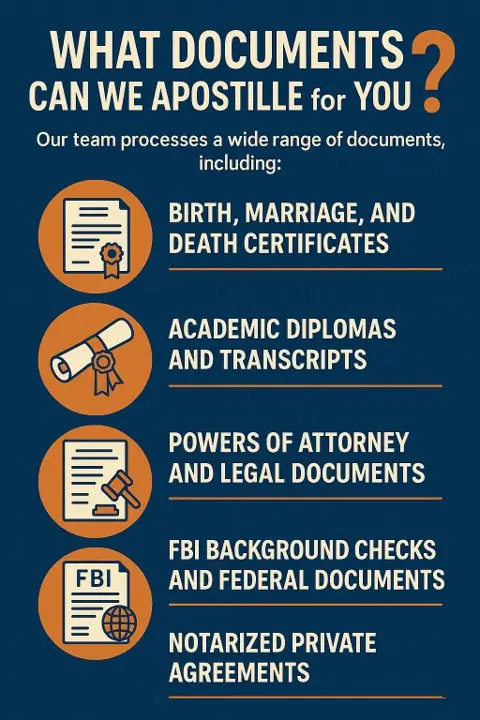
No matter your need, we ensure your document is well done and apostilled for use in any Hague Convention country.
Steps to Obtain an Apostille in the USA (who can apostille a document in USA)
Identify the Type of Document
With the help of APOSTILLE DE LA HAYA, you can easily identify whether your document is state-issued, federally-issued, or a notarized private document. Our experts will review your paperwork and advise you on the correct classification or if you need an FBI background check apostilled, the process is unique. You can read our guide on FBI apostille to understand it step by step. Ensuring that each document is processed through the appropriate authority without confusion or delays.
Verify Pre-Requirements
Some documents may need to be notarized or translated before apostille. If you’re doing it remotely, check how online notary works in the U.S. and in Florida. For example, a power of attorney must be notarized; foreign-language documents may require certified translation.
Submit to the Correct Authority
To ensure your documents are processed correctly and to avoid costly mistakes, we strongly recommend using APOSTILLE DE LA HAYA. Our team will identify the appropriate authority—whether it’s a state Secretary of State or the U.S. Department of State Authentication Office—and handle all submissions on your behalf. This guarantees your documents are directed to the right office, saving you time and preventing rejections due to procedural errors.
Processing Times and Costs
Processing times and costs for obtaining an apostille will vary depending on the type of document, the issuing state, and the specific requirements of the process. At APOSTILLE DE LA HAYA, we look at each case on its own to provide you with the most accurate information and ensure a smooth, efficient experience.
Receive Your Apostilled Document
Once processed, you’ll receive your original document with the apostille attached, ready for international use.
Tips from APOSTILLE DE LA HAYA:
Double-check all requirements on the official website of the issuing authority.
Use trackable mail services for document safety.
Allow extra time for processing, especially if mailing documents.
Why Choose APOSTILLE DE LA HAYA Instead of Doing It Yourself?
While anyone can technically request an apostille, the process is filled with potential pitfalls: incorrect notarization, missing requirements, or submitting to the wrong authority can cause delays or rejections. With APOSTILLE DE LA HAYA, you benefit from:
Expert review: We verify every detail before submission.
Time savings: We handle all steps, so you avoid government lines and paperwork.
Security: Your documents are tracked and handled with maximum confidentiality.
Personalized support: Our staff support guide you from start to finish.
How Does the Process Work with Us?
Contact us: Share your needs and the type of document you want apostilled.
Document review: Our experts check your documents and advise on any additional requirements (notarization, translation, etc.).
We manage the process: We submit your documents to the correct authority, monitor progress, and resolve any issues.
Delivery: Receive your apostilled documents quickly and securely, ready for use abroad.
Experience the APOSTILLE DE LA HAYA Advantage
Thousands of clients have trusted us to handle their apostille needs—saving time, avoiding mistakes, and gaining peace of mind. Our process is transparent, efficient, and fully compliant with U.S. and international standards.
Ready to get started?
Contact APOSTILLE DE LA HAYA today for a free consultation. Our experts are here to answer your questions and guide you every step of the way.
Who Can Actually Issue an Apostille in the USA?
This is the question that trips up most people, so let us answer it plainly. In the United States, only two kinds of authorities can issue an apostille, and which one applies depends entirely on where your document originated. For documents issued or notarized within a state — birth certificates, marriage certificates, diplomas, powers of attorney, corporate records — the apostille comes from that state’s Secretary of State. For documents issued by the federal government — FBI background checks, certain immigration papers, documents signed by federal officials — the apostille comes from the U.S. Department of State in Washington, D.C.
No notary, law office, or private company can issue the apostille itself; those parties can only prepare, notarize, and submit your document to the correct government authority. Understanding this distinction is the single most important step, because sending a state document to the federal office (or the reverse) guarantees a rejection and weeks of lost time. At Apostille de La Haya, we classify your document correctly from the start and route it to the authority that can actually certify it.
State-Issued vs. Federal vs. Notarized Private Documents
Every document you might need apostilled falls into one of three buckets, and each follows a different path:
- State-issued documents (vital records, diplomas, court records) are apostilled by the Secretary of State of the state that issued them.
- Federal documents (FBI Identity History Summary, federal agency records) are apostilled by the U.S. Department of State.
- Notarized private documents (powers of attorney, affidavits, company agreements) must first be notarized, after which the Secretary of State authenticates the notary’s commission and issues the apostille.
Because the origin of the document dictates the authority, the same person may need apostilles from two different offices for two different documents. We manage that complexity so you are not shuttling paperwork between agencies on your own.
Documents We Commonly Apostille
People request apostilles for a wide range of life and business needs. Some of the most frequent include birth, marriage, and death certificates for immigration or marriage abroad; diplomas and transcripts for study or work overseas; powers of attorney for property or family matters in another country; corporate documents for opening foreign subsidiaries or bank accounts; and FBI background checks for work visas and residency applications. Whatever your document, the key is matching it to the correct issuing authority and confirming it is in an apostillable condition before submission.
Common Mistakes That Cause Rejections
Most apostille delays come from a handful of avoidable errors. Submitting a plain photocopy when a certified copy is required. Sending a federal document to a state office. Forgetting the required notarization on a private document. Assuming the destination country accepts an apostille when it actually requires consular legalization because it is not a Hague Convention member. Or leaving out a translation that the receiving country demands. Each of these forces you to start over. Working with a specialist who verifies apostillability before filing removes that risk entirely.
What If My Document Was Issued in Another State?
You do not have to travel to the state where your document was issued. Apostille de La Haya can request an apostille from any state’s Secretary of State on your behalf, as well as from the U.S. Department of State for federal documents. If you are outside the United States entirely, we coordinate secure international shipping so your finished, apostilled document reaches you wherever you are. One team handles the entire chain — classification, notarization when needed, filing with the correct authority, and delivery.
Apostille vs. Consular Legalization
An apostille only works between countries that belong to the 1961 Hague Convention, which includes more than 120 nations. If your destination country is a member, a single apostille certificate makes your document valid there with no further steps. If the destination is not a member, the apostille does not apply and the document must instead go through consular legalization, a longer process involving that country’s embassy or consulate. Confirming your destination’s status before you begin prevents wasted effort, and it is one of the first things we check for every client.
Who can issue an apostille in the USA?
Only two authorities: the Secretary of State of the state that issued or notarized your document, and the U.S. Department of State for federally issued documents. Notaries and service companies can prepare and submit your document but cannot issue the apostille themselves.
How do I know if my document is state or federal?
If it was issued by a state or county office or notarized within a state, it is handled by that state’s Secretary of State. If it was issued by a federal agency (such as an FBI background check), it is handled by the U.S. Department of State. We classify your document correctly before filing.
Can you help if my document is from another state or I'm abroad?
Yes. We can request an apostille from any state’s Secretary of State or from the U.S. Department of State, and we arrange secure international shipping for clients outside the United States.
How long does the apostille process take?
Processing times vary by the issuing office, seasonal volume, and whether prior notarization or county authentication is needed. We give you a realistic window after reviewing your document and manage tracked logistics throughout.
Will my apostilled document be accepted abroad?
If your destination is a Hague Convention member, an apostille makes the document valid there. If it is not a member, the document needs consular legalization instead. We confirm your destination’s requirements before starting.
Do I need my document translated?
Some destination countries require a translation, and it must be done in the correct sequence relative to the apostille. We advise you on whether a translation is needed and coordinate it properly.
Let Apostille de La Haya Handle Every Step
From identifying the right authority to notarization, filing, and international delivery, we manage your apostille end to end — so your U.S. documents are recognized abroad without headaches, mystery fees, or do-overs.
Start My Apostille → Apostille de La HayaFrequently Asked Questions
How long does it take?
Processing times vary, but our experience and network allow us to expedite most requests.
Can you help if I’m outside the U.S.?
Absolutely. We assist clients worldwide and can arrange secure international shipping.
Do you guarantee acceptance abroad?
We ensure your documents meet all legal requirements for the destination country.
What if I have special circumstances?
Our team specializes in complex cases and offers tailored solutions.
Legal Disclaimer:
This article is provided for informational purposes only and does not constitute legal advice. This information is not a substitute for legal advice. For specific guidance regarding your individual circumstances, please consult directly with a qualified attorney licensed to practice in your jurisdiction.