Marriage certificate attestation comes up often in international family paperwork, yet the phrase doesn’t point to a single worldwide procedure. For a certificate issued in the United States, the right preparation depends on who issued the record, the destination country, and the office asking for it. Start by finding out what that office means by attestation and which certificates it expects to see.
This guide looks at the handoff between a family’s U.S. marriage record and the foreign recipient. It covers how to read the request, how to check names and translations, and how to keep document certification apart from the wider family application. Apostille de la Haya can review the certificate and explain which preparation service fits the confirmed route. It cannot promise any residence, immigration, or registration decision.
Marriage certificate attestation begins with the recipient’s request
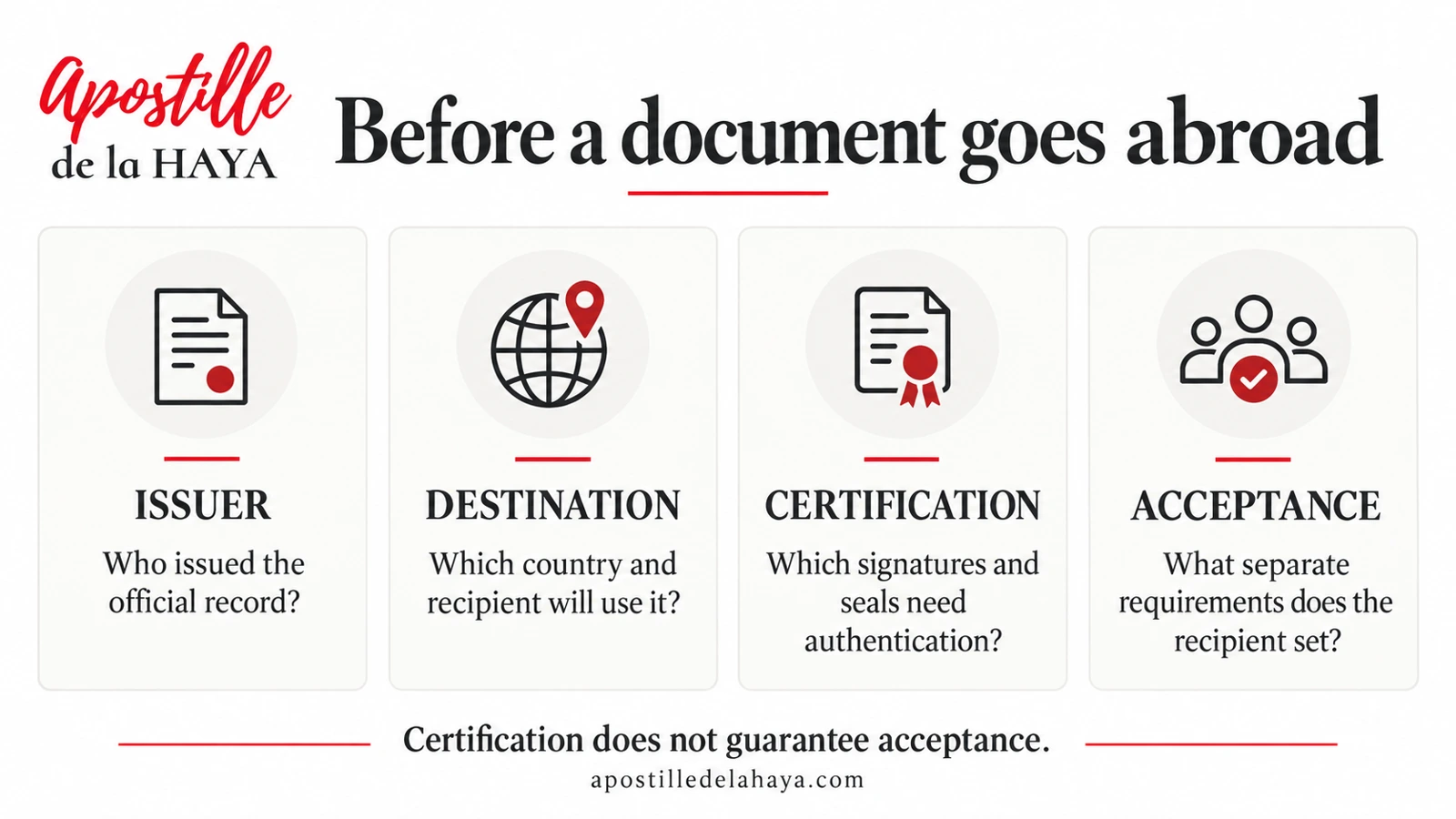
Ask whoever is requesting the document to name the receiving institution and the specific purpose. An HR contact, a relocation coordinator, or a relative may pass along a shortened instruction that leaves out important details. Get the underlying official requirement when you can. “Send an attested marriage certificate” doesn’t say which country issued the record or which authority has to certify it.
Find out whether the request is about preparation in the United States, certification by a foreign mission, or a step inside the destination country. People may use the same English word for all three, even though different offices handle each one. Work out which stages are already done and which are still pending before you arrange another service or send the original across a border.
Ask as well what the recipient will do with the record. It may use it as evidence in a family file, require a separate marriage registration, or need it for a private administrative purpose. Attestation doesn’t automatically complete any of those wider processes. Stating the purpose plainly helps keep anyone from mistaking a document service for a guarantee about the final application.
Confirm that the record was issued in the United States
This article is about marriage records issued in the United States. A certificate issued abroad doesn’t follow a U.S. state route just because the spouses live in America or hold U.S. passports. Identify the authority printed on the record and the place where the official record is kept. Citizenship, language and current residence do not establish where the record was issued.
USA.gov’s information on marriage certificates explains that U.S. and foreign records are handled differently. For a U.S. certificate, state or local custodians may be involved, depending on the jurisdiction. If you ordered the copy through a private service, identify the public office that actually issued the certified record. The ordering service is not the issuer.
If all you have is a scan, find out who holds the official certified copy and where you can get it for submission. A readable image is useful for a preliminary assessment. It does not show that an office will accept an image instead of the required original or authorized copy, so confirm the acceptable format before you arrange delivery or translation.
Tell the marriage record apart from other family papers
A marriage certificate, an unused license, a ceremonial certificate, and a divorce record all serve different purposes. Don’t lump them under one generic label when you ask for attestation. Look at the actual document and its certification statement. Some jurisdictions use a completed license-and-return format, so what the document is and how it is officially certified count for more than one word in its title.
Check the issuing office, the official signature, the seal, and whether the copy is complete. The recipient may need details that a short-form version leaves out. If you need a replacement, ask the lawful custodian which certified version has the required information and works for further authentication. Never add missing facts to the record yourself.
A private notarization won’t fix every public-record problem. The certified marriage copy guide explains the underlying record question before international certification. Florida’s accepted-document guidance, for example, identifies the official records and signatures relevant to state certification. Judge the copy by the issuing jurisdiction’s rules. A spouse’s sworn statement that a photocopy is accurate is a different document from the marriage record certified by its custodian.
What each seal in marriage certificate attestation is for
A state certificate may support the signature or capacity of the official connected to the record. A federal authentication certificate can play a part in a confirmed legalization route. After that, a foreign mission may certify the signature that came before it, and a destination authority may add its own requirement. Work out what each requested act does. Counting stamps won’t tell you whether the packet is complete.
The U.S. Department of State’s authentication guidance matters when the federal stage applies. That does not mean every marriage certificate has to go through the federal office. The destination and the document framework decide whether that stage belongs in the route, and earlier state preparation still matters where it is required.
If an apostille route applies, check the HCCH information on the Apostille Convention. An apostille is not just a preliminary stamp that comes before every embassy attestation. If the recipient’s request seems to conflict with the likely route, clarify the exact document and intended use with the competent authority before ordering both processes. Every additional certificate in a marriage certificate attestation file should have a confirmed purpose.
Use destination examples with care
Say a family is preparing a U.S. marriage certificate for an institution in the UAE. The questions to answer include the certified copy, state preparation, federal authentication, the current U.S. submission channel, and any remaining requirement at the destination. The UAE embassy’s instructions for personal documents send this category through VFS after Department of State authentication. Check the current channel for your actual file.
The UAE attestation service page is a starting point for talking through that preparation. The example is about handling the document. It says nothing about whether the family is eligible for residence. Sponsorship conditions, identity checks, and other application requirements have to be assessed by the authority in charge of the wider procedure.
A family preparing a record for Qatar or another destination shouldn’t reuse the UAE checklist as it is. The competent mission, document category, submission method, translation requirements, and local completion steps may all differ. Reviewing the specific country matters most when the family already has a certificate prepared for an earlier move or a different institution.
Check names without changing the historical record
Compare both spouses’ names with the recipient’s forms and their current ID. A marriage certificate may correctly show a previous surname while the applicant now uses a married surname. In that case the task may be linking the records, and the certificate itself may be fine. Ask the recipient what evidence it accepts before you go after a replacement or a formal amendment.
Look for real inconsistencies, such as a wrong given name or a date that doesn’t match the official record of the event. When there is an error, the issuer should explain its correction process. An attestation office can’t correct the underlying facts by adding a stamp. Nor should a translator quietly replace the source information with what the applicant believes it ought to say.
Transliteration calls for the same care. Spellings that differ across alphabets may need an accepted explanation or a consistent translation method. Settle the requirement with the recipient and a qualified translator. If the underlying documents record different legal names, don’t promise that making every spelling look identical will solve the identity issue.
Plan translation around the full submission
Confirm the accepted language and the translator requirements before ordering any work. Some recipients accept the English record. Others want a translation produced or certified in a particular way. Ask whether the whole certification packet has to be translated and whether a translator’s declaration needs its own authentication. Those answers affect the order of steps and how many separately prepared documents you end up with.
If the translation is done before later certificates are attached, check whether those new pages also need translating. On the other hand, if the translation itself must go through a certification stage, leaving it to the end can cause a delay you could have avoided. The receiving authority’s requirements set the right order. Translation isn’t always the first step, and it isn’t always the last.
Keep the link clear between the original record, the attached certifications, the translation, and the translator’s declaration. Check names, dates, office titles, and document references across the whole set. A translation conveys the source, while marriage certificate attestation supports the relevant signatures. Neither one automatically does the other’s job, and neither settles the recipient’s substantive questions about the family application.
Organize the family file before it goes out
Write a short note of what you are sending: the issuing jurisdiction, the type of copy, existing certificates, the destination, the recipient, the translation status, and the deadline. Record who holds the original and who will receive the finished packet. Families often coordinate across several countries, and a clear handoff helps keep the wrong copy or an incomplete translation from being delivered.
Leave official attachments intact and keep a legible copy of the full set. Confirm the submission office’s current application, and return requirements. Don’t detach certification pages to make a packet thinner, and don’t move a certificate from one copy to another. If the recipient asks for several certified copies, confirm that requirement before assuming one finished packet can be split up.
Handle supporting documents as separate items. If the recipient needs a birth certificate or another civil record, that document has its own issuer and its own preparation question. Don’t send extra identity records just because they might come in handy. A well-organized file holds the evidence that is actually required, shows the status of each document, and keeps the wider application requirements apart from the attestation work.
Frequently Asked Questions
Does attestation guarantee that a family residence application will succeed?
No. It deals with preparing a document and the relevant official signatures. The receiving authority decides eligibility and may ask for more evidence, forms, or conditions. A properly prepared marriage certificate can be one required item, but it doesn’t decide how the broader application turns out. Treat a finished document and an approved application as two separate milestones.
Can I use the same attested certificate for several purposes?
Possibly, but you have to check each recipient’s requirements. A certificate prepared for one country or institution may not meet another’s format, language, or certification rules. Have the complete existing packet reviewed before you arrange more work. Acceptance in one place doesn’t give you a right to reuse the same packet everywhere without changes.
Does every marriage certificate need a translation?
There’s no universal rule. The recipient sets the accepted language and translation format for its own procedure. Confirm who may translate, which pages must be included, and whether a separate declaration or certification is needed. If you order a translation without that information, you may have to redo it or add to it later.
What if my spouse’s passport uses a different surname?
Work out whether the difference comes from a legitimate name change, a transliteration, or an error. Ask the recipient which supporting evidence it accepts to link the records. Don’t alter the marriage certificate, and don’t ask the translator to hide the difference. If the official record is wrong, look at the issuer’s correction procedure before you continue with certification.
Can someone else handle the document for our family?
That depends on the office and the service. Some document submissions allow a representative, while other acts may require the applicant to take part in person or give authorization. Confirm the actual rules before you arrange handling. A service provider can’t replace a required personal appearance, and it can’t make eligibility declarations for someone without the necessary authority.
Request a document review for your destination
The marriage certificate legalization service can help match your U.S. record to the recipient’s attestation requirements. Send the complete copy, any existing attachments, the country of use, and the written request. If the record already carries certifications, include them so the assessment starts from the work that is really done.
Contact Apostille de la Haya on WhatsApp +1 305 500 0185 to talk about the preparation you need. Tell us the document deadline for the family filing and which institution is involved. With that, the review of your marriage certificate attestation can focus on the certificate, the right route, and any open translation or identity-document question before the original is sent on.