
A notarized affidavit is a written statement of facts voluntarily made by an affiant (the person making the statement) under oath or affirmation, which is then certified by a notary public. It serves as a legally binding document used in various court proceedings, immigration cases, and business transactions to provide sworn testimony in a written format that can be accepted as evidence even when the witness cannot be physically present.
If you are dealing with a legal matter, the slightest error in the notary block or the identification process can lead to your affidavit being rejected by a court or government agency. At Notary Public Center, our specialists ensure that every affidavit is drafted and executed with the strict precision required by law. By avoiding the pitfalls of amateur notarization, you protect your legal position and ensure your documents stand up to professional scrutiny.
What Exactly is an Affidavit?
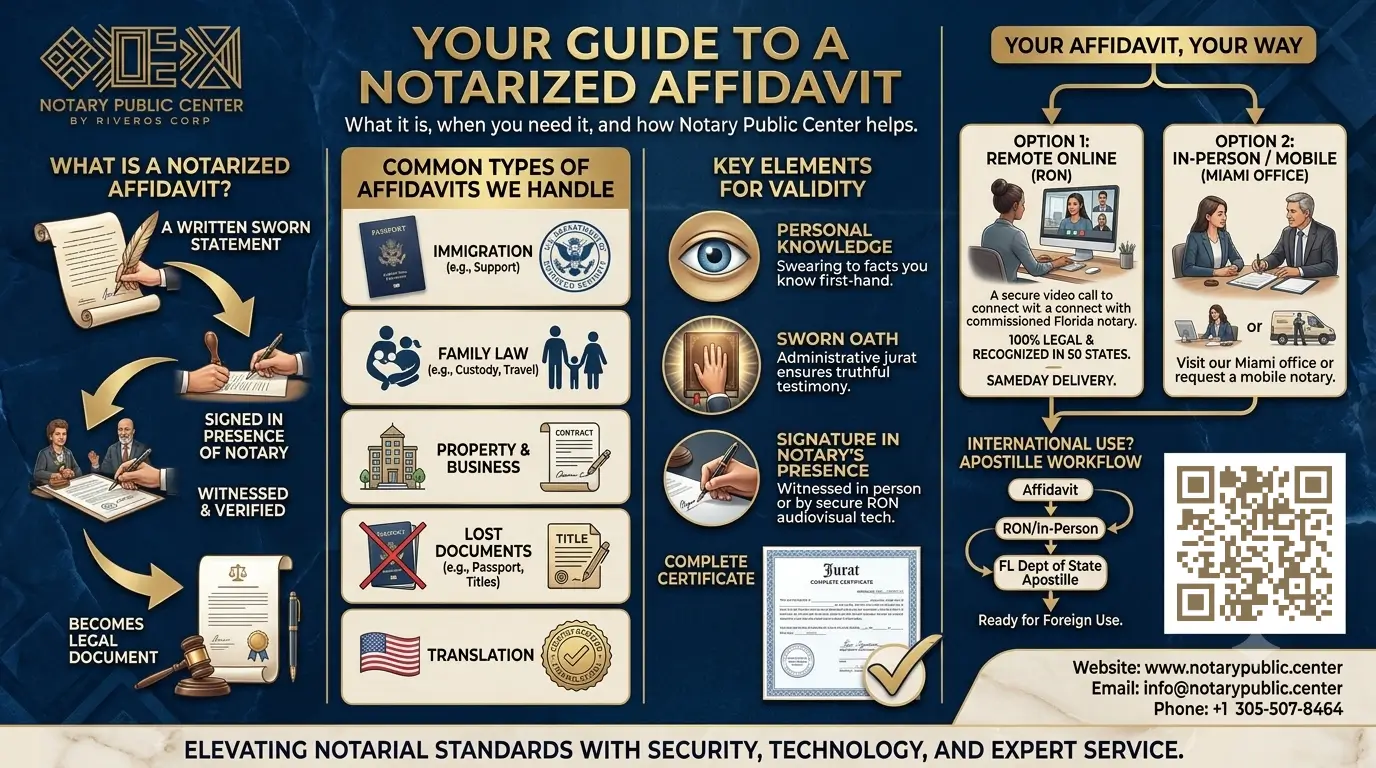
An affidavit is essentially a «testimony on paper.» Unlike a standard contract or a letter, an affidavit carries the weight of a court appearance. Because you are swearing (or affirming) that the contents of the document are true to the best of your knowledge, the document must be handled with extreme care.
The notarization process is the final, critical step. The notary public does not necessarily verify the truth of the facts inside the affidavit; rather, they verify the identity of the signer, ensure the signer is acting voluntarily, and witness the act of swearing to the truth of the statements.
Common Situations Requiring a Notarized Affidavit
You will likely encounter a request for a notarized affidavit in the following high-stakes scenarios:
Immigration Proceedings: Used to prove relationships, bona fide marriages, or financial support to USCIS.
Court Litigation: Serving as written evidence when a witness cannot appear in person to testify.
Real Estate Disputes: Clarifying facts about property ownership or boundaries.
Debt Validation: Swearing to the facts regarding outstanding balances or payment history.
Divorce and Custody: Outlining specific details regarding assets or child-related arrangements.
How to Get a Notarized Affidavit
There are two main steps:
- Write or complete the affidavit: This includes your sworn statement and personal details.
- Sign it in front of a licensed notary public, who verifies your identity and certifies the document.
Many people struggle with writing the affidavit or finding a fast, available notary — especially when dealing with time- sensitive cases like immigration or court deadlines.
What Makes a Notarized Affidavit Legally Valid?
An affidavit is only as strong as its execution. For it to hold up before a court, bank, or foreign authority, four elements must be present:
- Personal knowledge: you can only swear to facts you know first-hand, not to what someone told you.
- A sworn oath or affirmation: the notary must administer the oath — this is what turns a written statement into sworn testimony, and lying on it constitutes perjury.
- Signature in the notary’s presence: you sign the document in front of the notary (physically or by approved audiovisual technology), never before.
- Complete notarial certificate: the jurat must state the date, the county, the notary’s commission details, seal, and signature. A missing element is the most common reason institutions reject affidavits.
If you are unsure what notarization actually certifies, our plain-English guide on what «notarized» means clears it up in five minutes.
Notarize Your Affidavit Online (RON) or In Person in Miami
Florida law allows Remote Online Notarization (RON): you connect by secure video call, verify your identity electronically, swear the oath before a commissioned Florida online notary, and sign digitally. See exactly how the digital seal and e-signature work in our guide to notarizing documents online. The result is legally equivalent to an in-person notarization and is accepted throughout the United States. It is the fastest route if you live in another state — or another country. Learn how the process works in our guide to the online public notary.
Prefer pen and paper? Visit our Miami office or request a mobile notary. Either way, bring a valid, unexpired government-issued photo ID; the notary verifies your identity before administering the oath.
How Much Does It Cost and How Long Does It Take?
Timing depends on the route you choose. A Remote Online Notarization is usually completed the same day you book it — often within the hour — while in-person appointments in Miami adapt to your schedule. If your affidavit also needs an apostille, add the Florida Department of State’s processing and shipping time; we prepare everything so that step starts immediately after notarization. Because every document and destination is different, contact us to evaluate your specific case and we will give you a realistic timeline before you commit to anything.
Using Your Affidavit Abroad: the Notarization + Apostille Workflow
When your affidavit is headed to another country — a consulate, a foreign court, a university, a marriage registry — notarization is only the first half of the journey. Most member countries of the Hague Convention will require an apostille issued by the Florida Department of State that authenticates the notary’s signature and commission.
Handled separately, the two steps mean two providers, two shipments, and twice the chance of a formatting error. Handled together, your affidavit is drafted in the correct format, notarized (in person or by RON), sent for the apostille, and returned to you ready for international use, with a scanned copy in advance if your deadline is tight. That single-workflow approach is exactly what Notary Public Center does every day for clients in the United States and abroad.

Common Mistakes That Get Affidavits Rejected
- Signing before the appointment: if the document arrives already signed, the notary cannot complete a jurat — you will need to re-sign in their presence.
- Blanks left in the text: empty lines invite tampering; institutions routinely reject affidavits with unfilled spaces.
- Wrong notarial certificate: an acknowledgment is not a jurat. Affidavits require a sworn oath, and using the wrong certificate invalidates the purpose.
- Name mismatches: the name on the affidavit must match your ID exactly.
- Missing the destination country’s requirements: if the affidavit will be used abroad, it usually needs an apostille after notarization — something we handle in the same workflow.
Not every sworn statement needs a notary, though — some agencies accept unsworn declarations under penalty of perjury. We break down the cases in do affidavits need to be notarized? and share practical tips in our guide to choosing a notary public for your affidavit.
The Notary Public Center Advantage
You are not just looking for a stamp; you are looking for legal peace of mind. At Notary Public Center, we provide a professional environment where your affidavit is handled with the seriousness it deserves.
Jurisdictional Expertise: We understand the specific nuances of document preparation and notarization requirements, ensuring your affidavit meets the standards of the agency or court requesting it.
Verified Integrity: Our process guarantees that every signature is verified, every oath is properly administered, and every seal is legally affixed according to state statutes.
Flexible Options: Whether you require professional in-person notarization or need to explore Remote Online Notarization (RON) for convenience, our team ensures the process remains compliant and secure.
Don’t let a technical error jeopardize your legal filings. Contact Notary Public Center today to ensure your notarized affidavit is prepared, executed, and authenticated correctly the first time.
Notarize Your Affidavit Today
Online (RON) or in person in Miami. Write to us on WhatsApp

Frequently Asked Questions about Notarized Affidavits
1. Does a notary public check if the facts in my affidavit are true?
No. A notary’s role is to verify your identity, ensure you are signing voluntarily, and witness the swearing or affirmation of the truth of the statement. The notary does not validate the accuracy of the information provided in the document check witn online notary guide.
2. Can I sign the affidavit before I see the notary?
In most cases, no. One of the primary duties of a notary is to witness the actual signing of the document. You should bring your unsigned document and a valid, government-issued photo ID to your appointment.
3. What is the difference between an affidavit and a sworn statement?
They are essentially the same thing. An affidavit is simply the formal legal term for a sworn statement of fact that has been signed and notarized.
4. Can an affidavit be notarized online?
Yes, in many jurisdictions, Remote Online Notarization (RON) is a legally valid way to have an affidavit notarized, provided the notary is authorized to perform the service and the appropriate technology is used to verify the signer’s identity.
5. What happens if my notarized affidavit is rejected?
If a court or agency rejects an affidavit, it is almost always due to a technical error in the notary block or an identification issue. You would typically need to redraft the document and undergo the notarization process again, which can result in significant delays and legal costs.
The information contained in this publication is provided for general informational purposes only and does not constitute legal advice. Reading or using this content does not create and is not intended to create an attorney-client relationship. No reader or user should act or refrain from acting based on the information presented herein without first consulting an attorney duly licensed to practice law in their jurisdiction.