Power of attorney authentication for a document signed in the United States starts with one question: which signature needs to be certified? A privately signed instrument, a state notarial certificate, and a federal public document each follow their own route, even if all three are going overseas. The competent office has to be able to certify the relevant official signature, and the certificate it issues has to fit the destination’s requirements.
This article is about deciding whether your file needs state authentication, federal authentication, or some other route. It covers U.S. powers meant for use abroad. Whether an agent has enough legal authority is a separate question, and we don’t address it here. Apostille de la Haya can assess preparation and certification requirements once it has reviewed the complete instrument, its attachments, and the receiving authority’s instructions.
Power of attorney authentication begins with the official act
A typical privately prepared power contains the principal’s grant of authority and a notarial act performed under the law of a particular state. That notarial act is what ties the document to a state. Where the principal lives, where the lawyer practices, or where the document was printed does not necessarily matter. Look at the jurisdiction shown in the notarial certificate before you pick an authentication office.
Read the instrument and its certificate side by side. The names, date, venue, signature, and notarial details should hang together as one record. If a certificate refers to a different document or signer, adding more authentication will not fix the discrepancy. Sort out the underlying problem with the right person or authority before the file moves to a later certification stage.
The word “federal” showing up in a transaction does not make the power a federal document. Mentioning a U.S. passport, a federal tax identification number, or a federal matter overseas is different from being issued by a federal official. USA.gov explains the state and federal distinction based on where the document comes from and which authority is involved. Office selection starts there.
Confirm what the recipient wants before choosing a certificate
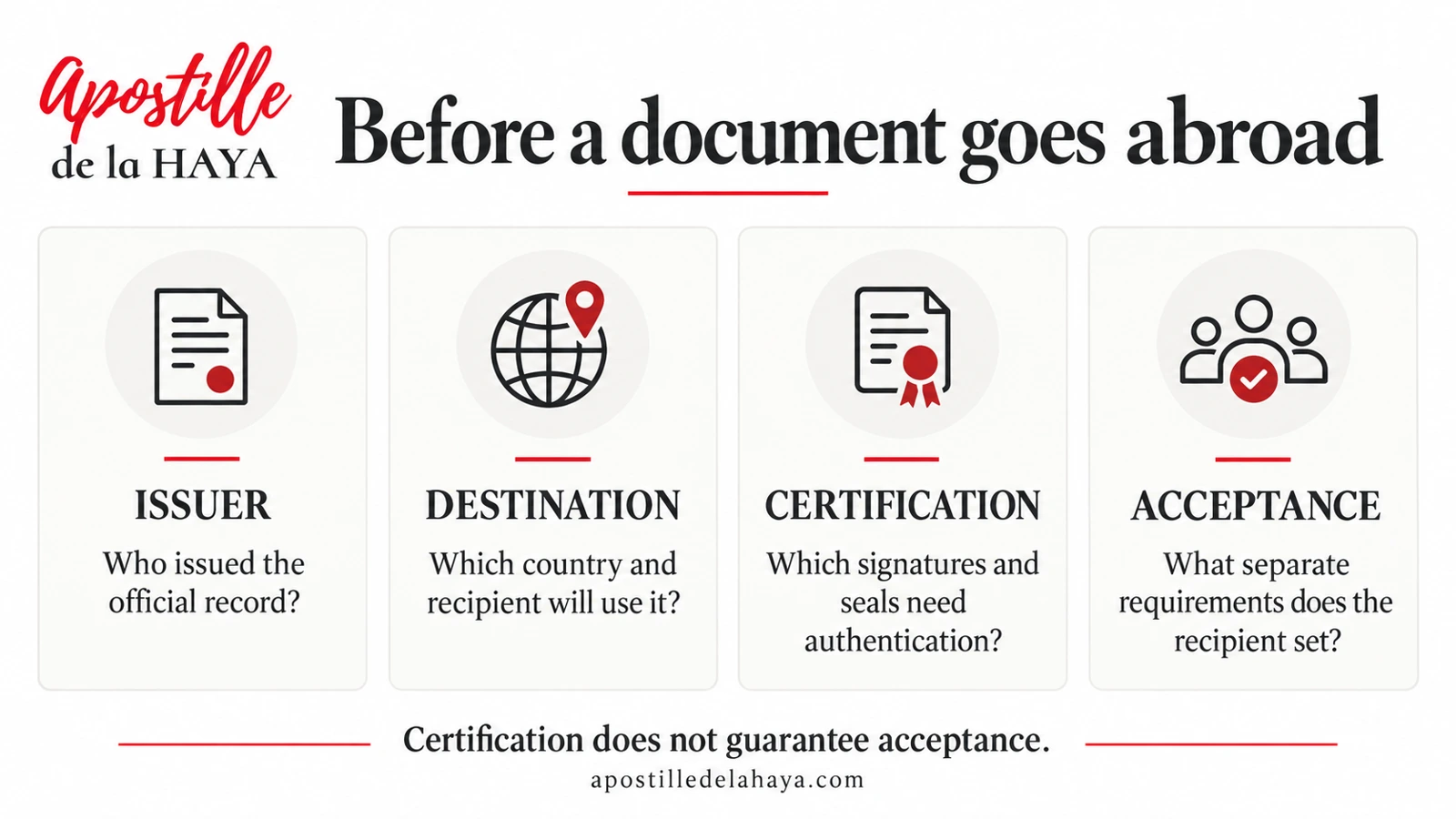
Identify the country, the institution, and the purpose. A bank, a court, a property registry, and a company registry may each want different wording or supporting documents, even in the same country. Ask for the current requirement in writing instead of acting on an informal instruction to “authenticate everything.” You may need to clarify the recipient’s terminology before you can match it to a U.S. certification service.
Find out whether the document will go through an apostille route or a consular legalization route. Ask, too, whether the recipient needs an original, an authorized copy, or an acceptable electronic form. The HCCH information on the Apostille Convention helps set out the treaty framework. You still have to check the specific document and the relationship between the country of origin and the destination before deciding which certificate to request.
If the recipient sent you a form, make sure it is the version meant for signing in the United States. A form written for signing locally before a foreign official may carry assumptions that don’t fit a U.S. notarial act. Those issues are for the appropriate legal professional. A certification service shouldn’t quietly change the principal’s powers just to make an unfamiliar form easier to process.
Where the state fits in the chain
A state authentication office generally deals with signatures and official acts within its competence. For a notarized private instrument, that may mean certifying the notary’s authority under the state’s procedures. Some cases call for an extra local certification or specific supporting information. Whether you need that preparation depends on the applicable state instructions, and a generic nationwide checklist won’t answer it.
Check the issuing office’s requirements for the actual notarial act and the document format. An acknowledgment, a sworn statement, and a certified copy are different acts. A photocopy of a signed power does not automatically carry the same standing as the signed original. If the recipient allows a copy, find out how it must be certified and whether that copy format qualifies for the intended route.
A state certificate does not judge whether granting the authority was wise, whether the statements in the power are accurate, or what the foreign law governing the transaction says. Its job is to support the relevant official signature within the certification system. If the document is missing a required power or names the wrong agent, it still needs legal correction, whether or not a state office could authenticate the notary’s signature.
When power of attorney authentication needs a federal step
Federal authentication may follow state certification when the confirmed route for the destination requires a U.S. Department of State authentication certificate before foreign legalization. Not every U.S. power used abroad needs it. If you add a federal step without knowing why, you may introduce unnecessary work, wait longer, and end up with a certificate the recipient never asked for.
The Department of State’s authentication certificate requirements explain how to prepare state and federal documents. For a state-based instrument on the authentication route, the right prior state certification is a material part of that preparation. Sending a notarized power straight to the federal office without that state certificate does not remove the earlier requirement.
The reverse also holds. A true federal public document is not prepared as if it were an ordinary state-notarized paper. Review its issuing authority and the federal requirements that apply to that record. If the packet holds both a private power and a separately issued federal document, assess each one on its own. Sharing an envelope does not give them a single origin or certification history.
Plan the federal submission around current official instructions
Where the federal step applies, follow the current service instructions from the Office of Authentications. They identify the request form, the destination information requirements, and how to submit. The destination you enter should match the real intended use. A generic or outdated entry can cause confusion about which certificate you are requesting.
The preparation depends on the nature, complexity and requirements of the instrument. Confirm the service conditions directly with Apostille de la Haya. The agreed scope should identify the necessary notarial, state, federal and consular work, any translation and the final delivery. These are distinct services, and a federal authentication alone does not complete every overseas requirement.
The same page lists processing estimates for each submission method. Treat them as the office’s current estimates and not as a guaranteed finish date for the whole international file. Transit, state processing, foreign mission review, and corrections may fall outside that estimate. When you schedule, list every required stage and leave room to fix an item that comes back rejected or incomplete.
Check the consular stage on its own
An authentication certificate from the federal office may support a later act by a foreign mission. It does not prove that the mission’s whole application is complete. Confirm the correct embassy or consulate, its jurisdiction, the document category, the submission channel method, and the return requirements. You can’t borrow another country’s mission instructions just because the documents have similar names.
Some consular services involve the principal appearing in person before an officer. Others deal with an instrument that was already signed and certified. That difference affects identification, eligibility, and signing requirements. Egypt’s published instructions for signature legalization, for example, separate situations that should be reviewed with the competent mission. Don’t assume a direct consular act is equivalent to a U.S. notarial route.
For that destination, the Egypt document legalization overview can help you start a preparation discussion. For other countries, use that country’s mission requirements. A past approval for a relative, for a different document, or in another consular district does not set the procedure for the current principal and transaction.
Review legal content and translation separately
Power of attorney authentication does not confirm the scope, duration, or legal sufficiency of what the principal authorized. Under the applicable law, the instrument may need a specific transaction description, a limitation, or a particular signing form. Questions about capacity, revocation, conflicts between agents, or the effect of a broad grant of powers belong with a qualified professional. The office certifying an official signature won’t answer them.
The power of attorney notary discussion gives background on the signing context. Use it to spot questions, and get advice on your own case where you need it. Settle material changes before anyone signs. If a signed instrument has to be revised, find out whether it must be signed again and whether the earlier certificates can still be used. Never swap pages inside an authenticated packet.
For translation, confirm the language, the translator’s qualifications, the certification requirements, and whether attachments also need translating. A translator’s declaration may carry its own signature and certification needs, because it does not automatically inherit the authentication of the original instrument. Make the principal’s and agent’s names match across versions. Where there are legitimate differences, ask the recipient how to document them instead of changing the source record.
Keep a clear record of what is done
A useful review record lists the final signed version, the notarial jurisdiction, any state certificate, any federal certificate, and the foreign act you still expect. Note who issued each attachment. With that record, a reviewer can tell finished work from planned work. It also keeps you from requesting a second certificate just because someone described the first one with an unfamiliar term.
Keep every attachment intact and hold on to a legible copy of the full packet. Don’t remove official fasteners or reorder certificates for convenience. If an authority asks for a replacement or corrected instrument, record which version you submitted and which version now controls. This matters most when several family members, an agent overseas, and a professional adviser are all working on the same file.
Before you send anything, check the addressee, reference information, application, and return delivery arrangements against the office’s current instructions. Track the shipment and keep the submission reference. A courier’s “delivered” status proves delivery. It says nothing about whether the office accepted the substance of the file. If the office asks for a correction, read the actual reason before you order another stamp or resend the same submission unchanged.
Frequently Asked Questions
Must every U.S. power of attorney go to the Department of State?
No. Whether you need federal authentication depends on where the document comes from and which route its destination requires. Some documents go through an apostille route instead. Confirm the recipient and the certification framework that applies before you schedule a federal submission. International use alone does not create a federal requirement.
Can my home state authenticate a power notarized elsewhere?
Don’t assume it can. The relevant authority generally follows the official act or signature being certified, and the principal’s current mailing address doesn’t change that. Identify the notarial jurisdiction and check that state’s instructions. If you moved to another state after signing, the original notary’s certification route does not automatically move with you.
Does federal authentication approve the language in my power?
No. Authentication deals with the relevant official signatures and the certification chain. It does not decide whether the agent has the powers the overseas transaction requires, whether the restrictions are appropriate, or whether the recipient has to accept the instrument. Settle those legal questions with the recipient and a suitable professional before certification goes ahead.
What if my power already has an apostille?
Review the complete instrument, the existing certificate, the destination, and the recipient’s current instructions. An apostille is not simply an early stage of every consular legalization process. Don’t remove it, and don’t request more certificates until the applicable route is clear. If the destination or use has changed, the preparation may need a fresh assessment.
Can authentication make a scan acceptable instead of the original?
Not automatically. Both the office certifying the document and the final recipient may have their own rules on originals, copies, and electronic records. A scan is handy for a preliminary review, but that doesn’t make it a substitute for the required submission format. Find out which form is acceptable at each stage before you ship anything or rely on an electronic copy.
Have your power of attorney authentication route reviewed before submission
The power of attorney legalization service can help identify the preparation question your existing U.S. instrument raises. Send the complete document, its attached certificates, the destination, and the recipient’s instructions. Say whether the wording is final and whether the principal has already signed, so we can assess the version you have and the work already completed.
Contact Apostille de la Haya on WhatsApp +1 305 500 0185 to talk about the next stage. A focused assessment can tell you whether you are missing a state certification, facing a federal requirement, or dealing with a consular submission issue. It can also flag a question that needs legal review before any more power of attorney authentication is arranged.