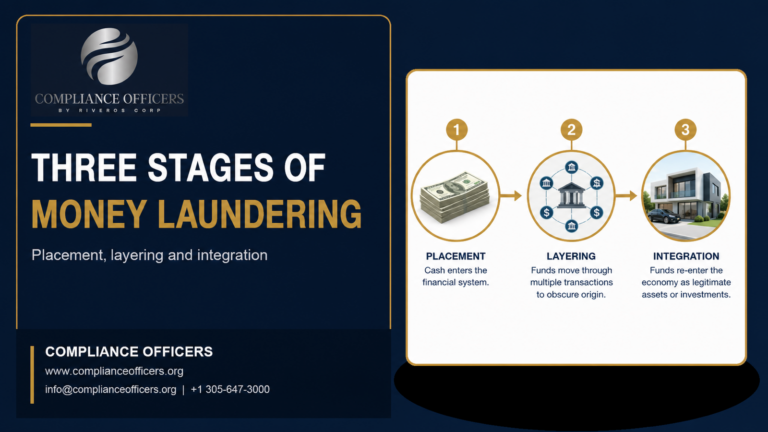
Money laundering is commonly explained through a three-stage model: placement, layering and integration. It is not a legal test. No statute requires you to classify a transaction as placement or layering, and nothing turns on getting the label right.
What the model is genuinely good for is different and more practical: it tells you where in the chain your business sits, and therefore what you are in a position to notice. A cash-intensive retailer and a real estate closing agent are exposed to entirely different stages, and the signals that reach them look nothing alike. This article uses FinCEN’s own definitions and its own examples. Compliance Officers works with businesses that need to know which stage they are exposed to, and who is on the other side of the transaction.
Money Laundering: FinCEN's Three-Stage Model
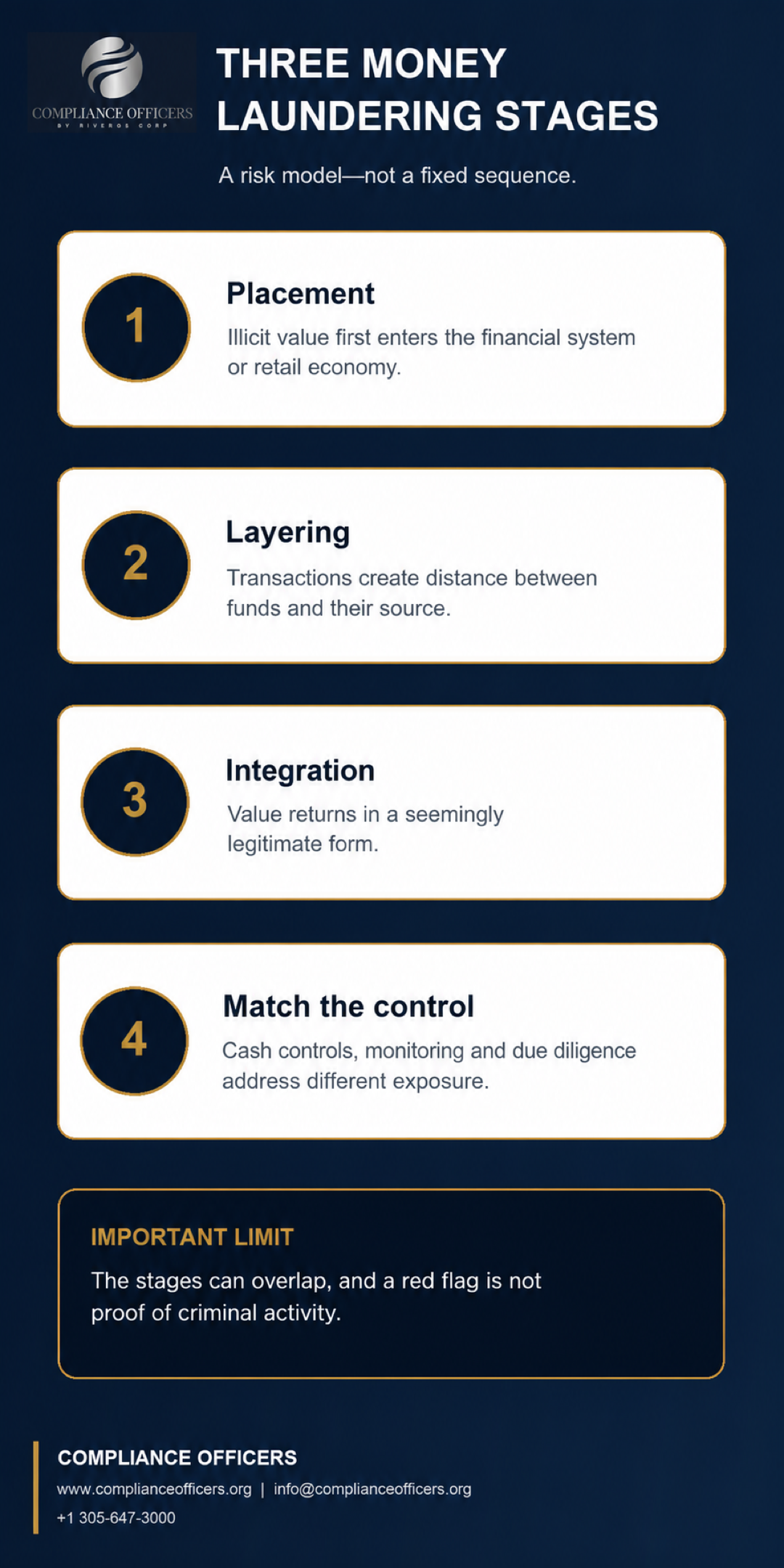
FinCEN describes money laundering as a process that “involves three different, and sometimes overlapping, stages.” The phrase sometimes overlapping is doing real work and is usually dropped in retellings. The stages are not a sequence a launderer must complete in order; they are functions, and a single transaction can serve more than one.
| Stage | What FinCEN says it involves |
|---|---|
| Placement | “Physically placing illegally obtained money into the financial system or the retail economy.” Money is most vulnerable to detection and seizure during placement. |
| Layering | “Separating the illegally obtained money from its criminal source by layering it through a series of financial transactions, which makes it difficult to trace the money back to its original source.” |
| Integration | “Moving the proceeds into a seemingly legitimate form.” It “may include the purchase of automobiles, businesses, real estate, etc.” |
The sentence that explains the whole regime
FinCEN adds: “An important factor connecting the three stages of this process is the ‘paper trail’ generated by financial transactions. Criminals try to avoid leaving this paper trail by avoiding reporting and recordkeeping requirements.” That is the design principle behind every Bank Secrecy Act duty. The reports are not bureaucracy for its own sake — they are the trail.
Placement: The Stage Where Detection Is Easiest
Placement is the bottleneck. Illicit proceeds usually begin as physical currency, and currency is the hardest form in which to hold large value. FinCEN identifies two common methods: depositing structured amounts of cash into the banking sector, and smuggling currency across international borders for deposit elsewhere.
This is precisely why the Currency Transaction Report exists at more than $10,000 (31 CFR 1010.311), and why deliberately breaking a deposit into smaller pieces to stay under it — structuring — is a separate federal offense under 31 U.S.C. 5324. The offense is the evasion itself. It does not require the underlying money to be dirty.
Who sits here: banks, check cashers, currency exchangers, casinos, and any business that takes large amounts of cash. If your business receives currency, placement is your stage.
Layering: The Stage Designed to Defeat You
Once funds are inside the system, the objective is distance. FinCEN describes layering as multiple and sometimes complex financial transactions conducted to conceal the illegal nature of the funds and to make the source difficult to identify or to eliminate an audit trail. Its examples: purchasing monetary instruments — traveler’s checks, bank drafts, money orders, letters of credit, securities, bonds — with other monetary instruments, transferring funds between accounts, and using wire transfers.
Layering is the stage that is hardest for a single business to see, because by design no participant holds the whole picture. What a business can see is incoherence: activity that does not match the customer, transfers with no commercial logic, instruments bought with other instruments. That is the reasoning behind the suspicious activity standard, which asks whether a transaction “has no business or apparent lawful purpose or is not the sort in which the particular customer would normally be expected to engage.”
Who sits here: banks, money transmitters, securities firms, and any business handling payments it did not originate.
Integration: The Stage That Looks Like Ordinary Business
At integration the funds re-enter the economy disguised as legitimate business earnings — securities, businesses, real estate. FinCEN notes a specific technique: unnecessary loans obtained to disguise illicit funds as the proceeds of business lending.
Integration can expose an otherwise legitimate business because a transaction may appear ordinary on its face: the buyer has funds, documents are presented and the transaction is ready to close. Relevant controls can include verifying the counterparty and beneficial owners, testing the commercial purpose and source-of-funds explanation, and checking whether the payment route matches the transaction. Transaction monitoring may still contribute where the business has relationship-level data; pre-closing due diligence is especially important because it can identify inconsistencies before value or title changes hands.
Who sits here: real estate professionals, business brokers, luxury goods dealers, lenders, and any company accepting investment or acquiring a partner.
Which Stage Is Your Business Exposed To?
| If your business… | Your stage | The control that works |
|---|---|---|
| Receives significant currency | Placement | Currency reporting, structuring awareness, staff trained to notice avoidance behaviour |
| Moves or processes funds for others | Layering | Transaction monitoring against a customer profile; coherence checks |
| Sells high-value assets or takes on investors and partners | Integration | Counterparty due diligence and source-of-funds enquiry before closing |
| Does all three | All three | A written risk assessment that says so, and controls sized to each |
The value of the exercise is that it stops businesses buying the wrong control. Transaction monitoring software does very little for a company whose exposure is at integration; what that company needs is to know who it is dealing with before it signs.
Why the Three-Stage Model Does Not Replace an Investigation
The three-stage model helps a business ask where it is exposed, but it does not establish that a particular customer or transaction is criminal. A cash-intensive sale can resemble placement and still have a lawful explanation. A complex cross-border transfer can resemble layering and still reflect a genuine supply chain. A real-estate or business acquisition can resemble integration and still be financed from legitimate wealth.
The next step is controlled inquiry. Compare the activity with the known customer profile, the stated purpose, expected transaction size, business records, ownership, counterparties and geography. Preserve the facts that support the conclusion as well as the facts that cut against it. Where a regulated institution has a SAR duty, the governing standard is knowledge, suspicion or reason to suspect—not proof beyond doubt and not a private finding of guilt.
Controls should also match the point of exposure. Cash controls and structuring awareness matter at placement. Monitoring and relationship-level pattern analysis are more useful during layering. At integration, the decisive work often happens before closing: verifying the buyer, investor, entity, beneficial owners, source-of-funds explanation and commercial purpose. One generic “AML check” cannot perform all three functions.
Finally, avoid turning the model into an operational manual for evasion. Training should help staff recognize anomalies, escalate them and preserve records without teaching threshold-avoidance techniques. The stages of money laundering are a way to organize risk and controls; they are not an accusation, a mandatory sequence or a substitute for the institution’s documented decision process.
How Compliance Officers Helps at the Stage That Affects You
Compliance Officers provides documented AML checks and due-diligence support for U.S. and international clients. We examine the legal, financial and reputational background of the person or company in scope, verify identity and legal existence from available records, and organize the findings in a written report for the client’s decision file.
The service does not issue a legal opinion, determine guilt, replace the institution’s designated decision-maker or guarantee a regulator’s response. It helps establish facts, identify inconsistencies and preserve a review record before the company commits to a transaction or closes an alert.
A useful engagement begins with a defined subject, purpose and risk question. The client defines the review subject—a person, entity, transaction or relationship—and provides the available identifiers and context. The resulting work can address legal existence, ownership information, relevant public-record findings, sanctions and adverse-information indicators, and inconsistencies that require clarification. The report records its scope and limitations so readers do not mistake an absence of findings for proof that no risk exists.
Due diligence is also time-specific. A report reflects the sources and facts available during the review; it does not remain current indefinitely. A new owner, jurisdiction, product, payment route, regulatory event or material adverse fact can justify an update. The client should connect the report to its own risk classification, escalation process, retention rules and authorized decision-maker. That creates an auditable handoff between external research and the company’s internal compliance responsibility.
For related context, review our resources on corporate KYC, FinCEN filing and compliance and FinCEN requirements for small businesses. These topics overlap, but they are not interchangeable: counterparty due diligence, BSA program duties and beneficial-ownership reporting each have their own trigger and scope.
Frequently Asked Questions
Are the three stages a legal requirement?
No. Placement, layering and integration are an analytical model used by FinCEN and other authorities to describe how laundering works. No U.S. regulation requires a business to classify transactions by stage. The binding duties are the reporting, recordkeeping and program requirements in 31 CFR Chapter X.
Does laundering always follow all three stages in order?
No. FinCEN describes the stages as “three different, and sometimes overlapping” — they are functions rather than a fixed sequence, and a single transaction can serve more than one.
Why is placement described as the most vulnerable stage?
Because at that point the money is still physical currency and must enter the financial system or the retail economy to become useful. FinCEN states that money is most vulnerable to detection and seizure during placement, which is why currency reporting thresholds sit there.
What is structuring, and is it a crime by itself?
Structuring is breaking transactions into smaller amounts to avoid a reporting requirement. It is a separate federal offense under 31 U.S.C. 5324, independent of whether the underlying funds came from crime.
My business only sells goods. Can I still be used?
Yes. A sale can be used at integration, where illicit proceeds are converted into assets; FinCEN cites purchases of automobiles, businesses and real estate as examples. A seller that accepts significant currency may also encounter placement risk. Verify the counterparty and payment context before closing, and apply any reporting or recordkeeping rule that actually governs the business.
Can you check a buyer or investor before we close?
Yes. That is the core of our AML Checks and Due Diligence work: verifying identity and legal existence and examining legal, financial and reputational background, with a written report delivered to you. It can be arranged remotely for clients outside the United States.
Know Who Is on the Other Side of the Transaction
Are you about to close a sale, accept an investor or take on a partner you cannot fully verify?
Compliance Officers examines the legal, financial and reputational background of individuals and companies, confirms legal existence and identity, and delivers a written report before you commit.
Phone and WhatsApp: +1 305-647-3000
Email: info@complianceofficers.org
Legal disclaimer: This article provides general information about United States anti-money laundering rules and does not constitute legal advice, a legal opinion or a guarantee of any regulatory outcome. Obligations depend on the type of institution, its activities and its regulator, and the rules change. Citations reflect the text in force on the date shown. Confirm current requirements with FinCEN, your functional regulator or qualified counsel before acting.