Before you arrange US Department of State authentication, check whether your document belongs in the federal process at all. A university diploma, a state birth certificate and an FBI report are all American documents, but each one starts with a different issuing authority. If you send them together without sorting them by origin, part of the request may not be ready. The destination matters too: a country that asks for legalization may need a different certificate from a country that accepts an apostille.
This article covers documents issued in the United States that will be presented abroad. It focuses on the federal office’s role: what you need to settle before you submit, what goes into a request, how to read the processing information, and what may still be pending after the federal certificate is issued. Apostille de la Haya can review your document and how you plan to use it before you commit to a route. The review compares the U.S. certification requirements with the receiving authority’s instructions for your particular document.
US Department of State authentication starts with the issuing authority
The word “State” causes a lot of confusion. A state’s Secretary of State and the U.S. Department of State are two different authorities. A state office handles signatures and records within its own authority. The federal Office of Authentications handles eligible federal signatures and the federal certification step that certain documents need before they go abroad. A document issued somewhere in America is not automatically a federal document.
Take a certified birth record from a state vital records office. That is a state document. A signed certification from a federal agency falls into a different category. A privately prepared declaration may enter the certification process through the notarial act attached to it. So the right starting point depends on whose signature is being authenticated. The owner’s citizenship, mailing address or preferred courier has nothing to do with it.
The State Department’s requirements for authentication certificates separate federal documents from state documents. On the state-document route, its instructions call for state authentication before the federal submission. They also warn against notarizing original federal documents. Sort these points out before you arrange delivery, because an extra stamp cannot fix a file that started with the wrong document.
What US Department of State authentication proves, and what it leaves open
Authentication deals with the official signature, capacity or seal in the certification chain. It does not change the underlying record. It does not decide whether a power of attorney grants the right powers, and it does not guarantee that a foreign employer will accept an academic qualification. A document can be properly certified and still fail a separate requirement set by whoever receives it.
Say an employer asks for a final degree and a transcript. Authenticating the degree does not produce the missing transcript. In the same way, an authenticated marriage certificate does not automatically register the marriage in another country. Keeping these questions apart makes the request more useful: first confirm the record you need, then its certification route, and then any remaining presentation requirements.
If the destination accepts an apostille under the applicable Convention relationship, the right certificate may be an apostille instead of an authentication certificate meant for further legalization. The federal apostille overview explains that route. Decide between the two before you arrange a submission. They are not interchangeable, so don’t pick one because its name sounds more official.
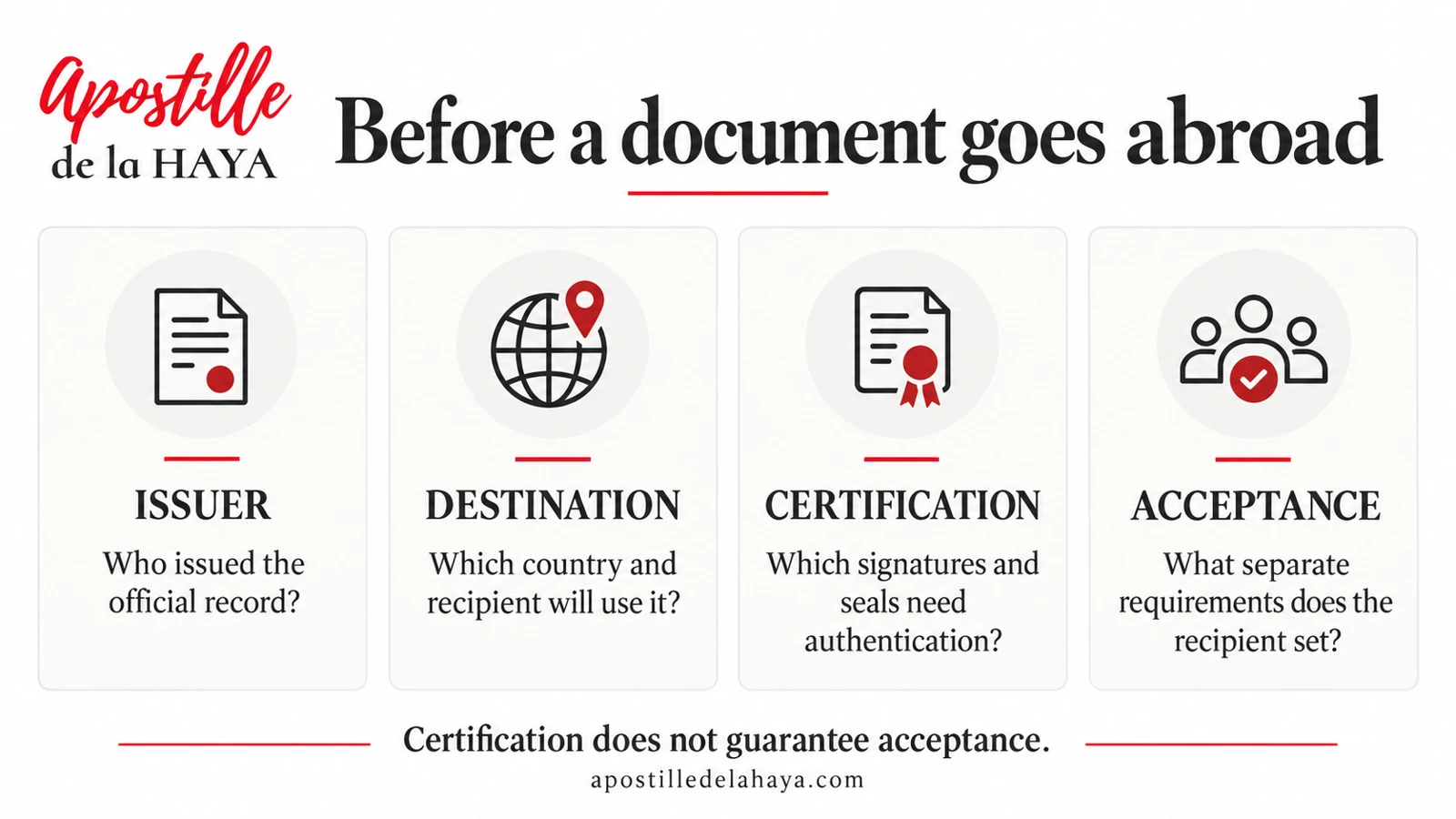
What to check before you submit
Start with the whole document, including every certification page already attached. A photo of the front can hide an important signature or a restriction on the back. The office has to recognize the official act involved, and whoever reviews the case needs to see enough to tell which authority is being asked to certify it. Keep all attachments in place while the file is being evaluated.
For a state-issued record, identify the actual issuer and the state responsible for that issuer’s signature. The state where you live now may have nothing to do with it. For a federal record, identify the agency and the type of certification it supplied. For a notarized document, tell apart the person who wrote the document and the notary whose act enters the official chain. They play different roles, even when their names sit on neighboring pages.
The version you hold matters as well. “I have a copy” can mean an official certified copy, a photocopy of that certified copy, a scan or a printout from an online account. These are not the same thing. If your version won’t work, get the proper record before you arrange later stages. A preliminary document review can catch this problem without changing the record itself.
Translation is its own preparation question. Find out whether the receiving authority wants a translation, which language and format it accepts, and whether the translator’s certification needs separate treatment. Translating the main text does not mean you can ignore seals, notes on the back or certification pages. The recipient’s instructions decide how much of the document needs translating.
Request details, delivery and tracking
The current federal service instructions identify Form DS-4194 and require the destination country and the documents submitted for authentication. The application should describe the actual intended use. Review the official instructions for the selected channel before dispatch. Apostille de la Haya can explain the assistance available; conditions depend on the nature, complexity and requirements of the file.
The federal office distinguishes mailed requests from in-person services. Review the processing information for the channel that actually applies to your submission. A delivery confirmation at the intake address does not mean the examination is finished. Return shipping and any later authority add time. Check the current page before you submit, because a planning estimate does not guarantee the date on which a foreign recipient can use the document.
Confirm the federal office’s current submission and return arrangements before dispatch. Keep the request reference and delivery details together, and use the official contact channel for a case-specific inquiry. Carrier tracking and government processing describe different events. A delivered packet may still await review, and a status inquiry does not guarantee a completion date.
When US Department of State authentication is done but the plan still fails
The federal office can finish its part while you are still short of what the recipient needs. This happens when nobody pinned down the destination, when the wrong document was certified, or when someone assumed the federal certificate necessarily closes the process. Measure completion against how the document will be used, not against an envelope coming back.
A common planning mistake is to confuse a foreign embassy in Washington with an American embassy abroad. They represent different governments and offer different services. If the destination requires its embassy’s involvement, identify that country’s competent mission and the relevant document category. Don’t book an appointment at a U.S. embassy in its place just because the word “embassy” showed up in an email.
Another mistake is to schedule the latest possible shipping date using only the office’s published processing estimate. That leaves no room for an unsuitable copy, a request for clarification or a separate requirement from the recipient. A better question is which parts of the file are ready and which still depend on another person or authority. The answer shows you where the real bottleneck is.
What may follow US Department of State authentication
If the destination uses consular legalization, the next question is whether its competent foreign mission must certify the federal signature, and what its current submission rules are. There may also be a later stage with the destination’s foreign affairs authority or with the recipient. The sequence changes from country to country. If a document was prepared for one destination, have it reassessed before you reuse it for another.
For example, the service information for U.S. documents intended for the UAE involves a different destination review from the one for documents intended for Egypt. The country pages help you find the right service. They do not mean that every record goes through the same embassy chain, or that the same form can be sent to either mission.
The broader document legalization service ties these stages together. When you ask for a review, say who will receive the finished record and what that recipient has asked for. A short written requirement helps much more than a vague instruction like “make it legal overseas,” because it gives the reviewer a concrete result to plan toward.
How Apostille de la Haya helps you organize the federal stage
Apostille de la Haya starts with the document you have and the destination you name. The goal is to settle the preparation questions before the file travels: who issued it, which version is acceptable, what certifications it already carries, what the recipient asked for and any delivery limits. If an earlier stage is missing, we can flag it as a specific requirement, so you don’t discover it after a federal submission has already used up time.
The service scope should state which stages are included and which decisions belong to a government office or the receiving institution. You should know whether the assignment covers only the federal stage or also preparation for a later legalization stage. You should also know where the completed documents will be delivered and who will handle any presentation the recipient requires after delivery.
Working this way cuts avoidable paperwork and makes progress easier to follow. It does not mean an authority will overlook an incomplete record or move a file ahead because it is urgent. If your deadline is close, tell us about the event behind it and the current state of the file. A realistic assessment is worth more than a completion date that ignores what is still outstanding.
Frequently Asked Questions
Does every U.S. document need federal authentication?
No. The route depends on the issuing authority, the destination and the certificate requested. A state-issued document going to a country where an apostille applies may be handled by the competent state authority. A federal document, or a state document that needs a later federal authentication stage, raises different questions. Apostille de la Haya can check which category your record falls into before you submit it.
Can I send an ordinary photocopy instead of the certified record?
Don’t assume an ordinary photocopy qualifies. An official certified copy and a photocopy of that copy are different things. The issuing office and the authentication authority decide which version is acceptable. For an initial review, show the complete document with its certification pages, so Apostille de la Haya can help you see whether the record is ready or needs to be replaced.
Does federal authentication complete the whole legalization process?
Not necessarily. The federal office performs its own certification act. State preparation, translation, delivery and the destination’s consular requirements remain separate where they apply. Send Apostille de la Haya the document type, issuer, destination and deadline to clarify the appropriate assistance. Consult the brand directly about conditions for your particular case.
If tracking says delivered, is the document authenticated?
No. Delivery only records that the package arrived. Intake, examination, completion and return are separate events. Keep the shipping reference, the submission details and the official response together so you can tell them apart. If a deadline is coming up, Apostille de la Haya can help you understand the file’s documented stage instead of guessing from a courier notification.
Can the same authentication be used in a different country later?
Not without a new review. A US Department of State authentication prepared for one country has to be checked against the second destination’s requirements. That receiving authority may ask for a different certificate, additional legalization, a particular translation or another version of the record. Don’t remove existing attachments to make the document look new. Send Apostille de la Haya the complete file and the new destination before you arrange another submission.
Have your U.S. document reviewed before the federal submission
Tell Apostille de la Haya what the document is, who issued it, where it will be used and when you need it. We can assess the preparation and explain the right service scope before you send the record on to the next stage.
Contact Apostille de la Haya by phone or WhatsApp: +1 305 500 0185.