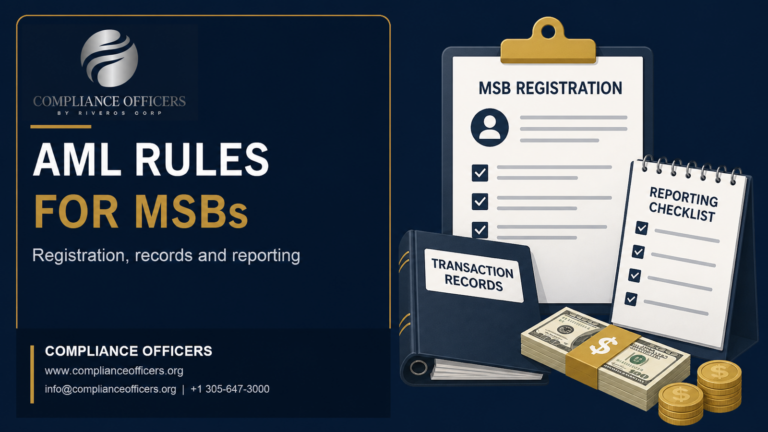
Money services businesses occupy a distinct position in the U.S. financial system. A registrable MSB has a federal registration duty that banks do not have, and covered MSB transactions use a $2,000 suspicious-activity threshold under FinCEN’s rule rather than the $5,000 threshold stated in 31 CFR 1020.320 for banks.
A business can meet the MSB definition because of what a product actually does even when its contract or marketing uses a different label. This article sets out the three duty groups — registration, records, reporting — with the deadlines that attach to each. Compliance Officers works with money services businesses and with the companies that need to verify them.
First: Are You One?
The definition at 31 CFR 1010.100(ff) covers a person, wherever located, doing business wholly or in substantial part within the United States in one of seven capacities — and it applies “whether or not on a regular basis or as an organized or licensed business concern.” Operating without a required license creates a separate problem; federal registration does not provide a defense.
| Capacity | Threshold |
|---|---|
| Dealer in foreign exchange | More than $1,000 per person per day |
| Check casher | More than $1,000 per person per day |
| Issuer or seller of traveler's checks or money orders | More than $1,000 per person per day |
| Provider of prepaid access | Program-based |
| Money transmitter | No threshold |
| U.S. Postal Service | By definition, except sale of postage or philatelic products |
| Seller of prepaid access | Program-based |
The regulation defines money transmission broadly: accepting currency, funds or other value from one person and transmitting it to another person or location by any means, including electronic networks and informal value-transfer systems.
Duty Group 1 — Registration
This registration obligation has no banking equivalent and remains separate from the written AML program. Each money services business must register with FinCEN on FinCEN Form 107, completed and signed by the owner or controlling person.
| Requirement | The rule |
|---|---|
| Initial filing | The MSB files by the end of the 180-day period that begins the next day |
| Renewal | Every two calendar years—the MSB files by the last day of the calendar year before the renewal period |
| Re-registration within 180 days | A change in ownership or control requiring re-registration under State law; a transfer of more than 10 percent of voting power or equity interests; or a more than 50 percent increase in the number of agents during a registration period |
| Agent list | Each money services business must maintain a list of its agents, as required by 31 U.S.C. 5330 |
| Record retention | The MSB keeps the registration form and assigned number at a U.S. location for five years |
Two registration traps
Agents. A person that is a money services business solely because it acts as an agent of another money services business need not register. But a business that acts both on its own behalf and as an agent for others must register. Retailers offering a branded money transfer service alongside their own currency exchange are squarely in the second category.
Shared ownership. Each registration period requires only one form, and co-owners may designate one owner to file it. But the failure of the designated person to register does not relieve the others of liability (31 CFR 1022.380(c)). A handshake is not a defence.
FinCEN states plainly that violations of the registration requirement can trigger civil and criminal penalties. Registration is not part of the AML program; it is a separate duty, and a business with an excellent program that never filed Form 107 is still in breach.
Duty Group 2 — The Written Program
A money services business must develop, implement and maintain an effective AML program that reasonably prevents people from using the business to facilitate money laundering or terrorist financing (31 CFR 1022.210(a)). The program must match the risks created by the business’s location, size, service types and transaction volume.
The MSB must keep the program in writing and provide copies to the Treasury Department for inspection on request. The four minimum elements:
- Policies, procedures and internal controls, including provisions for verifying customer identification, filing reports, creating and retaining records, and responding to law enforcement requests.
- A designated person to assure day-to-day compliance — responsible for proper filing and retention, keeping the program updated to reflect current requirements and Treasury guidance, and ensuring training is provided.
- Education and training of appropriate personnel, including training in the detection of suspicious transactions.
- Independent review, with scope and frequency commensurate with risk. An employee may conduct the review, but the MSB may not assign the person who handles element 2.
The deadline: an MSB established after July 24, 2002 must implement the program by the end of the 90-day period that begins the next day (31 CFR 1022.210(e)). The two deadlines are different: the written program is due at 90 days, while initial registration is due at 180 days.
Duty Group 3 — Reporting
| Report | Trigger | Deadline |
|---|---|---|
| Currency Transaction Report | A transaction in currency of more than $10,000 (31 CFR 1010.311) | As specified in the form instructions |
| Suspicious Activity Report | A transaction conducted or attempted involving or aggregating at least $2,000, where the business knows, suspects or has reason to suspect illegal source, evasion of BSA requirements, no apparent lawful purpose, or use of the business to facilitate criminal activity | No later than 30 calendar days after initial detection |
| Suspicious Activity Report — issuers reviewing clearance records | At least $5,000 when the issuer detects the activity by reviewing clearance or similar records for money orders or traveler's checks (31 CFR 1022.320(a)(3)) | The same 30-day rule applies, with the limited no-suspect extension and 60-day maximum |
Three further points that govern how the reporting duty behaves in practice.
Retention. The MSB must keep every SAR and its supporting documentation for five years after filing.
Confidentiality. The rule protects a SAR and any information revealing its existence and prohibits disclosure except as authorized (31 CFR 1022.320(d)).
Shared transactions. When several MSBs participate in one transaction, each bears the duty, but one report can satisfy them if it contains all relevant facts. Whether one business can be liable for another’s failure depends on the contractual relationship between them.
For possible terrorist activity, institutions may call FinCEN’s Financial Institutions Hotline at 1-866-556-3974 in addition to—never instead of—filing a required SAR on time.
The Compliance Calendar, in One Place
| Days from establishment | What is due |
|---|---|
| 90 | Written AML program implemented (31 CFR 1022.210(e)) |
| 180 | FinCEN Form 107 registration filed (31 CFR 1022.380(b)(3)) |
| Ongoing — 30 calendar days | Each SAR, from initial detection |
| Ongoing — every two calendar years | Registration renewal, by the last day of the preceding calendar year |
| Ongoing — within 180 days | Re-registration after a qualifying change |
| 5 years | Retention of SARs, supporting documentation and registration records |
Federal Registration Is Only One Layer of MSB Compliance
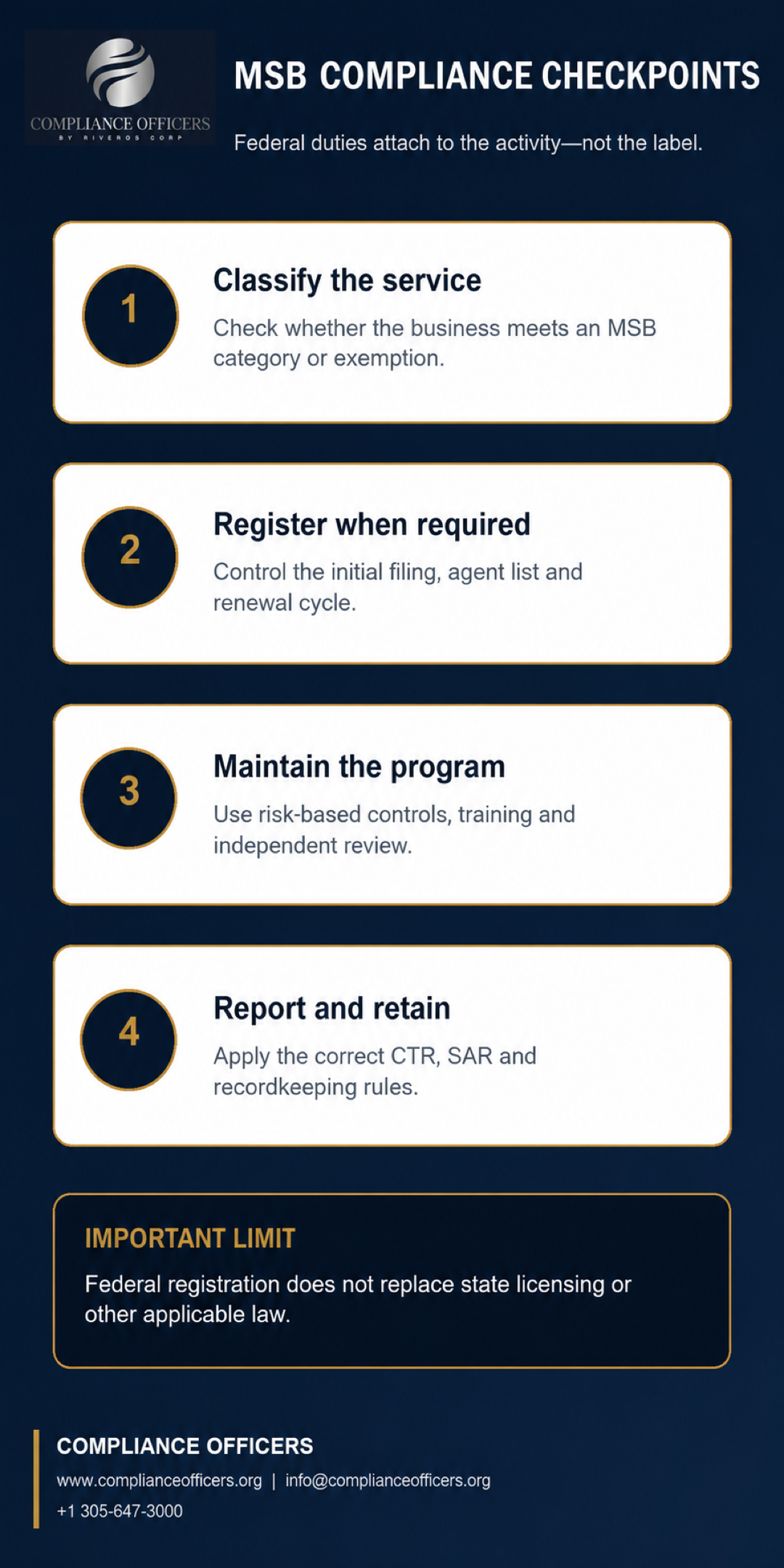
An MSB that begins covered operations after December 31, 2001 generally files its initial FinCEN registration within 180 days and renews on the applicable two-year cycle. A registrable MSB must also prepare and maintain an agent list, revise it for the required period and retain the initial and revised lists for five years. The MSB maintains the agent list rather than submitting it with the registration form, and gives authorized examiners access on request.
Classification comes first. A person acting solely as an agent of another MSB can fall under a registration exception, while a business that conducts covered activity on its own behalf may have a separate duty. Money transmission has no general dollar threshold; other listed services can use the regulatory per-person, per-day threshold. The file should document exemptions and agency relationships instead of inferring them from a contract label.
Registration does not replace the written AML program, suspicious-activity reporting, currency reporting, monetary-instrument records or other applicable Chapter X duties. It also does not replace state money-transmitter licensing. A federal registration number therefore does not prove authorization for every product, state or agent relationship.
The MSB retains responsibility when a vendor handles the work. A vendor can support monitoring, screening, training or filing, but the MSB should define data quality, escalation, retention, testing and access. AML rules for money services businesses operate as a connected system: classification determines the duties, governance assigns them, records show performance and independent review tests whether the system works.
How Compliance Officers Supports Money Services Businesses
Compliance Officers provides documented AML checks and due-diligence support for U.S. and international clients. We examine the legal, financial and reputational background of the person or company in scope, verify identity and legal existence from available records, and organize the findings in a written report for the client’s decision file.
The service does not issue a legal opinion, determine guilt, replace the institution’s designated decision-maker or guarantee a regulator’s response. It helps establish facts, identify inconsistencies and preserve a review record before the company commits to a transaction or closes an alert.
A useful engagement begins with a defined subject, purpose and risk question. The client defines the review subject—a person, entity, transaction or relationship—and provides the available identifiers and context. The resulting work can address legal existence, ownership information, relevant public-record findings, sanctions and adverse-information indicators, and inconsistencies that require clarification. The report records its scope and limitations so readers do not mistake an absence of findings for proof that no risk exists.
Due diligence is also time-specific. A report reflects the sources and facts available during the review; it does not remain current indefinitely. A new owner, jurisdiction, product, payment route, regulatory event or material adverse fact can justify an update. The client should connect the report to its own risk classification, escalation process, retention rules and authorized decision-maker. That creates an auditable handoff between external research and the company’s internal compliance responsibility.
For related context, review our resources on corporate KYC, FinCEN filing and compliance and FinCEN requirements for small businesses. These topics overlap, but they are not interchangeable: counterparty due diligence, BSA program duties and beneficial-ownership reporting each have their own trigger and scope.
Frequently Asked Questions
How long do I have to register a new money services business?
The MSB must file by the end of the 180-day period that begins the day after covered operations start (31 CFR 1022.380(b)(3)). The written AML program is due earlier — 90 days.
How often must an MSB renew registration?
Every two calendar years. The MSB must file the renewal by the last day of the calendar year before the renewal period.
We are only an agent for another company. Must we register?
A person who qualifies as an MSB solely by acting as another MSB’s agent generally does not need to register. But if you also engage in money services activities on your own behalf, you must register (31 CFR 1022.380(a)(3)).
What is the SAR threshold for a money services business?
At least $2,000 for transactions conducted or attempted (31 CFR 1022.320(a)(2)). For issuers of money orders or traveler’s checks identifying activity from a review of clearance records, the threshold is at least $5,000.
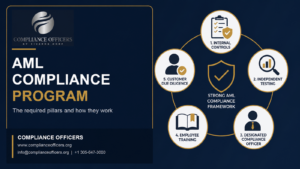
Does a money services business need five pillars?
No. 31 CFR 1022.210(d) requires four elements. The five-element list belongs to the bank rule at 31 CFR 1020.210(a)(2). Applying the bank list is a common template error and can distract from the duties that are specific to money services businesses, such as registration.
Can you verify whether a company we deal with is a registered MSB?
Yes. Confirming registration status, ownership and background is part of our AML Checks and Due Diligence work, delivered as a written report. It can be arranged remotely for clients outside the United States.
Resolve the MSB Classification Question
Do you operate a money services business, or are you about to route funds through one?
Compliance Officers examines legal, financial and reputational background, verifies legal existence and identity, and delivers a written report for your review and records.
Phone and WhatsApp: +1 305-647-3000
Email: info@complianceofficers.org
Legal disclaimer: This article provides general information about United States anti-money laundering rules and does not constitute legal advice, a legal opinion or a guarantee of any regulatory outcome. Obligations depend on the type of institution, its activities and its regulator, and the rules change. Citations reflect the text in force on the date shown. Confirm current requirements with FinCEN, your functional regulator or qualified counsel before acting.