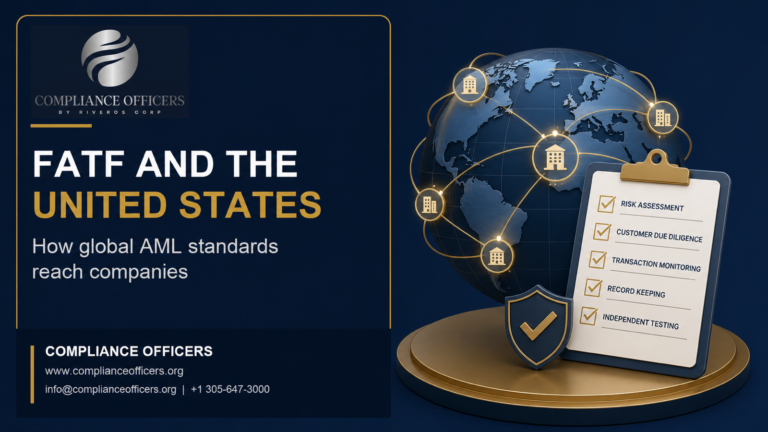
The Financial Action Task Force has no power to fine anyone, issues no binding law, and cannot compel a single American company to do anything. It is nonetheless one of the most consequential forces in U.S. anti-money laundering practice, and understanding why explains a great deal about where the rules are heading.
The mechanism is peer review. The FATF publishes standards, assesses each member against them, and publishes the result. The United States has been a member since 1990, and its scorecard is public. This article sets out what that scorecard actually says — including the parts that are uncomfortable — and what it means for businesses on the ground. Compliance Officers works with international clients on precisely the cross-border expectations this system creates.
What the FATF Is and How Its Standards Travel
The FATF sets the international standard through its 40 Recommendations, and assesses countries on two separate axes:
- Technical compliance — does the country’s legal and regulatory framework meet each Recommendation? Rated Compliant, Largely Compliant, Partially Compliant or Non-Compliant.
- Effectiveness — does the system actually work? Assessed against eleven immediate outcomes.
The standards reach American businesses by three routes, none of which is direct legal force:
- Through domestic rulemaking. A poor rating is a documented, public argument for legislative or regulatory change.
- Through your counterparties. A foreign bank assessing a U.S. client applies its own FATF-derived rules. The request for beneficial ownership information arriving from a European correspondent is FATF reaching you through commerce.
- Through country risk. Higher-risk jurisdiction lists shape onboarding decisions across FATF member jurisdictions — the FFIEC red flags expressly reference activity involving countries designated by national authorities and the FATF.
The United States' Actual Ratings
The U.S. mutual evaluation was published on 30 November 2016. Its headline finding was that the country has a robust regime to combat money laundering and terrorist financing, however — and the FATF’s own summary uses the word — “serious gaps impede timely access to beneficial ownership information.”
The most recent technical compliance re-ratings come from the United States’ 7th Enhanced Follow-up Report, published 26 March 2024. As of that date the standing is:
| Rating | Number of the 40 Recommendations |
|---|---|
| Compliant | 9 |
| Largely Compliant | 23 |
| Partially Compliant | 5 |
| Non-Compliant | 3 |
Thirty-two of forty at Compliant or Largely Compliant is a solid result. The eight that are not are where the interesting information sits.
The Three Non-Compliant Ratings Are All the Same Issue
The United States is rated Non-Compliant on exactly three Recommendations, and they form a single cluster:
- R.22 — DNFBPs: Customer due diligence
- R.23 — DNFBPs: Other measures
- R.28 — Regulation and supervision of DNFBPs
DNFBP stands for designated non-financial businesses and professions: lawyers, accountants, trust and company service providers, real estate agents, dealers in precious metals and stones. The FATF standard expects these gatekeeper professions to carry customer due diligence duties and to be supervised for them. In the United States these professions are not subject to one uniform federal AML/CFT framework matching the full FATF standard, although particular sectors and transactions can have specific federal or state duties.
That single fact explains a striking amount of recent U.S. rulemaking — including the sustained regulatory attention to real estate closings and settlements, which now has its own part of 31 CFR Chapter X at part 1031. A documented gap can influence later legislation, regulation and supervisory priorities, but a FATF rating does not determine the timing or content of U.S. law.
The Five Partially Compliant Ratings
| Recommendation | Subject |
|---|---|
| R.1 | Assessing risk and applying a risk-based approach |
| R.12 | Politically exposed persons |
| R.16 | Wire transfers |
| R.20 | Reporting of suspicious transactions |
| R.25 | Transparency and beneficial ownership of legal arrangements |
R.1 and the 2026 proposal are the same conversation
The United States is rated only Partially Compliant on Recommendation 1 — assessing risk and applying a risk-based approach. FinCEN’s proposed rule of 10 April 2026 would place a documented risk assessment process at the front of every AML/CFT program, requiring institutions to identify, assess and document their illicit finance risks and to incorporate the national AML/CFT priorities. The proposal’s emphasis is consistent with the concern reflected in Recommendation 1, although the FATF rating alone does not establish why FinCEN selected any particular provision. The ratings are useful context for areas receiving policy attention, not a prediction of a final U.S. rule.
There is also a genuine success on the record. Following the country’s 2020 report on actions taken to strengthen its framework, the FATF re-rated the United States on Recommendation 10 (Customer Due Diligence). Re-rating is available where progress has been made, and it happened here — the customer due diligence rule at 31 CFR 1010.230 is the domestic instrument behind that movement.
The United States will report on further progress in its 5th round mutual evaluation.
Who Represents the United States
The U.S. delegation is led by the Department of the Treasury, and includes the Federal Bureau of Investigation, FinCEN as the country’s financial intelligence unit, the Department of State, the Department of Justice, the Department of Homeland Security, the Internal Revenue Service, Immigration and Customs Enforcement, and the Securities and Exchange Commission.
The composition tells you something useful: this is not a financial-regulation conversation with a law-enforcement annexe. Anti-money laundering policy in the United States is made where financial supervision, criminal investigation, tax enforcement and immigration all meet — which is exactly why a compliance question so often turns out to also be a documents question.
What This Means for a Business, Practically
Three consequences are worth planning around.
Beneficial ownership questions may continue to arise across financial and commercial relationships. The 2016 evaluation named timely access to beneficial ownership information as a serious gap, and R.25 remains Partially Compliant. Foreign counterparties, their banks or regulators may ask who ultimately owns the company and request supporting documentation. Being able to answer quickly, with documentation, is a commercial asset.
The three Non-Compliant ratings concerning DNFBPs identify a documented gap. Any future U.S. obligation would still require domestic legal or regulatory action.
Risk assessment is receiving increased policy attention. Recommendation 1 and FinCEN’s April 2026 proposal both emphasize a written, updated and documented assessment, while current binding duties remain sector-specific until a final U.S. rule says otherwise.
How FATF Expectations Travel Through Commercial Relationships
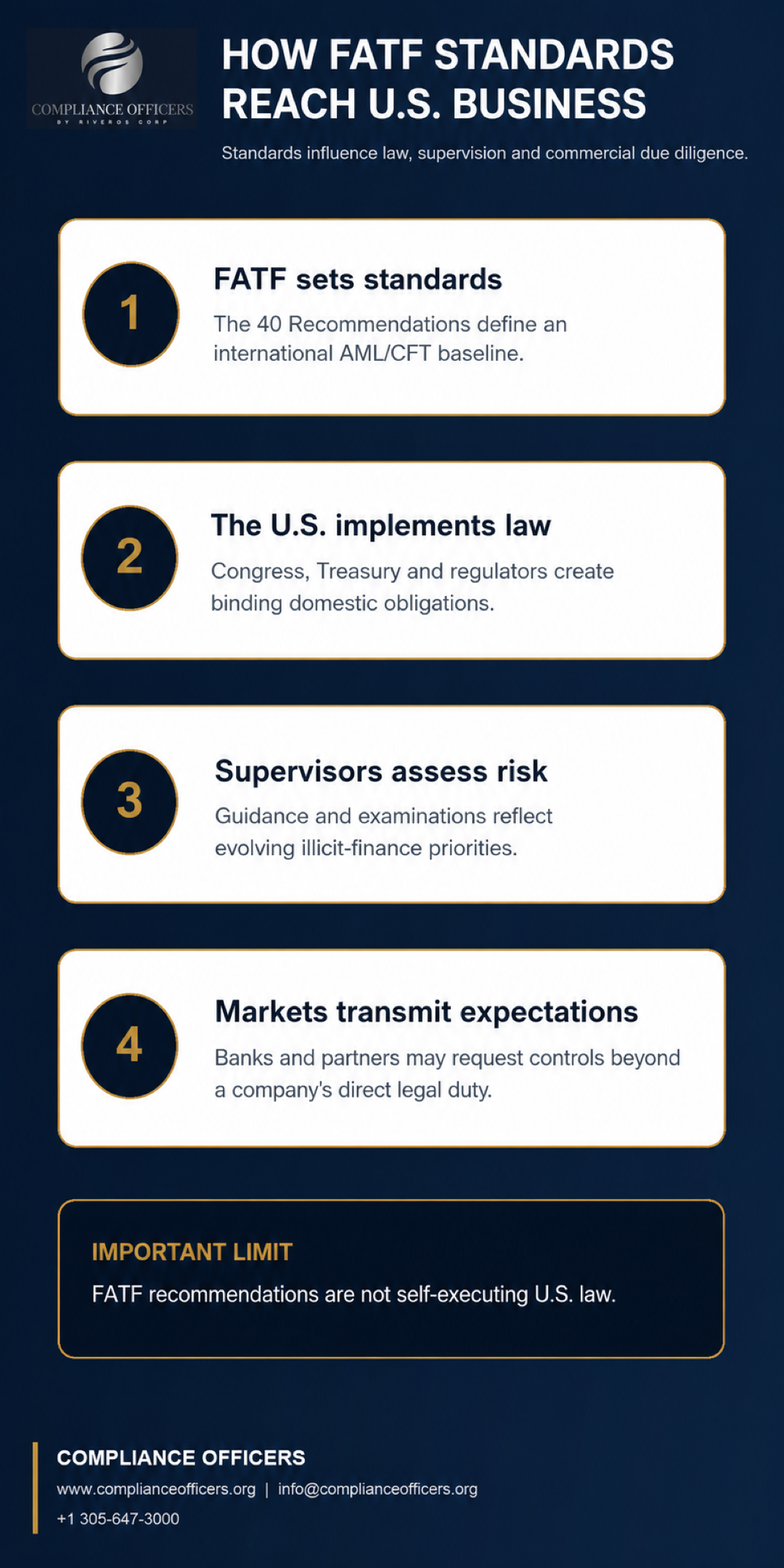
The Financial Action Task Force does not issue self-executing U.S. law. Its recommendations influence domestic legislation, regulation, supervisory priorities and international cooperation. Binding duties for an American company still come from applicable U.S. law, regulations, orders, licensing requirements and enforceable contracts.
Commercial expectations can move faster than legislation. A bank may adjust country risk after FATF updates jurisdictions under increased monitoring or subject to a call for action. That decision can affect onboarding questions, transaction review, correspondent relationships and requests for ownership or source-of-funds evidence. A company outside a direct BSA program rule can still encounter those expectations through its financial institutions and counterparties.
The United States’ March 2024 enhanced follow-up report illustrates the difference between standards and implementation. FATF reported 9 Recommendations rated Compliant, 23 Largely Compliant, 5 Partially Compliant and 3 Non-Compliant, while noting the upgrade of Recommendation 24 on legal-person transparency. Those are technical-compliance ratings, not a conclusion that every U.S. control is effective or that every company has the same obligation.
Policies should therefore translate FATF developments into a documented risk question. Identify the affected customer, jurisdiction, product or relationship; determine whether U.S. law, an advisory, sanctions rule or contract creates a specific action; and record the response. The financial action task force supplies an international baseline and risk signal. U.S. authorities and private institutions determine how that signal becomes a domestic requirement or commercial control.
How Compliance Officers Works Across Borders
Compliance Officers provides documented AML checks and due-diligence support for U.S. and international clients. We examine the legal, financial and reputational background of the person or company in scope, verify identity and legal existence from available records, and organize the findings in a written report for the client’s decision file.
The service does not issue a legal opinion, determine guilt, replace the institution’s designated decision-maker or guarantee a regulator’s response. It helps establish facts, identify inconsistencies and preserve a review record before the company commits to a transaction or closes an alert.
A useful engagement begins with a defined subject, purpose and risk question. The client identifies the person, entity, transaction or relationship to be reviewed and provides the available identifiers and context. The resulting work can address legal existence, ownership information, relevant public-record findings, sanctions and adverse-information indicators, and inconsistencies that require clarification. The scope and limitations are recorded so that an absence of findings is not mistaken for proof that no risk exists.
Due diligence is also time-specific. A report reflects the sources and facts available during the review; it does not remain current indefinitely. A new owner, jurisdiction, product, payment route, regulatory event or material adverse fact can justify an update. The client should connect the report to its own risk classification, escalation process, retention rules and authorized decision-maker. That creates an auditable handoff between external research and the company’s internal compliance responsibility.
For related context, review our resources on corporate KYC, FinCEN filing and compliance and FinCEN requirements for small businesses. These topics overlap, but they are not interchangeable: counterparty due diligence, BSA program duties and beneficial-ownership reporting each have their own trigger and scope.
Frequently Asked Questions
Is the FATF a law-making body?
No. The FATF sets international standards through its 40 Recommendations and assesses countries against them, but it does not enact binding law. Its standards reach businesses through domestic rulemaking, through counterparties applying their own FATF-derived rules, and through country risk assessments.
How is the United States rated?
As of the 7th Enhanced Follow-up Report of 26 March 2024, the United States is Compliant on 9 of the 40 Recommendations, Largely Compliant on 23, Partially Compliant on 5 and Non-Compliant on 3.
Which Recommendations is the U.S. Non-Compliant on?
R.22 (DNFBPs: customer due diligence), R.23 (DNFBPs: other measures) and R.28 (regulation and supervision of DNFBPs) — all three concerning designated non-financial businesses and professions such as lawyers, accountants, company service providers and real estate professionals.
When was the last U.S. mutual evaluation?
The mutual evaluation was published on 30 November 2016. Technical compliance re-ratings have followed in enhanced follow-up reports, most recently in March 2024. The United States will report further progress in its 5th round mutual evaluation.
Does a FATF rating create an obligation for my company?
Not directly. Your legal obligations come from U.S. law — the Bank Secrecy Act and 31 CFR Chapter X. FATF ratings provide context for areas of international and domestic policy attention, but they do not predict a particular U.S. rule or a counterparty’s requirements.
A foreign bank is asking for documents about my U.S. company. Can you help?
Yes. Verifying legal existence, identity and background and producing a written report for presentation to an institution is the core of our AML Checks and Due Diligence work, and the review can be handled remotely for clients abroad.
Satisfy International Scrutiny From Wherever You Are
Is a foreign bank, partner or regulator asking for verified information about a U.S. person or company?
Compliance Officers examines legal, financial and reputational background, confirms legal existence and identity, and delivers a written report you can present.
Phone and WhatsApp: +1 305-647-3000
Email: info@complianceofficers.org
Legal disclaimer: This article provides general information about United States anti-money laundering rules and does not constitute legal advice, a legal opinion or a guarantee of any regulatory outcome. Obligations depend on the type of institution, its activities and its regulator, and the rules change. Citations reflect the text in force on the date shown. Confirm current requirements with FinCEN, your functional regulator or qualified counsel before acting.