Marital status verification helps establish what available records show about a person’s marriage history. A foreign marriage registry, title company, court, or estate representative may need that information for a specific purpose. However, no single U.S. search produces a complete answer for every person.
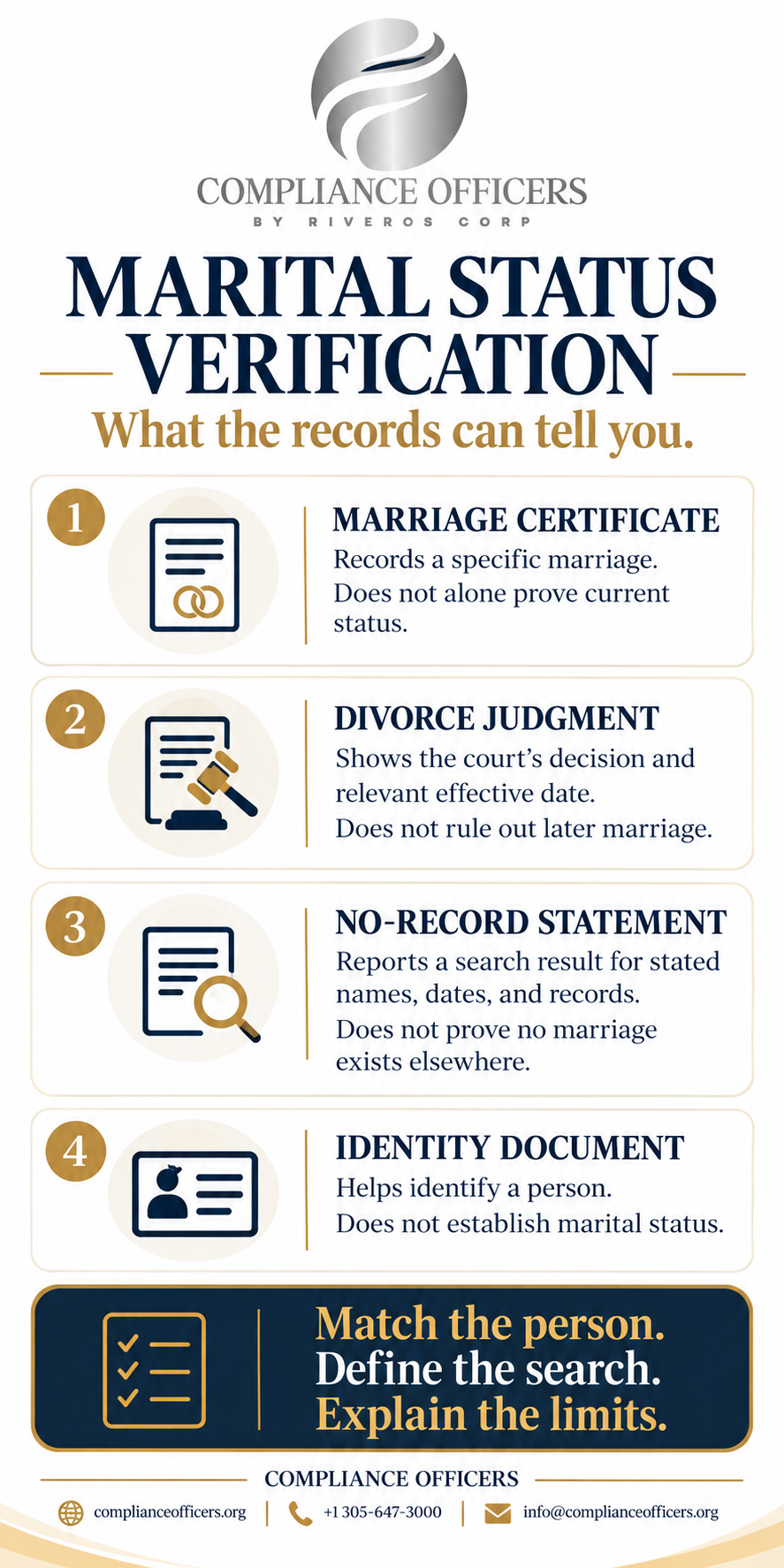
The review must distinguish identity from status. A passport may help identify someone, while a marriage certificate records a particular marriage. Neither document alone establishes the person’s full marital history or present legal capacity to marry.
Compliance Officers helps locate relevant records, compare identifying information, and organize the findings. The scope depends on the purpose, jurisdictions, and lawful access to the information. A useful file explains both what the evidence supports and what remains unresolved.
Where marital status verification records originate
U.S. marriage and divorce records generally sit with state, local, territorial, or court offices. The federal government does not operate a public nationwide marital-status registry. Therefore, the first question is which office holds the record relevant to the inquiry.
Marriage licensing and recording arrangements vary by jurisdiction. A local office may issue the license and retain the completed record, while a state office also receives information. Consequently, it is inaccurate to assume that a marriage leaves a record only in one county.
For example, Florida’s Bureau of Vital Statistics holds recorded marriage information dating from June 6, 1927. The county clerk also has relevant records. A recent marriage may reach the state system only after the clerk forwards it, so recording delays matter.
What marital status verification documents establish
Each document answers a particular question. Before requesting a copy, identify the conclusion the receiving organization needs to assess. Then check whether that document supplies the necessary information and certification.
| Record | What it can establish | Principal limit |
|---|---|---|
| Recorded marriage certificate | Details of a particular recorded marriage | It does not alone show whether that marriage later ended. |
| Uncompleted marriage license | Authorization to marry under the issuing jurisdiction’s rules | It does not establish that the marriage occurred. |
| Final divorce judgment | The court’s disposition and relevant effective date | It does not rule out a later marriage. |
| Dissolution certificate | The recorded dissolution information within its scope | It may omit terms contained in the full judgment. |
| No-record statement | No matching record within the stated search scope | It does not cover every other place, period, or name. |
| Death certificate | The death recorded for an identified person | It does not alone establish the applicant’s complete marriage history. |
| Photo identity document | Evidence relevant to the holder’s identity | It does not establish marital status. |
| Social Security number | An identifier used in specified government and other authorized processes | The number alone does not prove the presenter’s identity. |
Single-status statements in marital status verification
Some U.S. offices issue documents commonly described as single-status statements. Their actual wording and coverage matter. They may certify that a search found no matching marriage record, rather than make an unrestricted legal determination that someone is free to marry.
Florida offers a Single Status Statement application covering its statewide records from all 67 counties for specified names and years. If the search finds no record, the office issues a corresponding statement. Its instructions exclude the most recent 60 days and require a separate application for each name or alias.
Accordingly, even this statewide search has limits. It does not establish that no marriage occurred elsewhere or during an excluded period. The receiving authority should confirm which names, dates, and supporting documents it requires before the request proceeds.
Affidavits serve a different purpose
Some countries accept or require an affidavit concerning eligibility to marry. The person making the affidavit states the facts under the applicable oath or declaration procedure. A notarization does not independently establish that every statement about marital history is true.
Also, the U.S. Department of State explains that the U.S. government cannot attest to a person’s marital status. A destination may accept a written declaration, but its own rules govern acceptance. An affidavit and a government record search should therefore remain clearly identified as different forms of evidence.
Identity checks in marital status verification
A matching name is a starting point, not a complete identity finding. Dates of birth, prior names, residence details, and other available identifiers can help distinguish individuals. However, the information present on a record varies by jurisdiction and record type.
Compare the evidence carefully when records conflict. A difference may reflect a clerical error, naming convention, or a different person. The report should explain the discrepancy rather than choose the most convenient interpretation.
A valid passport or state photo ID can support identification for appropriate purposes. It does not supply a complete name history or marital history. Likewise, a Social Security number provided in a transaction does not establish that the presenter is its assigned holder.
Authorized identity services have defined limits
SSA offers consent-based verification services for eligible or enrolled users under specified conditions. Those services can compare identifying data with SSA records. However, SSA expressly states that its CBSV service does not verify identity, citizenship, or employment eligibility.
There is no unrestricted public SSA lookup for a private marital-status investigation. Any use of identifying data must follow the applicable access and purpose rules. Our explanation of record verification and background screening discusses why a search result requires careful interpretation.
Names and jurisdictions in marital status verification
People may use different names at different times. Marriage, divorce, legal name changes, transliteration, and variations in compound surnames can affect an index search. Therefore, the review should identify relevant names before treating a negative result as meaningful.
The same care applies to geography. Residence history can suggest possible record locations, but people may marry outside their home state or country. A search limited to current residence may therefore miss an event recorded elsewhere.
A reasonable scope should reflect the purpose and available information. It cannot promise to exclude every unreported event worldwide. Instead, the report should list the jurisdictions, names, record systems, and periods actually covered.
Explain both positive and negative findings
If a search locates a possible marriage, confirm the available identifiers before attributing it to the subject. A shared name alone may be insufficient. Similarly, a no-record response needs its search parameters and any stated exclusions.
Commercial search products may help locate leads. However, their coverage, update cycles, and matching methods can limit accuracy. A material conclusion should rely on appropriate underlying records and evidence, rather than an unexplained database summary.
Divorce records in marital status verification
Filing for divorce does not by itself end a marriage. The review must establish the court’s actual disposition and the date marital status ends under the relevant law. That date may differ from the date someone filed a petition or signed an agreement.
For instance, California judgments identify when marital status ends. The record may also address property or support matters. Therefore, a reviewer should examine the relevant judgment information instead of assuming that any docket entry means the person is divorced.
Certified judgments generally come from the court clerk or other designated custodian. In Florida, the state can also issue a dissolution certificate summarizing recorded judgment information. That certificate can support evidence of a dissolution, while the full judgment may be necessary for its terms.
Separation, annulment, and foreign judgments
Legal separation and dissolution have different effects. Annulment raises another set of legal questions. Consequently, the title and operative provisions of the order matter more than how someone informally describes the case.
A foreign divorce also requires attention to recognition. Whether a U.S. state recognizes it depends on that state’s law and the process abroad. When validity or capacity to remarry is disputed, qualified counsel should assess the judgment and applicable legal requirements.
Why marital status verification matters for property
Marriage can affect property rights even when a document names only one spouse. Community-property states include Arizona, California, Idaho, Louisiana, Nevada, New Mexico, Texas, Washington, and Wisconsin. However, classification depends on the applicable law and the facts concerning acquisition and ownership.
Gifts, inheritances, agreements, timing, and other circumstances may affect whether an asset is separate or community property. Therefore, a reviewer should avoid assuming that every asset acquired during marriage belongs equally to both spouses. A records file can identify relevant facts for counsel’s analysis.
Homestead rules can also affect required signatures. For example, Florida’s constitution provides for a married owner’s spouse to join in specified transfers or encumbrances of homestead property. The application of those rules requires review of the property and transaction.
Estate and business interests
A surviving spouse may have statutory inheritance or elective-share rights. Florida law, for example, provides an elective-share right for a qualifying surviving spouse, subject to the applicable provisions. The will alone may therefore leave important questions unanswered.
Likewise, marriage-related property rights may affect a business ownership review. For example, the CDD Rule has an ownership threshold of 25 percent for relevant legal entity customers, subject to its definitions and exceptions. However, marriage alone does not automatically establish that a spouse meets that test. Our guide to beneficial ownership and control explains the need to identify the relevant standard.
FinCEN’s August 2026 BOI rule exempts U.S. companies and U.S. persons from reporting. Its database is not a public directory for resolving spousal ownership questions. Consequently, the review needs evidence appropriate to the applicable property and compliance rules.
Lawful access and confidential information
Access rules differ by jurisdiction and document. Some records are public; others require proof of eligibility, consent, a court order, or another authorized basis. There is no single direct-interest test that applies to every U.S. marriage and divorce record.
Before requesting restricted information, establish who may obtain it and for what purpose. Public availability also does not automatically permit every later use. The scope should reflect applicable privacy rules and the requirements of the receiving organization.
Personal identifiers should receive appropriate handling throughout the review. For example, a report may need to explain an identity match without reproducing every sensitive detail in every copy. Access and distribution should follow the purpose of the file.
Federal records may require a separate request
An immigration or other agency file may contain relevant information in a particular matter. However, access can depend on consent, identity verification, exemptions, and other legal requirements. A federal request does not replace the appropriate marriage or court record.
The FOIA request process has its own limits and timing. A statutory response deadline does not guarantee that all requested documents will arrive by that date. Potential delays should form part of the initial scope discussion.
Marital status verification for use abroad
The receiving authority determines the document package it will accept. Requirements may concern certified copies, translations, authentication, or the recency of issuance. Therefore, the file should begin with the destination and intended use.
An apostille or authentication concerns the official signature, capacity, or seal within the applicable process. It does not resolve an incomplete search or independently establish the person’s legal capacity to marry. Our guide to document certification for international use explains related distinctions.
Some authorities impose particular translation or notarization requirements. Others may require further legalization. Those details vary, so a generic assurance of worldwide acceptance would be misleading. The record’s substance and its required form both need review.
How Compliance Officers supports marital status verification
Compliance Officers helps define the names, jurisdictions, periods, and record types relevant to the client’s purpose. The work can include requests to appropriate custodians, comparison of identifiers, and organization of findings with source references.
The team can also coordinate certified copies, translation, or authentication within the agreed scope. However, access depends on the issuing office’s requirements and the requester’s eligibility. Some matters require legal advice or a decision from a court or receiving authority.
Many coordination tasks can take place remotely, including for clients abroad. Nevertheless, particular signatures, identity checks, or appointments may require the client’s participation. Timing depends on source availability, record age, jurisdiction, and the intended use.
Marital status verification: frequently asked questions
Is there a nationwide U.S. marriage search?
There is no public federal registry that establishes everyone’s current marital status. Records generally come from relevant state, local, territorial, and court offices. Therefore, the search scope must identify the systems and periods relevant to the inquiry.
Does Florida issue a single-status statement?
Yes. Its application supports a search of statewide marriage records for specified names and years. However, the resulting no-record statement has defined limits, including exclusion of the most recent 60 days. It does not certify that no marriage exists anywhere else.
Do all searches require the person's consent?
Requirements vary by record, jurisdiction, and intended use. Some records are public, while restricted records may require consent or another authorized basis. The review should establish the relevant rules before requesting or distributing sensitive information.
Does a marriage certificate prove someone is still married?
It records a particular marriage, but does not alone establish that the marriage remains in effect. A later divorce, annulment, or death may change the analysis. The relevant chronology and legal effect need review.
Can someone arrange the review from abroad?
Often, much of the coordination can occur remotely. However, the issuing office or destination may require specific identity checks, signatures, or appearances. The team should identify those requirements before promising an entirely remote process.
What determines the scope and timing?
The number of jurisdictions, prior names, record age, and certification requirements affect the work. Missing court records or restricted information may require additional steps. Consequently, an initial assessment should explain the proposed scope and known constraints.
Discuss the records your file needs
Contact Compliance Officers to discuss the purpose, relevant jurisdictions, and documents already available. Call +1 305-647-3000, use WhatsApp, or email info@complianceofficers.org. The team can assess the record requirements and explain the proposed work.
This publication provides general information and does not constitute legal advice. Questions about marriage validity, property rights, inheritance, or eligibility to marry require the applicable legal analysis. Record research cannot guarantee acceptance by a particular authority.