A foreign consulate, a civil registry, an immigration office or a lawyer abroad has asked you for a marriage certificate apostille, and the request sounded simple until you started looking into it. You have a document at home with both signatures and an official-looking seal, you have another copy somewhere from the county, and now you are not sure which one they mean. That uncertainty is not carelessness on your part. A single American marriage produces several different pieces of paper that all describe themselves as a marriage certificate, and only some of them can legally carry an apostille.
The marriage certificate apostille is not a stamp of approval on your marriage. It is a narrow, technical certificate that authenticates the signature and seal of the public official who issued your record, and the authority that issues it is determined by where the marriage was recorded, not by where you live or where the document is going. Below you will find what the certificate actually proves, which version of your record qualifies, and the points where these files quietly fail before anyone abroad ever sees them.
What a marriage certificate apostille actually certifies
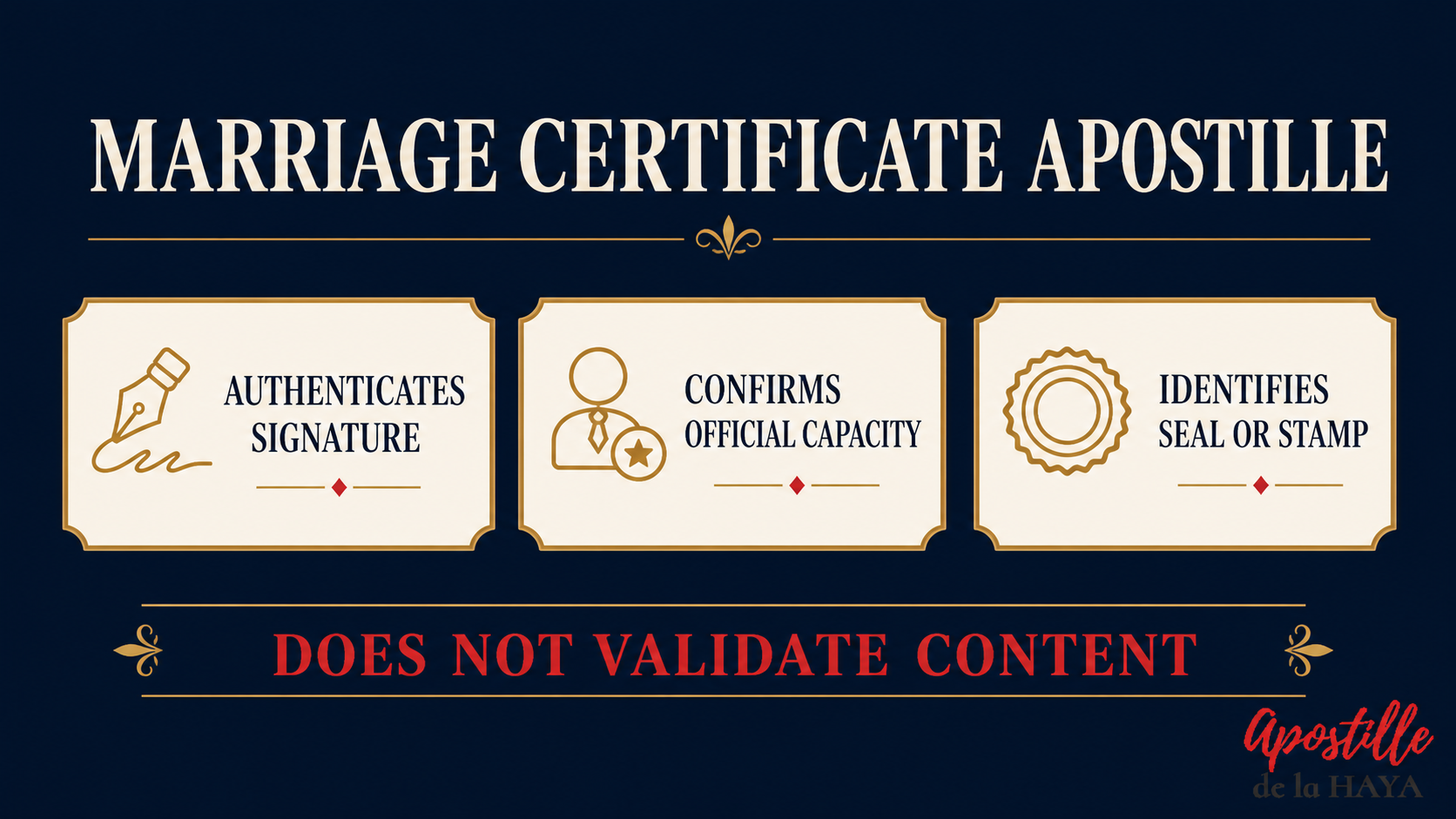
An apostille is a certificate created by the Hague Convention of 5 October 1961, which abolished the requirement of legalisation for foreign public documents. Its purpose is narrow and worth stating precisely, because almost every misunderstanding in this area starts here. The apostille certifies the authenticity of the signature on the document, the capacity in which the person signing acted, and the identity of the seal or stamp the document bears. That is the whole of it.
What the apostille does not do matters just as much. It says nothing about the content of your record. It does not confirm that the marriage was valid, that it is still in force, or that either spouse was free to marry. It does not translate anything. And it does not compel any foreign authority to accept the document: the receiving office abroad decides what it requires, and it can also require a translation, a recent issue date, a particular format, or an additional registration step of its own. An apostille removes a bureaucratic obstacle to recognition; it does not manufacture recognition.
The apostille also only exists as an option when the destination is a party to the Convention. According to the status table maintained by the Hague Conference on Private International Law, updated on 30 June 2026, there are 130 Contracting Parties, including accessions that are not yet in force. The controlling question is whether the Convention is in force between the United States and the destination on the date the document will be used, including any objection affecting that bilateral relationship. If it is not, the apostille is the wrong instrument and the file generally follows a longer authentication and consular-legalization chain. Working out which of the two routes applies is the first decision in any file, and getting it wrong costs the entire processing time twice over.
Which office issues it, and when the federal route applies
In the United States there is no single national apostille authority, and this is the structural fact that sends most marriage certificate files to the wrong desk. Marriage is recorded at state and county level. Accordingly, public documents issued by the states, the District of Columbia and other U.S. jurisdictions are apostilled by the competent authority designated within that jurisdiction, which in practice is generally the office of the Secretary of State. The U.S. Department of State’s Office of Authentications issues apostilles for documents issued by federal agencies. A marriage certificate is not a federal document, so the federal office is not the route, no matter how urgent the file is or how convenient Washington may seem.
The practical consequence is that jurisdiction follows the record, not the person. If you were married in Florida and now live in Texas, Florida is the issuing authority. If you were married in New York twenty years ago and have not been back since, New York is the issuing authority. If you married in one state and the destination country expects a document from your state of residence, the destination is simply mistaken about how American records work, and the file needs to be explained rather than re-ordered. Files that involve a state you no longer live in are common enough that we treat them as their own category, described in our guide to a marriage certificate issued in another state.
A narrow historical federal record does exist, but it should not be confused with a modern U.S. marriage certificate. The Department of State issued Certificates of Witness to Marriage Abroad only for certain marriages witnessed by a U.S. consular officer and filed before 9 November 1989. Passport Vital Records can issue copies and apostilles for those historical certificates. The Department does not hold ordinary foreign marriage records, and this limited route does not apply to a marriage recorded by a U.S. state or county.
Practical points the checklist may not resolve
State apostille pages are written to explain a fee and an address. They are not written to tell you which version of your own record will pass and which will bounce, and that is where these files are actually won or lost.
One marriage produces several documents, and most of them cannot be apostilled. The license application, the marriage license itself, the decorative certificate signed by the officiant and the witnesses at the ceremony, the county clerk’s recorded certified copy and the state registrar’s certification are five different things. The apostille authority can only act on a signature it is able to verify in its own records, which means the signature of a public official acting in an official capacity. The keepsake certificate handed to you after the ceremony, however beautiful and however genuinely signed, is usually not that document. This confusion is common enough that we treat it separately in our comparison of a marriage certificate against a marriage license.
The version you order changes how many certifications the file needs. Florida accepts both a Certification of Marriage issued by the state Bureau of Vital Statistics and a certified copy of the marriage record issued by the Clerk of the Circuit Court of the county that recorded it. Both are valid, but the Florida Department of State charges more where the record was certified by a Florida Clerk of the Court, because that file needs an apostille plus a Certificate of Incumbency confirming the Clerk held office. Same marriage, same state, two different fee structures depending on which office you asked.
Some states insert a county step before the state will even look at the file. New York is the clearest illustration. A birth, death or marriage certificate issued by a local or county official must first be certified by the County Clerk of the county where it was issued, and New York City records must then be certified by the New York County Clerk’s Office. But a certificate issued by the New York State Department of Health bearing the signature of the Director of Vital Statistics or the NYS Registrar may be submitted for apostille with no County Clerk certification at all. Ordering the state-level version rather than the county-level version can remove an entire stage from the file.
Processing time is often unpublished, and a published figure is a snapshot rather than a guarantee. Florida’s apostille page gives submission instructions but no fixed turnaround. New York offers same-day counter service at several locations while publishing no guaranteed mail time. California publishes the receipt date currently being processed and states that in-person apostille service typically takes about thirty minutes. Those conditions can change, so a responsible estimate must be checked against the issuing office when the file is ready.
Logistics gate the file more often than law does. Florida requires a check or money order payable to the Florida Department of State, in U.S. currency drawn on a U.S. bank, and accepts neither cash nor credit cards. For a spouse already living in Bogotá, Madrid or Mexico City, that single line is frequently the reason a self-managed file stops moving. And an original certified copy is required in the first place: Florida states plainly that a photocopy is not acceptable.
Mistakes that can add time and cost
The following are plausible mistakes because each begins with a reasonable assumption. Their effect depends on the issuing state and receiving authority, but each can force a new submission or an additional document order.
- Sending the ceremonial certificate. The document is returned unprocessed. You have lost the mailing time in both directions and still need to order the correct record from the county or the state.
- Sending a state record to the federal office for a Hague destination. The federal Office of Authentications is not the competent authority for a state marriage record in that route, so the request will not produce the required state apostille and must be redirected to the issuing jurisdiction.
- Getting the apostille and stopping there. A correctly apostilled certificate that arrives at a foreign registry without the translation that registry requires is rejected at the counter, and the apostille does not need to be redone but the trip, the courier and the appointment do.
- Translating before apostilling. If the translation is produced first, it does not cover the apostille text that is later attached, and receiving offices that read both do notice.
- Missing a deadline that exists abroad, not here. Under Mexico’s Código Civil Federal, a marriage celebrated abroad transcribed in the Registro Civil within three months of the spouses’ arrival in Mexico has civil effects that retroact to the date of the wedding; transcribed later, it produces effects only from the day of the transcription. The apostille is quick compared with the consequence of being late.
- Mailing your only certified copy. Certified copies are replaceable, but replacing one adds the ordering cycle to a file that was already urgent.
What these have in common is that none of them are visible at the moment they are made. The cost shows up weeks later, usually at the worst possible time: days before a consular appointment, a residence filing, a property closing or a court date abroad.
How Apostille de la Haya resolves it for you
Our starting point is deliberately the opposite of the usual one. We do not begin with the apostille. We begin with the authority that will receive the document, because that authority determines which version of your record you need, whether a translation is required and in what form, whether the certificate must have been issued recently, and whether an apostille is even the correct instrument for that destination.
From there we order the correct certified record from the office that can issue it, route it to the competent authority of the right jurisdiction in the right sequence, absorb the county-level certification step where a state imposes one, handle the payment method the state actually accepts, and arrange the translation when the receiving office requires it. You do not deal with the county, the registrar, the Secretary of State or a consulate. We coordinate the required offices and document handoffs, reducing avoidable paperwork and preventable submission errors.
We are also candid about the part nobody controls. State offices publish their own processing rhythms and consular appointment calendars move; we can verify the route, required record and submission package before mailing, coordinate the handoffs, and identify unusual receiving-authority requirements as early as the available instructions permit. You can see the full range of what we prepare on our apostille services page, and if timing is the pressing issue, the realistic drivers are set out in our analysis of how long a marriage certificate apostille takes.
Frequently Asked Questions
How long does a marriage certificate apostille take?
It depends on the state and on whether a county certification comes first. Many states publish no guaranteed mail turnaround. Florida states none on its apostille page; New York offers same-day counter service at several locations; California publishes the receipt date currently being processed and says in-person service typically takes about thirty minutes. The real timeline usually depends on obtaining the correct certified copy, not on the apostille itself. We map the whole sequence before starting so you have a realistic date.
How much does a marriage certificate apostille cost?
The government fee is set by the state and charged per document. In Florida it rises where the record was certified by a Florida Clerk of the Court, because a Certificate of Incumbency is added to the file. On top of the state fee you have the cost of the certified copy, and any translation the destination requires. Contact us with the destination and we will evaluate the full cost of your specific case.
Can I apostille a photocopy or a notarized copy of my marriage certificate?
Generally no. Florida is explicit that an original certified copy is required and that a photocopy is not acceptable, and state vital records are treated differently from private documents a notary may copy-certify. The distinction is set out in our article on which marriage certificate copy can be apostilled. We obtain the correct certified record for you so this question does not arise.
Do I have to be in the United States to get it done?
No. Nothing in the process requires you to appear in person, which is fortunate, because several of the practical obstacles are hardest to solve from abroad: Florida, for instance, accepts only a check or money order drawn on a U.S. bank and takes neither cash nor cards. We handle files for spouses who are already living in the destination country and have no way to walk into a U.S. county office.
Does an apostille on a marriage certificate expire?
The apostille itself carries no expiry date. What does expire, in practice, is the tolerance of the receiving authority: some registries and consulates will only accept a certificate issued within a recent window, often measured in months, and in those cases a new certified copy has to be ordered and apostilled again. Because the rule belongs to the destination and not to the apostille, we confirm it before ordering anything.
Will the apostille make my marriage recognised in another country?
No, and this is the most important limitation to understand. The apostille authenticates a signature and a seal so that a foreign authority can rely on the document. Recognition or registration of the marriage itself is a separate procedure governed by the law of the destination country, frequently with its own deadlines and its own supporting documents. We prepare the document so that this second stage is not blocked by a defect in the first.
Need your U.S. marriage certificate apostilled for use abroad?
Apostille de la Haya coordinates the document from record retrieval through apostille or legalization and delivery, reducing avoidable paperwork and preventable submission errors.
Phone and WhatsApp: +1 305 500 0185